Specs are compiled from manufacturer listings and verified buyer reviews and can change over time — please confirm the key details on the product page before buying.
Waiting for hot tap water wastes time, and a tank keeps heating unused water. A 110V tankless unit at the sink heats water instantly, delivering warm water in seconds. These are point-of-use heaters for one faucet, not whole-house showers. This guide ranks the best by heating speed, flow rate, and how truthfully they deliver on the “instant” promise.
I’m Mo Min — the founder and writer behind Non Toxic Blog. This guide is built by comparing the manufacturers’ published specifications and the patterns across verified customer reviews, so you get each pick’s real strengths and trade-offs instead of marketing spin.
Find the right 110v tankless water heater for your sink, kitchen, or small space without wading through confusing specs and mixed reviews.
Our Picks at a Glance

How To Choose The Best 110V Tankless Water Heater
Every unit on this list runs on standard 110V or 120V household power, which is the same voltage as a normal wall outlet. That low voltage puts a hard limit on power — most top out around 3000W to 3500W — which is plenty for one sink but not for a shower. Your first job is to match the heater to the single job you need it to do.
Match wattage to your water temperature
The wattage number (3000W, 3500W, 4000W) tells you how much heat the unit can add to the water. More watts means a bigger temperature jump, so a 4000W unit can make a bigger difference when your incoming water is cold. If your tap water arrives very cold in winter, a lower-wattage unit will only take the chill off rather than delivering genuinely hot water.
Read the flow rate before you buy
Flow rate, measured in gallons per minute (GPM) or liters per minute, is how much water can pass through while still getting heated. A heater rated at 0.5 GPM delivers hot water at a modest trickle. Cranking the tap wide open will overwhelm the heater, and you will get lukewarm water. These units work best with a low-flow aerator that keeps the stream slow enough to heat properly.
Hardwired means planning, not plugging
Most 110V tankless heaters are hardwired directly into a dedicated circuit — there is no plug, despite the low voltage. Check the required amperage (often 29A to 32A) and the wire size (usually 10 AWG minimum), because that decides whether you can install it yourself or need an electrician. Never assume a 120V unit simply plugs into the outlet under your sink.
Quick Comparison
| Model | Best For | Wattage | Flow Rate | Max Temp | Amazon |
|---|---|---|---|---|---|
| ThermoMate ET035★ Best Overall | Best Overall | 3500W | 0.66 GPM | 131°F | Amazon |
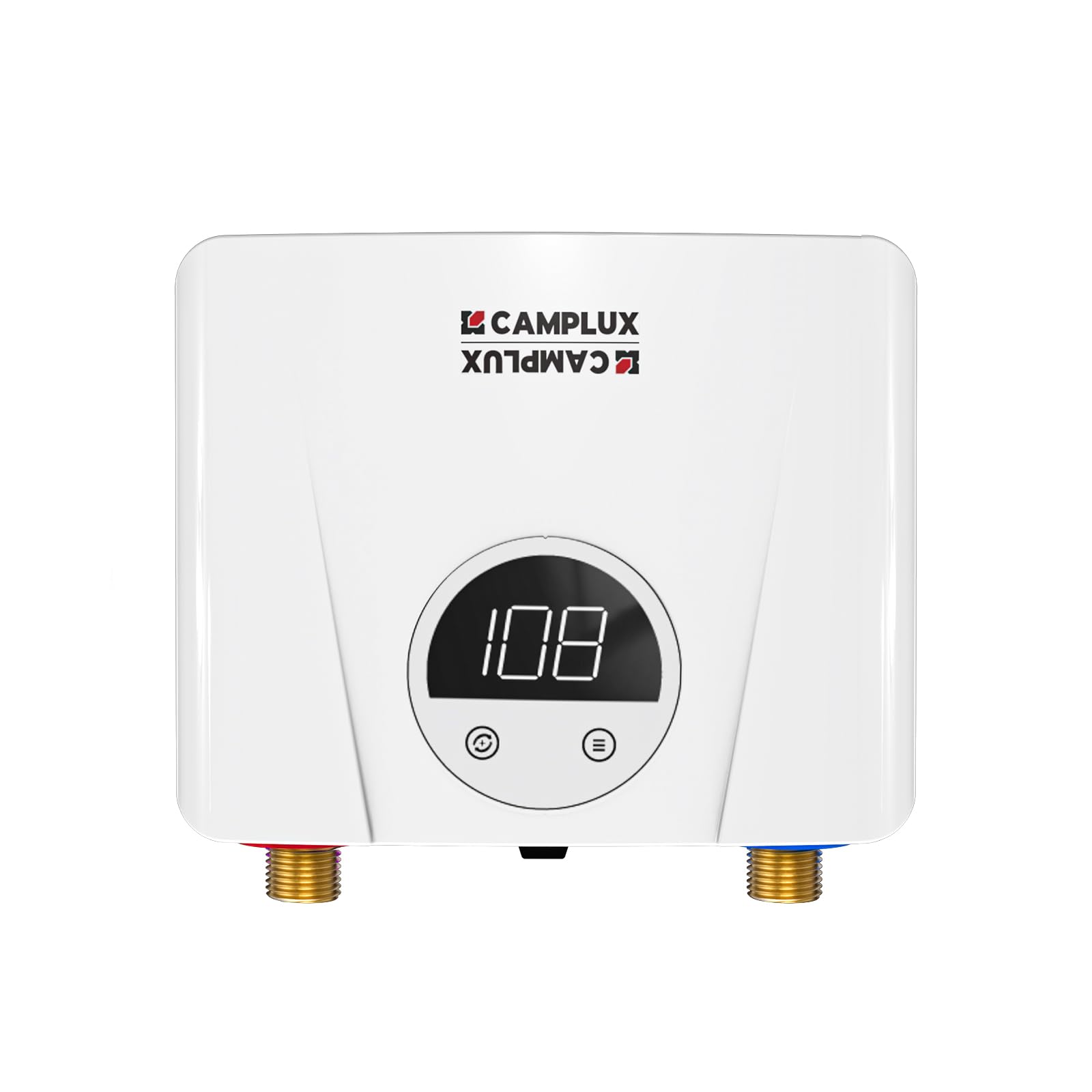
| CAMPLUX TE04N3Energy Saver | Energy Saver | 3.5 kW | 2.5 L/min | 131°F | Amazon |
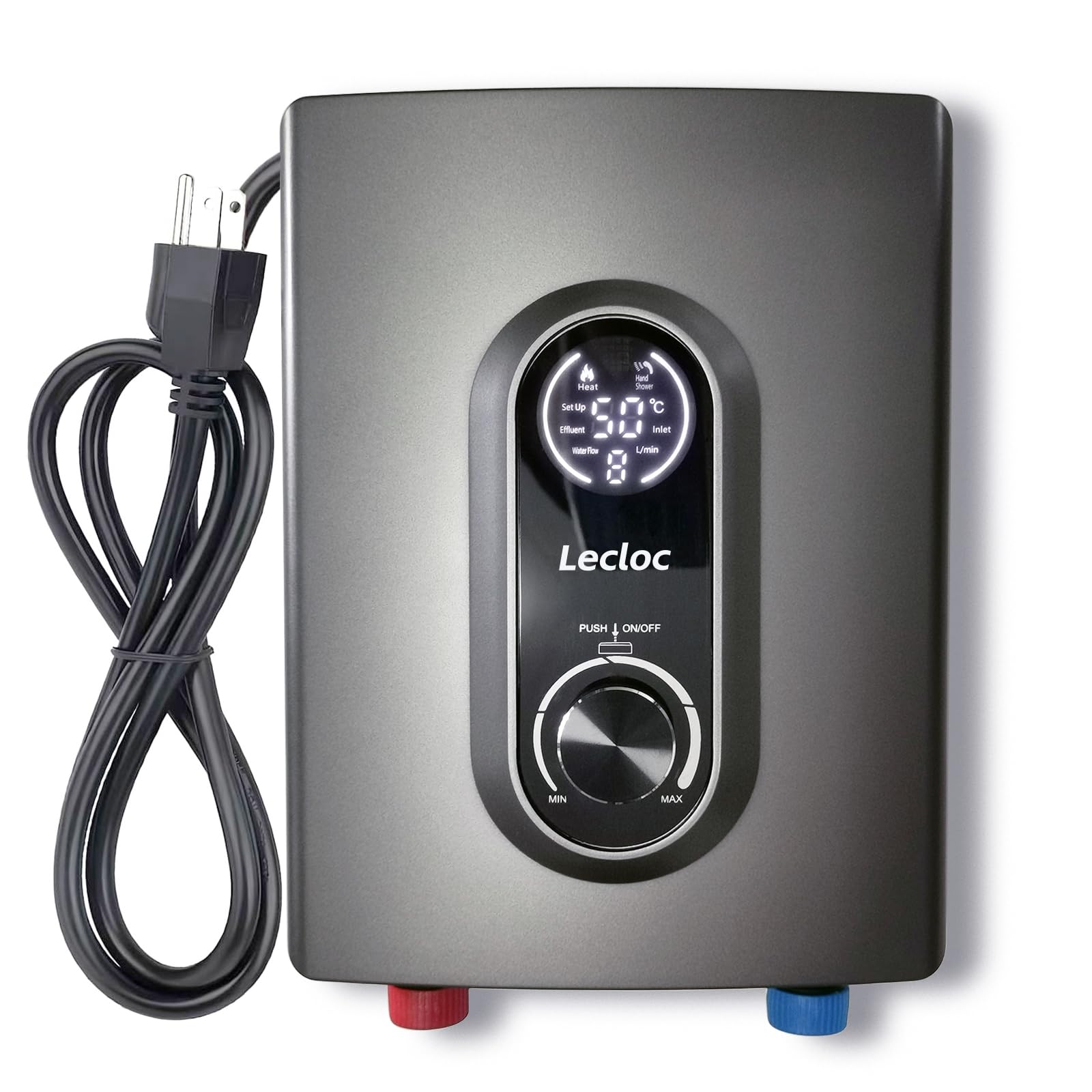
| LECLOC C3000Plug-In Simplicity | Plug-In Simplicity | 3000W | — | 55°C | Amazon |
| Eemax EEM12004 | Hot Water Output | 4 kW | 0.5 GPM | — | Amazon |
| EcoSmart POU 3.5 | Warmer Climates | 3.5 kW | 1.5 GPM | — | Amazon |
| GE GE04SNLPDG | Remote Control | 3500W | 0.7 GPM | — | Amazon |
| Rheem RTEX-04 | Digital Control | 3.5 kW | 6 GPM | 140°F | Amazon |
| HNK D3548A11 | Multi-Angle Mount | 3500W | 1.9 L/min | 131°F | Amazon |
| Chronomite SR-20L | Commercial Use | 2400W | 0.4 GPM | 120°F | Amazon |
In‑Depth Reviews
1. ThermoMate ET035
Our pick — over 4★ from 750+ verified ratings; the strongest balance of quality and price.
The under-sink favorite that turns a cold tap into near-instant warm water.
You get hot water back in about 5 minutes with this 3500W unit, which draws 29.2Amp and pushes 0.66 GPM (gallons per minute). Buyers report it suits two people for everyday washing, and it is a 2.5-gallon under-sink heater. The touch panel lets you adjust temperature in 1° increments from 86°F up to 131°F, so you dial in exactly the warmth you want rather than accepting a fixed setting.
Hard water won’t clog it quickly. The cast aluminum heating element stays separated from the water line, which slows scale and corrosion, and the water tube is SUS 304 stainless steel (a corrosion-resistant grade). At 3.1 pounds and just 6.5″W x 7.8″H, it fits under sinks, behind bar counters, even at salon stations. It connects with a standard 1/2″NPT pipe fitting plus a pre-wired pigtail, so installation is simpler.
The one honest limit is scope: this is a hardwired unit requiring a 32A double pole circuit breaker and 10AWG minimum wire, so it is not a plug-and-go device. It is also a single-point heater, so keep the flow at a trickle to avoid dumping cold tank water in faster than it can heat. The crowd verdict is that for a sink or a small space, it does exactly what it claims.
What owners love
- Heating speed is the most-praised trait — the water comes back hot in about 5 minutes
- Compact footprint slides into tight under-cabinet spots without eating space
- 1° temperature steps give precise control from 86°F to 131°F
What to plan for
- Hardwired only — no plug, needs a 32A breaker and 10AWG wire
- Best for light use; heavy dish loads can outrun its 0.66 GPM output
- Low flow is required to keep water genuinely hot
Reach for this if: you want a proven under-sink heater with fast reheat and precise temperature control for a kitchen or bathroom sink.
Look elsewhere if: you expect to fill a washer or run a shower — its flow rate is built for one faucet at a gentle stream.
2. CAMPLUX TE04N3
A self-modulating 3.5 kW unit that trims its power to match your flow.
The smart part here is the self-modulating design, which adjusts power input in real time based on the flow rate and the temperature you set. That means the unit does not blast full power when you only want a quick hand rinse — it scales down, which underpins the maker’s claim of up to 98% energy savings.. Pair that with a flow rate of 2.5 liters per minute, and you have an energy-conscious pick that still delivers a temperature rise of 22°F at 1.0 GPM.
It is also one of the lightest options in this class at 3 pounds, with a compact 7″W x 6″H footprint that mounts at multiple angles — kitchens, wet bars, salons, even boats are all listed use cases. The interior separates water and electricity lines to reduce leakage risk from scale build-up, and it is ETL safety certified with lead-free water claims and a 2-year limited warranty.
Owners mention the real-world catch clearly: this is a one-sink heater, and “not big enough to heat a lot of water without running luke warm before the washer fills up” is the recurring theme. If you keep it to a single faucet at 0.4-0.66 GPM, owners find it consistent and easy to install. If you push it harder, the lukewarm wall arrives fast.
Why it wins praise
- Self-modulating power trims energy use to match real-time flow
- Light 3-pound build mounts at multiple angles in tight spots
- Separated water and electricity lines reduce scale-related leakage risk
Where it falls short
- Single-sink only — a washer fill will run lukewarm
- Hardwired install needs a 32A breaker and 10AWG wire
- Energy savings live on the maker’s claim, not a meter
Pick this for: a sink where you want the heater to throttle its own power and save energy while keeping water steady.
skip it if: your plan involves high flow — it is physically not built to keep up.
3. LECLOC C3000
The rare 120V tankless that actually plugs into an outlet instead of needing hardwiring.
Most low-voltage tankless heaters demand a dedicated circuit and an electrician, which is exactly why this 3kW 120V unit stands out — it is a plug-in model, so the install is dramatically simpler for a DIY owner. The large LED display and a single control knob for power and temperature beat fiddly touchscreen buttons, and you can set the water anywhere between 30°C and 55°C. It delivers 24-hour endless warm water without preheating for one point of use.
Safety is layered on thick here: leakage protection, overheat protection, dry combustion protection, high water pressure protection, and an IPX4 waterproof rating all come standard, alongside an automatic fault diagnosis and constant temperature memory. The compact body measures 7.1″ x 9.8″ x 2.8″ and is drop-test passed, so it can live in a kitchen, laundry, garage, dorm, or salon.
The honest trade-off shows up in reviews: some owners wanted more heat and returned it, with one noting the 6000 model was only “marginally better.” This is a warm-water machine, not a scalding-hot one — one owner called it “makes warm water, not necessarily prolonged hot water.” Buy it if you want an easy, safe, dependable warm-water upgrade at a sink, not a blast furnace.
The easy wins
- Plug-in design skips the hardwiring and electrician entirely
- Single knob plus big LED display is simpler than touchscreen controls
- Multiple safety layers include IPX4 waterproofing and dry-burn protection
Set expectations
- Delivers warm water, not prolonged hot — owners say so plainly
- 3kW output is the lower end of this category for heat rise
- Low-flow use only; not for showers or multiple taps
Best for: renters or DIY owners who want a genuinely simple plug-in warm-water fix under a sink.
Not for: anyone expecting truly hot water from a cold incoming line in winter.
4. Eemax EEM12004

The highest-wattage 120V pick here — 4 kW — for genuinely hot water output.
Most 110V tankless units top out at 3500W, but this Eemax runs at 4 kW, which means a bigger temperature jump for the same sink. The payoff, per owners, is “very hot water instantly” — it is “compact, instant hot water” that one user ran two of for a month while their main heater was down. It uses the most advanced self-modulating technology available, adjusting energy input based on how much hot water you actually need, so it only heats what you demand.
This unit serves a single point of use like a shop sink or kitchen faucet, with a 0.5 GPM flow rate, stainless steel build, and wall-mount design. One owner notes it needs just the right aerator — the included 0.5 GPM one is “a little too weak,” but swapping in a 1.2 GPM version made it “perfect.” The setup demands a dedicated 110V circuit with 10 gauge wire from breaker to outlet, hardwired, no plug.
The reliability question is the one to weigh. The 5-year leak and 1-year parts warranty is a standout in this category. But the review mix includes a unit that failed after 20 minutes of first use, and the install instructions drew criticism for being unclear on the electrical connection. It is a powerful, hot-water performer when it works — just treat the wiring details with care.
The strong points
- 4 kW output is the top wattage in this 120V field
- Customers note very hot water instantly at low flow
- 5-year leak warranty plus 1 year on parts
The weak points
- Reliability is a mixed bag — an occasional unit dies early
- Install instructions are vague on electrical hookup
- Right aerator is essential; the included one is too weak for some
Choose this if: you want the most heating muscle a 120V circuit can deliver, for a shop sink or low-flow showerhead.
Think twice if: you want simple to use instructions and bulletproof reliability straight from the start.
5. EcoSmart POU 3.5

A point-of-use classic best suited to warm-climate sinks where the water starts hotter.
The performance math here is transparent and honest: this 3.5 kW unit delivers a max temperature rise of 47.8°F at 0.5 GPM, dropping to 23.9°F at 1 GPM and 15.9°F at 1.5 GPM. In plain terms, the faster the water flows, the less it heats — which is why EcoSmart itself says it is for one sink at 0.5 GPM in warmer climates, and recommends the POU 6 for colder climates. In a warm state, owners confirm it works well.
The build is solid — 4 pounds, 11″W x 6″H, with a self-modulating design that draws 29 amps and requires a 1 x 30 amp breaker with 10 AWG wire. For a second kitchen sink or a shop handwash station, it solves the problem “perfectly,” as one owner put it. The manufacturer backs it with a 1-year warranty covering the electronics, exchanger, and element, though it does not cover labor or incidental damage.
The flip side: this is not an instant-hot machine for cold climates. Buyers in cooler areas report it never really gets the water hot, and a unit that quit after 6 weeks shows up in the mix. It is an honest, well-priced performer — if you match its climate and flow assumptions. If your incoming water is cold, look at the higher-wattage options instead.
What works
- Published temperature-rise numbers make expectations crisp
- Light 4-pound build with 1/2″ NPT fittings is install-friendly
- Solves second-sink problems cleanly in warmer climates
What limits it
- Not meant for cold climates — the maker says so outright
- Heat output drops fast as flow climbs toward 1.5 GPM
- Long-term reliability is not a given
Reach for it if: you live somewhere warm and need a dependable second-sink heater with clear performance specs.
Look elsewhere if: your tap water arrives cold in winter — you will be disappointed by the heat rise.
6. GE GE04SNLPDG

A 3500W GE that lets you tweak the temperature from across the room.
This GE heater brings something rare to the category: a remote control. The touch screen on the unit handles on-device adjustments, but you can also change temperature settings from up to 30 feet away — handy when the heater is mounted under a cabinet or behind a door. At 3500 watts with a flow rate of up to 0.7 GPM, it is sized to run a single faucet in multiple climates, per GE’s own performance claims based on a 72°F inlet and 105°F outlet.
The build is meaningful — 4.7 pounds, 9.9″W x 9.8″H, in a Diamond Gray finish, with a 5-year replacement warranty from GE Appliances and a max pressure rating of 150 psi. The included remote control and water heater come in the box, and the energy-efficient design only draws power when hot water is actually in use.
The honest read from owners: it is a fantastic kitchen-sink point-of-use heater (“instant hot water now without any problems”), but it is not a shower machine. One Florida owner said it “just takes off the coolness of my shower water” rather than delivering real heat, and a few report it “hardly heats the water” at all when expectations run too high. Match it to a sink, and the remote alone might win you over.
The standouts
- Remote control adjusts temperature from up to 30 feet away
- 3500W with 0.7 GPM covers a single faucet well
- 5-year replacement warranty from a major appliance brand
Keep in mind
- Not a shower heater — it warms, it does not blast
- Heat output disappoints if your water starts cold
- Best outcomes come from a professional install
Pick this if: you want a reputable brand with remote control and an easy kitchen-sink install.
pass on it if: you are hoping to boost a shower — the wattage is not there.
7. Rheem RTEX-04

A Rheem with digital temperature control in precise 1°F steps, from 80°F to 140°F.
You control the exact warmth with this 3.5 kW Rheem, which lets you set the output in 1°F increments from 80°F to 140°F. Its 99.8% energy efficiency rating is among the highest claimed in this category., and a 4.5-pound frame with 10.88″W x 5.88″H dimensions that fits a camper or a small condo wall.
The review pattern is genuinely split. Satisfied owners call it “compact but efficient,” noting it replaces a camper water heater perfectly, “heats water fast and stays hot,” and installs easily. Those who knew what they were buying — a point-of-use unit for a small space — tend to be happy. The other side reports units that stop working after about a year, screens going blank, and water that only reaches 74°F.
The recurring reliability complaint is the real caution here — multiple owners describe units failing to turn on or dying after roughly a year of use. It comes with a 3.5-gallon capacity rating and a flow rate of 6 GPM, but those numbers do not tell the whole story if the unit itself does not hold up. For a camper or a single shared wall in a condo, it can be great; for long-term dependability, opinions clash hard.
What impresses
- 1°F adjustment steps from 80°F to 140°F give fine control
- 99.8% energy efficiency is a top-tier claim
- Compact 4.5-pound build suits campers and small condos
What worries
- Reliability is the biggest concern — some units fail within a year
- Temperature control draws mixed reviews on real output
- Value for money is questioned when units die early
Best for: a patient owner who values precise temperature control and has modest hot-water needs in a small space.
Not for: anyone who needs a heater to run flawlessly for years with zero maintenance — the failure reports are too frequent to ignore.
8. HNK D3548A11

A flexible 3500W heater that mounts at any angle and aims at sinks, not showers.
The flexible mounting is the defining trait here. HNK builds this 110V 3500W unit with a wall-mount design that installs at various angles on a wall or cabinet surface, with detailed instructions and diagrams in the manual. The maker is upfront about its limits, stating plainly it is “suitable for sinks, not for shower” — unless the incoming water is already above 77 degrees Fahrenheit. That honesty is useful when setting expectations.
The materials list reads well for durability: a 304 stainless steel water pipe, an all-aluminum die-cast heating body, and a corrosion-resistant housing. It also carries a built-in anti-leakage protection device and insulation material, plus a 5-year quality assurance from the maker. At 9.13″W x 7.59″H and with a flow rate of 1.9 liters per minute, it is meant for kitchen and bathroom sink washing, laundry rooms, small offices, and even RV travel.
The review reality is less kind. Multiple reviewers point out the unit shutting down after about 5 minutes of operation, one found it tripping a 30A breaker after 3-4 minutes even on a dedicated #10 wire, and a measured max temp of 113°F at low flow. A positive outlier says it “packs a punch” with three adults and delivers long hot showers — but that contradicts the maker’s own sink-only guidance. Treat this as a budget-friendly experiment, not a proven workhorse.
The good
- Multi-angle wall mount fits odd spaces and cabinets
- 304 stainless steel pipe and aluminum die-cast body for durability
- Maker offers a 5-year quality assurance
The risk
- Reliability is the top complaint — units shut down after minutes
- Heat output fails to deliver for some owners
- Sink-only by design; don’t plan on showers
Reach for this if: you need a flexible mounting angle for a sink and are willing to gamble on quality for the price.
Look elsewhere if: dependability is non-negotiable — the shutdown reports are too common here.
9. Chronomite SR-20L/120

A 2400W commercial-grade unit built for hall baths and office breakrooms.
This Chronomite is rated for both commercial and residential use, and shoppers say running them in hall baths, powder rooms, office bathrooms, and breakrooms with “plenty of hot water on demand.” At 2400W and 120VAC drawing 20 amps, it delivers a 33°F temperature rise at 0.5 GPM and a 12°F rise at 1.5 GPM, with a temperature range from 90°F to 120°F. The 0.4 GPM minimum flow activation keeps it from cycling on accidentally.
The physical package is distinctive: 4 pounds, with 3/8″ compression water connections, a horizontal mounting orientation, and a pressure range of 25 to 150 psi. It holds UL, IAMPO, HUD, and ADA listings and is made in the USA. The trickle-friendly design with faucet flow controls in the box makes it a fit for commercial sinks where a steady warm stream beats a scalding blast.
The honest limits are clear in the data. Owners describe the output as lukewarm — “OK for rinsing dishes, insufficient for hand-washing” is the recurring note, and a buyer who paid to return a non-working unit shows the risk. It connects to a cold water line, not a hot one, so it is a warm-water supplement, not an instant-hot replacement. For commercial low-flow sinks, it does a job; for a home kitchen wanting real heat, the 3500W options beat it.
What stands out
- Commercial/residential rating suits office and hall bath use
- UL, IAMPO, HUD, and ADA listed for broader compliance
- Made in the USA with a compact 4-pound build
What holds it back
- 2400W is the lowest wattage here — expect lukewarm, not hot
- Reliability is mixed, with some units arriving dead
- Requires a 20A circuit with 12 AWG wire
Choose this if: you manage a commercial space needing steady warm water at many low-flow sinks.
it’s not for you if: you want genuinely hot water for home hand-washing — the wattage is simply too low.
Understanding the Specs
Wattage and Temperature Rise
Wattage is the single most important number on a 110V tankless heater because the 120V circuit caps how much power you can draw. A 3500W unit adds more heat than a 2400W unit at the same flow, which is why the temperature rise — measured in degrees Fahrenheit at a given flow rate — tells you what to expect. For example, a unit rated for a 47.8°F rise at 0.5 GPM will make a big difference on cold incoming water, while a 12°F rise at 1.5 GPM barely takes the chill off. Always compare the rise at the flow rate you will actually use.
Flow Rate and the Cold Wall
Flow rate, in gallons per minute (GPM) or liters per minute, is the speed of water that can pass through while still getting heated. Turn the tap too far open and you outrun the heater, pushing the output down toward lukewarm — the “cold wall” effect. These point-of-use units are designed for one sink at a gentle stream, often 0.4 to 0.66 GPM, and they work best with a low-flow aerator that keeps the stream slow. Filling a washer or running a shower overwhelms them almost instantly.
FAQ
Can a 110V tankless water heater run a shower?
Why does my tankless heater need a 30-amp or 32-amp breaker if it runs on 120V?
Will a 110V tankless heater give me instant hot water?
Can I plug a 120V tankless heater into the outlet under my sink?
What size heater do I need for a kitchen sink?
What wire gauge and breaker do I need for a 3500W 120V tankless heater?
Why is a 110V tankless heater better than a small tank under the sink?
How long does a tankless water heater last?
Final Thoughts: The Verdict
For the majority of shoppers, the 110v tankless water heater winner is the ThermoMate ET035 because it pairs the fastest reheat times with precise 1° temperature control and a compact, durable build that owners genuinely love. If you want the simplest possible install without calling an electrician, grab the LECLOC C3000 plug-in model instead. And for the highest heat output a 120V circuit can physically deliver, the Eemax EEM12004 at 4 kW is the one to reach for.
How We Picked
We do not accept paid placement. Every pick is matched to a real buyer and a real use-case; we do not hands-on test units.
Sources & Methodology
Specifications: manufacturer listings and product documentation. Review insights: verified customer reviews, as of August 2026. Pricing: not shown on this page (it changes often); check the current price via the retailer link.
As an Amazon Associate, Non Toxic Blog earns from qualifying purchases. This does not affect which products we feature.