Specs are compiled from manufacturer listings and verified buyer reviews and can change over time — please confirm the key details on the product page before buying.
You want one honest cup of espresso — not a carafe of drip coffee, not a pod that tastes like cardboard. A true single-shot maker fits on a countertop corner, slips into a backpack, or goes straight on the stovetop. This guide separates genuine performers from imitations so your morning shot delivers real flavor.
I’m Mo Min — the founder and writer behind Non Toxic Blog. This guide is built by comparing the manufacturers’ published specifications and the patterns across verified customer reviews, so you get each pick’s real strengths and trade-offs instead of marketing spin.
Before you buy, know this: a 1 Cup Espresso Maker does not need to cost a fortune to brew a rich, crema-topped shot, but the cheapest options often cut corners on pressure and heat. 1 cup espresso maker
Our Picks at a Glance


How To Choose The Best 1 Cup Espresso Maker
Match the maker to your daily routine first. A stovetop moka pot needs no electricity and is nearly indestructible, an electric pump machine gives you crema and steamed milk with a button press, a manual lever offers total control, and a portable electric unit travels with you. Each type brews one cup at a time — the difference is in the ritual and the result.
Pressure: the crema maker
Espresso’s signature foam layer comes from pressure. A gentle 3.5-bar system (like the entry-level pump machines) pushes water through the grounds softly, which reduces bitterness but produces a lighter crema. A 19 or 20-bar pump (found on the mid-range and premium electric picks here) forces water through harder, creating that thick golden layer you see in a café. For a moka pot or lever machine, you supply the pressure yourself — the lever models let you feel exactly how hard you’re pushing.
Heat source and brew time
Think about where you’ll brew. Stovetop moka pots need a burner (gas, electric, or induction with an adapter) and take around 10 minutes from start to gurgle. Electric machines with an 800W heater reach brew-ready temperature in far less time — some pull a shot in under 5 minutes. Portable electric units heat their own water, often in under 3 minutes, which matters if you’re camping or in a hotel room with only a kettle.
Cleanup and maintenance
Choose a model with simple, tool-free disassembly for easy rinsing. Moka pots come apart into three pieces and rinse with plain water — no detergents, ever. Pump machines with detachable drip trays and portafilters are similarly straightforward, and the manual lever Flair has a brewing head that fully detaches for rinsing. A few owners note that any machine with a steam wand needs a wipe-down after each use to keep milk from baking on.
Quick Comparison
| Model | Best For | Type | Pressure | Weight | Amazon |
|---|---|---|---|---|---|
| Bialetti Moka Express 3-Cup★ Best Overall | Classic stovetop ritual | Moka Pot | — | 1 lb | Amazon |
| Bialetti Moka Express 1-CupBest Value | True single serving | Moka Pot | — | 1.5 lb | Amazon |
| XIXUBX Compact 3.5 BarCompact Pick | Budget-friendly learning | Electric Pump | 3.5 Bar | 3.3 lb | Amazon |
| XIXUBX EM700-BL | Beginner café-quality shots | Electric Pump | 20 Bar | 7 lb | Amazon |
| Alessi AAM33/1 | Designer stovetop style | Moka Pot | — | 10.88 oz | Amazon |
| cutesun Capsule Machine | Pod convenience | Electric Pump | 19 Bar | 6 lb | Amazon |
| Flair Classic | Manual control and portability | Manual Lever | — | 4.9 lb | Amazon |
| OutIn Mino | Travel with self-heating | Portable Electric | — | 1.5 lb | Amazon |
In-Depth Reviews
1. Bialetti Moka Express 3-Cup
Our pick — over 4.5★ from 119,500+ verified ratings; the strongest balance of quality and price.
The original 1933 design that still defines stovetop espresso for millions.
This is the pot that put Italian coffee culture on counters worldwide — a 4.3 oz (130 ml) aluminum brewer that needs nothing but a burner and ground coffee. You fill the boiler to the safety valve, add grounds without pressing, and pull it off the heat the moment it starts to gurgle. Owners consistently praise its rich, full-bodied brew as the main appeal., and its 3-cup size lands between the single-serve and family models for a flexible one-to-two-person brew.
Build quality earns the loudest praise, with thousands of owners citing the sturdy aluminum construction. — the patented safety valve and ergonomic handle are the details they call out. It’s fully manual, so there’s no electricity, no buttons, and nothing to break; buyers report it works on any cooking surface and even travels for camping or hotel mornings. It holds a 4.6-star average from thousands of verified owner ratings.
The catch is heat management. The handle gets hot, and the aluminum body demands respect — owners advise having a towel on hand and using a metal plate on gas burners for even heat. Seasoning with three initial brews is the ritual owners recommend before your first real cup, and about 12g of beans fills the basket perfectly.
What wins owners over
- Rich, strong espresso-like coffee with no electricity needed
- Easy to take apart and rinse — no detergents required
- All-metal build with a patented safety valve
The honest trade-offs
- Handle gets hot — keep a towel nearby
- Not true espresso, just strong concentrated coffee
- Durability and size both draw mixed feedback from owners
The daily driver: this is the pick for anyone who wants espresso-like coffee without a machine, a single ritual piece for stovetops from gas to electric.
Watch the heat: the hot handle and aluminum body mean this suits adults who won’t rush the brew.
2. Bialetti Moka Express 1-Cup
The true single-shot version of the icon, brewing exactly one 2 oz cup.
If you want your coffee strictly one cup at a time, this is the same legendary Bialetti design sized down to a 2 oz (60 ml) serving. It stands just 5 inches tall but weighs in at 1.5 pounds — a full 50% heavier than its 3-cup sibling, which gives it a reassuringly solid feel in your hand. Same ritual, same rules: fill to the valve, don’t press the grounds, stop at the gurgle.
Owners mention identical rich flavor and build quality to the larger 3-cup version., and the ease of cleaning is a recurring high point — three pieces, rinse with water, done. The size earns the most split feedback here: some find it perfect for one or two people, while others find it almost comically small. That’s the honest reality of a true single-serve brewer — it’s built for a solo ritual, not a shared pot.
Buyers who own both the 3-cup and this 1-cup version describe using the larger one for guests and reaching for this one for their own daily espresso. It works on any cooking surface and packs small for travel, though the plastic handle still gets hot enough that owners recommend using towels when pouring.
The solo ritual: this is the pick for one person who wants a genuine single shot with the classic Italian method, at a friendlier entry point than the electric machines.
Size reality: it’s small by design — owners who wanted a fuller cup found the 3-cup version a better fit.
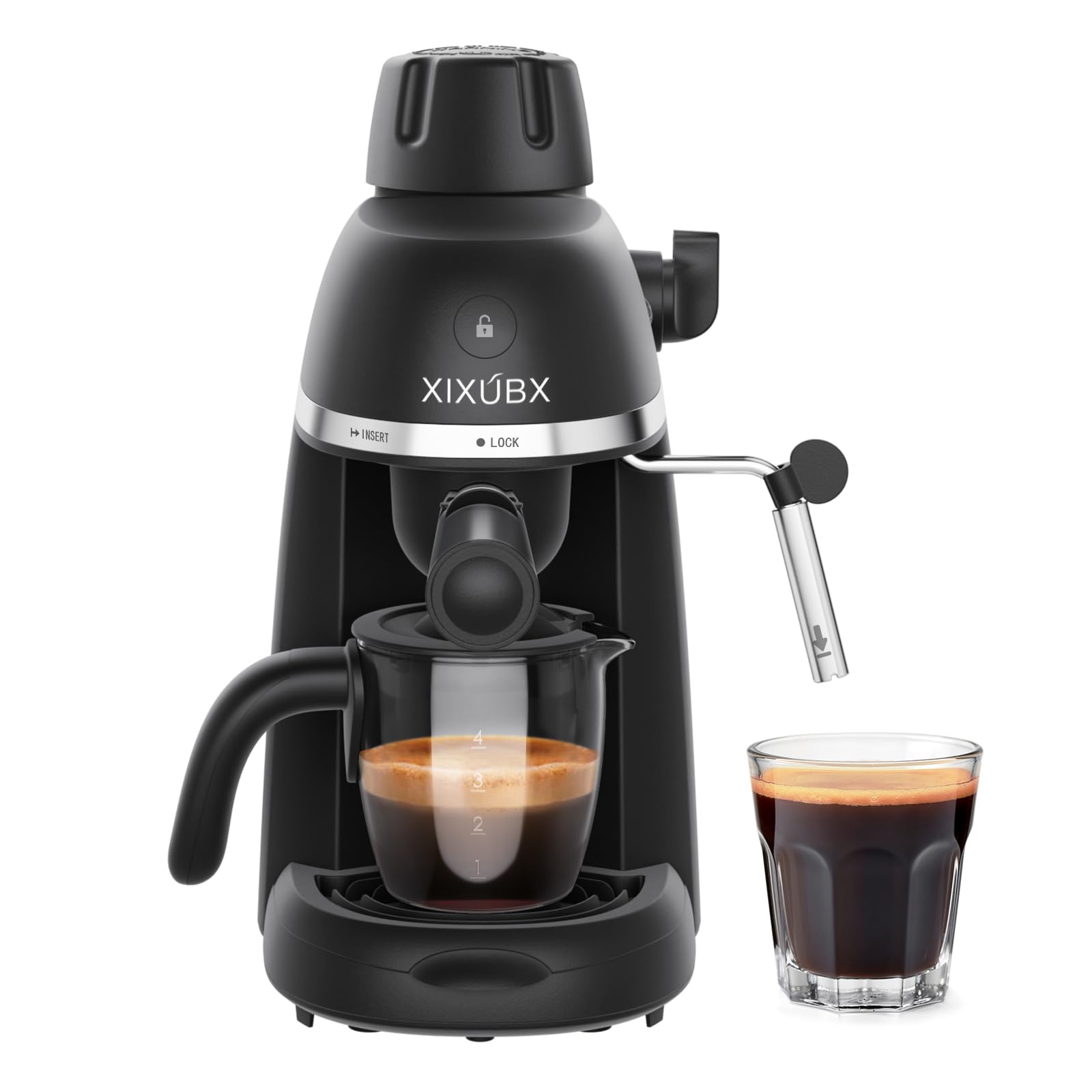
3. XIXUBX Compact Espresso & Cappuccino Machine
A gentle 3.5-bar entry machine that fits dorms, RVs, and first-timers.
This is the budget-tier electric that skips the high-pressure learning curve. Its gentle 3.5-bar extraction is designed to cut bitterness and acidity for a noticeably smooth, mild flavor — a friendlier first espresso than a hard 20-bar pull. The 800W heater gets to brewing temperature fast, and the one-knob control switches between Brew, Steam, and Off with no menus or fragile electronics.
What owners appreciate most is simplicity and speed. Reviewers report an espresso drink in under 5 minutes, daily use for 2 months straight, and results they describe as matching a workplace espresso machine — all in a unit measuring just 8.3″D x 6″W x 11.8″H and weighing 3.3 lbs. The integrated steam wand handles milk foam for cappuccinos, and the BPA-free Tritan cup includes precise scale marks for consistent dosing.
The trade-off is the plastic construction and the modest pressure ceiling. This is a learning machine, not a café replica — the gentle pressure means lighter crema than a 20-bar unit, and the low-pressure system is the defining compromise. Owners say it recoups its cost within weeks when it replaces daily café purchases.
The friendly starter: best for beginners, students, and small-space dwellers who want milk-foaming ability without a big footprint or a big learning curve.
The limit: light crema and plastic parts mean serious espresso fans will outgrow it quickly.
4. XIXUBX EM700-BL Espresso Machine
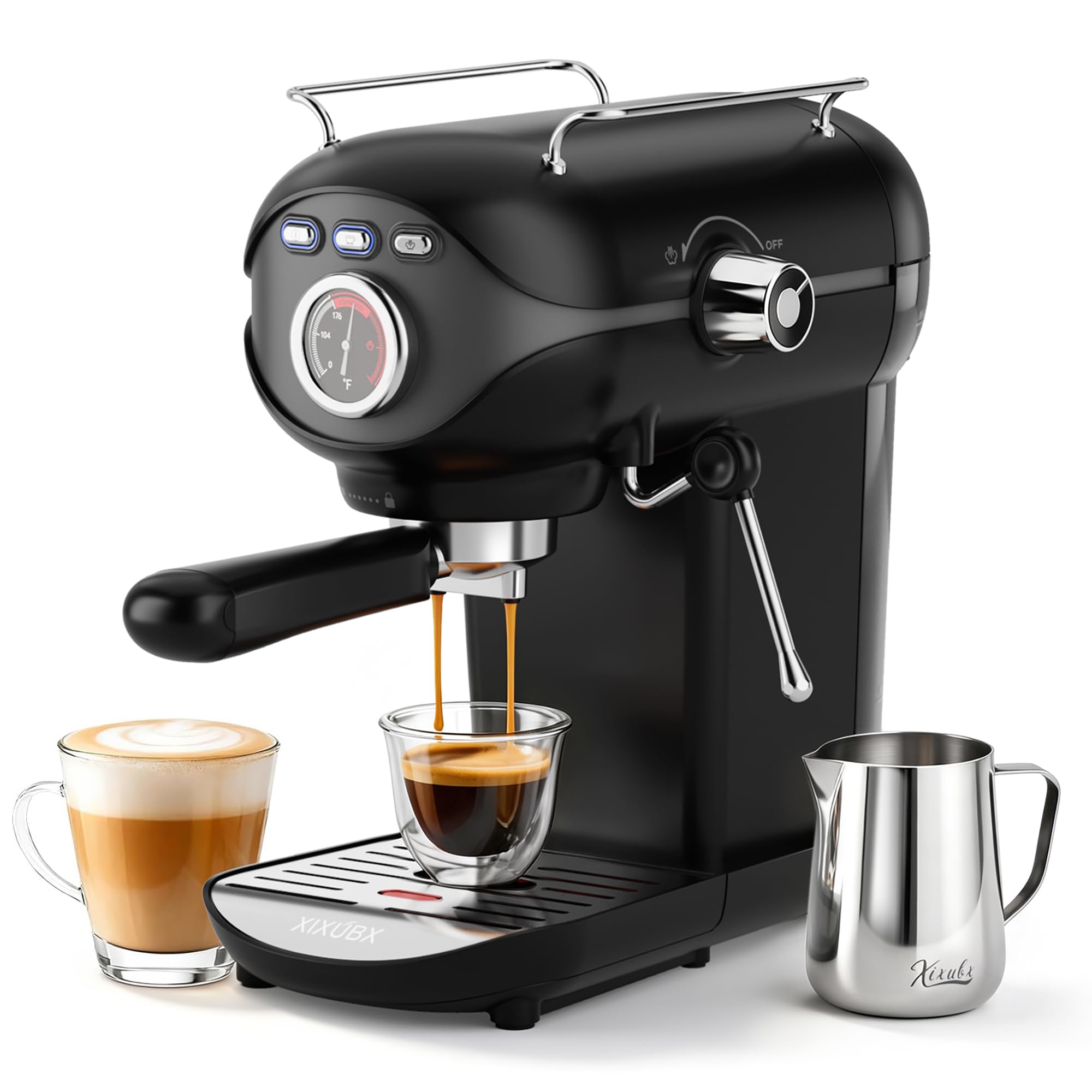
A 20-bar semi-automatic with PID heat control aimed at first-time baristas.
This is the step-up that treats beginners like they deserve real espresso. The 20-bar pressure and mild pre-infusion soak the grounds evenly for rich golden crema, while the built-in PID temperature controller keeps the brew water steady so you don’t get burnt or sour aftertaste. Brewing takes just 22–30 seconds with a single button — one press for a single shot, a different press for a double.
Owners call it a great introduction to home espresso, praising the compact vertical design that fits small counter spaces and the included stainless steel frothing pitcher that makes cappuccinos and lattes approachable. The 51mm portafilter comes with both one-cup and two-cup baskets, and detachable parts make cleaning straightforward. Quality and ease of use are the top owner callouts by a wide margin.
The catch is the steam wand — several owners find it powerful enough to spray milk everywhere until you learn the angle, and the first shot can come up short unless you use the double long-press. Heating speed draws mixed feedback too: it warms fast initially, but the temperature can drop quickly between shots.
Why it earns its slot
- 20-bar pressure plus PID stability for café-style crema
- Includes a stainless steel frothing pitcher and two filters
- 22–30 second single-button brew for busy mornings
Notes for beginners
- Steam wand is powerful — practice the angle to avoid spraying
- First shot may need the double long-press for full volume
The first real machine: choose this if you’re ready for true crema and milk drinks but want a guided, forgiving process.
The learning curve: the steam wand and shot timing need a few tries before they feel natural.
5. Alessi AAM33/1 Design Espresso Maker

A stovetop moka pot designed by Alessandro Mendini, for the coffee ritual as art.
This is the moka pot that treats the daily coffee rite as a design object. Designed by Alessandro Mendini, it’s a rounded aluminum casting with a handle and knob in thermoplastic resin — a deliberate nod to the traditional moka shape with a sculptor’s touch. At 2.4 fl oz it brews a single cup, and the polished aluminum body and heat-resistant handle make it a countertop statement.
Owners praise the quality and the unmistakable Italian design, with the elegant look and great espresso the top callouts. One happy owner describes it as a perfect single-cup moka, ideal for one large or three small shots; another calls the coffee balanced and not too strong with a medium roast. It’s available in 1, 3, and 6 cup sizes, so you can match the design language across your morning.
Be honest about the expectations here. Some owners loved it, but the functionality and size reviews run mixed — a few report leaking or incomplete brewing, and the “1 cup” is genuinely tiny, with one buyer admitting they misread the size and were surprised by how small it is. This is a design-first purchase where the coffee quality is good but the value-for-money verdict lands negative for some.
The solo design statement: this is for the buyer who wants a beautiful object on the stove and enjoys the ritual as much as the shot.
The caveat: it’s small and the price reflects the designer name — sturdier budget moka pots brew the same coffee for less.
6. cutesun Mini Capsule Espresso Machine

A 19-bar capsule brewer that accepts Nespresso Original and many more pods.
If you want espresso without grinding, weighing, or tamping, this machine delivers a 19-bar pump (135 PSI) that forces water through a capsule in 35 seconds. It’s compatible with Nespresso OriginalLine capsules plus Bestpresso, Gourmesso, Jones Brothers, Battistino, Rosso Caffe, and Peet’s Espresso — giving you real brand flexibility. The patented brewing system holds a constant 90–92 degrees and produces crema over 3mm thick, per the maker.
Owners like the small footprint, easy setup, and the two programmable drink sizes — a 2 oz Espresso button and a 4.2 oz Lungo button. The removable 0.8 L water tank makes refilling and cleaning simple, and the auto power-off after 25 minutes saves energy. The coffee quality earns consistent praise, with one owner calling it café-quality.
The durability question is real. One owner reported the machine working perfectly for 2 weeks and then failing with overflow issues, while others note the pump may be the weak link long-term. The water reservoir is small, there’s no milk frother, and it runs a bit louder than a Keurig — but for pod convenience at a compact size, the value is hard to argue.
The quick single shot: ideal for pod users who want a true espresso machine footprint without the manual work of grinding and tamping.
The durability bet: an occasional unit fails early — treat the 1-year warranty as part of the value.
7. Flair Classic Manual Espresso Maker

A 100% human-powered lever press that turns espresso into a hands-on craft.
This is the espresso maker for people who want to feel the shot. The Flair Classic is a fully manual, direct-lever press — no plugs, no electronics — where you add 60ml of boiled water and up to 18 grams of coffee to yield a 40 ml shot with beautiful crema. It comes with both a Bottomless 2-in-1 Portafilter and a Flow Control Portafilter, so you can brew for speed or dial in full control.
The build is the headline: cast aluminum press stand and stainless steel brewing head, both backed by a 3-year warranty. Owners describe coffee quality that approaches dedicated home machines, with proper crema when you use fresh beans and a good grinder. It’s the only manual espresso maker with a completely detachable brewing head, so cleanup means separating the parts and rinsing under cool water.
The recurring gripe is the learning curve and a few durability hiccups. One owner’s plastic piston broke after 15 uses (replaced free, but the stainless upgrade can stick), and others note preheating is time-consuming and inconsistent. This is a travel-and-hobby machine — owners say it beats the handheld options for quality but demands practice to master.
The craft appeal
- Professional-level control with a fully manual lever
- Detachable brewing head makes cleanup genuinely easy
- 3-year warranty on the aluminum and stainless build
The effort required
- Steep learning curve — practice needed for consistent shots
- Preheating is slow and can vary brew to brew
The espresso enthusiast: choose this if you enjoy the craft and want café-level control without a plug.
skip it if: you want speed or consistency without practice — this rewards patience.
8. OutIn Mino Portable Electric Espresso Machine
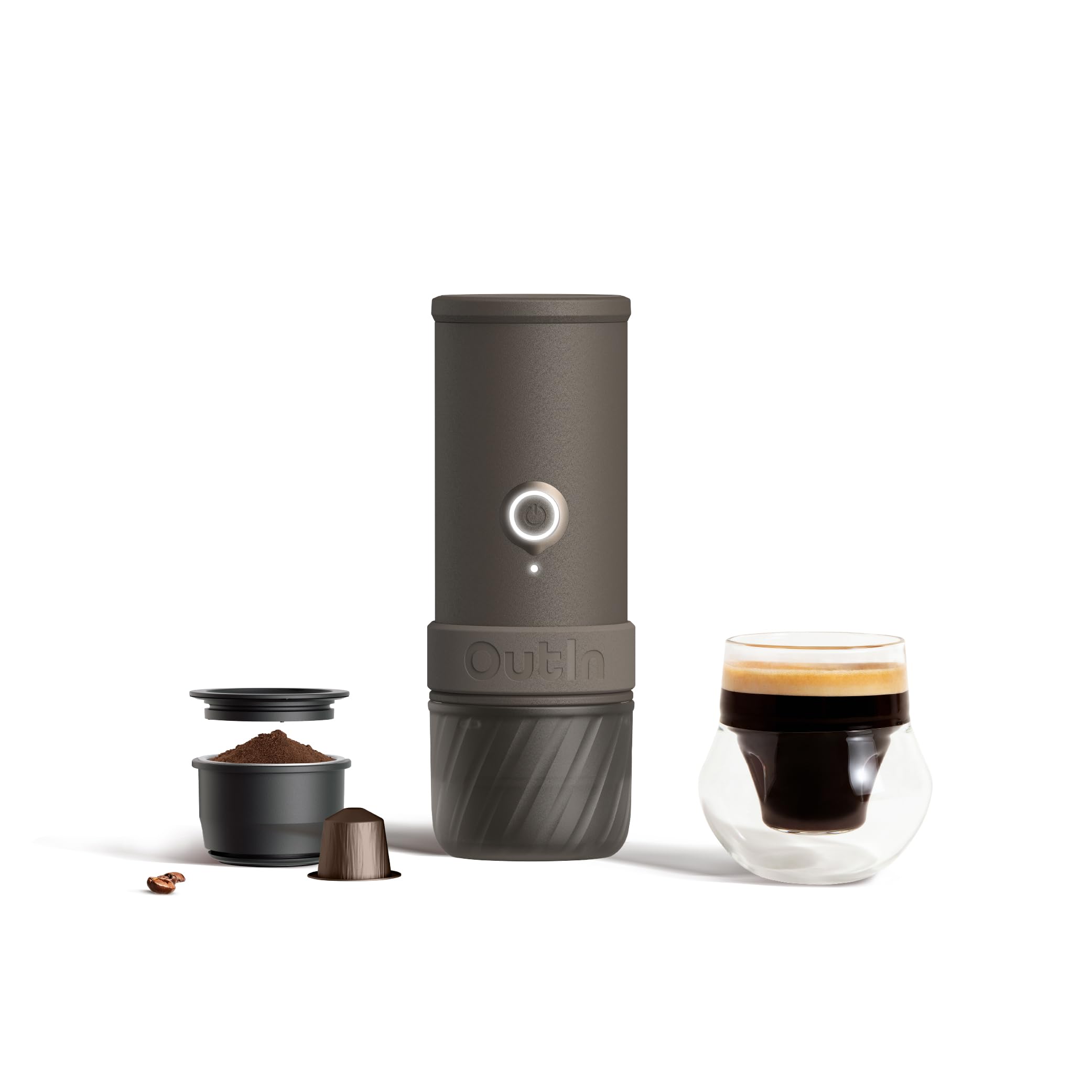
A pocket-sized electric espresso maker that heats its own water anywhere.
This is the travel espresso maker that removes the biggest roadblock: hot water. The OutIn Mino measures just 2.64in x 7.68in and weighs 685g, and it heats room-temperature water itself — customers note a 77℉ fill reaching brew temperature in 2 minutes and 40 seconds. No kettle, no thermos, just the machine, grounds or a capsule, and a USB-C cable.
Three 3000mAh batteries deliver up to 6 cups on a single charge if you use cold water, or up to 500 cups on that same charge when you start with hot water — the self-heating is only needed for the cold-water path. The IP67 waterproof and dustproof rating means rain won’t stop a brew, and the smart chip keeps extraction stable up to 5000m altitude across temperatures from 5℉ to 113℉. The stainless steel portafilter and BPA-free Tritan cup handle both ground coffee and capsules.
Frequent travelers call it a lifesaver that replaces poor hotel coffee, and the crema quality genuinely surprises people. The honest limits: it’s heavier than a manual handheld press, the battery can die mid-extraction if you don’t charge it, and grinding coarser is key to avoiding bitter over-extraction. Owners who compare it to the Picopresso note the Mino wins on convenience while the manual option wins on flavor nuance.
The adventure barista: this is for hikers, campers, and road warriors who refuse to drink bad coffee away from home.
The real limits: battery life requires planning, and its flavor ceiling trails a good manual press.
Understanding the Specs
Bar pressure
This number tells you how hard the machine pushes hot water through your coffee grounds. Gentle 3.5-bar systems make a smoother, less bitter cup with lighter crema — great for beginners. A 19 or 20-bar pump (the standard for café-style espresso) forces water through harder, producing that thick golden crema layer and a more intense shot. If you see no bar rating, it’s a moka pot or manual lever, where you or steam create the pressure instead.
Heating system and wattage
Wattage (like the 800W heaters on the XIXUBX machines) tells you how fast the machine reaches brewing temperature. Higher wattage means less waiting in the morning. Portable units like the OutIn Mino skip the plug entirely — they heat their own water with internal batteries, which matters most when you’re traveling or camping. A PID temperature controller (found on the EM700-BL) keeps the water at a steady temperature so your shots don’t taste burnt or sour.
FAQ
What is the difference between a moka pot and an espresso machine?
How many grams of coffee does a single cup moka pot need?
Will a 1 cup espresso maker work with espresso capsules?
How long does it take to brew a single shot?
Is a moka pot espresso maker safe to use on induction cooktops?
Why does the moka pot handle get so hot?
Can I make a cappuccino or latte with a single cup espresso maker?
How do I clean a moka pot without ruining it?
Final Thoughts: The Verdict
For most people, the 1 cup espresso maker winner is the Bialetti Moka Express 3-Cup because it pairs an iconic, durable design with rich coffee and zero electricity — the crowd favorite with one of the strongest owner bases in the category. If you want true crema and steamed milk at home, grab the XIXUBX EM700-BL for its 20-bar pressure and PID heat control. And for anyone who refuses bad coffee on the road, the OutIn Mino is the one to reach for — it heats its own water and fits in a backpack.
How We Picked
We do not accept paid placement. Every pick is matched to a real buyer and a real use-case; we do not hands-on test units.
Sources & Methodology
Specifications: manufacturer listings and product documentation. Review insights: verified customer reviews, as of August 2026. Pricing: not shown on this page (it changes often); check the current price via the retailer link.
As an Amazon Associate, Non Toxic Blog earns from qualifying purchases. This does not affect which products we feature.