Specs are compiled from manufacturer listings and verified buyer reviews and can change over time — please confirm the key details on the product page before buying.
When you’re off-grid at a campsite, on an RV roof, or during an outage, a 100-watt foldable or rigid kit is the balance for topping off a power station or keeping a 12V battery alive. But not all “100W” panels actually deliver 100W in real sun, so this guide separates the real performers from the spec-sheet dreamers.
I’m Mo Min — the founder and writer behind Non Toxic Blog. This guide is built by comparing the manufacturers’ published specifications and the patterns across verified customer reviews, so you get each pick’s real strengths and trade-offs instead of marketing spin.
Before you buy, understand that “100W” is a lab number, not a guarantee of daily output — weather, angle, and your controller all matter. Here is how to pick the right 100 watt solar panel kit for your exact setup, with honest trade-offs for each contender.
Our Picks at a Glance

How To Choose The Best 100 Watt Solar Panel Kit
A 100W kit is only as good as its parts: the panel itself, the charge controller, and the cables that tie it to your battery. Start by deciding if you need portability or permanence — a foldable suitcase for camping trips or a rigid framed panel bolted to an RV roof.
Foldable vs. Rigid: Which fits your life?
Foldable panels with kickstands are for people who move every day — think overlanding, fishing trips, or emergency bags. Rigid kits with Z-brackets are for people who mount once and forget, like keeping a trailer battery topped off between trips. Weight tells the story: a foldable like the FlexSolar weighs 4.1 lbs, while a rigid kit with brackets and controller runs closer to 15 lbs.
Efficiency and real-world output
Efficiency ratings in the 23% range (measured on monocrystalline cells) mean more power per square inch of panel. But buyers consistently report real output between 50W and 80W in average conditions, and occasionally near 100W in perfect noon sun. A 45° kickstand angle captures up to 25% more sunlight than flat laying—angle matters as much as cell quality.
Controller type and cable compatibility
Every kit needs a charge controller between panel and battery. PWM controllers (the common budget type) are fine for a single 100W panel. Your power station brand dictates the cable connector you need — XT60 for EcoFlow, DC8020 for newer Jackery models, Anderson for original Jackery 1000. The best kits ship a 5-in-1 cable, so you skip buying adapters separately.
Quick Comparison
| Model | Best For | Weight | Efficiency | Controller | Amazon |
|---|---|---|---|---|---|
| ZOUPW 100W (B0CR42CFJ9)★ Best Overall | Power station topping | 9.5 lbs | 23.5% | Built-in (3 ports) | Amazon |
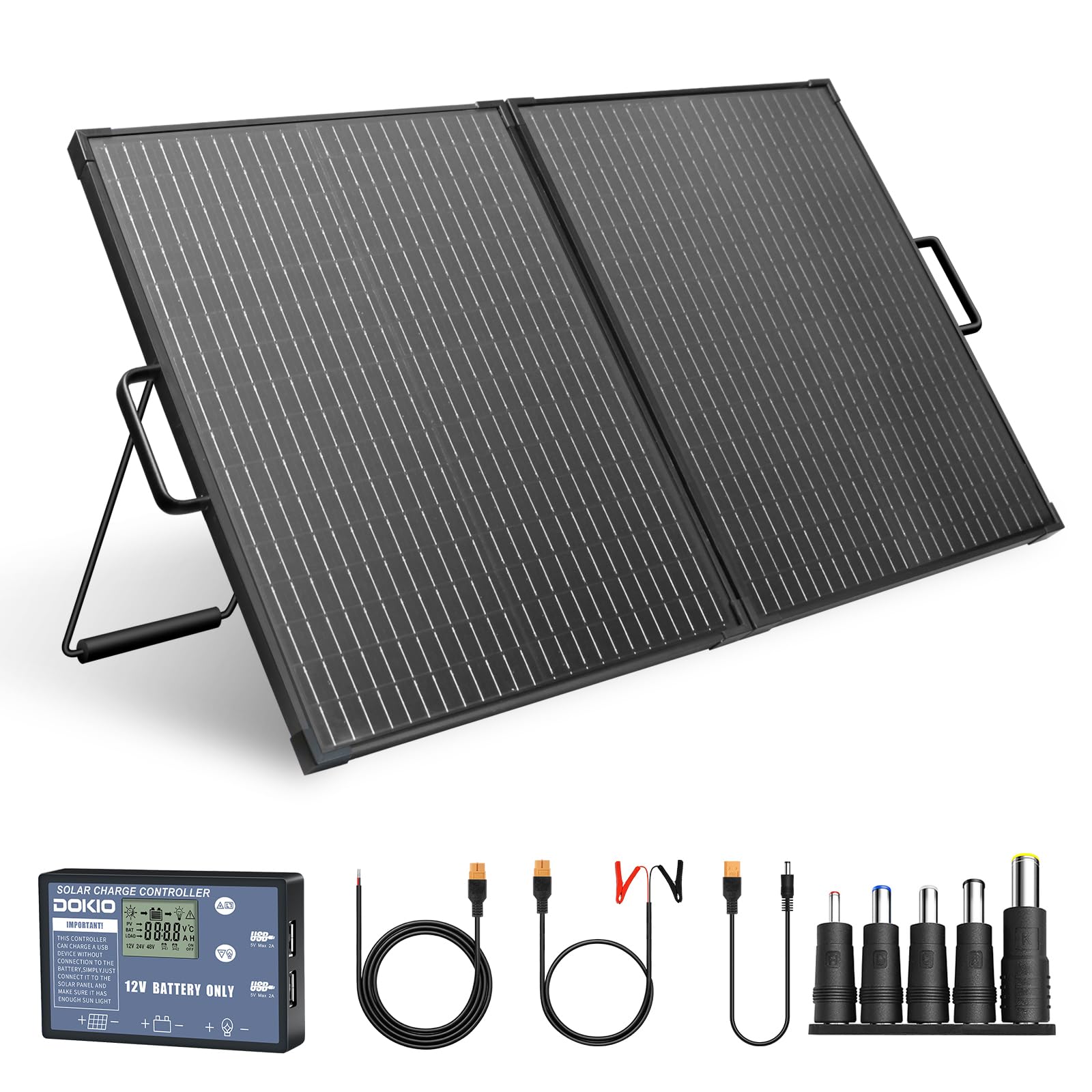
| DOKIO 100W SuitcaseBest RV Value | RV battery charging | 10.1 lbs | High (mono) | Detachable 10A PWM | Amazon |
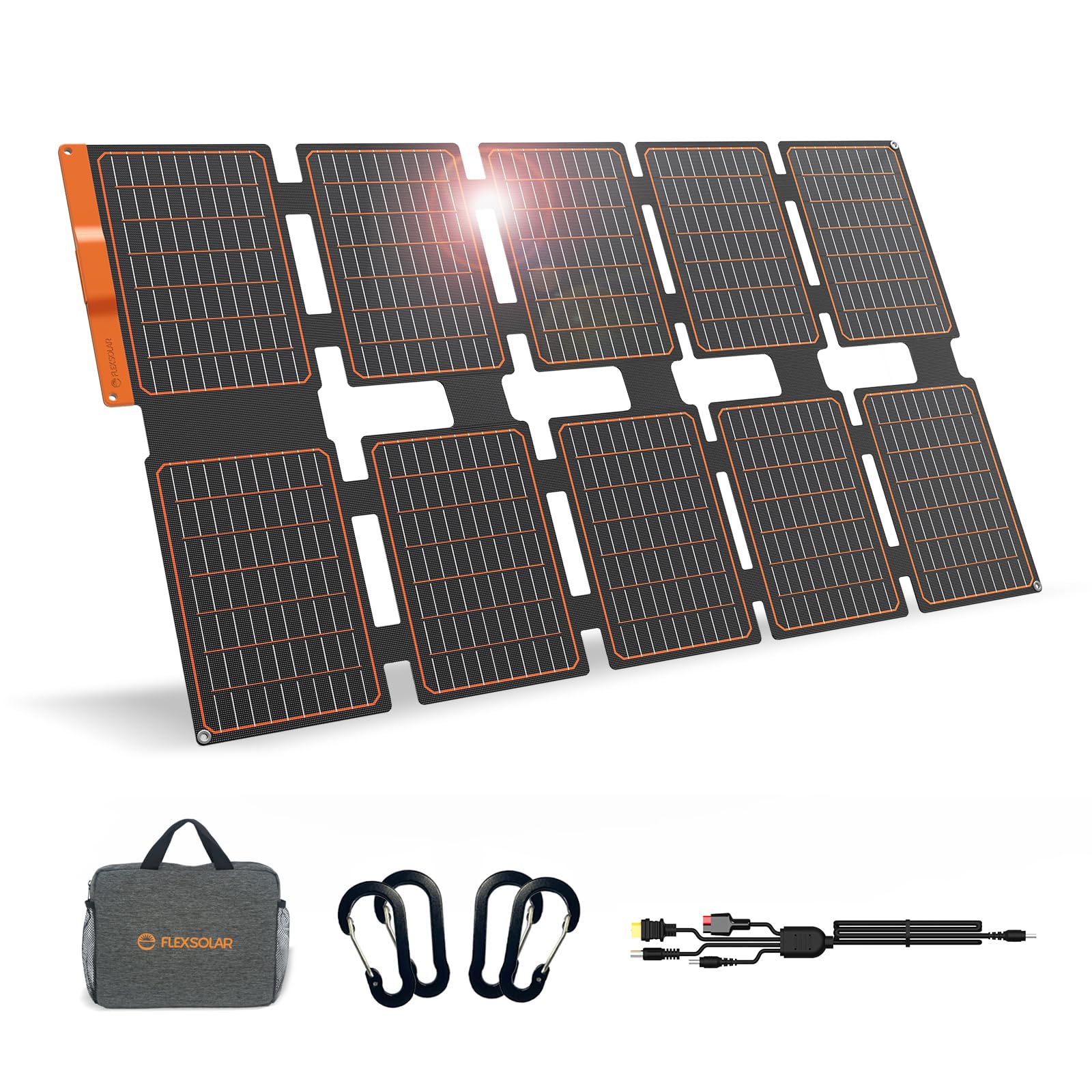
| FlexSolar 100WUltralight Pick | Ultra-light hiking | 4.1 lbs | 23%+ | None (direct output) | Amazon |
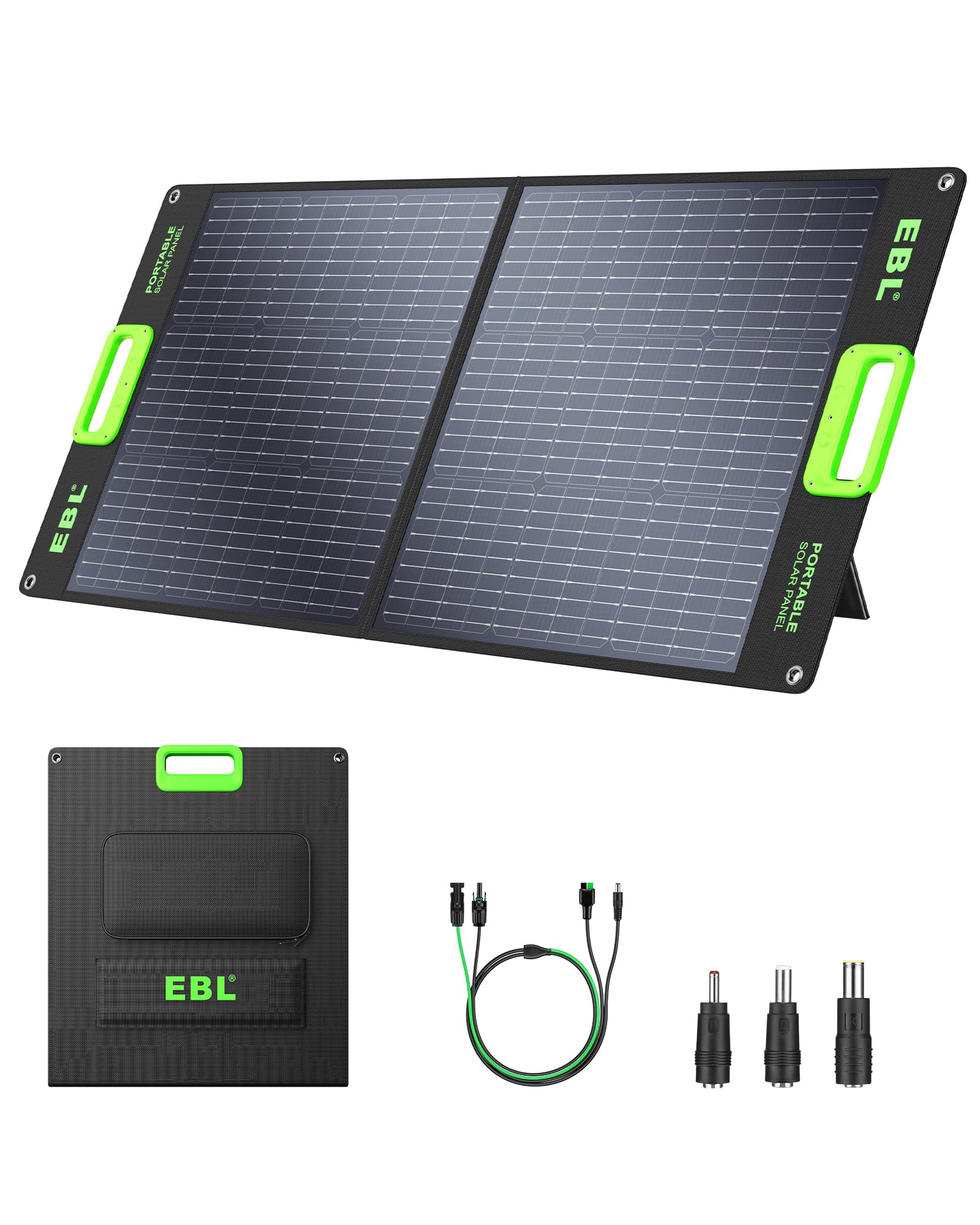
| EBL Solar 100W | Multi-device charging | — | 23% | Smart IC built-in | Amazon |
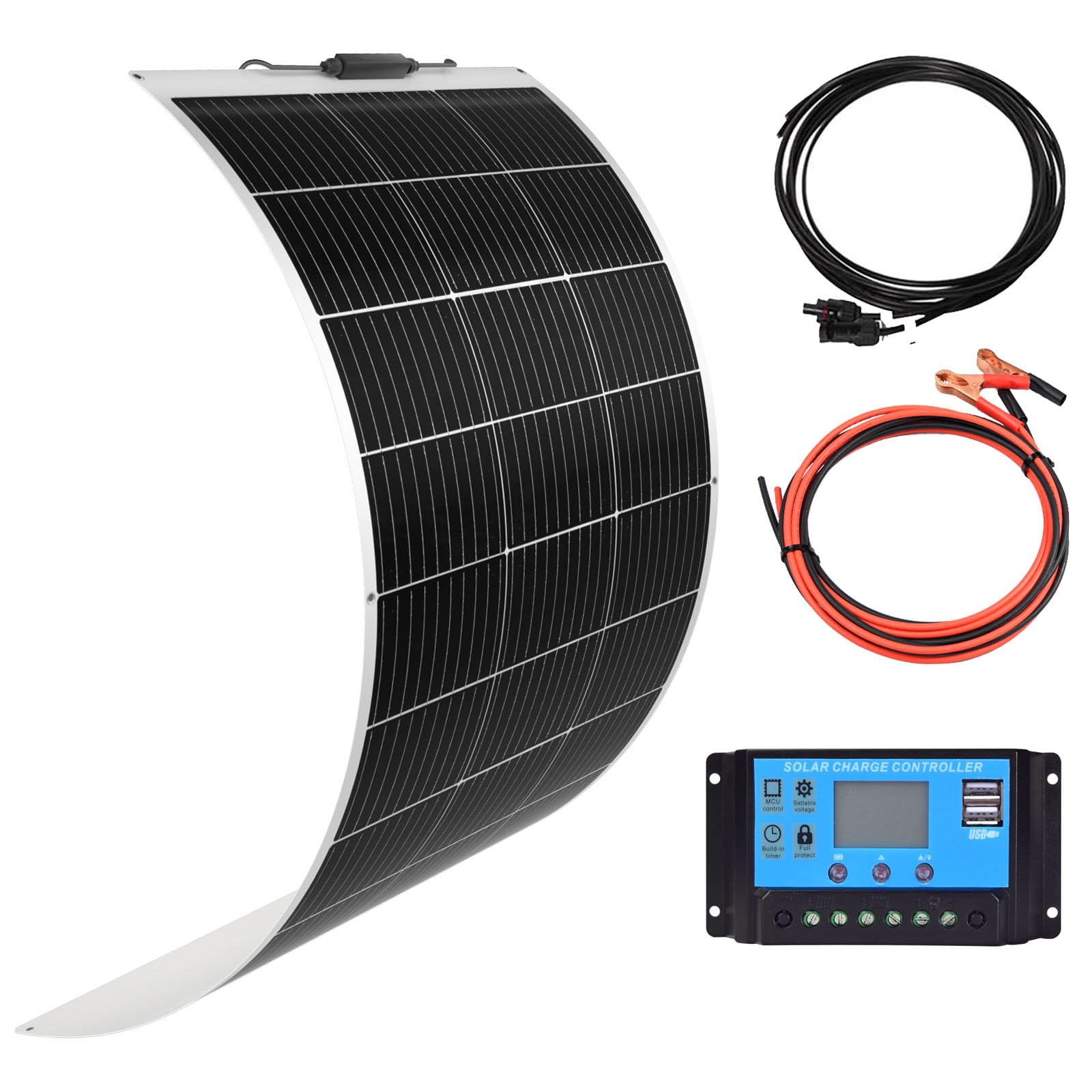
| XINPUGUANG Flexible | Curved surfaces | ~4 lbs | 23% | 10A included | Amazon |
| Topsolar 100W | Fixed off-grid install | 15.84 lbs | High (mono) | 12V/24V intelligent | Amazon |
| ZOUPW Tempered Glass | Durable folding | 9.36 lbs | 23.5% | 20A PWM included | Amazon |
| Hoysicy 100W | Starter shed power | — | High (mono) | Smart LCD included | Amazon |
| Voltset 100W | Battery maintaining | 7.8 kg | High (mono) | 20A smart LCD | Amazon |
| ExpertPower Kit + Battery | Complete starter system | 14.6 lbs | High (mono) | 10A PWM | Amazon |
| Nature Power 110W | Whole-camp setup | 19 lbs | High (poly) | 11A + 300W inverter | Amazon |
In‑Depth Reviews
1. ZOUPW 100W Portable Solar Panel
Our pick — over 4.5★ from 700+ verified ratings; the strongest balance of quality and price.
The crowd-pleaser that actually pulls 60W in late-afternoon sun
The defining trait here is the 23.5% efficiency monocrystalline cells — the top spec in this lineup, which translates to better output when the sun is low or thin clouds roll through. Buyers report “Receiving over 60w of charge in the late afternoon sun,” which is genuinely strong for a 100W nominal panel. The 45° kickstand angle captures up to 25% more sunlight than flat laying—a real edge for stationary camps.
The 5-in-1 cable covers DC8020 (newer Jackery), XT60 (EcoFlow), Anderson (original Jackery 1000), plus DC7909 and DC5521 for older stations. No adapters needed for 99% of power stations. The built-in controller adds 1x USB-C (PD 15V/3A) and 2x USB-A (QC3.0 12V/1.5A) so you can charge phones and GPS directly without a separate battery box.
At 9.5 pounds with a magnetic handle, it folds to 24.13 x 21.06 x 1.77 inches. The IP67 ETFE coating shrugs off rain while a zippered pocket protects the controller and cables. Note the honest spec: a 60W-limit power station will only draw 60W from this panel, so check your station’s input limit first.
What wins people over
- Build quality is the most-praised trait — owners describe it as well-made and durable
- Cloudy-day performance beats typical panels, with 60W reported on overcast days vs. the usual 25W
- Charged a Jackery from 84% to 100% in about 20 minutes
The honest trade-offs
- Power output splits opinion — some report nearly 100W, others only 20-25W in weaker sun
- Kickstand legs lack adjustability, so fine-tuning the angle is limited
- Heavier than expected for some — awkward for long carries on foot
Reach for this if: you own a Jackery, EcoFlow, or Anker power station and want one cable to rule them all
Look elsewhere if: you need a featherweight for multi-day backpacking — the 9.5 lbs will weigh on you
2. DOKIO 100W Foldable Solar Panel Suitcase
A rugged suitcase kit that keeps RV batteries fed without fuss
The DOKIO arrives as a true all-in-one: the 100W panel, a detachable LCD charge controller, a 9.8ft (3m) extended cable, and 5 DC adapter plugs. That means you can connect alligator clips directly to a battery by polarity and start charging immediately. It runs 0.6 lbs heavier than the ZOUPW above at 10.1 pounds — a small gap for a unit with a metal grip and a carrying case.
The N-type battery cells and corrosion-resistant aluminum frame handle extreme temperatures from -40°F to 185°F. It resists 5400Pa snow load and 2400Pa wind — real numbers for year-round outdoor duty. The 30° adjustable bracket helps chase the sun, and the built-in 5V 2A USB port charges phones or small electronics directly.
The 10-year power output warranty is the longest here, backing long-term reliability. Owners mention the monocrystalline cells work on cloudy days and can power phones, a fan, and even a mini fridge at camp. The recurring caveat is the legs — a few found them wobbly or sharp enough to risk panel damage, so treat the angle adjustment gently.
Solid all-rounder: alligator clips, 5 DC adapters, and a detachable LCD controller make this genuinely ready from the start — with one buyer even recommending it over a Renogy kit.
The catch: the carrying bag lacks padding, so a dented cell (still outputting 5-5.5A within spec, per one owner) is possible in transit.
Pick this if: you want a suitcase-style kit with a controller included and a decade-long warranty
Think twice if: you demand a padded bag — this one is thin, and the legs need care
3. FlexSolar 100W Foldable Portable Solar Panel
Half the weight of its peers, still chasing rigid-panel output
At 4.1 lbs with a 0.59-inch profile, this is the lightest panel in the entire lineup — roughly 5.4 lbs lighter than the ZOUPW and ideal for hikers who count every ounce. It folds to 12.99 x 10.43 x 2.17 inches (about notebook size) and comes with a padded carry bag. The unfolded 45.47 x 26.18 inches captures a generous surface area for its pack weight.
The 23%+ efficiency monocrystalline cells hold their own against rigid panels in real use — one owner measured 70W+ horizontal in Maine July, and another reported peak 80W at noon with 60-70W sustained from 10am to 6pm. That’s comparable to rigid 100W panels, which is impressive for something that fits in a backpack side pocket. The PD 3.0 45W USB-C, 18W USB-A, and 100W DC outputs let you charge a laptop directly via the included 4-in-1 cable (DC5521, DC7909, Anderson, XT60).
The 3-in-1 output is its superpower, but it lacks a built-in charge controller — you’ll need an inline one to protect a 12V battery. One owner notes the DC/USB circuitry gets hot at 60W+ loads, and the USB connector can corrode if left in heavy rain despite the IP67 rating. For hiking-first buyers who prioritize weight, this is the clear winner.
Featherweight champion: no other pick here folds this small or carries this light while delivering 80W peaks.
One real limitation: no MC4 connector and no controller included — budget for add-ons if you plan to charge a battery directly.
Best for: backpackers, kayakers, and anyone who walks to their campsite
Not for: fixed rooftop installs — this is a travel panel, not a permanent mount
4. EBL Solar Panel 100W Portable
The universal match that powers sheds, fridges, and CPAP machines
The EBL pairs 23% high-efficiency monocrystal cells with a long list of included adapters: MC4 to Anderson, MC4 to DC5521, plus 5.5×2.1mm adapters for several barrel sizes. That breadth is why owners run everything from a 75qt fridge to a CPAP machine on it. The Smart IC adds overcharging, overheating, and short-circuit protection, so you can connect devices without constant supervision.
Two kickstands angle the panel to 45°, capturing 20% more sunlight than flat laying. The magnetic handle folds cleanly with a soft rubber grip for storage. At IP65 it’s splash-resistant but not submersible — the manual is explicit: don’t leave it in rain or soak it. That’s the main honesty gap versus the IP67-rated competitors.
Power output is the mixed story here. Some customers note impressive real-world numbers — one measured enough to run a fridge daily, another saw strong wattage in Ohio summer sun. But others note a max around 65W rather than the advertised 100W, and output can drop to 1-2W in heavy clouds or shade. The versatility of adapters and rugged build make it a solid value, just not a guaranteed 100W performer.
Why buyers stick with it
- Performance is the top praise — able to power a 75qt fridge and keep a 1kW power station topped up over two days
- Build quality and lightweight design get consistent shout-outs
- Cables and connectors store neatly in the back pocket
Where it falls short
- IP65 means rain exposure is a risk — daily setup and takedown may be needed outdoors
- Some owners see 65W max output, well below the 100W label
- The 6ft cable is shorter than competitors’ 10ft offerings
Grab this if: you want maximum adapter compatibility for various gadgets and power stations
skip it if: you need guaranteed near-100W output or plan to leave it out in the rain
5. XINPUGUANG Flexible Solar Panel Kit 100W
The bendable panel that hugs curved RV roofs and boat decks
Unlike every other pick here, this one is semi-flexible — the plastic back sheet curves to a maximum 250° arc, so it mounts on RVs, boats, cabin roofs, trucks, and trailers with irregular surfaces. At roughly 4 lbs and 0.1 inches thick, it weighs 70% less than conventional rigid panels, which changes how you think about permanent installation. Six grommet holes accept fasteners, or you can bond it with silicone and adhesive tape.
The 23% conversion rate Perc monocrystalline cells include a bypass diode, plus input overcurrent and reverse protection built into the circuit. The kit ships with a 10A charge controller, alligator clip wire, and extension cable. One owner ran a refrigerator and kept a Bluetti EB3A charged in Utah June heat, with the fridge holding 34°F while temps sat in the 80s-90s.
The trade-off is real-world output — that owner saw max 60W, not the full 100W, and noted cloudy days may require a second panel or larger battery. Another unit arrived as open-box with a missing controller, though it was shipped fast. The 4lb weight makes it the lightest permanent-install option, but flexible panels generally run hotter than glass ones in direct sun.
Shape-shifter: no other 100W in this list bends to fit a curved boat hull or RV nose cone.
Know this: 60W real-world max output means it’s better as a maintainer than a primary charger on demanding days.
Choose this for: curved surfaces where rigid frames simply won’t fit — boats, truck caps, trailer noses
Pass on it if: you want maximum daily watt-hours from a flat, optimally-angled install
6. Topsolar 100W 12V Solar Panel Kit

A rigid workhorse for sheds, gates, and off-grid cabins that just works
The Topsolar is a fixed-install kit: 100W monocrystalline panel, a 12V/24V intelligent charge controller, a V-shape tilt rack bracket, two 16ft MC4 cables, and two 5ft O-ring cables for battery connection. The 15.84 lbs panel features an anodized aluminum frame and tempered glass coating, built to sit outdoors year-round. The bracket adjusts the mounting angle for better sun reception, and it mounts on ground, wood, or wall.
Owners praise how it keeps batteries charged — one runs a fridge on cloudy days, another wired two in parallel to charge all the tractors and buggies on their property. The controller offers full protection against overcharge, over-discharge, over-voltage, and short circuit. Setup is genuinely plug-and-play: “I just hooked up battery then solar panel and it started by itself, no need to do any programming.”
The recurring honest caveat is the mounting hardware — the roof mounting holes don’t always line up, though owners simply drill through the aluminum frame to fix it. One unit got stuck in 24V mode after three years and couldn’t switch back to 12V. The instructions also draw negative feedback, so expect a learning curve if you’ve never wired a controller.
What earns its keep
- Functionality tops the praise list — keeps fridges running even on cloudy days
- Battery charging is a standout: can bring a battery from dead to full
- Easy setup with no programming required for most users
What you’re signing up for
- Mounting bracket holes may need drilling to fit your roof
- Some reviewers point out missing brackets in the box
- Instructions are the most-complained-about aspect
Best for: permanent off-grid installs where you set it once and forget it
Not ideal for: portable use — at 15.84 lbs you won’t want to carry it far
7. ZOUPW 100W Tempered Glass Panel Kit
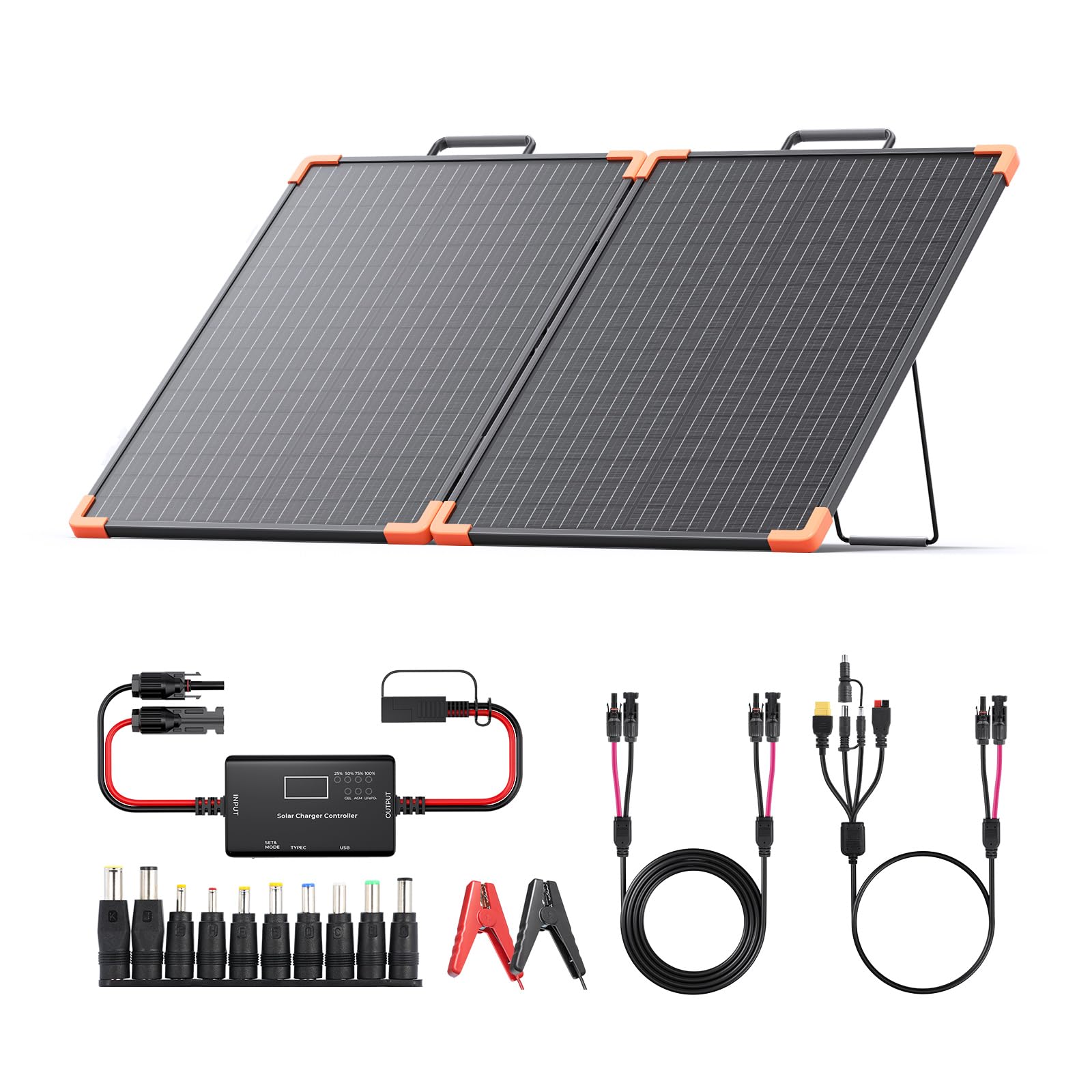
The foldable that hits 99-101W in full sun — verified by owners
Most foldable panels give up some output for portability, but this ZOUPW variant uses a 1.6mm tempered glass surface instead of the usual ETFE or PET film. That’s a durability upgrade that also delivers genuine performance — one owner tested it in full sun and “the 100 watt panel put out 99-101 watts,” which is the closest to spec in this entire list. The aluminum frame adds impact resistance against scratches and cracks.
The kit is complete: 20A PWM controller, 5-in-1 cable (XT-60, Anderson, DC5521, DC7909, DC8020), SAE-alligator clip cable, a 10-in-1 DC adapter set, and a storage bag. It folds to 27 x 17.9 x 1.77 inches and weighs 9.36 lbs, just under the top ZOUPW pick. The kickstands position at about a 90° angle toward the sun for maximum output. IP68 waterproofing means it handles submersion better than the IP67-rated competition.
A Group 27 lead-acid battery went from 65% to 100% in under 3 hours in testing — strong for RV boondocking. The PWM controller (a type that regulates charging by switching power on and off) offers overcharge, reverse charging, short circuit, reverse polarity, and over-temperature protection, all for 12V batteries. Two quirks: the controller isn’t waterproof (keep it out of rain), and the control box and connectors are tucked inside the folded panels rather than a case pocket — a detail that caused one buyer to initially think items were missing.
Performance king: near-100W output is rare for a foldable, and the tempered glass backs it up with real durability.
One heads-up: always check between the folded panels for the controller and alligator clip cable before discarding packaging.
Reach for this if: you want foldable convenience without sacrificing the output of a rigid panel
Consider another if: you need a waterproof controller — this one must stay dry
8. Hoysicy 100W Solar Panel Kit 12V Battery Maintainer
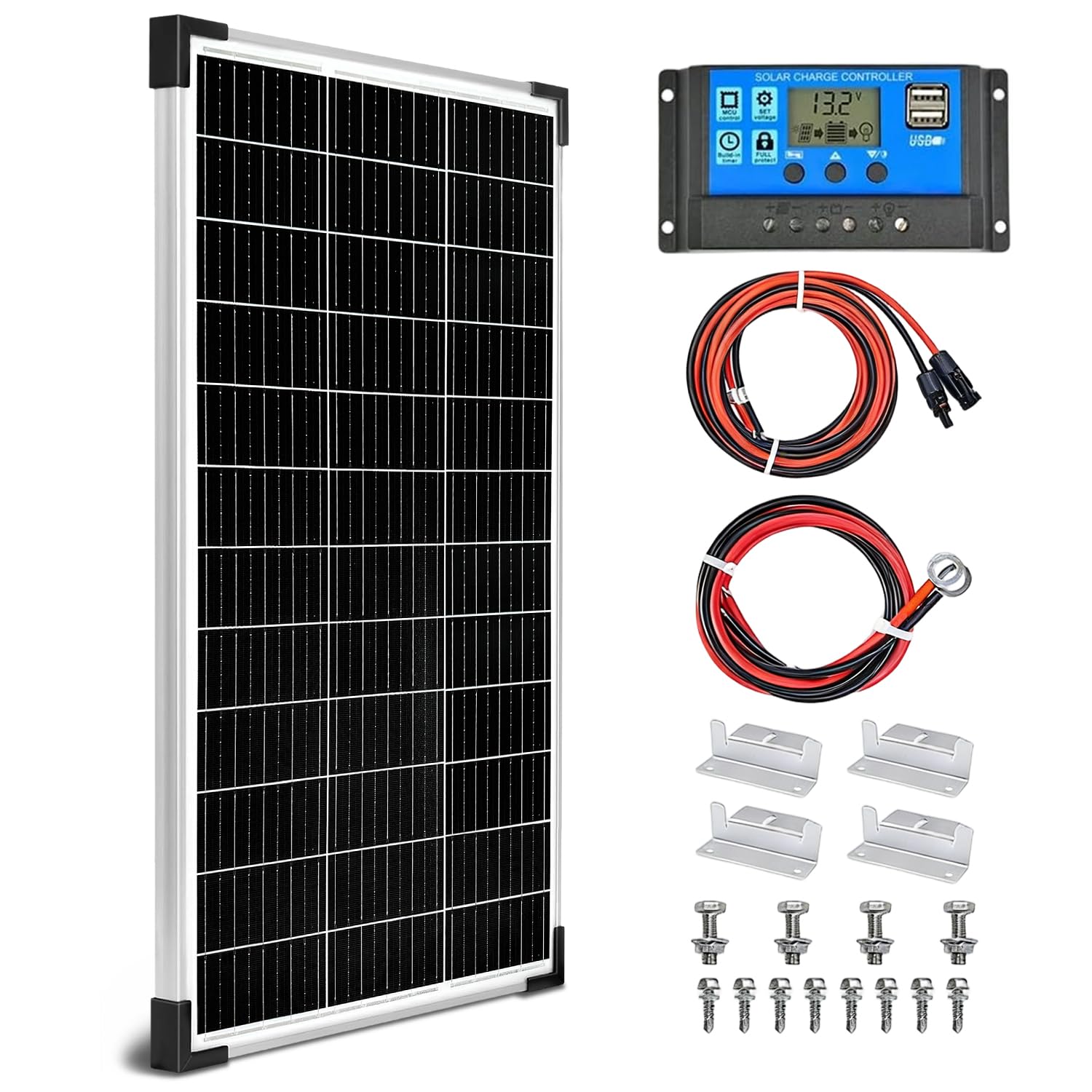
A budget-friendly starter that punches above its weight for sheds
This is the entry-level pick that focuses on the essentials: a 100W monocrystalline panel (a type made from a single silicon crystal) with a waterproof junction box, a smart charge controller with LCD display and USB ports, and all the mounting hardware (Z-brackets, screws, O-ring terminal cables). The monocrystalline cells claim up to 30% higher efficiency than standard silicon, boosting low-light output. It’s designed to withstand hail, snow, and rain with its edge-seal waterproofing and corrosion-resistant aluminum frame.
Real-world use shows it’s genuinely capable for light loads. One owner ran two LED patio light strings and a 22′ LED awning light for 3+ hours nightly under heavy pine canopy, while USB-charging phones — all from one panel. Another charges a 20Ah LiFePO4 battery in a shed with minimal effort, and a third keeps an RV battery topped up between trips. For basic 12V maintenance and small-device charging, it delivers.
The honest concern is build quality — this is the one area where feedback turns negative, with some describing it as poor. One owner’s fan controller drained the battery overnight before recovering at dawn. The included controller works but one buyer swapped it for an MPPT controller for better efficiency. If you want a no-frills starter to learn on, this fits; if you’re building a serious off-grid system, budget for a better controller.
Function-first: the functionality is proven across sheds, campers, and patios — it genuinely maintains batteries.
The honest catch: build quality is the most-discussed negative, so handle and install carefully.
Good for: first-timers who want a complete kit to learn solar basics without a big investment
Better options exist if: you need a system that runs daily without any supervision
9. Voltset 100W 12V Solar Panel Kit
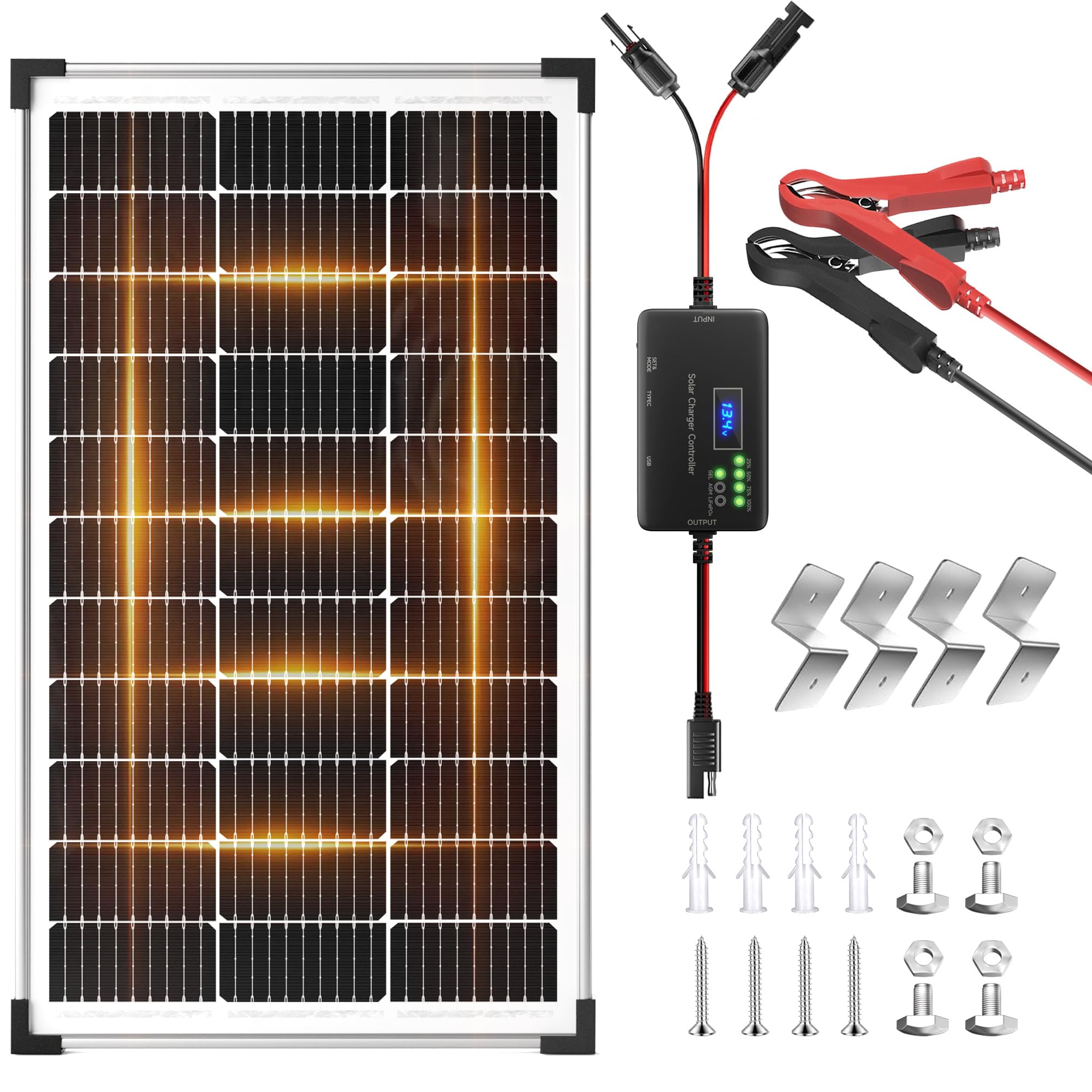
The maintainer that keeps excavators, boats, and RVs ready to go
The Voltset’s defining feature is its 20A smart controller with a full LCD screen and LED indicators — press a button to view current for 5 seconds, hold for 3 seconds to switch battery modes. It works with LiFePO4, AGM, Gel, Flooded, and Lithium Ion batteries, making it the most battery-flexible 12V kit here. The 25-year lifespan and 500+ watt-hours per day claim signal a long-term investment.
This is a tool-owner’s favorite. Shoppers say keeping a mini excavator’s weak-alternator battery charged at peak all week, so it’s fully ready on project day with no pull starts. Another uses it for dump trailers with no cords to drag out — just mount and forget. On boats, installation takes about 2 minutes and it charges even in shade. The IP67 waterproof rating (meaning it’s fully protected against dust and can handle immersion in water up to 1 meter) and sturdy aluminum frame handle the outdoor abuse.
Two practical notes: the included cable may be too short for a rooftop install, so several owners bought an extension cord. The clamps are mostly plastic with minimal metal, which is fine for light duty but not heavy industrial use. Output runs slightly below spec at times — one owner measured >14V with amperage under the label — but for maintaining batteries rather than fast-charging, it’s a reliable workhorse.
What keeps owners loyal
- Battery life and maintaining is the top praise — keeps batteries fully charged and extends RV battery life
- Easy to install, solid build, and solid cables
- Serves as an excellent trickle charger through thunderstorms
What to plan for
- Cable length is insufficient for rooftop placement — budget for an extension
- An occasional unit fails after a day of use, though most last
- Not a full charger — treat it as a conditioner and maintainer
Best for: equipment owners — boats, trailers, excavators, and RVs that sit between uses
Look elsewhere if: you need to fast-charge a deeply depleted battery bank
10. ExpertPower 100W 12V Solar Power Kit with Battery

A true plug-and-play system with the battery included
This is the only kit in the list that ships with a battery: one 100W monocrystalline panel, a 10A PWM charge controller, and a 12V 21Ah Gel deep-cycle battery. Add the 10ft MC4 solar cables, 6ft battery cables, and mounting brackets, and you have a complete off-grid starter system in one box. The tempered glass and corrosion-resistant aluminum frame handle 2400Pa wind and 5400Pa snow loads — the same rated durability as the DOKIO above.
The gel battery is the differentiator. You can use power immediately while the panel charges it, or run devices from the battery after sunset. Owners run sheds, golf carts, and garden equipment from it. One husband-wife duo runs a golf cart entirely on continuous solar, no electric charger needed. Another powers a shed well and notes the battery lasts well between charges. Setup took about 2 hours for a first-timer, including stripping wires to fit the controller.
The 10A PWM controller handles 12/24V lead-acid, ternary lithium, and lithium iron phosphate batteries — FLD, GEL, LiFePO4, and AGM types. At 14.6 lbs total, it’s heavier than a bare panel, but you’re carrying a full power system, not just a charger. The mixed feedback centers on value — some see it as a bargain for a complete system, others question the price. For a first off-grid setup with zero extras to buy, it’s the most turnkey option.
All-in-one simplicity: quality and ease of install are consistently praised, with power output strong enough for sheds and equipment.
The trade-off: a 21Ah battery is modest — it’s a starter capacity, not a whole-cabin power reserve.
Pick this if: you want everything in one box — panel, controller, battery, cables, and brackets
pass on it if: you already own a battery or want a higher-capacity energy reserve
11. Nature Power 110 Watt Complete Solar Panel Kit
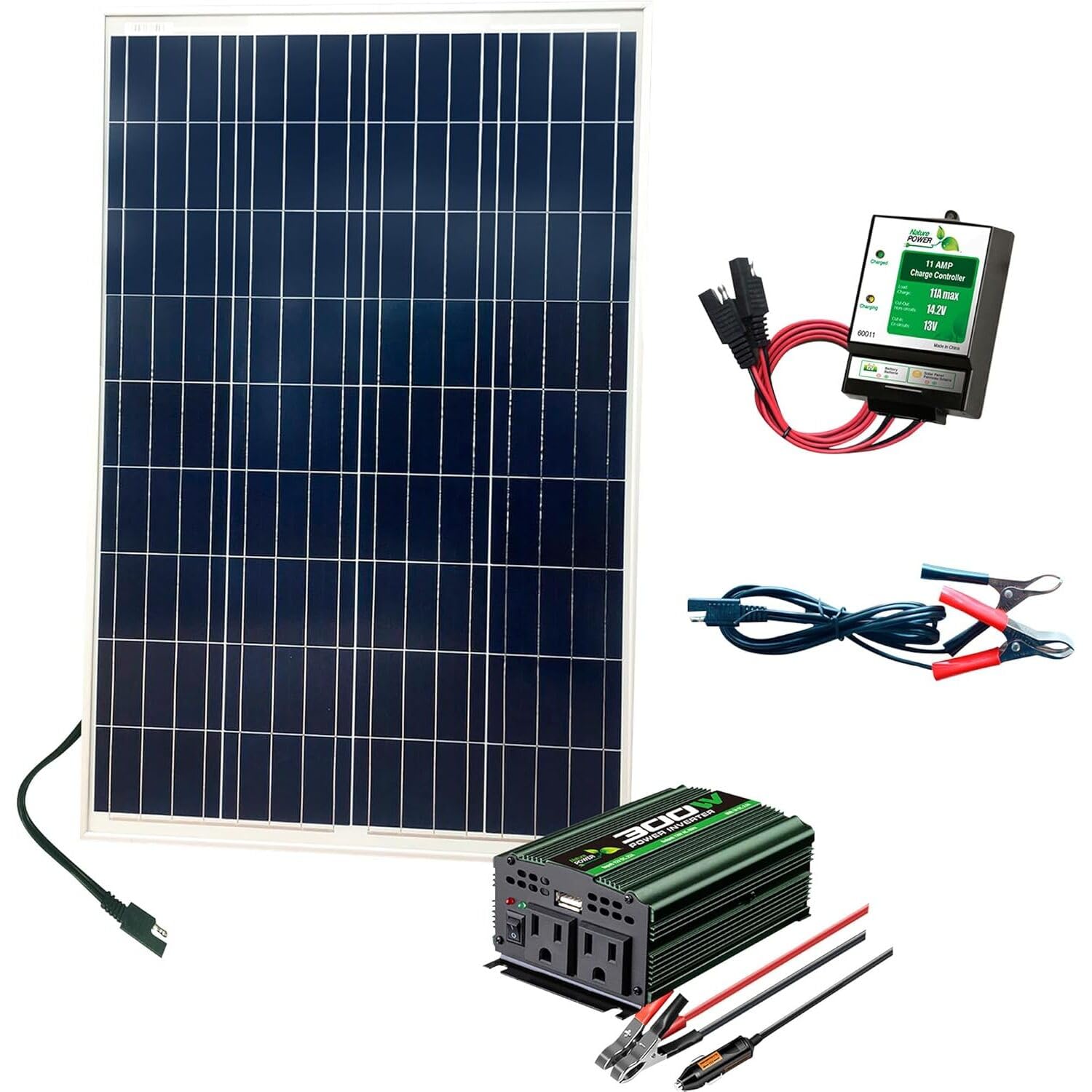
A 110W system with inverter that runs LED lights and phone chargers at camp
Technically a 110-watt panel, this kit edges past the 100W label and brings something none of the others offer: a 300W power inverter included in the box. The complete package also includes an 11A charge controller, solar kit connecting cables, wiring, and a 5V/2A USB charger. That means you can plug standard 110V devices directly into the system — a string of LED lights and phone chargers at night, all powered by the two deep-cycle batteries hooked to the panel.
The polycrystalline panel carries a strong warranty: the solar panels retain at least 80% efficiency for up to 25 years, backed by a 25-year limited warranty. Assembly is not required, and connections are plug-and-play for fast setup. At 19 lbs, it’s the heaviest kit here, but you’re getting an inverter that adds meaningful utility for campers who want real AC power without a separate generator.
Reliability is the honest mixed bag. Some buyers report flawless multi-year operation — one used a first unit for about 4 years before buying a second. Others hit problems: the alligator clips are a known weak point, one buyer found the instructions confusing for running a controller and inverter together, and another reported the 110V plug not working while USB charging did. For campers who want AC power and don’t mind occasional troubleshooting, the value is real; for set-and-forget reliability, other picks are safer.
Uniquely complete: the 300W inverter makes this the only kit that runs standard 110V appliances straight from solar.
Balance the risk: opinions split between “works great for years” and “stopped working after 7 months,” so treat it as a hands-on system.
Choose this for: base-camp setups where you want AC outlets, not just DC charging
Pass it by if: you want maximum reliability — the mixed feedback suggests you might get a lemon
Understanding the Specs
Efficiency (23% vs. 23.5%)
Efficiency tells you how much of the sunlight hitting the panel becomes electricity. A 23% panel converts 23 of every 100 units of sunlight into power. The difference between 23% and 23.5% is small on a single 100W panel — maybe a few extra watts in perfect conditions — but it matters more in low light. ETFE-coated panels (like the ZOUPW) transmit light better than PET, which is why they hold up better over years outdoors.
Charge Controller Type (PWM vs. smart)
The charge controller sits between the panel and battery, preventing overcharging and reverse current at night. PWM controllers (like the 10A on the DOKIO or 20A on the ZOUPW tempered glass kit) are simple, reliable, and fine for a single 100W panel. Smart controllers with LCD screens (like the Voltset’s 20A unit) add battery-type selection for LiFePO4, AGM, Gel, and Flooded batteries, plus USB ports for direct device charging.
FAQ
Will a 100W panel actually deliver 100W in real use?
What connector does my power station need?
Can I leave a foldable solar panel out in the rain?
Do I need a charge controller if I’m charging a power station directly?
What’s the difference between foldable and rigid solar panels?
What battery types can a 100W solar kit charge?
How long does a 100W panel take to charge a power station?
Is a flexible solar panel as good as a glass panel?
Do solar panels work on cloudy days?
What’s the difference between 100W and 110W panels?
Final Thoughts: The Verdict
For most people, the 100 watt solar panel kit winner is the ZOUPW 100W Portable because it pairs the highest efficiency (23.5%) with a 5-in-1 cable that fits nearly every power station, plus a built-in controller for direct device charging. If you want the lightest option for hiking, the FlexSolar at 4.1 lbs is a standout. And for a complete plug-and-play system with a battery included, the ExpertPower kit is the most turnkey choice — panel, 10A controller, and 21Ah gel battery all in one box.
How We Picked
We do not accept paid placement. Every pick is matched to a real buyer and a real use-case; we do not hands-on test units.
Sources & Methodology
Specifications: manufacturer listings and product documentation. Review insights: verified customer reviews, as of August 2026. Pricing: not shown on this page (it changes often); check the current price via the retailer link.
As an Amazon Associate, Non Toxic Blog earns from qualifying purchases. This does not affect which products we feature.