Specs are compiled from manufacturer listings and verified buyer reviews and can change over time — please confirm the key details on the product page before buying.
If your basement floods, you do not need a clever pump — you need one that moves the most water for the time, money, and frustration you put into it. A 1 HP sump pump is the point where motors stop being toys: real horsepower, real flow, and a discharge port big enough that water actually leaves the pit. This guide breaks down which of these eleven pumps handles a flooded basement, a pool cover, or a septic basin without leaving you ankle-deep.
I’m Mo Min — the founder and writer behind Non Toxic Blog. This guide is built by comparing the manufacturers’ published specifications and the patterns across verified customer reviews, so you get each pick’s real strengths and trade-offs instead of marketing spin.
The trick is matching flow rate (gallons per hour, or GPH) and total lift height to your actual pit depth and discharge run, because a 1 HP motor working against a 30-foot rise moves far less water than the same pump at ground level. So here is the straight talk on the 1 hp sump pump.
Our Picks at a Glance

How To Choose The Best 1 HP Sump Pump
A 1 HP pump is not automatically better than the 1/2 HP unit in your pit. Horsepower only matters when the discharge pipe can carry what the motor pushes. The pump gets hot, cycles more often, and shortens its life when a 1 HP motor is stuck behind a garden hose. Match the pump’s flow to the pipe, the pit, and the lift, and it will run for years.
Flow rate and max head are a trade-off, not separate specs
Flow rate is how many gallons per hour the pump can move — measured at the pump’s outlet, with no water rise. Max head is how high the water must be lifted before flow drops to nearly nothing. Pumps that advertise the biggest flow at zero lift lose most of it with every foot the water has to climb, so a basement with a shallow pit and short discharge run cares far more about flow than head. If your discharge line runs uphill or horizontal for a long distance, head and pipe diameter beat raw horsepower.
Discharge size and the pipe it connects to
The discharge port is the opening where water exits — a bigger opening means more water can pass without the motor fighting back. Big flow pumps tend to use wider NPT pipe, a thread standard for plumbing fittings, most commonly found in 1-1/2-inch and 2-inch. If your pit is plumbed for 1-1/2-inch PVC, a pump built for a 2-inch main will still work through an adapter but will never reach its rated flow. Every pump in this guide includes at least one adapter, so always check what the pump is designed to connect to.
Float switch design — the single most common failure point
The float switch is a buoyant float that rides the water level and tells the motor to start and stop. A tethered float swings on a cord, and if the pit is shallow it may never rise enough to trigger. An internal or caged float sits closer to the pump body and needs less water to actuate. Submersible pumps for narrow sump pits benefit most from a protected internal design, since a swinging tether is exactly what snags, tangles, or hangs on debris.
Construction — stainless steel, cast iron, or thermoplastic
Housing material drives how long the pump survives in dirty water. Cast iron and stainless steel pull heat away from the motor faster than plastic, which matters during the long runs of a flood event. Plastic housings save weight, which helps if you are carrying the pump between jobs or pulling it out of a pool by hand.
Quick Comparison
| Model | Best For | Flow Rate (GPH) | Max Head (ft) | Discharge Size | Amazon |
|---|---|---|---|---|---|
| Acquaer 1HP Submersible★ Best Overall | Flooded basements and pool draining | 4,948 | 30 | 1-1/2″ NPT + adapters | Amazon |
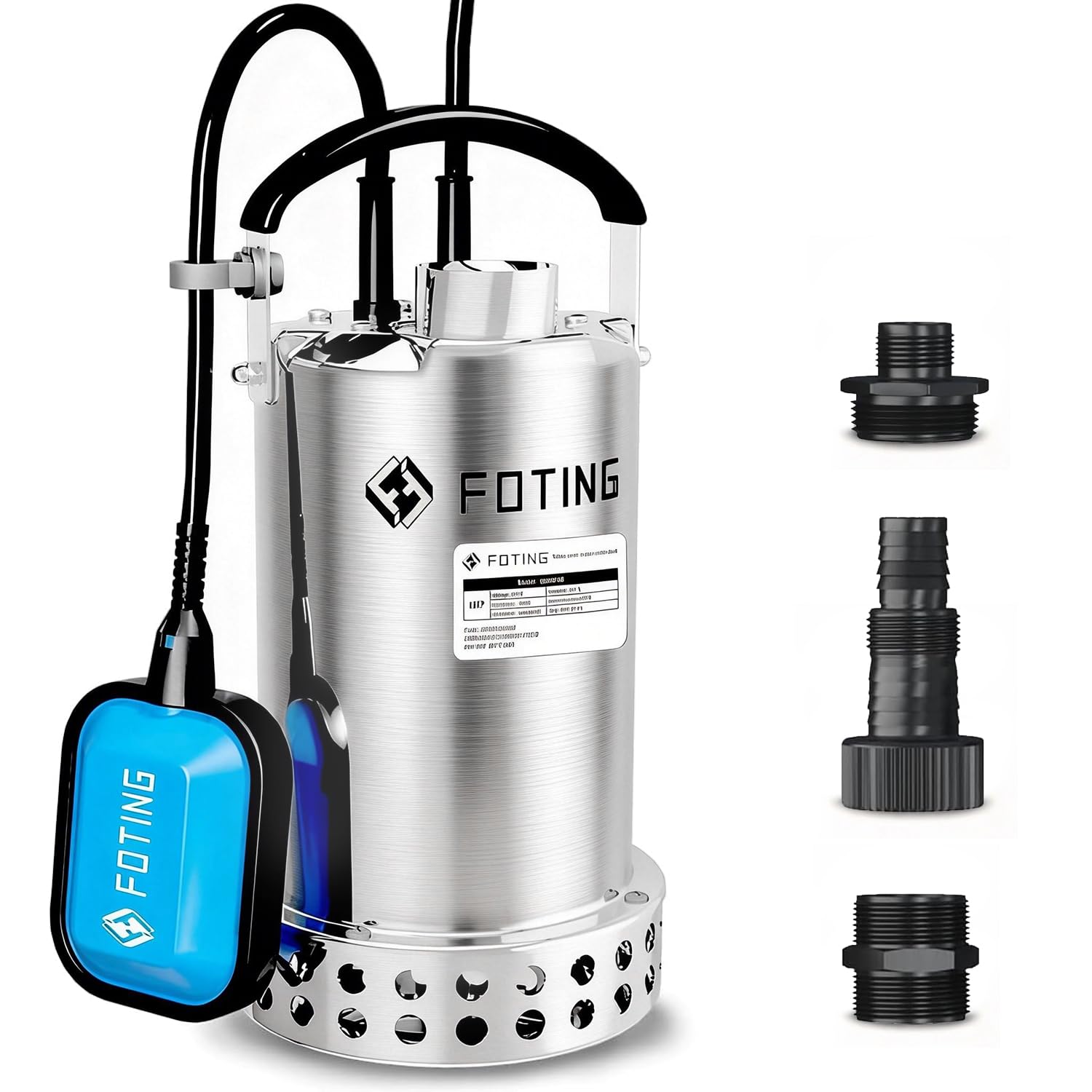
| FOTING Full 304 Stainless SteelLow-Water Specialist | Hot tubs and low-water draining | 4,600 | 32 | Multi-hose + 1-1/4″ GHT | Amazon |
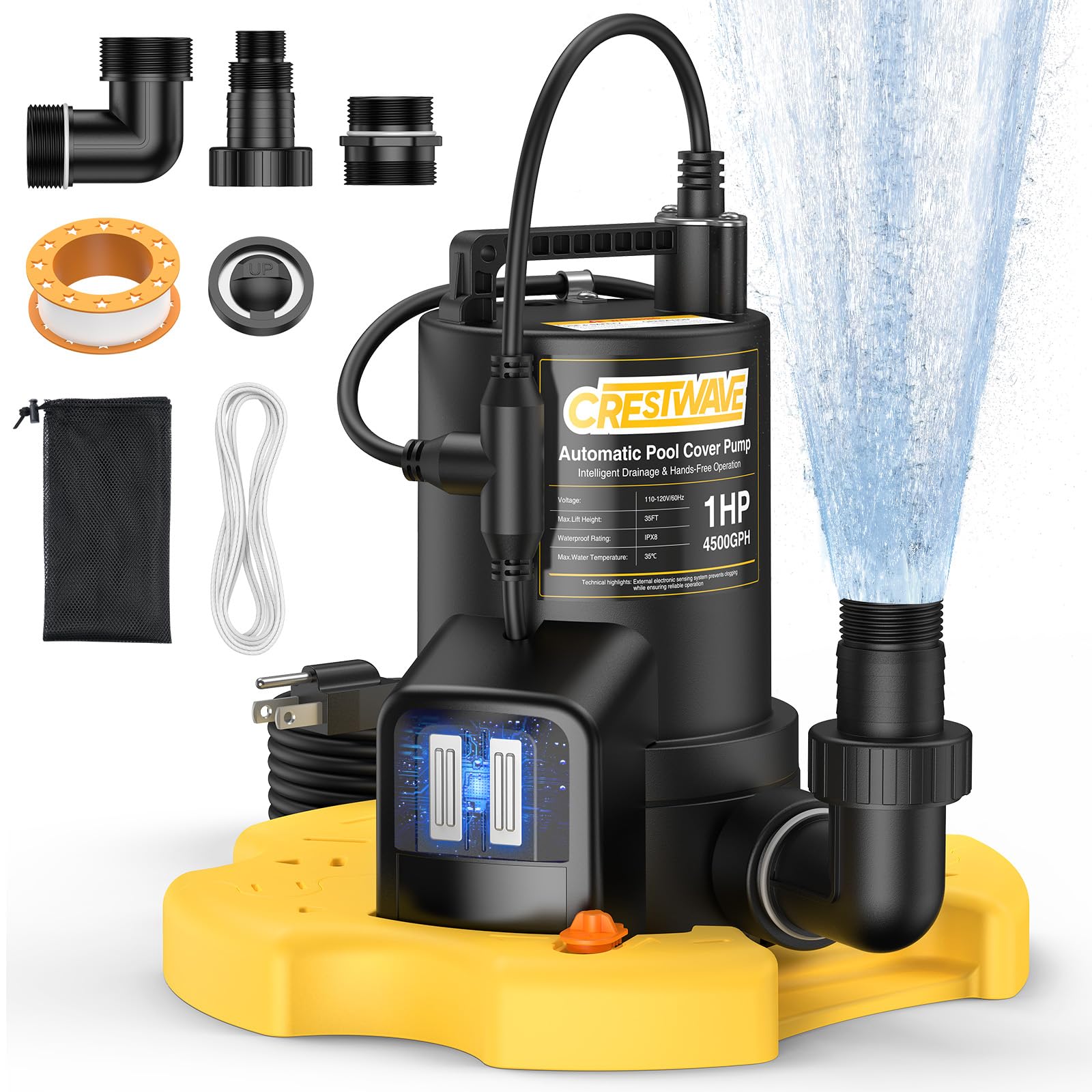
| CrestWave 1HP AutomaticSmartest Switch | Pool cover water removal | 4,500 | 30 | 1-1/4″ NPT + 3/4″ adapter | Amazon |
| Green Expert 1HP Stainless Steel | Manual drainage in tight pits | 4,000 | 32 | 1″ / 1-1/4″ / 3/4″ GHT | Amazon |
| Taskstar 1 HP Submersible | Deep basements and shallow residual water | 4,000 | 28 | 1″ / 1-1/4″ / 1-1/2″ + 3/4″ GHT | Amazon |
| FOTING 6000GPH Sewage Pump | Septic tanks and sewage wells | 6,000 | 32 | 1-1/2″ NPT | Amazon |
| LANCHEZ 6600 GPH Sewage Pump | Sewage systems and commercial dewatering | 6,600 | 27 | 2″ NPT | Amazon |
| Basement Watchdog BWSS100 | Continuous sump pit protection | 6,540 | 22 | 2″ discharge | Amazon |
| Superior Pump 92151 | Large solids and high-flow sumps | 5,160 | 10 | 2″ + 1-1/2″ NPT adapter | Amazon |
| Wayne CDU1000ET | Basement sump pit protection | 6,100 | 25 | 1-1/2″ NPT | Amazon |
| Red Lion RL-SS100T | Flood-prone effluent pumping | 5,300 | — | 2″ FNPT + 1-1/2″ adapter | Amazon |
In‑Depth Reviews
1. Acquaer 1HP Sump Pump, 4948GPH Utility Pump with Auto Float Switch
Our pick — over 4★ from 700+ verified ratings; the strongest balance of quality and price.
The highest-flow utility pump here, built to clear a flooded basement and then drain a pool.
Start with the number that fills a basement: 4,948 gallons per hour. That is real volume, and it pairs with a 30-foot max head, which is enough lift for a deep basement pit and a discharge run that climbs high. The 1 HP motor handles up to 1-1/3 inch solids without choking, which is what a storm surge full of leaves and gravel actually looks like. A 19.7-foot UL power cord gives you plenty of room to reach an outlet without an extension cord, and the pump handles immersion down to 13 feet. Compare that to the CrestWave’s 25-foot cord below and the Acquaer comes up short on that single dimension, but its extra flow more than compensates for most basement floods.
The float switch is adjustable and, handily, you can lock it upright to run the pump in manual mode — plug it in to run, unplug to stop. The discharge setup is where this pump earns points: the 1-1/2 inch NPT outlet arrives with both a 1-1/2 inch elbow and snap adapters for 3/4 inch, 1-1/4 inch, and 1 inch hose. The base plate sits high, so debris settles below the intake instead of collecting inside it. That said, the housing is reinforced engineering thermoplastic, not cast iron or stainless, so this is a pump you carry and stow rather than set and forget in a commercial pit.
Its 4,948 GPH work rate is the draw: buyers use it to dry a flooded basement before the next storm cell, and also for pool draining, hot tubs, and general water transfer. The 82.4 gpm flow rate translates directly to that draining speed. A 2-year manufacturer warranty covers it, and there is active customer service behind the brand. It earns 4.4 stars across 700+ ratings, making it the single most-reviewed pick on this list and the clearest crowd favorite for a utility pump that has to work across many jobs.
Where It Earns Its Keep
- Highest flow of any unit in this guide at 4,948 GPH, paired with a 30 ft max head, so both volume and lift are covered.
- Handles solids up to 1-1/3 inch without clogging, which means leaves and grit do not defeat it mid-flood.
- Adjustable float switch locks upright for manual operation — pull the plug to stop, plug it back in to run.
- Three discharge adapter sizes included (1-1/2″ NPT, 3/4″, 1-1/4″, 1″), so it fits most existing plumbing without a trip to the hardware store.
What To Know Before Buying
- Reinforced thermoplastic housing is lighter and more portable than cast iron or stainless, but not as resistant to long-term heavy-duty abuse.
- The 19.7 ft cord is shorter than several rivals in this guide and may need an outlet nearby for deep crawlspace runs.
- Maximum immersion depth of 13 ft means it is not built for extremely deep wells or vertical sewage columns.
Go for this if: you want one 1 HP pump that handles a flooded basement, drains a pool, and moves clean water for irrigation with maximum flow and minimal fuss.
Look past it if: you need an extra-long cord run to a distant outlet, or a cast-iron housing rated for constant industrial-duty use without ever being pulled out of the pit.
2. FOTING Full 304 Stainless Steel Sump Pump with Float Switch – 1HP 4600GPH
All-stainless inside and out, and it pumps down to almost nothing.
The best-niched pump here is the one that drains a hot tub or basin to a minimum suction level of 0.43 inches, leaving almost no residual water. It combines a 32-foot max head — the highest in this guide, ahead of the Acquaer’s 30 feet — with a 4,600 GPH flow rate that still empties a 275-gallon hot tub in about 15 minutes. The housing is integrated 304 stainless steel with better cooling than plastic during long runs, plus thermal overload protection for continuous-duty removal. Solid steel means 6 kg of actual weight, so plant your feet when you lift it out of a full basin.
The float switch handles work between a 7-inch on level and a 1-1/2 inch off level, so it does not short-cycle on a wide, shallow pool of water. And you can lock the float upright to run the pump non-stop in manual mode — useful when you want to run a pump down to its last usable drop or prevent dry-run damage. The power cord runs 16 feet, which lands between the Acquaer’s 19.7 feet and a shorter model, so plan the outlet distance. Two adapters ship in the box, a 1-1/4 inch GHT (garden hose thread, the standard outdoor spigot thread) and a multi-hose adapter, so you can hook it to whatever discharge line you already own.
Where this one splits the room is durability. The stainless construction is genuinely sturdy — that is what buyers consistently notice — but a small slice of buyers report reliability that did not hold up, and one long-term complaint describes the pump tripping a breaker after about a year of use. The installation adapters also take some fiddling: several buyers describe having to adjust or convert fittings to attach a standard PVC line. If you want the lightest, most corrosion-proof body with the deepest suction, this is the pick — just budget a few extra minutes for the connection step.
Best-suited to: pool owners, hot tub drainers, and anyone who needs water lifted from a deep pit or discharged to a high point — the 32 ft max head is the top number in this entire guide.
Plan around: the installation. Buyers praise the build but the adapters are not one-size-fits-all, and a small number of units have reported motor failures within the first year, so buy from a seller with easy returns.
The fit: pool covers, hot tubs, fountains, low-lying yards, and any drainage job where you want every last drop of standing water gone.
The mismatch: a permanent basement sump pit where you want a proven long-life motor with no installation quirks — a purpose-built sump pump may serve you better.
3. CrestWave 1HP Automatic Pool Cover Pump & Submerible Sump Pump
The one with the most cord here, and a switch that resists the classic clog.
CrestWave solves the most annoying part of owning a pool cover pump: the switch that keeps gumming up with debris. Instead of an internal sensing switch, this one uses an external sensor switch that does not depend on small holes staying clear, so the pump stays responsive through a whole fall of leaf drop. The 25-foot power cord is also the longest in this guide — 5.3 feet longer than the Acquaer’s 19.7-foot cord — so you can plug it into a standard 115V wall outlet without an extension cord. Flow tops out at 4,500 GPH with a 30-foot lift, and the quick-detach base converts it from a pool cover pump into a submersible sump pump.
The float logic is generous: the pump starts automatically once the water is 2-1/2 inches deep and shuts off when the level drops to 3/4 inch, with 30-second dry-run protection built in. That means it can sit on a pool cover and fight back melting snow and rain unattended, without you pulling it out in a storm. It is also rated to keep working at water temperatures below 35°C. If you have ever dragged a pump outside in a downpour just to unclog it, the sensor-free design here is the entire reason to buy it.
The honest trade-off is the float-base lock. A few owners mention the base mechanism does not hold tightly and the pump can tip sideways over time, and one unit arrived with a non-functioning sensor right from the start. The built-in overheat protection is a comfort here — if the motor starts to overheat, it shuts off and then restarts automatically once it cools. For a pool cover and shallow sump setup, it is a thoughtful, well-adapted piece of kit.
The buy signal: automatic 2-1/2″ on / 3/4″ off switching with 30-second dry-run guard, so you can walk away during melting snow season and let it work.
The watch-out: the detachable base can work loose and tilt the pump sideways, and the external sensor has been reported dead-on-arrival in at least one case — test it on the first fill.
Reach for this if: you have a pool cover, tarp, window well, or shallow pit that collects water automatically and you want the least possible interaction with the pump.
Consider an alternative if: you need a permanently installed basement sump pump — the quick-detach base is better suited to portable, above-ground duties.
4. Green Expert 1HP Submersible Sump Pump, 4000GPH Full 304 Stainless Steel Manual Utility Pump
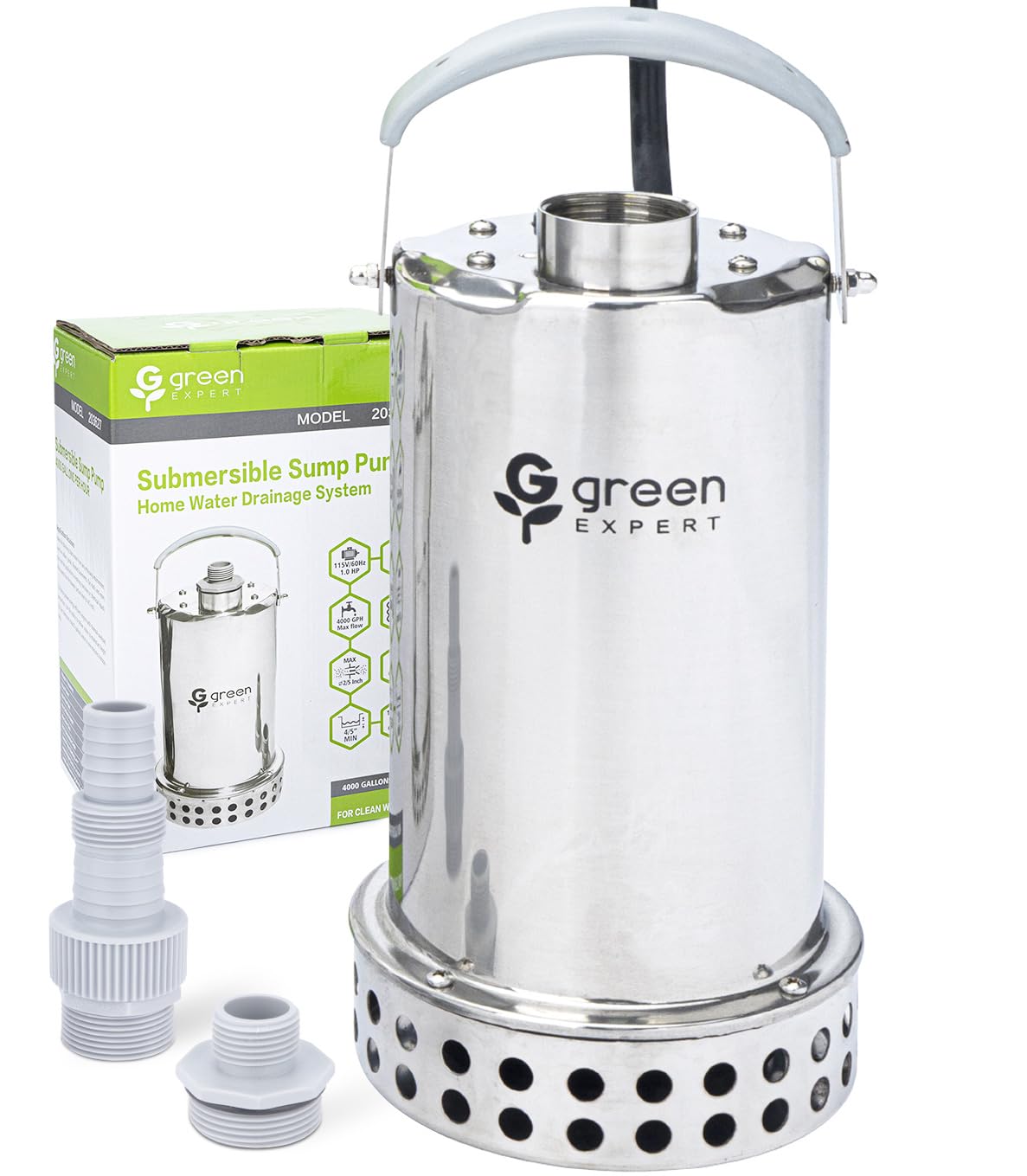
A slim stainless cylinder made to sink into pits where a fat pump will not fit.
The 6-inch cylindrical body slides down narrow wells and cramped sump pits where a wider pump gets stuck on the rim, and the top-discharge layout routes the power lead out of the way so it does not tangle on the pit wall. Flow runs 4,000 GPH with a 32-foot max head, on par with the FOTING above. The oil-free motor is the reason to pick this over a contractor-grade cast iron unit: no pump oil means nothing in the discharge water, which matters when you are moving water near a garden or a pond. It comes with a lifting rope and three adapter sizes — 1 inch and 1-1/4 inch barbed, plus 1-1/4 inch NPT and a 3/4 inch GHT.
This pump is a manual unit — no float switch, no automatic start. You plug it in, you unplug it or manage it, which makes it a supervised tool and not a year-round basement guardian. That is a deliberate design choice: manual pumps are typically simpler and less prone to the switch failures that take automatic pumps out of service. The trade-off is that a flooded basement will not pump itself overnight. If you want to set it and walk away, this is not that pump. If you want straightforward, no-sensor operation you can control by hand, it delivers.
What owners appreciate is the responsiveness — it clears a pool cover or open water fast and runs quietly. The recurring caveat is reliability: a small set of users report the motor stopping after a period of light use, and connection concerns come up too. The small cylindrical housing handles narrow pits easily, but the six-inch footprint and top-thread discharge also mean you need to match it to the pipe you already have. Buy it for supervised jobs where you are nearby, and it does exactly what you expect.
Built for: sumps and pools that need a slim body and a huge lift, where you will be standing by with the plug and want pinpoint control over each drainage round.
Small print: some units have reported early motor failures and the adapter kit is not a clean fit to every hose — inspect both when it arrives.
Works best when: you need a narrow, stainless, manual pump with a 32-foot lift for controlled draining — a flood where you are on-site and in charge.
Choose differently if: your flooding risk happens while you are away from home — an automatic float switch is functionally essential for unattended protection.
5. Taskstar 1 HP Submersible Water Pump, Auto/Manual Modes for Pool Draining
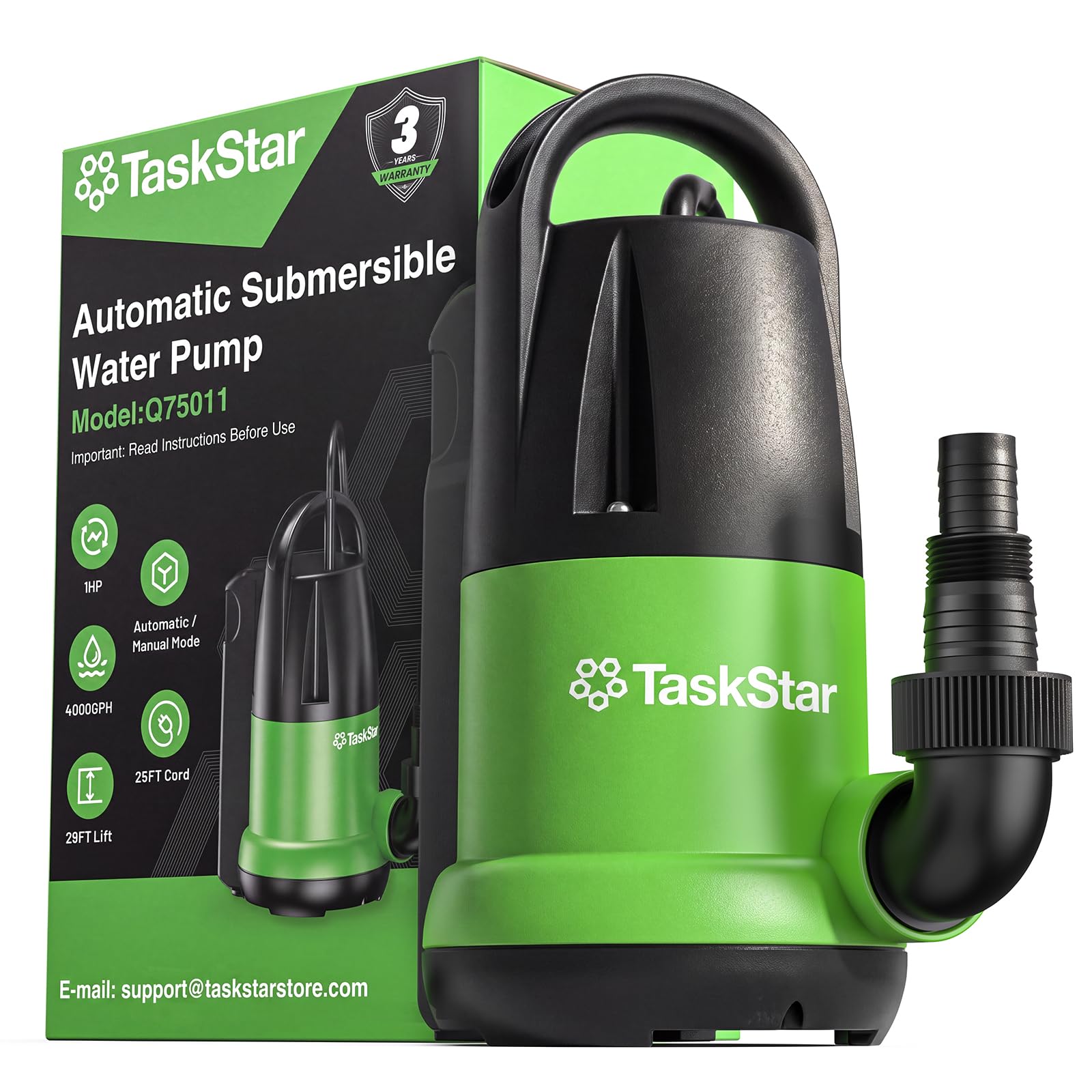
Pumps a shallow pool down to a whisper of water and starts itself.
If you have ever finished draining a job and still had half an inch of water stubbornly covering the floor, the number to look at here is 3/16 inch — that is the minimum residual depth this pump will drain down to. It also carries a 28-foot max head, more than enough for a basement pit or a flooded window well, and its float switch is built into the body rather than swinging on a tether, which is the feature that matters most in a tight sump pit where a tether catches on the sides. Flow runs 4,000 GPH. The 25-foot power cord is the second-longest here — the same length as the CrestWave — and that saves you from reaching for an extension cord in a wet basement.
Everything you need is in the box: adapters for 1 inch, 1-1/4 inch, and 1-1/2 inch NPT/barb outlets plus a 3/4 inch garden hose connector. The integrated float means it can also run in auto mode, turning itself on and off as the water rises and falls, or you can switch to manual mode for continuous draining. The motor housing is polypropylene (a tough, molded plastic), which keeps the whole pump at 10 pounds — one of the lighter 1 HP units in this guide. A 3-year manufacturer warranty backs it up, which is longer than the 2-year coverage on the Acquaer and Green Expert picks.
Customers single out the build quality first, then how quickly it plugs in and starts pumping. Real reports describe it moving 20 gallons in roughly 3 minutes and clearing a spa or a flooded pit fast. The honest snag is the included rubber hose: a common note is that it could be a few feet longer for easier reach, so if you have a long discharge run, budget your own hose. The 4.2-star profile reflects a pump that is strong for the money but still called “good for the price” rather than flawless. For pool draining and shallow residual water, it is a strong value pick.
The standout: draining to 3/16 inch of residual depth beats most pumps in this list, and the integrated float switch keeps working in a cramped pit where a tethered switch would snag.
What to expect: the stock hose runs short and the remote on the manual mode is reported to be unreliable, so plan to supply your own hose for anything beyond a short run.
Reach for this if: you drain pools, hot tubs, or shallow basins and want to get water down to almost nothing with a reliable integrated float and 25 feet of cord.
Look elsewhere if: you need a heavy-duty cast-iron pump for gritty sewage or a permanent sump with no monitoring at all — a different build in this guide is a better fit.
6. FOTING 1HP 6000GPH Sump Pump Submersible Sewage/Effluent Pump, Heavy Duty Cast Iron Septic Pump
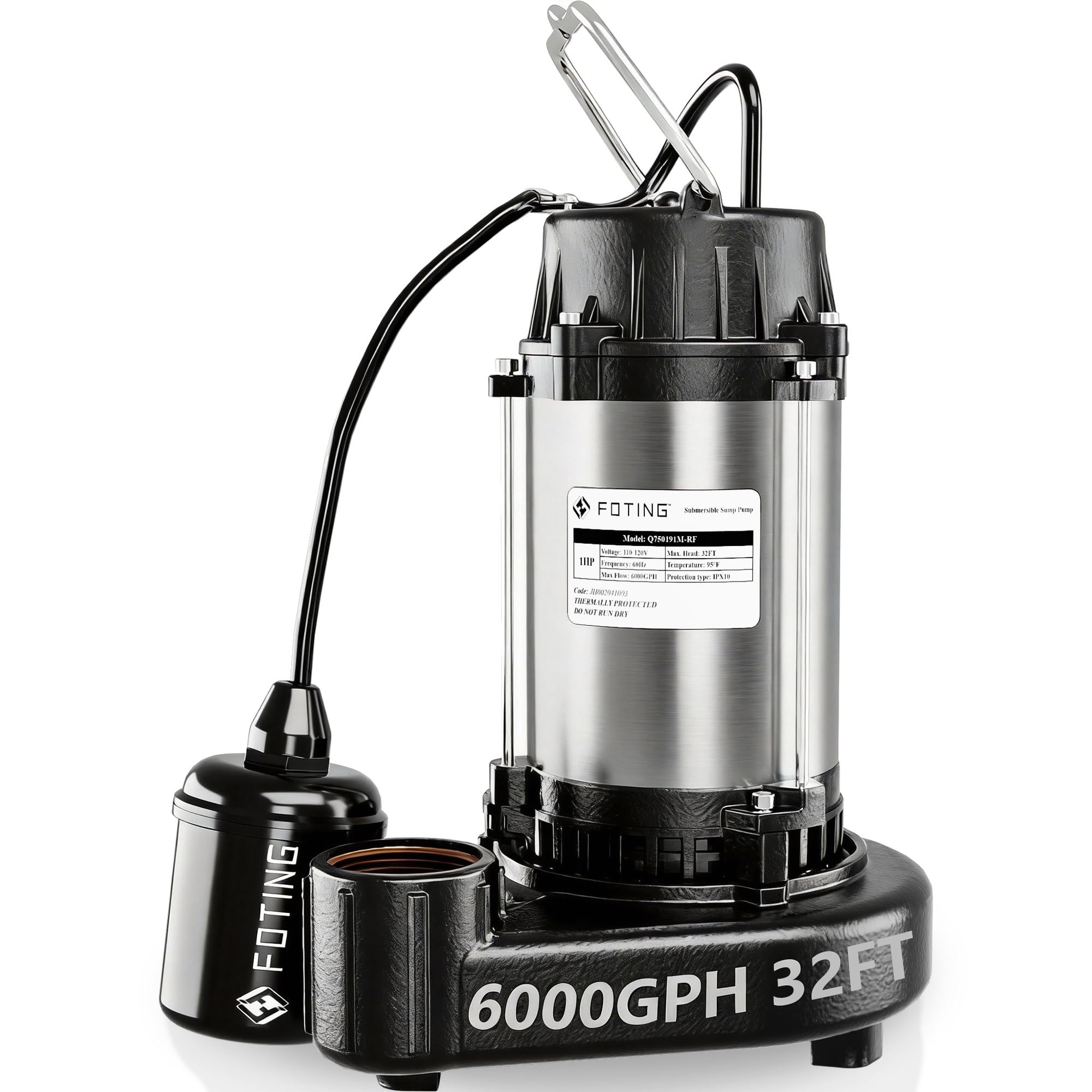
When the job is not a clean basement, this is the cast-iron unit built for the mess.
This pump is a sewage and effluent pump, not a general utility pump, and its 6,000 GPH flow and 32-foot lift are designed for the gnarly end of water removal — septic tanks, below-grade installations, and waste transfer. The casing is rugged cast iron and stainless steel with a reinforced anti-clogging design and heavy suction, which is what you need when the water carries solids a pool pump would choke on. The discharge is 1-1/2 inch NPT, a common size for basement and below-grade plumbing. A tethered float switch runs the pump automatically on water level, and the power cord runs 10 feet.
The mechanical seal and built-in thermal overload protection give it a longer service window than a plastic utility pump would have in a dirty environment. An air venting valve helps avoid air lock, so the pump does not spin dry at the top of a run. That cast-iron build has a cost beyond dollars, though: this is the heavier, more industrial pick, and you will feel it when you lower it into a tank. The 1-1/2 inch discharge is also a fixed fitting — no jump to 2 inch without an adapter, so plan your plumbing before you buy.
What this earns praise for is raw performance: an owner reported it emptying a tank in minutes, and several describe it simply as heavy duty and running well. Reliability is the honest caveat here — performance wins most of the conversation, but durability reports are split, with a minority describing a failure inside six months and difficulty reaching warranty support. For a properly sized septic or effluent job, it is a powerful, purpose-built tool; for a light-duty pool cover, it is far more pump than you need.
Strongest at: septic tanks, sewage wells, construction dewatering, and any water that carries solids — the cast-iron build and 1-1/2″ NPT discharge are made for fixed installations.
The trade-off: performance is what owners praise most here, but a minority report early failures and support difficulties, and it is too heavy and too specialized for a casual pool-drain job.
Fit for: households and light commercial settings with a septic tank, a sewage well, or below-grade waste water that needs a rugged, high-volume, automatic pump.
Wrong tool if: you need a lightweight pump to drain a pool or a hot tub — this one is designed for dirtier water and carries the weight to match.
7. LANCHEZ 1HP 6600 GPH Submersible Sewage Pump, Heavy Duty Cast Iron Effluent Pump
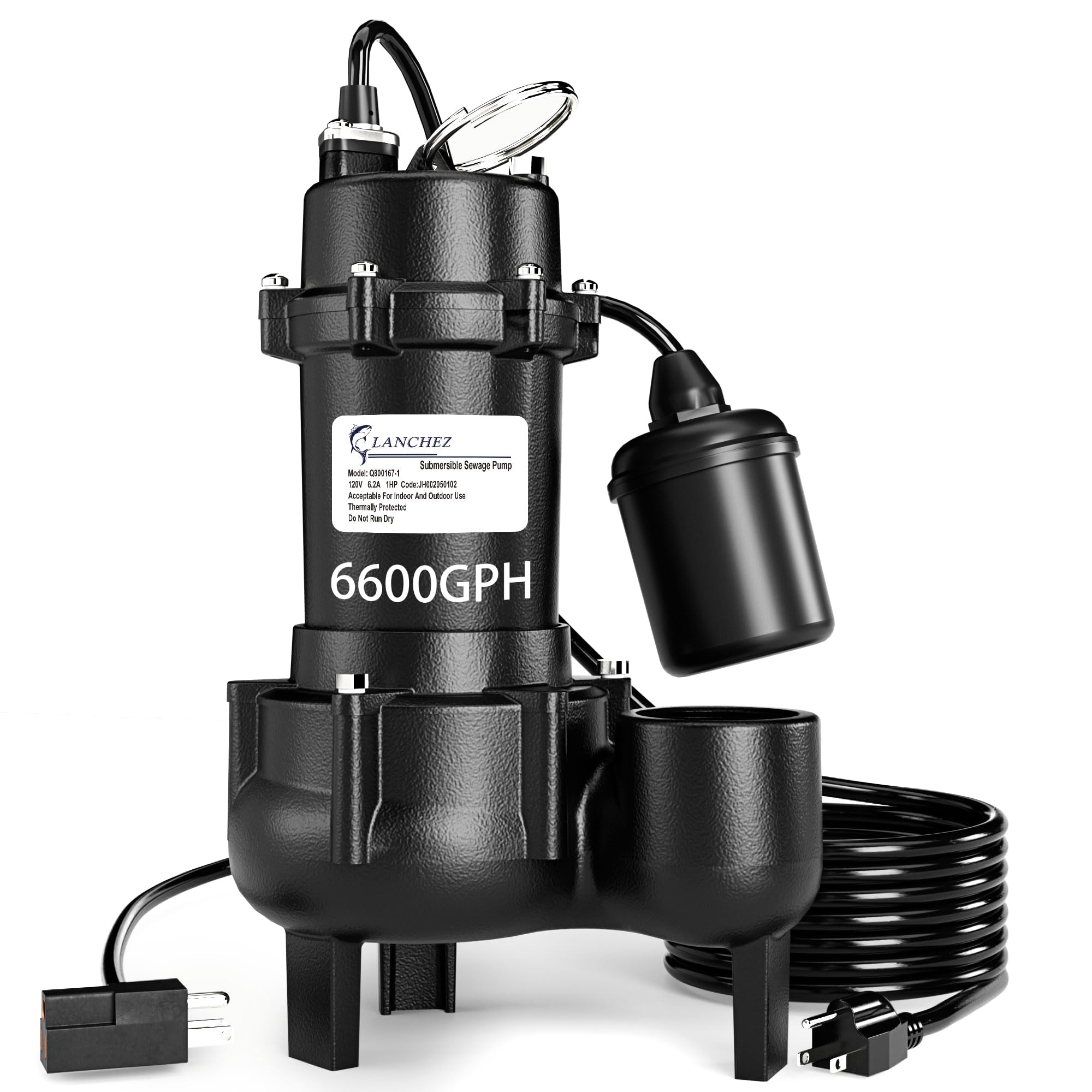
Highest flow of the entire list — and it moves water with quiet authority.
6,600 GPH is the biggest GPH number in this guide, and it holds up under real head pressure: at a 5-foot rise the LANCHEZ still pumps 5,644 GPH, so a shallow basement flood is cleared faster than anything else here can manage. It runs a 1 HP PSC copper motor (a copper-wound motor built for smoother, quieter, more efficient running) with a 27-foot lift, a 2-inch NPT discharge for high-capacity output, and a 10-foot grounded power cord with a portable handle. Cast iron throughout with thermal overload protection and an adjustable tethered float that switches the pump on and off automatically based on water level.
Quiet operation is the detail buyers notice most after raw power — this is a pump that does not announce itself from the next room. That matters in a basement sump pit right beside a finished space. The adjustable float is a real advantage in a pit with an unusual water level, because you can shorten or lengthen the tether to start at exactly the depth you want rather than a fixed factory setting. The pump can handle the flood volume from rain, snow melt, or a washing machine line burst, and the drain-from-a-duck-pond crowd loves the suction level — it pulls down to just a few inches before cavitating.
Where this needs honesty is durability. The performance category is mixed, with a share of long-term owners reporting it stopped working within a year, while others describe a full year of trouble-free heavy-duty running. The pump is also heavy with an awkward fixed handle that some find difficult to grip, and the unit can tip over when submerged due to the motor spin. Ensure the tethered float is fully vertical or the auto-start will not trigger. The 2-inch discharge is also a fixed fitting — no reduction to 1-1/2 inch without an adapter, so confirm your pit is set up for the wide pipe.
What makes it work: 6,600 GPH at zero lift, still 5,644 GPH at 5 feet, and a 2″ NPT discharge to move heavy sewage and effluent fast — with quiet operation that keeps a finished basement calm.
Before you buy: it is heavy, the handle is awkward for some, and the wide 2″ discharge will not fit every pre-plumbed sump without an adapter.
Best for: households with a sewage basin or high-volume dewatering job who want the highest flow in the guide and quiet operation from a fixed cast-iron install.
Skip the fit if: your pit uses a standard 1-1/2″ pipe and you do not want the extra step of an adapter — a 1-1/2″ discharge pump is the cleaner match.
8. The Basement Watchdog Cast-Iron/Stainless-Steel 1 HP Submersible Sump Pump (BWSS100)

A sump pit specialist built around one job: keeping the floor dry through a storm.
Here is a pump designed around continuous sump pit duty rather than portable draining. At zero lift it moves 6,540 GPH, and it still pushes 4,440 GPH at 10-foot lift, which is real sustained flow for a pit that fills fast. The 1 HP, 6.3-amp permanent split-capacitor motor (a motor design built to keep pumping without stalling under load) is paired with a 2-inch discharge for maximum output. The housing is cast iron and stainless steel for durability in a wet pit. Most notably, this is the only pick in this guide with a caged dual float switch and controller included, which gives you a redundant switch designed to keep triggering even if one float snags.
That caged double-float design is the defining purchase reason: on a conventional sump pit, the float switch is usually the first thing to fail, and a second protected float is insurance against the pit overflowing while you are at work. The pump is heavy — 36 pounds — which is a lot of mass to lower into a pit, but that weight also holds it steady on the floor of the basin with no chance of it drifting. The trade-off is that 2-inch discharge requirement: you need 2-inch PVC output, which not every home already has. If your existing plumbing runs 1-1/2 inch, adding the adapter is an extra installation step.
Buyers describe the drainage sound as a toilet flushing, and it kept up through days of heavy rain. It runs on a 2-inch discharge and moves water fast. As a fixed install with dual-float protection it is the safest choice for anyone who wants a permanent pit guardian rather than a pump they carry from job to job.
Why it earns the premium: 6,540 GPH at zero lift and 4,440 GPH at 10-foot lift, plus a caged dual float switch and controller for double protection — a much stronger fit for a permanent sump pit than a portable pump.
One consideration: 36 pounds of cast iron and a 2-inch discharge requirement — you either already have 2-inch PVC or you are adding an adapter on install day.
Made for: homeowners who want a permanent, automated basement-pit pump with redundant float protection and do not mind a heavy cast-iron install.
Not the one if: you need a light, portable pump to carry between the pool, the garden, and the basement — this is a set-and-leave sump specialist.
9. Superior Pump 92151 1 HP Cast Iron Sump Pump Side Discharge with Vertical Float Switch

A cast-iron workhorse that swallows half-inch debris without slowing down.
Most sump pumps choke on anything larger than a pebble. This one handles up to 1/2 inch solids, which is the biggest debris tolerance in this guide, and that matters when your pit or drainage canal collects grit along with the water. It moves 5,160 GPH with a 2-inch discharge for high-capacity output, and a rugged stainless steel and cast iron build with a continuous-duty, thermally protected split-capacitor motor that is made to run without overheating. The vertical float switch is a different design from a swinging tether — it rises straight up on a rod, so it needs less horizontal room in the pit and is less likely to snag.
The vertical float is the pick’s most underrated detail. In a narrow sump basin where a tethered float rests against the wall and never fully swings, a vertical float still actuates cleanly. The side-discharge layout also lets the pump sit lower in a tight pit, so it starts pumping at a lower water level. It is a heavier pump at 17.7 pounds, and the included 10-foot power cord with piggy-back plug and 1-1/2 inch NPT adapter covers most standard installs. Note the max lifting height is a published 10 feet on this pump, which is lower than the others in this guide — check your discharge run before committing.
Extended-use customers note it shooting water 70+ feet to the street, running quieter than older pumps, and passing 1/2-inch sediment without clogging. The honest caveat is that the quality and value categories split buyers — some consider the construction solid, while a smaller group reported the pump shutting down after only a few minutes of run time. That is the classic trade-off of a high-headroom motor in a consumer price band. Buy it if it fits your pit depth (10-foot lift ceiling) and your water carries solids; check the return policy either way.
Its niche: 1/2″ solids handling and a vertical float for narrow pits with debris-laden water — a real advantage over tether-float pumps in tight, gritty conditions.
Mind the ceiling: its 10-foot max lifting height is the lowest in this guide, and a minority of buyers reported early shutdowns, so match the pump to your actual discharge run before buying.
The right call when: your pit is narrow, your water carries small debris, and 10 feet of lift covers your discharge path — a solid cast-iron step up from a plastic utility pump.
Look onward if: you need more than 10 feet of lift or want a pump for very sandy water — a higher-lift pick in this guide will outlast the mismatch.
10. Wayne 1 HP Heavy Duty Submerisble Cast Iron and Stainless Steel Sump Pump (CDU1000ET)
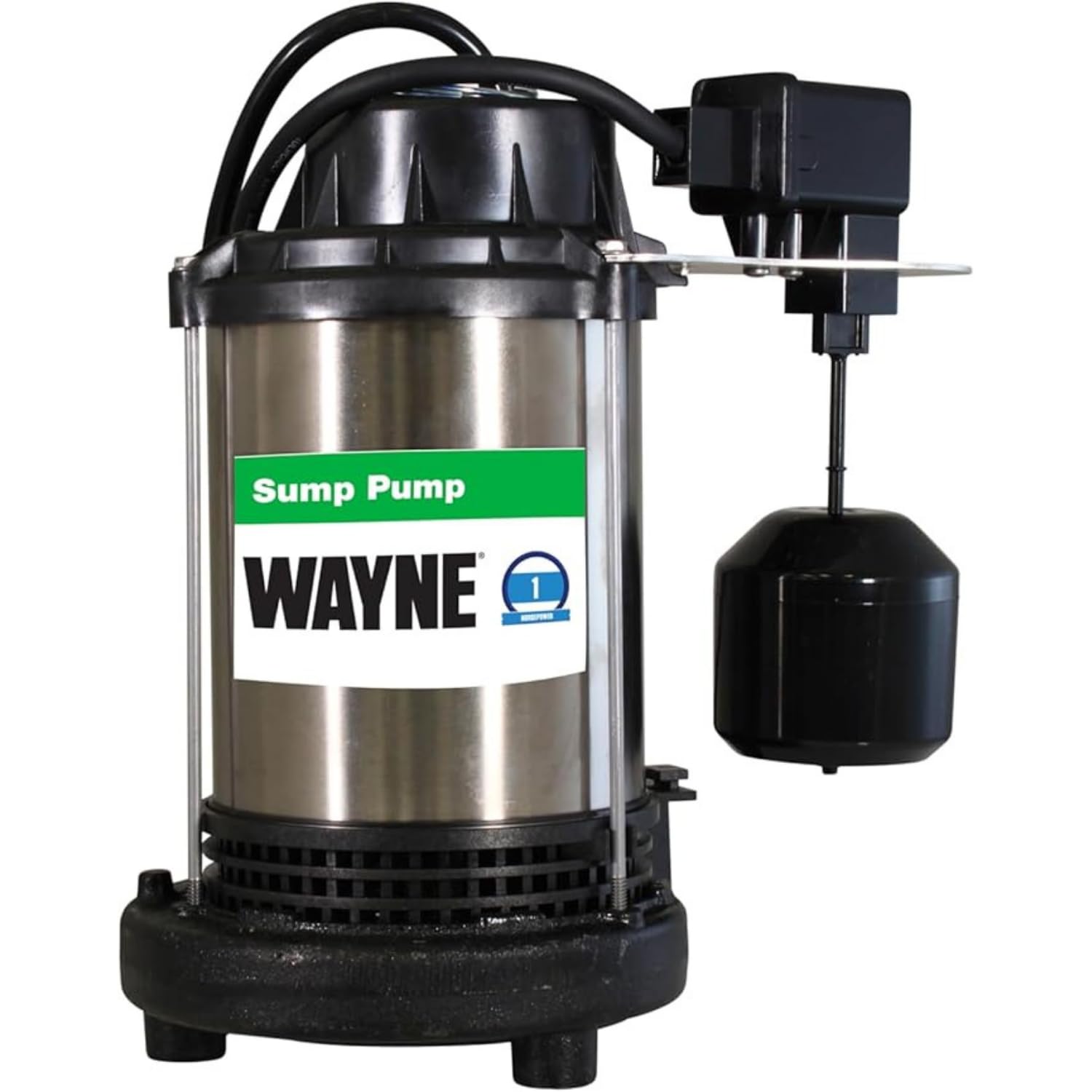
Tested to over 1 million cycles and backed by a 5-year limited warranty — if your pit fits it.
The headline here is not flow, it is cycle count: this pump is tested to run over 1 million cycles, which is a claim about how long the motor and switch are built to last, and the 5-year limited warranty is the longest coverage from a name-brand pump in this guide. Flow reaches 6,100 GPH, which puts it near the top of the pack in this guide. The housing is corrosion-resistant stainless steel with a cast-iron volute (the spiral casing that channels water out of the impeller), and the top-suction design reduces clogging from debris sitting at the bottom of the pit. The 1-1/2 inch NPT discharge is code-friendly for a standard basement setup.
Wayne’s build detail note is the pump’s design for a wider sump basin: it needs a sump of about 11 inches in diameter or larger, and it operates on a 9-inch on and 4-inch off water level. That is a wide pit, so this is the pick for a dedicated, properly sized basement sump rather than a tight retrofit. Installation is described as straightforward — many reviewers point out no need to drill a weep hole, and the pump installs quickly with a standard discharge line. It is indoor-only, so pair it with your basement pit and not an outdoor pool-cover duty.
Owners who buy this brand often do so because their last one ran for two decades.
Quiet operation is what buyers consistently flag — several describe it as the quietest sump pump they have owned, which matters in a basement beside bedrooms or finished space. The magnetic switch design is also reported to need less frequent replacement than a traditional mechanical float. What makes this a premium pick is the build quality and the low noise together, since you can install it and largely forget it is there. The clean trade-off is the pit requirement: if your existing basin is smaller than the 11-inch minimum or you need a portable pump to carry between jobs, this is not the right fit. But for a permanent basement installation where reliability and quiet matter most, it is the strongest long-cycle performer in this guide.
Why it costs more: over 1 million cycles tested, a 5-year limited warranty, and ultra-quiet operation — this is a pump bought for a decade of unattended basement duty, not a seasonal drain job.
The fine print: it needs a sump basin 11 inches or wider and is rated for indoor use only, so it will not fit a tight pit or handle outdoor pool-cover draining.
Worth it for: a proper basement sump basin where you want the longest-warranty, quietest, longest-cycle pump that money can buy, installed once and left to run.
Pass on it if: your pit is narrower than 11 inches or you need a pump that travels between the pool, the garden, and the drain — a portable pick serves you better.
11. Red Lion RL-SS100T, 115V, 1 HP, 5300 GPH Automatic Sump/Effluent Pump

Stainless and cast iron, built for yards and ditches that flood every spring.
This is the pump for the driveway that turns into a river, the yard sump that fills after every big rain, and the outdoor catch basin that keeps your crawlspace dry. It is a premium stainless steel and cast iron unit designed for aggressive water conditions, moving up to 5,300 GPH. The pump handles 3/4-inch semi-solids, so it clears grit and small debris that would clog a clean-water pump. A 2-inch FNPT discharge with an included 1-1/2-inch FNPT adapter gives you flexibility to connect to whatever drainage pipe you already have. The tethered float switch is a piggy-back style, which lets you override to manual mode for testing or emergency draining. It runs on 115 volts and draws 8 amps, and the 20-foot cord gives you reach to a nearby outlet.
The material choice explains the cost: cast iron and stainless steel resist the abrasion and corrosion of dirty outdoor water far better than plastic, and that matters when the pump sits in a muddy basin for months at a time. Red Lion’s 5-year warranty covers the motor, similar to the Wayne above. The tethered piggy-back float is a smart design — if the tether jams on the wall of a shallow catch basin, you can lock it out and run the pump manually instead of buying a replacement. One homeowner built a larger capped catch basin fed by a smaller grated basin to keep debris off the float and reduce freezing, which is a genuinely useful deployment tip for outdoor use.
Owners call it powerful and quiet, with enough flow to clear a major basement flooding event. It is note, though, that the pump needs a dedicated 20-amp circuit — this is a real amperage draw (8 amps continuous) that will trip shared circuits if you put it on an already-loaded line. There is also a minority report of a pump failing after a few months, so inspect the O-ring and impeller when the unit arrives and consider a spare for peak flood season. For a purpose-built outdoor sump where you want a beefy metal pump and a 5-year warranty, this is a strong final pick.
Its strongest suit: a stainless-steel and cast-iron body, 3/4″ solids handling, and 5,300 GPH in a pump meant for the outdoor sumps and catch basins that see the worst water in the yard.
Power and pitfalls: it draws 8 amps and needs its own 20A circuit, and a minority of units have failed within the first months — check the O-ring and impeller on arrival.
Reach for this if: you have an outdoor sump, a yard catch basin, or a driveway that floods and you want a metal-bodied, high-solid-tolerance pump with a 5-year warranty behind it.
The mismatch: a small indoor pit or an unpowered circuit — this pump wants a dedicated 20A outlet and enough room to house a 31.6-pound cast-iron unit.
Understanding the Specs
Flow Rate (GPH) and Why It Is Not a Straight Number
Flow rate is how many gallons of water a pump moves per hour — measured at zero lift, with the discharge port wide open and the pump sitting in a shallow bucket. It is the number that tells you how fast a flood disappears, but it only holds true at that zero-height condition. Every foot the water has to climb eats into the flow, which is why a 4,948 GPH rating and a 6,600 GPH rating can move very similar volumes once both are pushing water up a 10-foot basement wall. When you are comparing pumps, ask what the flow is at your actual lift height, not at zero. If you cannot find that figure, pick a pump with more headroom than your pit requires.
Max Head and Discharge Size: Reading the Two Together
Max head is the tallest column of water a pump can lift before the flow drops to zero — the absolute ceiling on the pump’s performance. If your discharge line rises more than the pump’s max head, the pump will strain and cycle without ever moving the flood. Discharge size controls whether the motor can push that flow: a 2-inch NPT thread (a standard pipe thread used for plumbing fittings) moves more water per hour than a 1-1/2 inch thread, which moves more than a 1-inch thread, at the same pressure. A 6,000 GPH motor behind a 1-inch garden hose will never hit its rating — the pipe becomes the bottleneck. Match the discharge to the flow and head, and the pump runs easy.
FAQ
What size discharge pipe do I need for a 1 HP sump pump?
How long does a 1 HP sump pump last?
Is a 1 HP sump pump too big for a typical basement?
What is the difference between a tethered float switch and a vertical float switch?
Can I use a 1 HP sump pump to drain a swimming pool?
Do I need a check valve on a sump pump discharge line?
How deep can a 1 HP submersible pump be submerged?
Will a 1 HP sump pump handle dirty water with small debris?
Can I run a 1 HP sump pump on a standard household outlet?
Does a 1 HP sump pump need an extension cord?
Final Thoughts: The Verdict
For most homes dealing with a flooded basement or seasonal water removal, the top pick is the Acquaer 1HP Sump Pump — it moves the most water of any utility pump here at 4,948 GPH with a 30-foot lift, handles solids up to 1-1/3 inch, and carries the 19.7-foot cord and three adapter sizes that make setup painless. It also holds the highest rating of the mid-range picks and the most owner experience behind it, so it is the safest buy for the widest range of jobs. If cast-iron durability in a permanent sump pit is your priority, the Wayne CDU1000ET is the long-cycle champion with a 5-year limited warranty behind it. And if you want maximum flow with the option of an outdoor catch basin or yard sump, the LANCHEZ 6600 GPH Sewage Pump delivers the highest rated output in this guide at 6,600 GPH with 5,644 GPH still available at 5-foot lift. The through-line across all eleven: match the pump’s head to your pit depth, its flow to your discharge pipe, and its float design to the width of the basin you are pumping from.
How We Picked
We do not accept paid placement. Every pick is matched to a real buyer and a real use-case; we do not hands-on test units.
Sources & Methodology
Specifications: manufacturer listings and product documentation. Review insights: verified customer reviews, as of September 2026. Pricing: not shown on this page (it changes often); check the current price via the retailer link.
As an Amazon Associate, Non Toxic Blog earns from qualifying purchases. This does not affect which products we feature.