Specs are compiled from manufacturer listings and verified buyer reviews and can change over time — please confirm the key details on the product page before buying.
If you are hunting for the best 1/4 inch copper pipe, the short answer is this: the BELLA BAYS 25-foot coil is the pick most buyers should start with. It is a smooth soft coil rated to the ASTM-B280 refrigeration standard (a manufacturing spec for tubing made to carry refrigerant), so you know the tube was built for refrigerant and HVAC work rather than general plumbing. Everything else on this list is a variation on the same idea — different lengths, different wall thickness, different price tiers — and your real decision depends on how many feet you need and whether the job involves refrigerant, water, or a craft bench.
I’m Mo Min — the founder and writer behind Non Toxic Blog. This guide is built by comparing the manufacturers’ published specifications and the patterns across verified customer reviews, so you get each pick’s real strengths and trade-offs instead of marketing spin.
Whether you are feeding an ice maker, flaring a line set, or building something on a workbench, these seven 1/4-inch copper coils cover the jobs worth buying for. It spells out the outside and inside diameters, wall thickness, and lengths so you can match a coil to your job without guessing.
Our Picks at a Glance


How To Choose The Best 1/4 Inch Copper Pipe
A 1/4 inch coil is a small purchase with a very specific job, and the wrong one wastes a weekend. The tube you buy has to match your fitting, survive the bend you put it through, and hold up to whatever is flowing inside it. Here are the four things that actually decide which coil you walk away with.
Match the OD and ID to your fitting, not just the label
Every coil here is 1/4 inch outside diameter — that is the measurement across the outside of the tube, and it is what your flare nut or compression ferrule grips. But the inside diameter is a separate number. The BELLA BAYS and GOORY coils both list a 0.195-inch ID, while the ELECTRAPICK coil lists a 3/16-inch ID with a 0.195-inch figure in its own item name. Check which one your application calls for before you order, because a 0.195-inch ID flows differently than a 3/16-inch ID.
Wall thickness decides whether the bend holds or kinks
Wall thickness is measured in thousandths of an inch, and it is the single biggest factor in how a coil behaves in your hands. A 0.028in wall — the figure on the BELLA BAYS and GOORY coils — is thin enough to bend by hand but thin enough that you must bend carefully. The ICS Industries 100-foot coil lists a 0.03-inch wall, a hair thicker. Every one of these tubes wants a proper tubing bender for tight radii; hand-bending works best over a large radius like a welding tank.
Know whether your job needs ASTM-B280 or utility grade
The ASTM-B280 standard is the specification written for air conditioning and refrigeration (ACR) tubing — the kind that carries refrigerant under pressure. The BELLA BAYS, GOORY, and ICS coils all carry that rating. The Mueller boxed coil is sold as utility grade for general plumbing, which is the right call for an ice maker feed or a water supply line, and it works with sweat, brass, compression, or flare fittings. Buying ACR tubing for a water line is not wrong, just more spec than the job needs.
Weigh length against how many joints you want to braze
Every joint you add is a potential leak point, so a longer continuous coil means fewer fittings in the run. Lengths here run from 10 feet up to 100 feet. A short coil suits a repair where you are replacing a foot or two of existing line. A long continuous coil suits a full line set where you would rather route one tube than splice three.
Quick Comparison
| Model | Best For | Length | Outside Diameter | Wall Thickness | Amazon |
|---|---|---|---|---|---|
| BELLA BAYS Copper Tubing 1/4″ OD x 0.195″ ID x 25 ft★ Best Overall | All-round HVAC and appliance work | 25 ft | 0.25 inches | 0.028in / 0.7mm | Amazon |
| ICS Industries 50 Foot CoilLongest Run | Longer HVAC line sets | 50 ft | 0.25 inches | — | Amazon |
| Copper Tubing 1/4″ OD x 0.195″ ID x 25Ft (ELECTRAPICK) | DIY and craft projects | 25 ft | 0.25 inches | 0.8 mm | Amazon |
| GOORY Copper Tubing 1/4″ OD x 0.195″ ID x 25 FT | Budget ACR runs and repairs | 25 ft | 0.25 inches | 0.028 inch / 0.7mm | Amazon |
| ICS Industries 100 FT Coil | Full line sets with no splices | 100 ft | — | 0.03 inches | Amazon |
| MUELLER INDUSTRIES GIDDS-203306 Boxed | Plumbing, ice maker, fridge water lines | 25 ft | 0.25 inches | — | Amazon |
| Mueller Industries D04010P 10 ft | Small repairs and craft work | 10 ft | 0.25 inches | — | Amazon |
In‑Depth Reviews
1. BELLA BAYS Copper Tubing 1/4″ OD x 0.195″ ID x 25 ft
Our pick — over 4.5★ from 500+ verified ratings; the strongest balance of quality and price.
A refrigeration-grade coil that lands at the thickness most home jobs actually want
The number to lead with here is 0.028in — the wall thickness, roughly seven-tenths of a millimeter. That wall is thin enough that you can shape a 25-foot run by hand and thick enough that a careful bend holds its curve instead of collapsing. The tube itself is UNS C12200 copper, which is the pure 99.9%-plus grade named in this coil’s own spec sheet, and the whole thing is built to the ASTM-B280 refrigeration standard. If your work touches a refrigerator, freezer, or air conditioning line, you are buying the right category of tube.
What wins people over is how cleanly it installs. The dominant theme across owner feedback is simple functionality — the coil does the job it was bought to do, with no drama at the fitting. Buyers report, as one put it, “Installed the tubing with no leaks and no problems.” The same coil has found a home in everything from a swamp cooler repair to a hydraulic line fix, which tells you the 1/4-inch OD (outside diameter, the measurement across the tube) fits a wider range of fittings than its refrigeration label suggests. It comes nitrogen-charged, a treatment that purges impurities and condensation from inside the tube so the copper resists oxidation over time.
The honest catch is the wall itself. Thin copper rewards patience — the recurring note from people who have bent this coil is that you need a proper bender for tight turns, because the tube was not built to be manhandled around a sharp corner. An occasional coil shows minor dents on arrival, a shipping reality for any soft copper in a box. And note the OD versus ID gap: this is a 1/4-inch outside diameter with a 0.195-inch inside diameter, so measure your fitting before you assume it matches an old line. The GOORY coil a few picks down shares that same 0.195-inch ID and sells for less, but it carries a lower rating and mixed durability feedback — the BELLA BAYS is the one that keeps its record clean.
Where this coil earns its keep
- ASTM-B280 refrigeration rating, so it is built for refrigerant and HVAC work, not just general plumbing
- 0.028in wall thickness at a 1/4-inch OD — thin enough to hand-shape, thick enough to hold a bend when you work it slowly
- Nitrogen-charged treatment keeps the interior clean and resists oxidation
- Functional, leak-free installs are the standout pattern in owner feedback
What to plan around
- Thin walls mean a tubing bender is not optional for tight radii — hand-bending works best over a large radius
- A few coils arrive with minor surface dents from shipping
- The 0.195-inch inside diameter will not match every old 1/4-inch line you are replacing
Grab this one when: your job involves a fridge, freezer, cooler, or ACR line and you want the standard-grade copper without upsizing to a 50-foot coil.
Rethink it if: you need to route more than 25 feet in one continuous piece — the ICS 100-foot coil is the answer there.
2. ICS Industries 1/4″ Outer Diameter smooth Copper Refrigeration ACR Tubing – 50 Foot Coil
Twice the copper of the standard coil, still short enough to store on a shelf
When the run is long enough that splicing would mean three or four extra joints, this is the pick. The headline is the length: one continuous 50-foot coil of 1/4-inch outside diameter smooth soft copper, rated for air conditioning and refrigeration use and weighing 4 pounds on the spool. Fewer joints means fewer places for refrigerant to leak, which is the whole argument for buying a single long coil instead of two short ones. It is soft-annealed (heated and cooled to make the metal bendable), so it hand-bends and flares without much fight.
Fitters come back to this supplier for its clean, capped coils. Delivered clean, with no dents and no oxidised interior, is the pattern — ends arrive separately capped and the coils are not contaminated. Owners have put this exact tube to work in places beyond its label, including a natural gas line running post-regulator, and it has held up to brazing onto an evaporator and condenser without complaint. Where the BELLA BAYS is your general-purpose 25-footer, this ICS coil is the one you buy when the routing distance itself is the problem.
Here is the trade-off to plan for. The wall runs thin, and thin walls demand respect at the bender — the safest approach for a tight radius is a proper tubing bender worked slowly, which is exactly how careful owners handle it. Also know that this coil lists a master dimension in the data that will not translate to a physical 1-inch tube; the working figure that matters is the 1/4-inch outside diameter printed on the label, which matches standard flare and compression fittings.
Length against joints: one 50-foot run replaces several spliced lengths, and each splice you skip is a leak point you never have to chase.
The bend discipline: thin-wall ACR copper likes large-radius bends or a slow pass through a bender — rush it and the tube will kink at the fitting.
Reach for this if: you are roughing in a refrigeration or HVAC line set and want the fewest possible braze joints.
Look elsewhere if: your job is a two-foot ice maker patch — a 50-foot coil is a lot of copper to unwind for that.
3. Copper Tubing 1/4″ OD x 0.195″ ID x 25Ft, T2 Pure Copper Tubes Soft Coil (ELECTRAPICK)

A 25-footer aimed at hands that are shaping, not plumbing
This one is made of C12200 copper and sold under the ELECTRAPICK name in a 25-foot soft coil, with a 0.8mm wall and a 1/4-inch outside diameter paired to a 3/16-inch inside diameter. The spec sheet describes it doing double duty: refrigeration and HVAC on one side, and jewelry, crafts, architectural models, and frames on the other. That second use is where it shines for a buyer who is not a contractor. Cut it, bend it, flare it, shape it into something — the coil is forgiving enough for bench work.
Owners using it for craft and custom jobs are the most enthusiastic. A fuel line build comes up in the feedback, and so does straight-up craft and design work, with people describing it as good quality at a fair price and exactly the size and bend-ability they were after. Where the ICS 50-foot coil is a job-site purchase, this is the one that earns its place on a hobbyist’s shelf.
The caveat is wall consistency. With a 0.8mm wall, this coil wants a gentle touch at the bender and rewards the same bend discipline every thin-wall tube on this list demands. It is also the shortest-serving of the 25-foot group in terms of refrigeration reputation — if you are charging a real refrigerant system, the rated BELLA BAYS or GOORY coils are the more standard-matched call. For craft work, repair, and small custom runs, though, the trade-off is easy to accept.
Right tool, right job: buy this for shaping and short custom runs where the finish of the copper matters more than the pressure rating.
Know its limit: this is not the coil to charge an operating refrigerant system with — for that, pick the ASTM-B280-rated options higher on this list.
Suits you if: you are cutting, bending, and shaping copper for a project that is not a pressure line.
skip it if: your run is going onto a live HVAC or fridge system and you want the appliance-rated spec on paper.
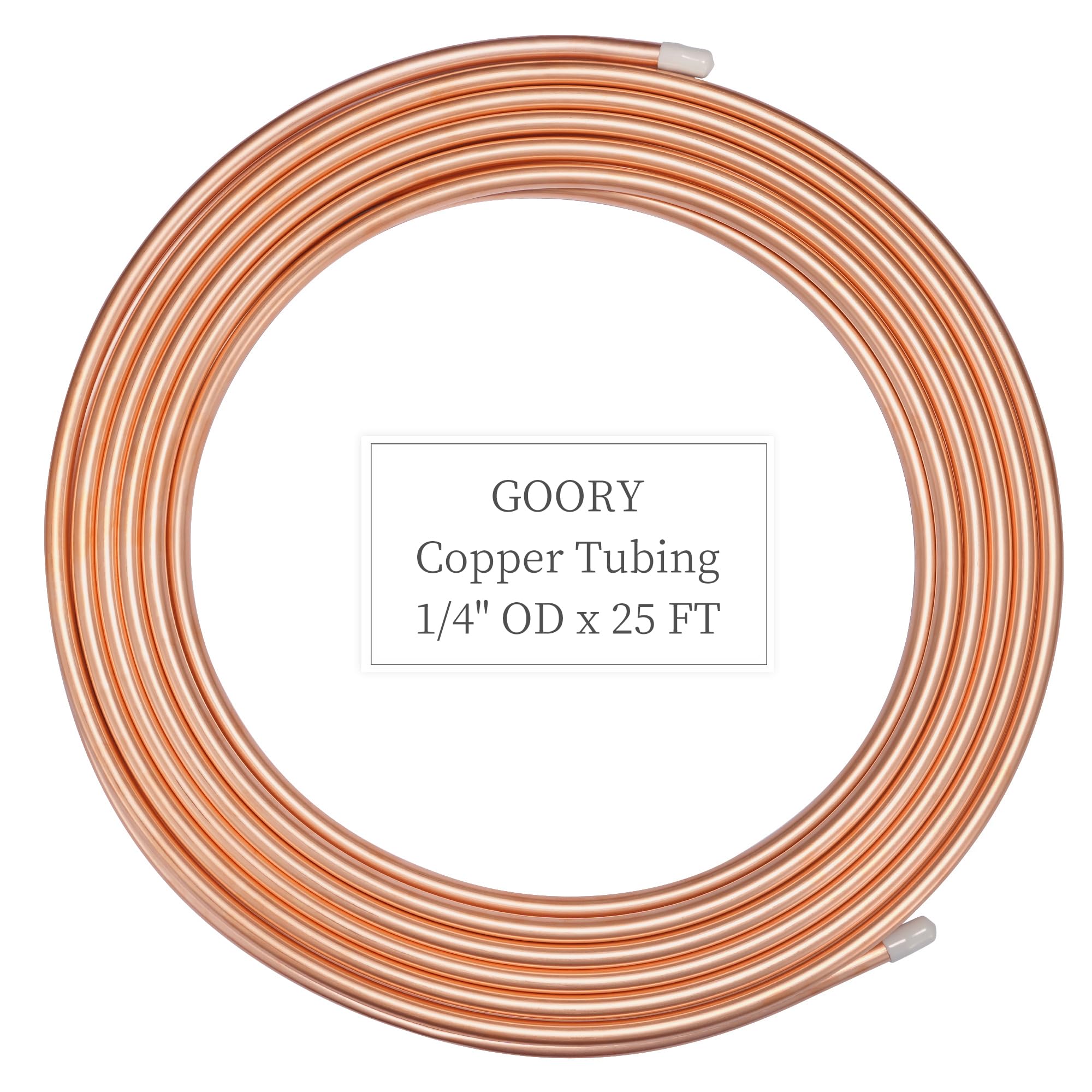
4. GOORY Copper Tubing 1/4″ OD x 0.195″ ID x 25 FT
Nearly the same spec sheet as the winner, sold for a little less — with caveats
Line this up against the BELLA BAYS and the paper specs look near-identical: UNS C12200 copper, ASTM-B280 compliant, a 25-foot soft coil, 1/4-inch OD, 0.195-inch ID, and the same 0.028in/0.7mm wall thickness. It also gets the nitrogen-charged treatment that clears impurities and resists oxidation inside the tube. On paper it reads like a straight swap for the top pick at a smaller outlay.
Owner reports are what separate the two. Functionality is the theme that carries this coil — a clean match for custom runs and repairs, and one buyer put it to work for a full HVAC install straight from the start. What you also hear, fairly often, is that this coil kinks more readily than the refrigeration-grade names, and that some coils land with dents or crushed ends from transit. The material quality gets mixed marks, and a few owners mention the coils arrive tightly wound.
None of that makes it a bad coil — it makes it a value buy with a narrower balance. If you are doing one job and can inspect the box on arrival, the spec-to-price ratio is strong. If you need to trust the tube to survive a full routed line and a careful brazing pass, the rated BELLA BAYS or ICS options are the lower-risk picks.
Same numbers, less money: identical copper grade, standard, length, diameters, and wall thickness to the top pick, for a smaller spend.
Where it can let you down: kink resistance and out-of-box condition are the two consistent soft spots — inspect before you cut.
Worth it if: you are price-sensitive, doing a one-off repair, and can check the coil before you commit it to a run.
Step up instead if: the tube has to survive a full line set — the ICS and BELLA BAYS coils have the stronger field record.
5. ICS Industries 1/4″ OD x 100 FT Soft Refrigeration Copper Tubing Coil (ASTM B280 Certified)
The hundred-foot run for when every extra braze joint is a risk you would rather not take
Jobs that span a whole building need length, and this coil delivers 100 continuous feet of 1/4-inch outside diameter soft-annealed ACR copper. It is manufactured in North America and built to ASTM-B280, the specification written for refrigerant-carrying lines. The tube is soft-annealed on purpose — it routes through framing and tight spaces by hand or bender, and one continuous 100-foot coil means you can skip the couplings and brazed joints you would otherwise be forced into. Fewer joints, fewer leak points.
This is the supplier HVAC fitters trust for full-building runs. The recurring theme from fittings is delivered clean — no bends, no kinks, ends capped against jobsite dust — and it flares and solders predictably under a standard kit. Weighing the whole thing, the wall here is a hair thicker than the standard 0.028in coil, which is what you want on a run that has to hold up to vibration and thermal cycling without hardening. On a longer job, that extra reserve is why you pay up.
The catch is the same as any thin-wall copper: it bends, but it wants a proper bender and a light hand for tight radii, and this much copper is not cheap. If your job is a foot-long patch, this is overkill, and the 25-foot coils above are the smarter spend. Consider it only if the alternative is more joints than you want to braze.
Built for the long run
- 100 continuous feet of 1/4-inch OD minimizes the joints in a full line set
- ASTM-B280 certified and made in North America for HVAC/R codes
- Soft-annealed so it routes by hand or bender through framing and tight spaces
- Factory-capped ends keep jobsite dust and moisture out of the interior
Worth knowing first
- Tight-radius bends still need a bender and a patient hand — thin walls kink if rushed
- A 100-foot coil is far more copper than a small repair calls for
Reach for this if: you are running HVAC or refrigeration lines across a large span and want one continuous coil with almost no joints.
Think twice if: you are replacing two feet of existing line — this much copper belongs on a bigger job.
6. MUELLER INDUSTRIES GIDDS-203306 Copper Tubing Boxed, 1/4″ Od x 25′

The utility-grade coil for water lines — where you want copper and no plastic in sight
This coil is not sold as refrigeration tubing and does not pretend to be. It is a utility-grade boxed copper coil from Mueller, made in the United States, meant for general plumbing and compatible with sweat, brass, compression, or flare fittings. If your job is a fridge water supply or an ice maker feed, this is the coil that matches it — a 1/4-inch OD with the fittings that plumbers actually stock.
Owner feedback comes almost entirely from water-line jobs, and it is positive. Refrigerator and ice maker replacements come up again and again, and the reason people switch to copper is consistent: as customers note, “Don’t trust cheap plastic supply lines they will eventually leak.” The tube bends without kinking in experienced hands, swages (widens the end so it fits over another tube) without splitting, and holds up in the runs people actually use it for. What people value most is that an ice maker line swap takes minutes and comes out dry.
Know the two limits. First, on some jobs the 25 feet runs short — the length is the most-discussed aspect, and while many runs finish within it, longer ice maker routing from a distant sink can come up wanting, so measure your run before you order. Second, this is utility-grade tubing rather than ACR (air conditioning and refrigeration grade) — if you are charging a refrigerant system, look to the ASTM-B280 coils above and leave this one for water.
What it is really for: water supply lines — fridge, ice maker, general plumbing — with copper instead of the plastic line that tends to fail.
Measure before you buy: 25 feet covers most appliance runs, but a distant sink can push you past it — the length is the one complaint that shows up.
Pick this if: your job is ice maker or fridge water supply and you want the durability of copper in place of plastic.
Not the one for: refrigerant or HVAC charging — for that, stick with the ASTM-B280-rated coils.
7. Mueller Industries D04010P 1/4″Odx10′ Refrig Tubing

The short coil for the small fix you want finished in an afternoon
When your job is measured in feet rather than a full line set, this is the coil to grab — 10 feet of 1/4-inch OD Mueller refrigeration tubing, 99% pure copper, made in the United States. It is the shortest option on this list, and that is its whole point. No basement-sized spool to store, no leftover copper you will never use, and it comes from the start in good enough shape to work straight away.
Owners put this ten-footer to work in ways the label does not quite cover. A loop antenna build, an air conditioning unit paired to a fan, and jewelry come up again and again in the reviews, and the running theme is a coil that forms easily and holds the shape you give it. One jeweller-friendly angle shows up too: as reviewers point out, it is “Perfect for hammering flat and turning into copper jewelry.” The tube forms and flattens well, which is exactly what a small-batch craft job wants.
The obvious caveat is length. Ten feet is a repair-size coil — a full line set or a long ice maker run will leave you short, and that is where the 25-foot coils higher on this list earn their place. The wall also wants a careful hand for tight bends, same as everything else in this category. For a small patch, a bench project, or a jewelry batch, though, there is no reason to buy more copper than you need.
Does one job well: a small repair or a bench project, with just enough copper and no leftover spool to store.
The obvious limit: ten continuous feet will not cover a full line set — measure big jobs against the 25-foot coils instead.
Choose this one if: you need a small quantity of 1/4-inch copper for a repair, a craft project, or a jewelry handful.
Size up if: your run is more than a few feet — a longer coil will save you from splicing two short pieces together.
Understanding the Specs
Outside Diameter versus Inside Diameter
The outside diameter — the measurement across the outside of the tube — is the number your fitting grips. The inside diameter is the bore the fluid or refrigerant flows through. These two numbers are never the same. A 1/4-inch OD coil with a 0.195-inch ID has a wall between them, and that wall is what gives the tube its strength. If you are replacing an old line, check the ID too, so a new coil with a slightly different bore does not surprise you at the fitting.
Wall Thickness and Why It Matters
Wall thickness is measured in thousandths of an inch — like 0.028in — or in millimeters, and it decides how a coil behaves. A thinner wall bends more easily and resists kinking less; a thicker wall takes a firmer hand but tolerates a tight radius better. Whatever the thickness, the safe move is a proper tubing bender for tight turns. Hand-bending a large, gentle radius over something smooth is fine; forcing a sharp turn by hand is how a soft copper tube collapses on itself.
ASTM B280 and Nitrogen Charging
ASTM-B280 is the standard written for air conditioning and refrigeration tube — the kind that carries refrigerant under pressure. Utility-grade coils, by contrast, are aimed at water and general plumbing. Nitrogen charging is a treatment applied during manufacturing that flushes impurities and condensation from the interior, which is what helps the tube resist oxidation from the inside out. Both of these appear on the higher-spec coils here.
Length and Joint Count
Every joint or fitting is a potential leak point, and a long continuous coil reduces how many you need. A 10-foot coil for a small repair means one or two fittings; a 50-foot or 100-foot coil for a full line set can replace several spliced lengths. Weigh the length against the routing distance and pick the coil that lets you finish the run with as few breaks as possible.
FAQ
Will a 1/4 inch copper coil fit my existing fitting?
What is the difference between refrigerant tubing and utility copper tubing?
Can I bend 1/4 inch copper by hand without a bender?
How is the inside diameter of a 1/4 inch coil different from the outside diameter?
How long does copper tubing last on an ice maker or fridge line?
Do I need a tubing bender for a 1/4 inch coil with thin walls?
Can I use 1/4 inch refrigerant tubing for a water line?
What does the 99.9% copper rating mean on these tubes?
How much copper tubing do I need for a fridge water supply line?
Is a longer copper coil better than a shorter one?
Final Thoughts: The Verdict
The seven coils here are all the right diameter — that is the filter — and the rest is matching one to your job. For most buyers, the best 1/4 Inch Copper Pipe value is the BELLA BAYS 25-foot coil, a 4.7-star rated ASTM-B280 tube that installs leak-free and bends cleanly with a little patience.
If the run is long and you want fewer brazed joints, the ICS 50-foot coil gives you twice the length of the top pick, and the 100-foot ICS coil is the one for a full building line. If your job is water — a fridge or ice maker feed — the Mueller boxed utility coil is the plumbing-matched pick, and it is the one most likely to get your water line off plastic for good.
How We Picked
We do not accept paid placement. Every pick is matched to a real buyer and a real use-case; we do not hands-on test units.
Sources & Methodology
Specifications: manufacturer listings and product documentation. Review insights: verified customer reviews, as of September 2026. Pricing: not shown on this page (it changes often); check the current price via the retailer link.
As an Amazon Associate, Non Toxic Blog earns from qualifying purchases. This does not affect which products we feature.