Specs are compiled from manufacturer listings and verified buyer reviews and can change over time — please confirm the key details on the product page before buying.
If you want microwave power that actually shortens cooking time, the honest answer is that almost no mainstream countertop unit is stamped “1500 watts” on the box. The closest picks sit in the same high-output class, roughly 1400 to 1600 watts, and they heat noticeably faster than the 700-1000W models sitting on most kitchen counters. So this list uses flexible, human-like matching: not every pick is the exact number you typed in, but each one serves the same job — quick, even, high-power cooking without a remodel.
I’m Mo Min — the founder and writer behind Non Toxic Blog. This guide is built by comparing the manufacturers’ published specifications and the patterns across verified customer reviews, so you get each pick’s real strengths and trade-offs instead of marketing spin.
You will see capacity in cubic feet, wattage, inverter versus standard heating, and how each control panel actually behaves in daily use. The three picks below cover a big-family inverter, a 1500W air-fry combo, and a premium cyclonic inverter. Here is what actually matters when you shop for the 1500 watt microwave.
Our Picks at a Glance

How To Choose The Best 1500 Watt Microwave
Start by deciding what you actually cook. A high-wattage microwave is not automatically the right one for your counter — what matters is the combination of heating method, interior room, and controls that fit your hands and your kitchen.
Wattage class, not a single number
Look for units in the 1400 to 1600 watt band if fast reheating is your goal. A 1250W model with inverter technology often reheats dry food more evenly than a plain higher-wattage unit.
Inverter versus standard heating
Standard microwaves cycle on and off at full blast to average a lower power level, which can leave edges overcooked. An inverter (which delivers continuous, variable power instead of pulsing) keeps the heat steady, so delicate foods defrost without cooking at the edges.
Interior capacity and turntable size
Measure your largest dish before you buy. A 1.6 cubic foot interior with a 13.6″ turntable handles a full 12″ pizza, while a 1.3 cubic foot interior suits single servings and smaller casseroles. Also check the exterior footprint — a compact body with a large interior saves counter space.
Controls you can actually read and press
A dim, unlit keypad and stiff buttons turn into daily annoyance. Look for a backlit or high-contrast panel and clearly labeled presets if anyone in the house has arthritis or cooks in low light.
Quick Comparison
| Model | Best For | Capacity | Wattage | Defrost Type | Amazon |
|---|---|---|---|---|---|
| Toshiba ML-EM45PIT(SS)★ Best Overall | Family portions and 12″ pizzas | 1.6 cubic feet | 1250W | Auto defrost | Amazon |
| Danby DADBMW1361ABSS | Microwave plus air-fry combo | 1.3 cubic feet | 1500W | Auto defrost (time or weight) | Amazon |
| Panasonic NN-SN76LS | Even heating on a small footprint | 1.6 cubic feet | 1250W | Turbo defrost / power defrost | Amazon |
In‑Depth Reviews
1. Toshiba ML-EM45PIT(SS) Countertop Microwave Oven
The big-interior inverter that swallows a 12″ pizza without eating your counter.
If you feed a household and want the most usable space for the smallest footprint change, this is the pick. The 1.6 cubic foot interior holds a 13.6″ removable turntable, which is large enough to fit a full 12″ pizza — that is 0.3 cubic feet more room than the Danby’s 1.3 cubic feet, a 23% larger gap in usable interior. The inverter heating also makes this unit lighter than a same-size standard microwave, so it slides easily if you need to move it.
Where it shines day to day is speed. Buyers report popcorn done in 1.5 minutes and coffee hot in a single minute. The six smart sensor menus handle pizza, potato, vegetables and reheat automatically, adjusting power on their own so food comes out evenly hot without you guessing a time. There is an Eco mode, a sound on/off option, and a child safety lock, so late-night reheats can run silent.
The catch is the control panel. The keypad is not backlit and the contrast is low, which makes it hard to read in a dim kitchen; several owners also mention that settings need a firm press, which is tough on arthritic fingers, and that the panel covering can pucker over time. Durability is the other real concern, with some units failing earlier than expected — though the heating, size and quiet operation are what keep most buyers happy. A 1 year limited warranty covers the unit.
What earns its keep
- 1.6 cubic feet and a 13.6″ turntable fit a 12″ pizza — 0.3 cubic feet more interior than the Danby.
- Inverter heating delivers even defrost and fast results; popcorn in 1.5 minutes.
- Six smart sensor auto menus, Eco mode, sound on/off, and a child safety lock.
Where it asks patience
- The keypad is not backlit and low-contrast, so it is hard to read in low light.
- Buttons need a firm press, which can be difficult for arthritic hands.
- The panel film can pucker over months of use.
Grab it if: you want the most interior room per inch of counter and fast, even reheating for a family.
Think twice if: you need a bright, easy-to-read backlit panel or rock-solid long-term durability.
2. Danby DADBMW1361ABSS 1.3 cu. ft. 1500W Multifunction Countertop Microwave
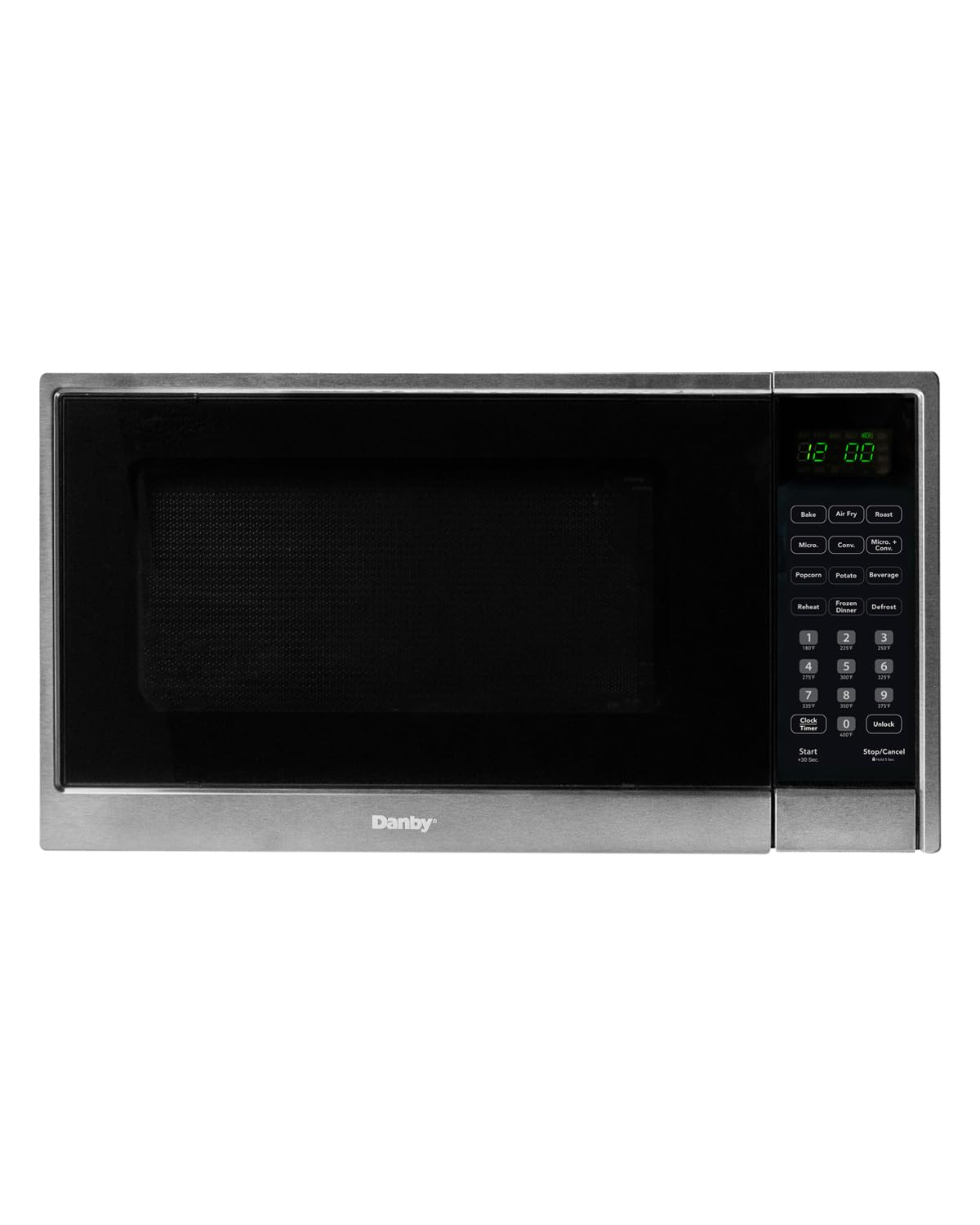
The only true 1500W here, and it air-fries on top of it.
The headline number most people search for is right on the spec sheet: a genuine 1500W of cooking power, 250W above the Toshiba’s 1250W. That extra grunt shortens cook times in recipes, and it is the main reason to shortlist this one over the two inverter models if raw wattage is your priority. The stainless steel interior and sleek exterior give it a high-end look that owners say suits the price they paid.
Where it separates itself is versatility. This is a multifunction unit that microwaves and air-fries in the same footprint, with 11 power levels for precise control, five auto cook options including reheat, auto defrost by time or weight, and express cook buttons for quick timed runs. That means you can crisp fries without turning on a second appliance. It also runs at 2.45 GHz, the standard frequency for microwave heating.
The honest trade-offs come down to size and setup. The 1.3 cubic foot interior is smaller than the Toshiba, and some owners found it tighter inside than they expected — so measure your largest dish before ordering. The manual takes time to work through, and owners mention the fry preset runs long, so monitor air-frying batches yourself. The power cord is also notably short, which matters for outlet placement. It lists at 3.8 stars across 23 ratings, a smaller review base than the other two picks.
Air-fryer in disguise: 11 power levels, five auto cook options, express cook buttons, and auto defrost by time or weight make this far more than a reheat box.
The catch: a 1.3 cubic foot interior can feel tight, and the fries preset is long enough that owners watch the timer themselves.
Reach for this if: you want the closest thing to a true 1500W unit and a crisping air-fry function without a second appliance.
Look elsewhere if: you need maximum interior space or a long power cord for your outlet layout.
3. Panasonic NN-SN76LS 1.6 cu.ft Cyclonic Inverter Countertop Microwave Oven
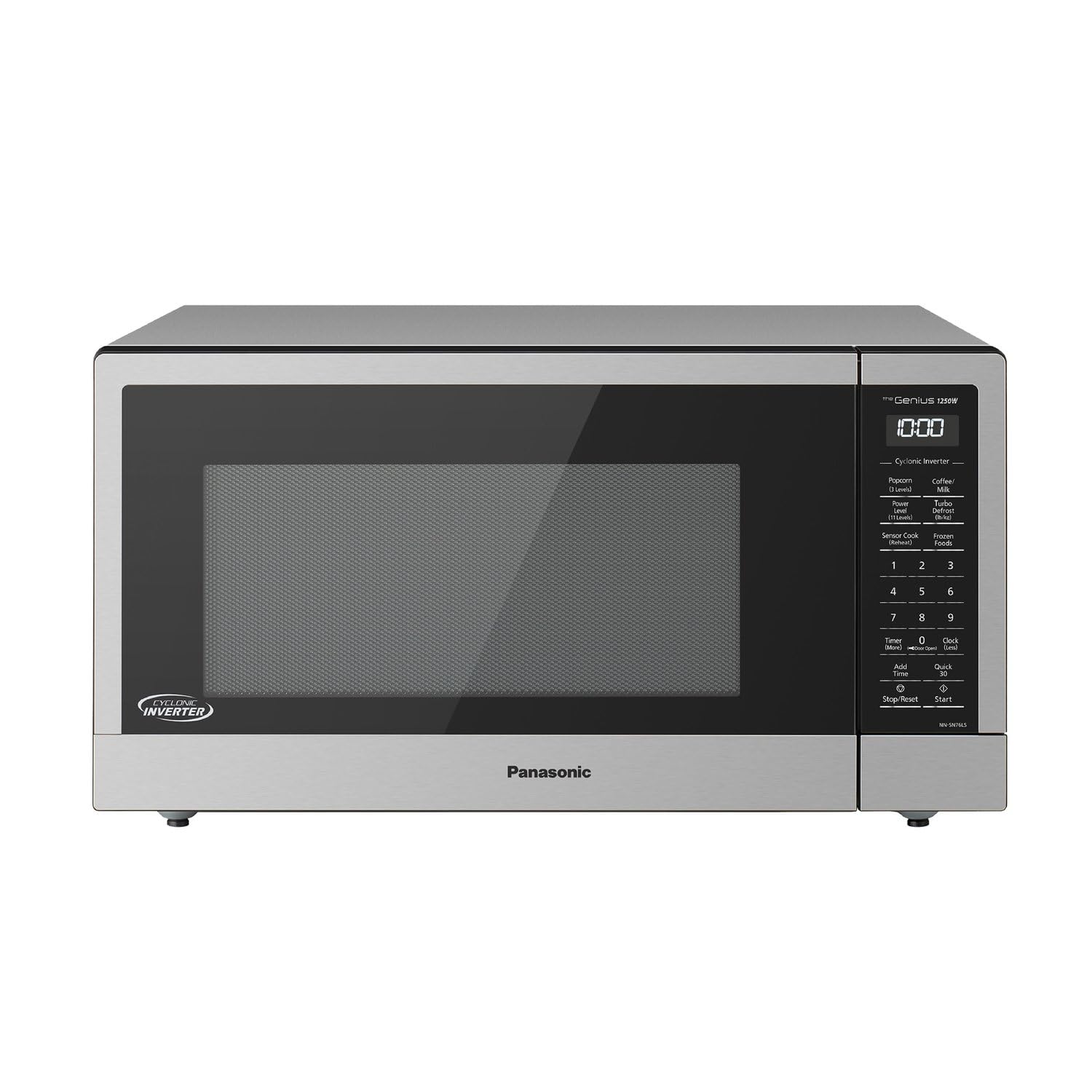
Premium even-ness, engineered to bury the guesswork of time-setting.
For anyone who cooks by sensor instead of by timer, this is the smoothest experience on the list. Panasonic’s Cyclonic Wave Inverter circulates heat in 3D waves for even, efficient cooking, and it pairs that with 15 Genius Sensor auto cook presets covering fresh and frozen entrees, vegetables, oatmeal, soup, potatoes, pasta, pizza and rice. In owner testing with a thermal camera, an auto-cooked frozen lasagna came out hot through the center. The 1.6 cubic foot interior matches the Toshiba’s capacity.
What makes it the premium pick is that it manages all that evenness in a small foot — the shortcut panel packs it into a compact body with a large interior, so it occupies less space than you would expect for the capacity. Dedicated buttons for Popcorn, Keep Warm, and Quick 30, plus a kitchen timer, 3 stage cooking, and Turbo Defrost, cover the common jobs without a manual. Owners who have used microwaves for decades still recommend it.
The friction is entirely in the interface. The control buttons need a firm, deliberate press, and the child lock — which resets after a power outage — adds extra button presses to everyday tasks. One owner noted that instead of a single “3” + start, you may be punching 3-0-0-start. The interior light is also dim, and the auto-lock takes some getting used to. Some reports of shorter-than-hoped durability exist, but the even heating and small footprint are what keep most buyers happy. It is the highest-priced pick here, at 4.0 stars across 289 ratings.
Even-heating specialist: the Cyclonic Inverter plus 15 sensor presets lets you cook by feel rather than by stopwatch.
Counter-friendly: a compact body with a 1.6 cubic foot interior saves space, and it cleans up alongside the Toshiba on capacity.
This one is for: cooks who want set-and-forget sensor meals and the most even heating, and can live with a firm-press keypad.
Choose another if: you need instantaneous, backlit touch controls or dislike the auto child-lock behavior.
Understanding the Specs
Wattage and the 1500W class
Wattage is how much cooking power the unit pushes into your food, and it is the number that decides how fast a reheat finishes. A true 1500W unit, like the Danby, delivers 250W more cooking power than a 1250W model, which is why recipes finish faster. The catch is that manufacturer labels vary, so shop by the 1400 to 1600 watt band and read each spec sheet carefully rather than trusting a single sticker number.
Inverter heating explained
An inverter (a circuit that feeds the magnetron continuous, variable power instead of pulsing it on and off) keeps heat steady at any power level. That is why inverter models defrost fish or reheat a plate without cooking the edges first, and why owners switching from an older cycling unit report more even results.. Both the Toshiba and Panasonic here use inverter technology; the Danby focuses on a raw 1500W output instead.
Capacity and turntable size
Capacity in cubic feet is really about whether your dishes fit. A 1.6 cubic foot model with a 13.6″ turntable swallows a 12″ pizza and a family casserole, while a 1.3 cubic foot unit suits single plates and smaller trays. Always measure the counter space you have, since a large capacity with a compact body, like the Panasonic’s, gives you the interior without a bulky exterior.
Defrost, sensors and controls
Defrost systems range from simple timed defrost to weight-based auto defrost and Panasonic’s Turbo Defrost, which sequences power for fast, even thawing. Sensor cooking (moisture sensors that detect when food is done and shut off automatically) removes the need to set a time. And the control panel matters more than any spec: an unlit, low-contrast keypad or stiff buttons will wear on you every single day.
FAQ
Is a 1500 watt microwave really worth it over a lower-wattage model?
What is the difference between inverter and standard microwave heating?
How many cubic feet do I need for a family of four?
Will these microwaves fit a 12 inch pizza?
Why does a microwave’s fan keep running after cooking stops?
How do I mute the beep on these microwaves?
Do I need to peel the protective film off the keypad before first use?
Why does the microwave ship with the child lock enabled?
Does an air-fry microwave actually replace a separate air fryer?
How much clearance do these microwaves need behind them?
Final Thoughts: The Verdict
The strongest all-around choice for a 1500 watt microwave search is the Toshiba ML-EM45PIT(SS), because its 1.6 cubic foot inverter interior fits a 12″ pizza and delivers fast, even reheating for a family. If raw wattage and a crisping air-fry function are what you are after, go for the Danby DADBMW1361ABSS — it is the only true 1500W unit here. And for the evenest, most hands-off sensor cooking in a compact body, reach for the Panasonic NN-SN76LS. Whichever you choose, check the interior size and panel readability against your kitchen before you buy.
How We Picked
We do not accept paid placement. Every pick is matched to a real buyer and a real use-case; we do not hands-on test units.
Sources & Methodology
Specifications: manufacturer listings and product documentation. Review insights: verified customer reviews, as of September 2026. Pricing: not shown on this page (it changes often); check the current price via the retailer link.
As an Amazon Associate, Non Toxic Blog earns from qualifying purchases. This does not affect which products we feature.