Specs are compiled from manufacturer listings and verified buyer reviews and can change over time — please confirm the key details on the product page before buying.
A 12V solar power kit answers one simple question for you: can you keep a battery topped up without plugging into the grid? If you run a camper, a dump trailer, a shed, or a boat, the right kit means your fridge, lights, and pumps keep working out there. The wrong one leaves you with a dead battery and a fridge that quits overnight. This guide translates panel wattage and controller specs into the kit that fits your camper, trailer, or shed.
I’m Mo Min — the founder and writer behind Non Toxic Blog. This guide is built by comparing the manufacturers’ published specifications and the patterns across verified customer reviews, so you get each pick’s real strengths and trade-offs instead of marketing spin.
You do not need an electrical degree — just the panel wattage and controller type that match your battery bank. What matters most is matching the panel wattage and controller type to the battery bank you already own. Each pick below lists the panel wattage, controller type, and battery chemistry it suits. Here is the practical breakdown of the best 12V solar power kit options for real off-grid use.
Our Picks at a Glance


How To Choose The Best 12V Solar Power Kit
Choosing a kit is really about three things: how much power you need, what kind of battery you are charging, and where the panels will live. Nail those three and the wiring and mounting choices fall into place. Here is what to weigh before you buy.
Match Panel Wattage To Your Daily Draw
The panel wattage number tells you the peak output in full sun. A 200-watt kit can deliver far more charge over a day than a 15-watt maintainer. That gap matters if you are running a fridge or tools instead of just keeping a stored battery from going flat.
Think about what you actually run. Lights and a phone charger draw very little. A 12V fridge or an inverter for small appliances pulls much more. Size the panel to the fridge or inverter, not the phone charger.
PWM Or MPPT Controller
The charge controller sits between the panel and the battery and manages the flow. A PWM controller is simple and affordable, good for smaller systems and mild climates. An MPPT controller tracks the panel’s best operating point and typically squeezes more usable charge out of the same panel, which pays off in bigger builds.
For lithium batteries specifically, check that the controller supports that chemistry. Many automatically detect 12V and 24V systems, which makes setup quicker.
Waterproofing And Mounting
Your panels face rain, dust, and road spray, so look at the IP rating — the scale that grades how well a housing keeps out water and particles. A pre-drilled frame with brackets saves you fabrication time on an RV roof or trailer.
Also check what cables are included. Short runs are fine for a shed, but a long run to a camper roof often needs heavier-gauge wiring than the kit ships with.
Quick Comparison
| Model | Best For | Max Power | Amperage Capacity | Item Weight | Amazon |
|---|---|---|---|---|---|
| Renogy 200W 12V N-Type RV Solar Panel Kit★ Best Overall | RV and camper battery banks | 200 watts | 30 A | 16.5 pounds | Amazon |
| Zuomeng 15W Solar Panel KitBest Trickle Charger | Trickle-charging a dump trailer | 15 watts | — | 0.75 kg | Amazon |
| Topsolar 100W 12V Solar Panel KitBest Starter Kit | First off-grid build, RVs and boats | 100 watts | 4.5 A | 7.2 kg | Amazon |
| ZOUPW 220 Watt Solar Panel Kit | Compact builds needing more output | 220 watts | 6.39 A | 26.9 pounds | Amazon |
| ECI Power 100W 12V Kit with LiFePO4 | All-in-one kit with lithium battery | 100 watts | 10 A | — | Amazon |
| ECO-WORTHY 400 Watt 12 Volt Premium Kit | Home and shed off-grid builds | 400 watts | 3.76 A | 32.66 kg | Amazon |
| ECO-WORTHY 200 Watt 12V Starter Kit | Camper and small shed starter | 200 watts | 3.76 A | 11.5 pounds | Amazon |
| Go Power Overlander 200W Kit | Extended RV and dry camping | 200 watts | 9.3 A | 35 pounds | Amazon |
| Renogy 400Watt Premium Kit | Whole-building off-grid power | 100 watts | — | 56.4 pounds | Amazon |
In-Depth Reviews
1. Renogy 200W 12V N-Type RV Solar Panel Kit with Adventurer 30A Controller
Our pick — over 4.5★ from 500+ verified ratings; the strongest balance of quality and price.
The 200-watt kit that keeps a van fridge cold without a single cloudy-day panic.
If you want one kit that covers a camper, a boat, or a small off-grid cabin without you having to become a solar hobbyist, this is the pick. It pairs two 100-watt panels with a flush-mount 30A Adventurer controller — the 30 amps is the current the controller can handle, which is generous headroom for a system this size. The panels use N-Type cells rated at 22% efficiency, meaning a bigger share of the sunlight hitting them turns into usable electricity.
What wins people over is the real-world output. Buyers report the setup “has enough energy to keep my 12 volt refrigerator running with two deep cycle batteries,” and one owner on a 10-day Glacier National Park trip charged batteries daily through clouds, trees, and mountains while also topping up camera batteries, phones, and laptops. The controller watches for overcharging, overload, short-circuit, and reverse polarity (current flowing the wrong way), so you can leave it wired and forget the babysitting. The panels are also built for tough weather, handling high winds (2400Pa, a measure of pressure the panel can take) and snow loads (5400Pa) with a corrosion-resistant aluminum frame.
The catch is the kit expects a little effort at install. It ships with pre-drilled holes and plug-and-play MC4 connectors — the standard solar connector type — plus a 30ft adaptor kit, a 16ft tray cable, and branch connectors for wiring panels in parallel. Longer RV roof runs may still call for heavier wire, and the controller is PWM rather than MPPT, so you give up some low-light efficiency versus a tracking controller. Both are easy trade-offs to live with, and the 5-year warranty plus 24/7 support softens them further.
What earns its keep
- 200 watts of N-Type panels at 22% efficiency, so more of each sun hour becomes charge
- 30A Adventurer controller guards against overcharge, overload, short-circuit, and reverse polarity
- Frame rated for 2400Pa wind and 5400Pa snow loads, built for real rooftops
- 5-year warranty with 24/7 technical support behind it
Where it asks for patience
- PWM controller rather than MPPT, so you lose some low-light harvest
- Long roof cable runs may need heavier-gauge wire than the kit ships
Reach for this if: you want one complete 200W RV system with the controller, wiring, and connectors already matched.
Look elsewhere if: your heart is set on MPPT charging for maximum output in shaded or overcast campsites.
2. Solar Battery Charger Maintainer, Zuomeng 15W Solar Panel Kit for Dump Trailer
A compact panel whose whole job is beating the slow death of a stored trailer battery.
The number that defines this kit is 15 watts — enough to keep a parked battery topped up, nowhere near enough to run appliances. It is built for 12V lead-acid batteries and sized to fight the number one cause of battery failure: acidification, the slow chemical breakdown that kills an idle battery. A built-in maintenance pulse kicks in as the battery nears full charge, and the whole thing fits in a 3″L x 4″W x 3″H footprint that stores under a seat.
The sizing story here is dramatic when you set it beside the big panels. Against the Renogy 200W kit, this one runs 15 watts versus 200 — a much smaller trickle. For a trailer, that tiny weight and footprint is exactly the point. The MPPT controller is the standout for a kit this size, with the maker claiming it lifts charging efficiency to more than 20% over a plain setup.
Functionality is where the honest caveat lives. Some owners mention it works great for years while others get nothing out of it, so treat it as a maintainer rather than a charger that will revive a deeply dead battery. The quality and durability feedback is similarly split, with a few describing it as flimsy. Set those expectations and the battery life and easy installation are what earn it its place.
Where it shines: the MPPT controller and semi-flexible monocrystalline panel keep a parked trailer battery healthy without wiring hassle.
What to plan for: it maintains a charged battery — it is not the tool to bring a fully flat one back from the dead, and a share of buyers hit units that never worked.
Best matched to: trailer, tractor, or mower owners who want a stored battery held at charge with zero effort.
Not the pick for: anyone hoping to run real loads or revive a battery that has been flat for months.
3. Topsolar 100W 12V Solar Panel Kit Battery Charger
The 100-watt build that turns a cautious first solar project into a working setup.
Start with the panel footprint: this thing measures 46.5″L x 21.8″W x 1.37″H, a big rigid monocrystalline panel framed in corrosion-proof aluminum with tempered glass over the cells. That is a serious piece of hardware at 7.2 kg — nearly ten times the heft of the 0.75 kg Zuomeng maintainer above — and the build is aimed at rooftops rather than dashboards. It ships with a V-shape tilt rack, a 12V/24V intelligent charge controller, two 16ft MC4 cables, and two 5ft O-ring cables.
What the kit gets right is flexibility. It can charge or maintain batteries in cars, RVs, boats, tractors, snowmobiles, and gate openers, and the tilt bracket lets you angle the panel toward the sun instead of leaving it flat. Owners wired two panels in parallel to charge tractor batteries and called the quality solid. The charging performance has real depth, too: one report describes a Class A engine battery going from hooked-up to charged in four hours with no programming at all.
Two things to know before you commit. The mounting brackets get a mixed reception, with some buyers finding the roof holes did not line up — the panel frame itself can be drilled to fix that. And the controller can be sticky about switching back from 24V to 12V once changed, so set it to your intended system on day one and leave it there.
The headliner: a 100-watt monocrystalline panel with a tilt rack, intelligent controller, and both MC4 and O-ring cables in one box.
Set it up once: pick 12V or 24V deliberately at install — customers note the controller is reluctant to switch back afterward.
Pick it for: a first off-grid panel on an RV, boat, or shed where the full accessory list and tilt bracket save you sourcing parts.
Think twice if: you expect bracket holes to align perfectly with your roof rails from the start.
4. ZOUPW 220 Watt Solar Panel Kit for 12V/24V Battery
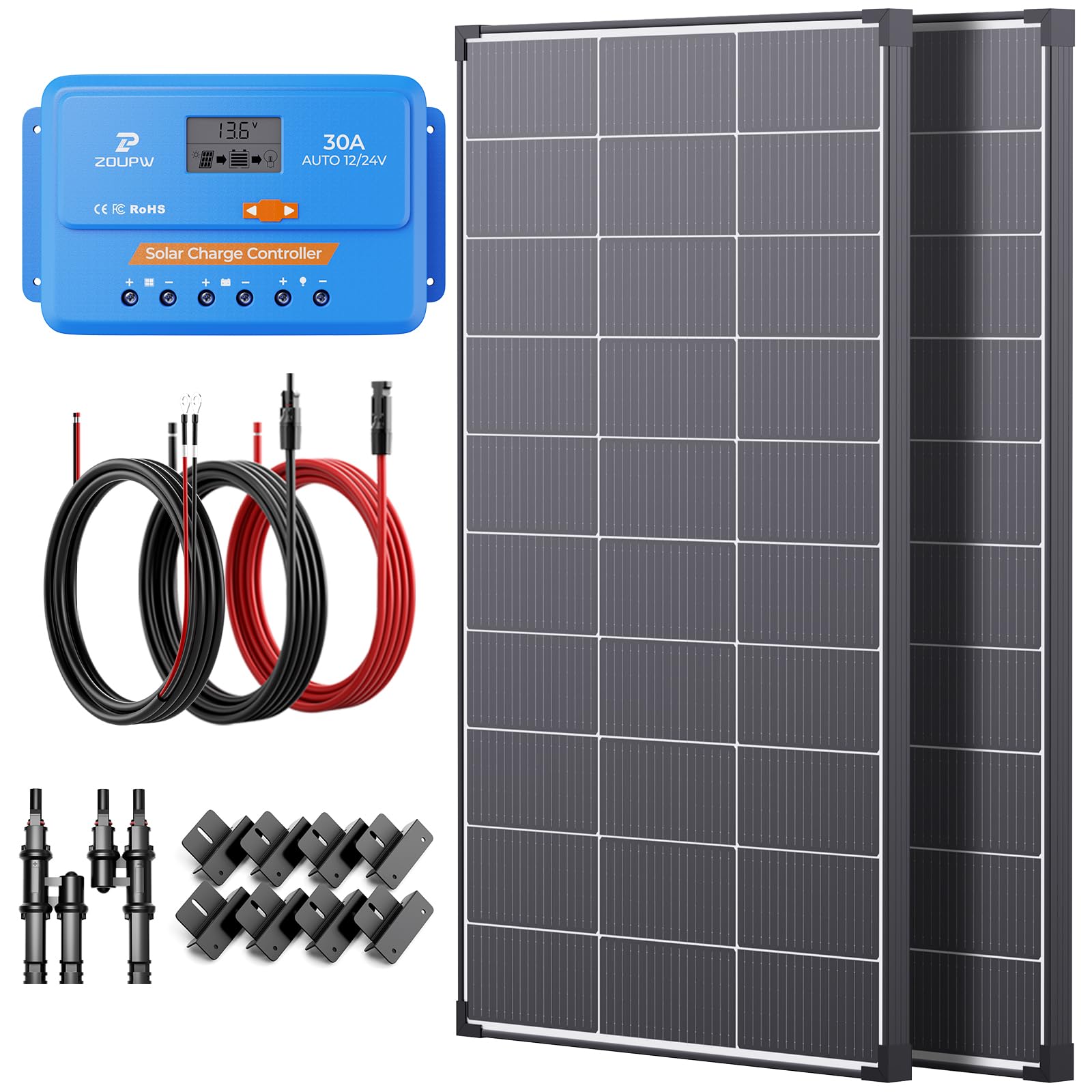
A two-panel kit that squeezes 25.6% efficiency into a tighter, lower profile.
Two 110W N-Type panels add up to 220 watts here, and the cells use a 16-busbar structure rated at 25.6% efficiency — the busbars are the thin conductive ribbons that carry current across a cell, and more of them means less resistance and steadier output. That efficiency is the reason this kit claims stable performance in low light and cloudy weather, where cheaper panels fall flat. The twin panels together measure 38.2″L x 22.7″W x 1.2″H, a more compact and slimmer footprint than the single 46.5″ Topsolar panel above.
The kit is built to expand. The 30A PWM controller senses 12V or 24V systems automatically, works with lithium, gel, sealed, and flooded batteries, and supports up to 400W of panel input — so you can add more panels later without swapping the controller. It carries an IP68 rating, which is the top end of the waterproof scale, and anti-shade bypass diodes that limit the output drop when part of a panel is shaded. The maker backs the panels with a 10-year warranty and the controller with a 2-year warranty.
Reviewers point out these panels beating their own numbers, with one describing a 50-watt panel in the same line putting out 75 watts on a bright morning. The finish is a minor lottery: order two and you may get one silver frame and one black.
Good fit for: Class B vans, rooftop builds, and anyone who wants headroom to expand past the included panels.
Watch for: frame color can vary between units in the same order, so match a visible install if that matters to you.
5. ECI Power 100W 12V Solar Power Kit with 12V 20Ah LiFePO4 Battery

The one kit that arrives with a lithium battery already inside the box.
Most solar kits here give you panels and a controller and leave the battery to you. This one does not. It bundles a 12V 20Ah LiFePO4 battery — lithium iron phosphate, a chemistry prized for long cycle life — alongside a 100W monocrystalline panel, a 10A PWM controller, MC4 solar cables, battery cables, and mounting brackets. That is a complete, ready-to-run off-grid loop for a shed, a fountain, or a small camper without a shopping list.
The battery is the flexible part. The maker rates it at a minimum 2000 cycles at 80% DOD — depth of discharge, meaning how far down you drain it each time — and up to 5000 cycles at 50% DOD. The 10A controller recognizes 12V and 24V systems, uses a CC-CV charging algorithm to protect the battery’s lifespan, and adjusts its charging profile to the ambient temperature. A digital display shows state of charge and battery health so you can read the system at a glance.
The honest limit is scale. Owners call it a good small starter kit and note it will not run anything big — a light or a fan is about the ceiling — with one powering a backyard fountain 24/7 and another running an irrigation pump. The panel itself holds up well over years outdoors, though the battery is the part that can fade in cold conditions. That is the trade for a kit this self-contained.
The smart-tech angle: a 10A controller that adapts its charge profile to temperature and displays state of charge and battery health on a digital readout.
The ceiling: this is a light-duty kit — think lights, a fan, or a small pump, not a fridge or power tools.
Made for: a beginner who wants a sealed shed or garden setup running on lithium without buying a battery separately.
Skip if: you need to run high-draw loads — this kit tops out well below the larger panel systems here.
6. ECO-WORTHY 400 Watt 12 Volt Premium Solar Panel Kit

Four panels and a Bluetooth-loading MPPT controller for a shed or cabin that runs on its own.
This is the kit for serious off-grid ambition. Four 100W monocrystalline panels sum to 400 watts and can produce an average of 1.6 kWh of electricity per day depending on available sunlight — that is a whole-shed’s worth of charge, far beyond the trickle of a maintainer. The panels carry a 3.2mm low-iron glass surface and a 35mm aluminum alloy frame, which the maker states is 2 to 5mm wider than typical frames, over cells rated at 21% efficiency.
The controller is the star. It is a 40A MPPT unit — a maximum power point tracking controller, which constantly finds the panel’s best operating point — with a tracking efficiency rated as high as 99% and peak conversion efficiency of 98%, which the maker says is 40% higher than a traditional PWM controller. It captures the panel’s best operating point continuously, so you harvest more power in less-than-perfect light. The included BT-02 Bluetooth module with Bluetooth 5.0 sends real-time panel, battery, and load data to your phone from up to 82 feet away.
Installation depends on your electrical comfort level. It is not plug-and-play — owners note it rewards someone who knows a little wiring, and the recurring gripe is undersized controller-to-battery cables that ran hot in one report, echoing the need to upgrade gauge for longer runs. Panels here and there arrive lightly scratched. ECO-WORTHY’s customer service, though, earned warm praise for replacing a faulty unit without friction.
Why it earns the wattage
- 400 watts across four panels yielding an average 1.6 kWh per day of sunlight
- 40A MPPT controller with up to 99% tracking efficiency for stronger low-light harvest
- Bluetooth 5.0 module streams live system data to your phone from up to 82 feet
- By-pass diodes and an IP-65 waterproof junction box limit shade-related losses
Installer be aware
- Not plug-and-play — needs basic electrical knowledge and possibly heavier cabling for long runs
- Instructions get mixed marks, and a controller can run warm if wires are undersized
Best for: a shed, cabin, or home off-grid build where you can handle the wiring and want serious daily output.
Not for: a plug-in-and-go buyer who wants the kit to assemble itself — this one asks you to know your cables.
7. ECO-WORTHY 200 Watt 12V Complete Solar Panel Starter Kit for RV Off Grid
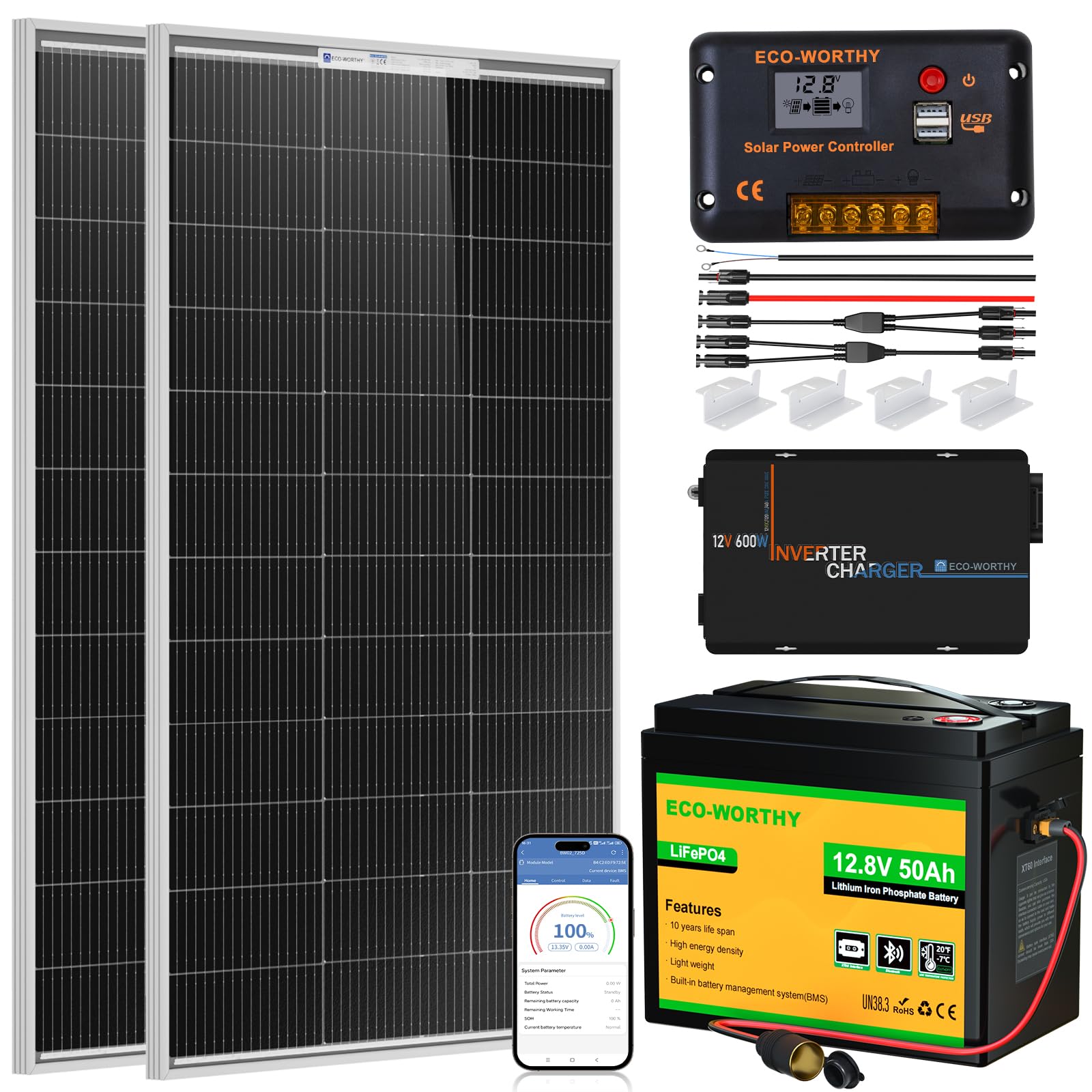
A starter kit that dares to include the battery and the inverter, not just the panels.
Where most kits stop at panels and a controller, this one keeps going. You get 200 watts of N-Type monocrystalline panels rated at 25% efficiency — the maker notes the dual-sided design captures reflected light for up to 15% extra output — plus a 30A charge controller, a 12V 50Ah LiFePO4 battery (a lithium battery type that lasts longer than lead-acid), and a 600W pure sine wave inverter (a device that turns battery power into household AC power). That last piece is what lets you run standard household plugs off the sun, and a 20ms UPS auto-switch keeps your loads alive if grid power drops.
The battery is built to last. ECO-WORTHY rates the LiFePO4 cells at 4000 to 15000 deep cycles (full charge-and-drain rounds), versus lead-acid batteries that the maker says generally manage only 300 to 400 cycles — a much longer service life for a battery you do not want to replace often. The panels themselves are compact for their output, measuring 35.63″L x 23.03″W x 1.18″H at 11.5 pounds, so they fit neatly on a camper roof or a small shed.
What to weigh: this is a starter system, and owners pushing its limits note it wants more battery capacity and a stronger inverter for heavier loads. Some units arrive working beautifully while others had a controller fail within a week — a reminder to test the system thoroughly during your return window. The parts list is genuinely complete, though, with clear labeling and a reasonable learning curve even if the manual is thin.
The complete-kit advantage: panels, controller, 50Ah LiFePO4 battery, and a 600W pure sine wave inverter arrive together, with a 20ms UPS switch between them.
Test early: check the controller and inverter as soon as the boxes land — a few units showed faults in the first week.
The right buy for: someone building a first camper or shed system who wants the battery and inverter included, not sourced separately.
Not for: anyone planning heavy 120V loads — the inverter and battery here are starter-sized.
8. Go Power Overlander 200W 12V Solar Panel Charging Kit

A 200-watt RV kit with a 25-year panel warranty behind its single big module.
The standout figure here is the 9.3A of charging capability, alongside 200 watts of panel output aimed squarely at extended RVing and dry camping. You get one large 200W module measuring 59″L x 26.3″W x 1.6″H — the biggest single panel in this roundup — a Bluetooth-enabled 30-amp PWM controller, and two 25ft solar output cables, one male and one female. The controller is expandable, supporting up to 600 watts of solar on the same unit, so your system can grow with your rig.
Performance is what owners bring up first, and the numbers back it. Reports describe around 8A of charge in full sun with the controller displaying charge percentage, voltage, and current, and one camper owner ran a fridge for four days on sun alone. The 31ft camper owner who installed a panel and then found they rarely needed the generator captured the outcome neatly. The panel itself carries a 25-year limited output power coverage — one of the longest support windows you will find on a rigid panel.
Two practical notes. This is a genuinely heavy panel at 35 pounds, so mounting takes muscle and a helper. And RV roofs made of rubber need a little caulk at the mounting points to seal properly. Neither is a dealbreaker for a kit this well-supported — just budget the time.
what separates it: a 25-year limited panel output warranty and a controller that will accept expansion up to 600 watts.
The install reality: at 35 pounds the panel wants two sets of hands, and rubber roofs call for caulk at the mounts.
Built for: RV owners who dry camp often and want the longest panel coverage and room to expand.
Consider the alternative if: you are mounting solo — the 35-pound panel is a two-person lift.
9. Renogy 400Watt Premium Solar Kit with 40A MPPT Charge Controller

Four panels and a 40A MPPT controller for a building that wants real, ongoing power.
This kit brings four 100W monocrystalline panels — 400 watts total — together with a 40A MPPT Rover controller and a Bluetooth module, and it lands among the heavier systems at 56.4 pounds on the pallet. It is built for a shed, a small cabin, or a serious RV bank where you want a stable daily charge and the headroom to grow. Z-brackets, an adaptor kit, and tray cables are all included, so there is no missing-parts scavenger hunt.
The MPPT controller is the reason to choose this over a cheaper PWM build, and the owners prove it in use. One ran a gaming PC — drawing 180W normally and up to 480W at peak — with no trouble, and another ran a half-inch drill, a chainsaw, and a log splitter from a garden-shed setup that recharged within hours. That is the difference between a trickle kit and a working system. The Bluetooth module and temperature sensor keep you informed of charge state without a trip to the controller.
The recurring annoyance is documentation and cable length. Owners note there is no whole-system manual, only controller and Bluetooth guides, and the included panel-to-controller wiring runs short for a large Class A motorhome. The Bluetooth pairing can be slow and is better as a convenience than a precision battery monitor. None of it stops the kit from performing; it just means a little extra planning on install day.
Power that keeps up
- Four 100W panels and a 40A MPPT controller for reliable daily charge in real use
- Handles heavy loads in owner reports — gaming PCs, drills, even a log splitter
- Bluetooth module and temperature sensor included for easy system monitoring
- Complete hardware set: Z-brackets, adaptor kit, and tray cables with the panels
Plan around these
- No whole-system manual, only controller and Bluetooth guides to work from
- Included wiring runs short for large motorhome installs and may need extending
- Bluetooth is a convenience, not a precise battery monitor
Best suited to: a shed, cabin, or large RV build that needs 400 watts and a strong MPPT controller to run real tools and appliances.
Look elsewhere if: you want step-by-step whole-kit instructions — you will be piecing the setup together from separate manuals.
Understanding the Specs
Panel Wattage And Daily Output
Panel wattage is the peak output in full sun, and the daily number is what you can count on over a day of sunlight. A 400W kit and a 15W maintainer sit in different leagues: one runs loads, the other only holds a stored battery at charge. Ask how much you draw per day, then size the panel past that figure so cloudy days do not leave you short.
MPPT vs PWM Controllers
The controller type changes how much of your panel’s output reaches the battery. PWM is simple and handles smaller systems fine. MPPT tracks the panel’s best operating point and, as one maker here states, can convert notably more of the available power — worth it when you have paid for large panels and want every watt of them.
Battery Chemistry And Cycle Life
Lithium iron phosphate (LiFePO4) batteries are rated here for thousands of deep cycles, while lead-acid units in the same data are noted at a few hundred. If you drain and recharge often, cycle life is the number that decides how many years of service you get. Match your controller’s battery settings to the chemistry you run.
Water And Weather Ratings
An IP rating grades how well a housing keeps out water and dust — the higher the number, the tougher it is against rain and spray. Wind and snow load ratings in Pascals tell you what a panel is built to withstand on a roof. For any outdoor install, both numbers matter more than the look of the frame.
FAQ
Will a 200W panel kit run a 12V fridge in my camper?
What is the difference between a solar maintainer and a full solar kit?
Do I need MPPT or is PWM good enough for my solar kit?
Can I use these panels with a lithium battery?
How many panels can I add to a kit’s controller?
Is a 100W solar kit enough for a small shed?
How long do these solar panel kits last?
Will these panels charge a battery that is completely dead?
Do I need extra wiring beyond what comes in the kit?
Can these kits be mounted on an RV roof?
Final Thoughts: The Verdict
If you want the one kit that does the most for a camper, boat, or cabin without a wiring marathon, the Renogy 200W 12V N-Type RV Solar Panel Kit is the pick that covers the widest range of real setups. If what you actually need is to keep a parked trailer battery from dying between tows, the Zuomeng 15W Solar Panel Kit handles that job for a fraction of the footprint. And if you are building a shed or cabin that runs on its own, the ECO-WORTHY 400 Watt 12 Volt Premium Solar Panel Kit delivers the daily output to run it — with the MPPT controller and expandability to grow when you do. Match the kit to your battery chemistry and bank size first, then pick the panel wattage.
How We Picked
We do not accept paid placement. Every pick is matched to a real buyer and a real use-case; we do not hands-on test units.
Sources & Methodology
Specifications: manufacturer listings and product documentation. Review insights: verified customer reviews, as of September 2026. Pricing: not shown on this page (it changes often); check the current price via the retailer link.
As an Amazon Associate, Non Toxic Blog earns from qualifying purchases. This does not affect which products we feature.