Specs are compiled from manufacturer listings and verified buyer reviews and can change over time — please confirm the key details on the product page before buying.
If your ceiling alarms are past ten years old, the upgrade that matters most is a hardwired unit that keeps a battery in reserve — so it still guards you through a blackout. The picks below are all 120-volt AC hardwired models with battery backup, tested against UL standards and built to drop onto existing wiring. That narrow group is where the real choice happens, and it depends on three things: how cleanly a new unit swaps onto your old bracket, whether it alerts the whole house when one sensor trips, and how it handles the nuisance chirps that wake you at 3 a.m.
I’m Mo Min — the founder and writer behind Non Toxic Blog. This guide is built by comparing the manufacturers’ published specifications and the patterns across verified customer reviews, so you get each pick’s real strengths and trade-offs instead of marketing spin.
Replacement is usually the trigger for this purchase, not a remodel, so wire compatibility and bracket fit decide whether you finish in ten minutes or spend an afternoon on a ladder. The first thing to confirm before you buy is that your old connector and mounting plate will accept the model you pick. That single check is why this guide ranks the 120 volt smoke detector options by how painlessly they drop into an existing system.
Our Picks at a Glance


How To Choose The Best 120 Volt Smoke Detector
A 120-volt smoke detector draws its everyday power straight from your home’s wiring, which is why it never needs a battery swap to keep watching — the backup cell only takes over when the circuit dies. That distinction separates this category from battery-only alarms, and it is the first thing to get right before you compare anything else.
Start with the wiring you already have
Most people buy a replacement, not a first install, so the connector at the end of your ceiling pigtail is the deciding factor. Some units ship with adapter plugs that mate to older harnesses; others need the pigtail rewired at the wire nuts. Before ordering, pull one old unit down and look at how its plug seats into the base — that shape tells you whether a straight swap is possible or whether you will be stripping wire.
Understand the two sensor types
An ionization sensor reacts fastest to flaming fires — the kind that flare up from paper or grease — while a photoelectric sensor is tuned to the smoldering, smoky fires that smolder for hours before they catch. Manufacturers sell both, and some combination units pack both senses into one housing. Knowing which risk worries you more helps you read a spec sheet without guessing.
Interconnect is the whole-house safety net
When alarms are interconnected, a single unit that smells smoke triggers every linked alarm on the same circuit. That matters most at night, when a fire in the basement needs to wake someone sleeping two floors up. Brands cap how many units can link together, so if you are covering a large home, check that ceiling before you buy.
Quick Comparison
| Model | Best For | Power | Sensor | Alarm / Pack | Amazon |
|---|---|---|---|---|---|
| BRK First Alert 9120BFF / SMI100-AC★ Best Overall | Direct swaps onto old wiring | 120V AC + 9V backup | Ionization | 85 dB, 1-Pack | Amazon |
| First Alert 9120BABest For Networking | Linking up to 12 alarms | 120V AC + 9V backup | Ionization | Audible, 1 Count | Amazon |
| Kidde 20SARBest False-Alarm Control | Cutting cooking false alarms | 120V AC + 2 AA backup | Smoke sensing | 85 dB, 1 Pack | Amazon |
| First Alert SM6W01 | Covering three rooms at once | 120V AC + AA backup | Ionization | 3-Pack | Amazon |
| Kidde i12040 | Big interconnected systems | 120V AC + 9V backup | Ionization, Photoelectric | 24-device link | Amazon |
| First Alert SC9120B | Smoke plus carbon monoxide | 120V AC + 10-yr lithium | Smoke + CO sensing | 85 dB, 1 Count | Amazon |
| Siterlink GS562A | Whole-home 4-pack coverage | 120V AC + 9V backup | Photoelectric | 4-Pack | Amazon |
| SITERWELL GS562A | Quiet, clean-looking installs | 120V AC + 9V backup | Photoelectric | 5 Count | Amazon |
| First Alert 9120B 5-Pack | One-trip whole-house swap | 120V AC + 9V backup | Ionization | 85 dB, 5 Count | Amazon |
In‑Depth Reviews
1. BRK First Alert 9120BFF / SMI100-AC Hardwired Smoke Detector
Our pick — over 4.5★ from 19,000+ verified ratings; the strongest balance of quality and price.
The contractor-pack alarm that slips onto wiring older than most houses
If your home still runs on decades-old detector plugs, this is the unit that ends the guessing. It wires into 120-volt AC power and carries a 9-volt battery in reserve, so the sensor keeps watching when the breaker trips. The ionization sensor inside is tuned to fast flaming fires — the paper-and-grease blazes that spread in minutes — and it sounds an 85-decibel alarm loud enough to pull you out of deep sleep.
Here is the detail that makes seasoned buyers reach for it: as one BRK owner put it, this is “direct plug and play for 35 year old hardwire detectors.” That matches the wider picture — the replacement angle is what this unit does best, and the fact that its connector geometry has barely changed in a generation is the reason. The bundled mounting bracket is universal, the battery drawer slides out from the side for a swap without pulling the unit down, and the tamper-resistant locking pins stop a unit from walking off a rental ceiling. A single test/silence button covers the whole interaction, which is the right call for a device you touch twice a year.
It measures 5.6 inches deep by 5.6 inches wide by 2.2 inches tall — a footprint that stays honest about ceiling space, and the sizing lines up neatly against the Kidde 20SAR, which runs 1.88 inches deep by 5 inches by 5 inches. The heavier build sits at 22.68 grams on the spec sheet, which tells you the housing is not flimsy. For coverage, plan one per level plus one in each bedroom, and note that it links to other compatible BRK or First Alert units so a single trip sets off everything on the network.
What owners keep coming back for
- Drops onto existing BRK and First Alert wiring with no pigtail change in most homes
- 85-decibel siren is loud enough to hear through a closed bedroom door
- 10-year limited manufacturer warranty covers the unit through its service life
- Locks into the universal bracket with tamper-resistant pins for rental properties
Where it could disappoint
- Battery life is the recurring mixed note — some arrive with a fresh 9-volt, others show up drained
- Plain contractor-style packaging feels no-frills for a device you trust with your family
- Not a carbon monoxide detector, so pair with a separate CO unit if your home needs that coverage
Built for the swap: If you are replacing old BRK or First Alert hardwired units and want the path of least resistance, this is the one.
Think twice if: You need carbon monoxide coverage in the same housing — this is a smoke-only detector and will not cover that gap.
2. First Alert 9120BA Hardwired Ionization Smoke Alarm with Battery Backup
The quiet link-builder for homes with twelve ceilings to cover
What makes this unit worth a spot on the list is how far it reaches: it will link with up to 12 other First Alert or BRK hardwired smoke detectors, so a single alarm on the far side of the house sets off the entire group. The 120-volt AC power runs it day to day, while the included 9-volt cell keeps the sensor live through a power failure. The ionization sensing element reacts to particles from fast-flaming fires — the flashover risks that catch paper and curtains — and the audible alarm is what you want at that moment.
Installation is the easy part here. It wires into the same 120-volt AC line as a battery-only unit would drop into, but with no need to rewire once it is seated. First Alert builds these to slot into existing hardwired systems, and the battery drawer sits on the outside of the housing so a swap takes seconds without pulling the unit off the ceiling. That drawer access is the detail that separates a smooth yearly battery change from a ladder-and-screwdriver event.
You will trade a bit of ceiling glare for that convenience — the enclosure is straightforward plastic without the visual trims you find on the premium units below, and there is no carbon monoxide sensing on board. That matters if you were hoping one unit would cover both risks. The brand’s reputation for longevity in this model line is real, and the ionization-sensor cost structure is what keeps it competitive against the more loaded SC9120B in the same family.
Where owners latch on: The interconnect ceiling is unusually generous for this price tier, and it is the reason bigger homes lean toward it over the single-unit picks.
One real limit to weigh: No carbon monoxide sensing in the same housing, so this stays a smoke-only purchase.
Reach for this if: You are building or replacing a multi-room interconnected network and want an ionization sensor that plays nice with existing First Alert and BRK hardware.
Look elsewhere if: You want carbon monoxide protection folded into the same device.
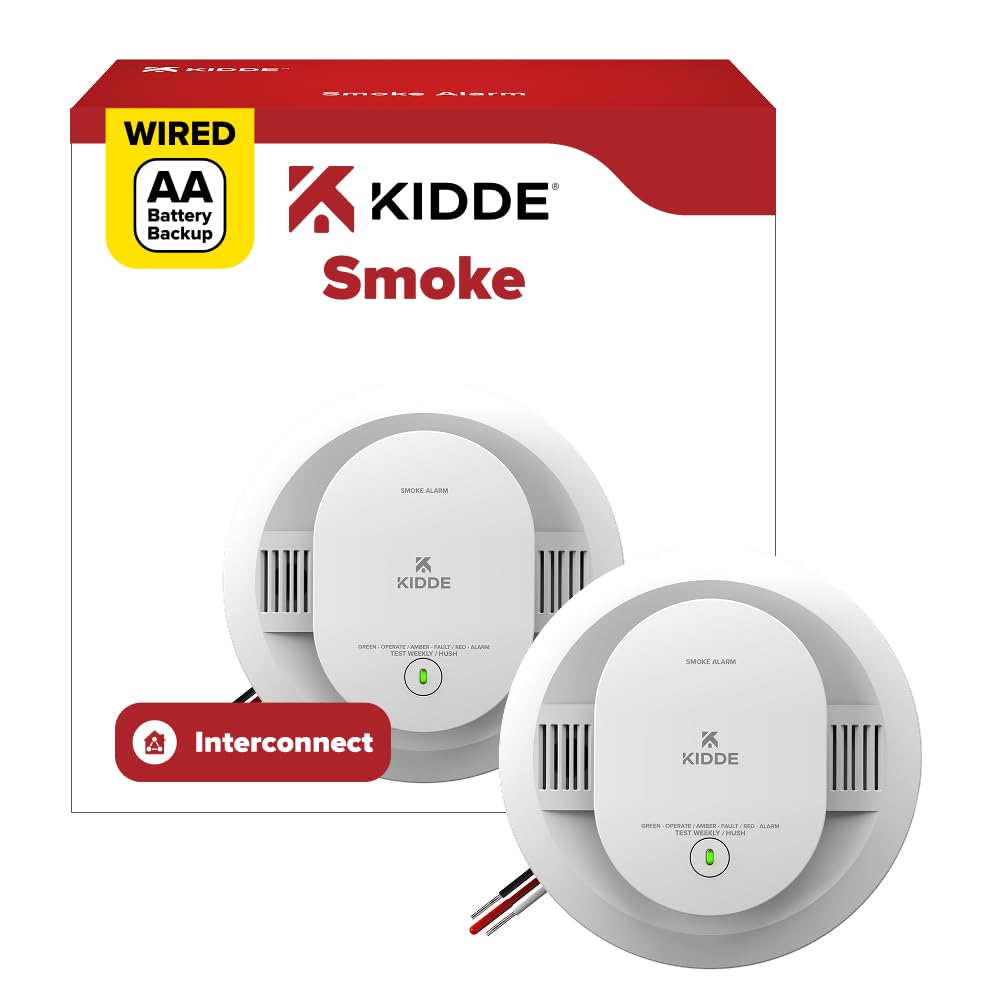
3. Kidde Smoke Detector, Hardwired with AA Battery Backup, 20SAR
The kitchen-adjacent pick that knows the difference between toast and smoke
Burn a piece of toast and this is the alarm least likely to stage a protest. Kidde’s Model 20SAR detects smoke over 25% faster and uses advanced sensing technology that distinguishes real smoke from everyday cooking and steam — a direct answer to the nuisance triggers that plague ordinary sensors near a stove. It runs on 120-volt AC power with two AA batteries as backup, so detection continues through an outage, and the 85-decibel alarm pairs with a red LED for a clear visual warning you can see across a dark room.
Installation is the balance here. The unit connects to existing hardwired wiring and its mounting base is just slightly larger than older Kidde plates — enough to cover a scuffed paint ring without needing a touch-up. Wiring it in is a matter of swapping the harness, and this unit ships with two AA batteries included, so you can finish the job in one pass. It is built to interconnect with other Kidde alarms, so one sensor sets off the whole group when something real happens.
The one honest caveat worth knowing before you buy is reliability, which receives mixed feedback across the review base. Some units run without a complaint for years — several buyers report their prior same-brand model lasted a decade or more, and that experience lines up with the 10-year limited warranty. A smaller set of owners mention failures or false alarms within the first year, often traced to dust or specific wiring quirks in the home. For most buyers this is still the right unit near a kitchen; the honest framing is fit, not a defect pattern.
The fit that sells it: Best for a hardwired home near a kitchen or hallway where the wrong sensor would chirp five times a week.
What to keep in mind: Reliability feedback is genuinely mixed — buy it for the false-alarm reduction and its 10-year warranty, and treat the sensor as a device you test monthly on schedule.
Best for: Anyone whose biggest fire risk is a cooking accident and whose current alarm always seems to be the one that rings first.
skip it if: You have already tried this model line and hit repeated failures — the pattern exists in the review base and it is note as an honest limit.
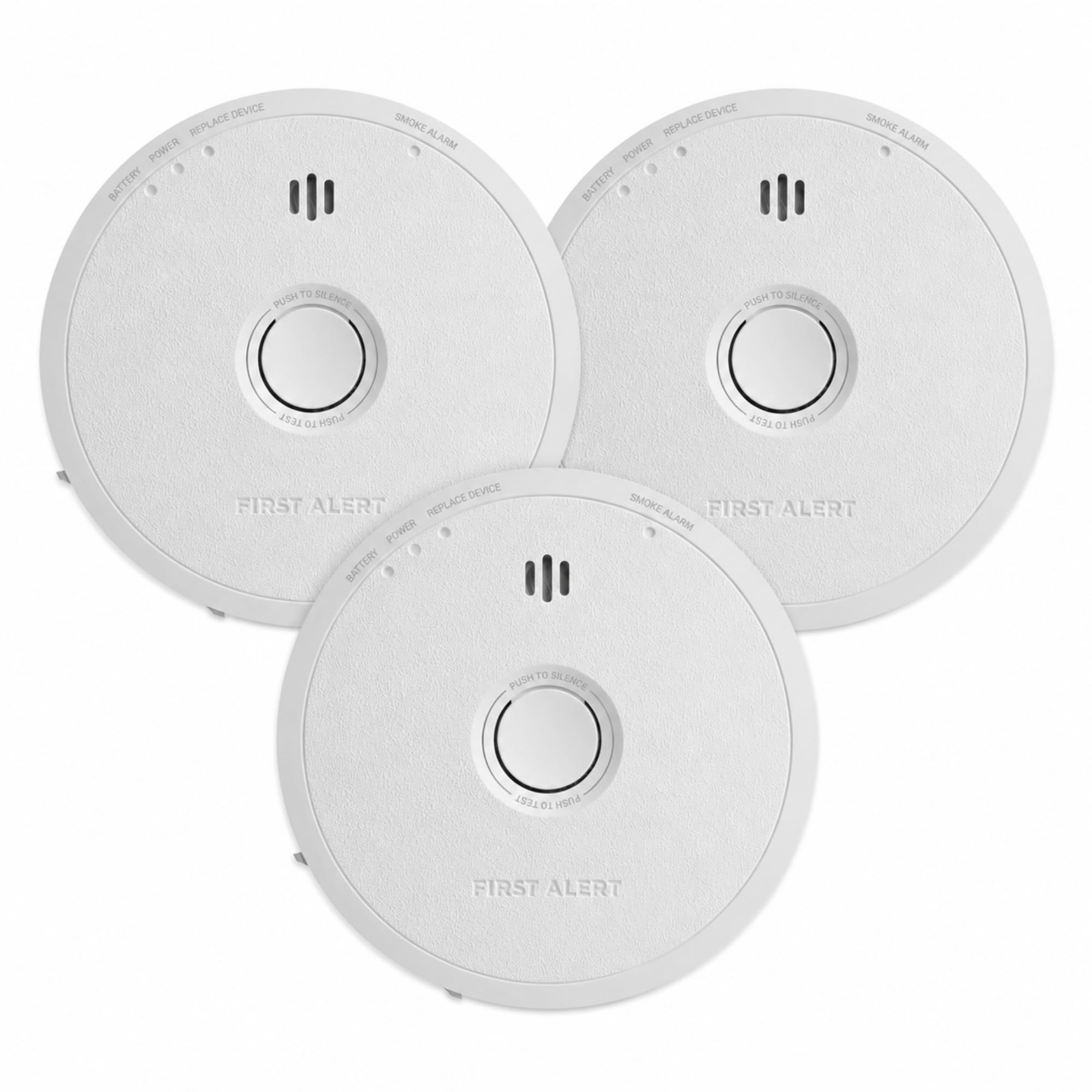
4. First Alert SM6W01 Hardwired Smoke Alarm with Battery Backup (3-Pack)
Three ionization alarms that warn you before the low-battery midnight chirp
Three ceilings, one order — that is the pitch, and the size math backs it up. The SM6W01 ships as a trio of 120-volt AC hardwired ionization sensors with AA battery backup, and the total pack weight lands at 16 ounces, so you are not adding meaningful load to your ceiling joists. Each unit runs on the household circuit day to day, with the AA cell taking over when the power drops.
What sets this trio apart from a plain three-pack is the SoftCue early-warning chirp, a low-battery signal that starts warning before the battery actually dies. In practice that means you can plan a weekend swap instead of being jolted awake at 2 a.m. The side-loading battery drawer lets you change the cell without pressing out the whole housing, and the LED indicators on the face tell you at a glance which unit is in what state. A standardized mounting bracket and an optional trim ring let the finish match your ceiling color without touch-up work.
For homes already running BRK’s connected-safety line, this trio integrates with the SC5 Smart Smoke & CO Alarm alongside the older platform. That matters if you have one smart alarm and want every ceiling on the same circuit to trigger together. Weigh the pack against the single-unit option: a buyer choosing between this trio and the standalone BRK at the top of the list is really choosing coverage breadth over the older unit’s long-proven connector geometry.
Coverage that makes sense: Best for someone replacing three old detectors in one trip — the per-unit economics on a pack this size beat buying singles.
One check before ordering: Confirm your old brackets accept the standardized base, or plan a mounting swap along with the electrical one.
Right pick if: You are upgrading a whole level or a short hallway run and prefer to handle the job in one weekend.
Wrong pick if: You only need one unit and want the simpler connector story of the BRK at the top of the list.
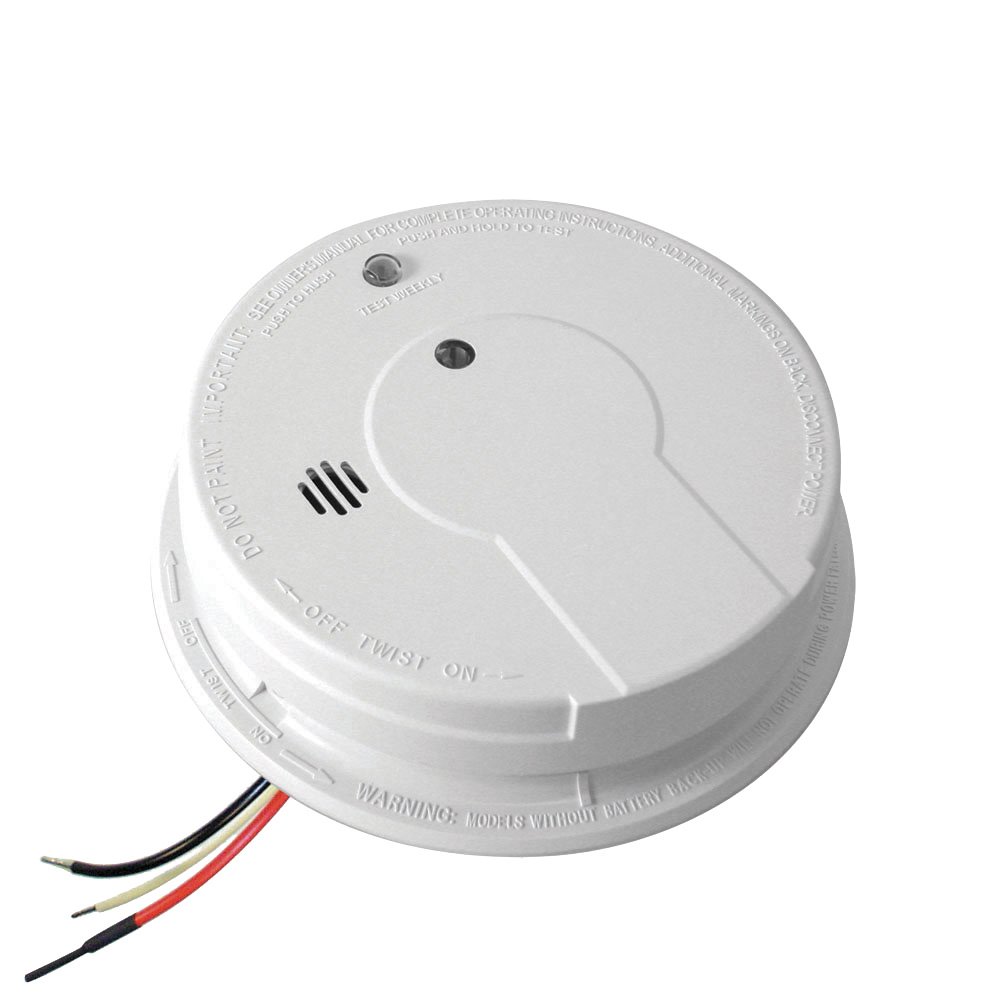
5. Kidde AC Hardwired Interconnect Smoke Detector with Hush, Model I12040
The big-network alarm that quietly reports which unit tripped first
If your system plans to run past a dozen units, this is where the ceiling gets interesting. Kidde rates the i12040 to interconnect with up to 24 devices, of which 18 can be initiating units — a serious jump from the 12-device cap on the First Alert 9120BA. Smoke, carbon monoxide, and heat alarms can all join the network when they are compatible, which means the whole house can be wired into one triggering system. The ionization sensor handles flaming fires, and the alarm memory feature flashes a red LED on the unit that tripped first, so you know exactly which sensor triggered the whole network.
Installation is where the thoughtful details live. The front battery pull tab activates the 9-volt backup without pulling the alarm off its bracket, and the pre-stripped wiring harness has a cap you pull off by hand — no stripper tool required. The tinned wire strands increase conductivity and give the wire nuts a better grip. The mounting base is oversized on purpose: it hides dirt, covers old paint imperfections, and stops the hardware from chewing up your ceiling. That base size is also why a few people note it does not drop onto every older Kidde bracket without a five-minute screwdriver swap.
One honest note from the review base: a handful of customers note the unit is not an exact fit onto older Kidde 1275 brackets and needed the new base installed instead. The swap takes minutes with a Phillips screwdriver, but it is worth checking your ceiling before you commit. The tamper-resistant locking feature, dust cover, and single-button Hush-and-test design round out a unit built for long-term multi-room systems rather than one-off replacements.
Where it earns its keep: The 24-device interconnect ceiling and the alarm-memory LED make it the choice for larger homes and light commercial installs.
Practical fit note: Some older Kidde brackets need the included base swapped in — quick work with a screwdriver, but plan for it.
Built for: Households running a dozen or more interconnected detectors where identifying the tripped unit fast matters.
Not built for: A single-alarm replacement where the network reach and memory feature are unused extras.
6. First Alert SC9120B Hardwired Combination Smoke and CO Alarm

Two life-safety alarms in one housing, both powered from the same ceiling wire
The SC9120B earns its place on this list by covering two hazards in one ceiling footprint — smoke sensing and carbon monoxide detection share a single housing. It runs on 120-volt AC power wired into the household circuit, and the backup cell is a 10-year sealed lithium battery in a locked drawer, so the unit will not nag you for a yearly battery change. The carbon monoxide side uses electrochemical sensing, while the smoke side pairs intelligent sensing with the same technology that quiets nuisance alarms. When either threat is present, the 85-decibel siren fires and the indicator lights on the face tell you which one it is.
Replacement is where this unit shines. Adapter plugs are included so it slots into existing hardwired wiring without a rewire, which is the detail that saves an afternoon on the ladder. A 10-year limited warranty covers the unit through its service life, and an end-of-life signal tells you exactly when the device needs retirement. Rigorously tested to meet UL standards, it also counts as one of the pieces that make up a full-home safety coverage plan — one unit on each level and in each bedroom is the manufacturer’s guidance.
Where buyers push back on this one is the price, which reads as premium against the plain smoke-only units on this list. That is the trade: you pay more for the CO sensor and the sealed 10-year battery, and you give up none of the hardwired interconnect capability. For families who would otherwise buy a separate CO alarm for the hallway, this consolidation usually lands cheaper than buying both devices separately — a math that only works if you already needed both.
The reasons this earns a slot
- Smoke and CO sensing in one housing, so ceilings stay uncluttered
- Included adapter plugs let it replace existing hardwired units without rewiring
- 10-year sealed lithium backup eliminates yearly battery swaps
- End-of-life signal tells you when the unit itself needs replacing
What to weigh before buying
- Value for money is a mixed note — some buyers find the combo pricing steep versus a separate CO unit
- Battery life also carries mixed feedback for a cell that is meant to last the unit’s whole service life
- If your home already has a separate CO alarm, the combo premium is money spent twice
For homes that need both: Families who want smoke and carbon monoxide coverage on the same ceiling without running two devices.
For homes that do not: If you already have CO alarms installed, a smoke-only alarm saves money and does the job.
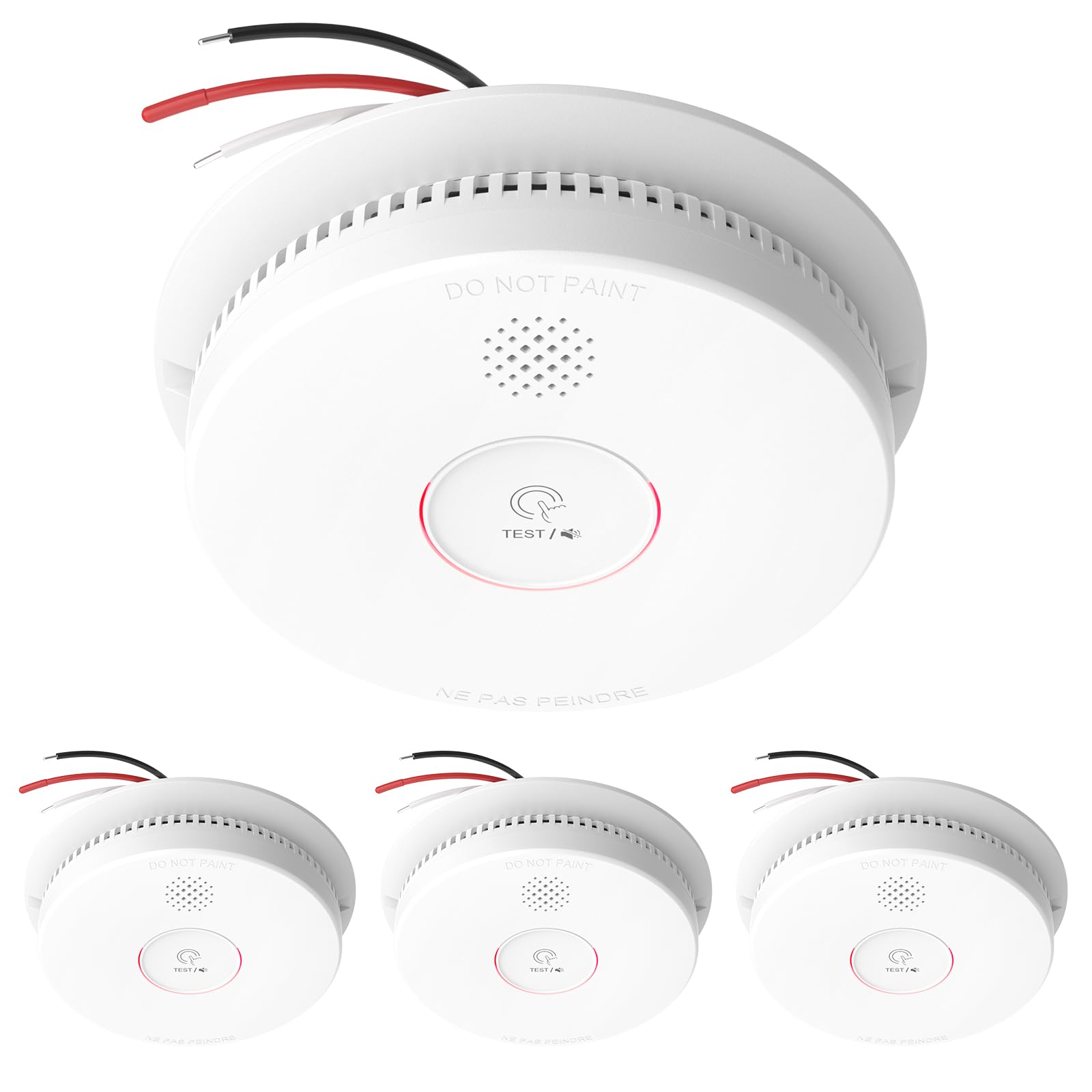
7. Siterlink GS562A Hardwired Interconnected Smoke Detectors (4-Pack)
Four photoelectric sensors tuned to keep quiet when dinner is on
Smoldering fires are what this pack aims at. The GS562A uses photoelectric sensing — the kind tuned to catch the slow, smoky fires that burn inside walls and furniture for hours before they catch — and its advanced sensing technology reads the surrounding environment more accurately to cut the nuisance alarms triggered by cooking. Four hardwired interconnected units ship in the box, each running on 120-volt AC with a 9-volt battery backup, and a test/silence button plus UL listing round out the spec sheet. The enclosure is ABS plastic and the housing is 5.67 inches deep by 5.67 inches wide by 1.5 inches tall.
What buyers tend to hit first is the wiring change. The pigtail on this unit does not plug directly into every existing brand’s harness — the connector style has shifted over the last generation — so most installs involve unwrapping the old pigtail from the home wire and rewiring directly to the new alarm with the existing wire nuts. That sounds fiddly on paper; in practice a four-unit swap runs around 20 minutes and only needs the breaker switched off first. The base is also a new install on the ceiling, which is why the coverage from the four-pack usually lands on older homes built before this connector era.
The perform side of this pack is quieter than its wiring story. Reviewers point out no false alarms, accurate sensitivity, and good backup battery life, and the interconnected system triggers the whole group when one sensor trips — the whole-home behavior you want. The unknowns are sensitivity and durability long-term, which is not a knock against a new entrant to this category but is a fair note for anyone replacing a ten-year-old First Alert system.
The value play: Cheap per ceiling for a four-pack of hardwired interconnected photoelectric sensors.
The install cost: Expect to rewire the pigtail and swap the mounting base — quick work, but not a straight plug-in.
Good fit for: Homes doing a full-level or whole-house swap where four photoelectric heads cover the coverage plan in one purchase.
Lesser fit for: Buyers who want the connector to match an old harness without any rewiring — this pack expects a fresh pigtail.
8. SITERWELL GS562A Photoelectric Smoke Alarm with 9V Battery Backup (5 Count)

Five hardwired heads with a night-quiet mode and a clean look on the ceiling
The unique angle here is how gracefully it handles a dying battery. This hardwired interconnected alarm can link up to 12 units, and when one detects smoke, every linked unit sounds at more than 85 decibels — loud enough that you will not sleep through it. It runs on 120-volt AC with a 9-volt DC backup included, so protection continues through a blackout, and the sealed photoelectric sensor inside is tuned to smoldering fires and to filtering out the cooking smoke that trips lesser sensors.
The clever bit is the Do Not Disturb mode: when the unit detects low voltage, a single press of the test button quiets the flashing and chirping for approximately ten hours, so a low battery will not put you through a night of noise before you can change the cell. Normal status is easy to read — a solid green LED for working state, and a red LED that flashes every 40 seconds as a heartbeat — and a weekly test press on one unit cascades through the whole interconnected network. The polycarbonate housing measures 5.67 inches deep by 5.67 inches wide by 1.5 inches tall and weighs 8.48 ounces, which is one of the lighter fixtures in this category.
The honest caveat here is the install, which does not align with every old harness. The white/black power wires and the red interconnect wire run through a pigtail and baseplate that most older homes need swapped in — the wiring itself is not plug-and-play across brands, which is a common thread in this category. A few defective units also turn up in the mix, though the seller has been responsive when that happens. For someone starting fresh or replacing after a full decade, the fit is usually straightforward.
Where it delivers
- 10-year product life with backup batteries included in the box
- Do Not Disturb mode gives you ten hours of quiet after a low-battery alert
- Green always-on status LED and a red 40-second heartbeat make health checks easy
- Over-85-decibel interconnect across up to 12 units keeps the whole house alerted
What to know before you order
- Pigtail and baseplate typically need swapping on older homes — not a drop-in for every existing harness
- A small number of units arrive defective — the seller’s response rate is the saving grace there
- Battery change requires unplugging the unit, which is a step some buyers find awkward
Right for: Anyone refreshing a full home’s worth of detectors who wants a quiet low-battery system and a modern-looking ceiling fixture.
Not ideal for: Buyers hoping for a same-harness swap on a twenty-year-old wired system without any pigtail rewiring.
9. First Alert 9120B Hardwired Smoke Alarm with Battery Backup (5-Pack)

Five alarms that cover a whole house in one trip up the ladder
Whole-house replacement is the job this pack was built for. Five of First Alert’s 9120B units ship together, each running on 120-volt AC power with a 9-volt battery backup included, and each sounding an 85-decibel alarm and a single-button silence-and-test feature. Tamper-resistant locking pins keep the units seated on the ceiling, and the ionization sensor inside targets fast-flaming fires. If you are replacing a home full of old 9120-series units, this is the direct-match move.
On the installation side, the story is the same as the single-pack BRK near the top of the list — the existing harness plugs straight in, the mounting footprint matches the same 9120B base, and a full house of replacements runs about 30 minutes for someone who has done this before. A near-handyman with no experience can still handle a single-unit replacement in around 10 minutes with just a screwdriver and a test press. Batteries come in the box, so there is no extra trip to the store.
One thing to flag if you are crossing brands: this unit replaces the older BRK 4120B but uses a different base, so a set of the old bases needs swapping out with the new ones included in the pack. That is a screwdriver job — the screw slots line up — but plan the ladder time accordingly. For the multiple-unit pack, the arithmetic on cost-per-ceiling is what makes the five-pack a straight upgrade over buying singles for a whole-home refresh.
The one-trip advantage: Best for a landlord, homeowner, or property manager refreshing an entire home without ordering piecemeal.
The mounting note: Cross-brand swaps from BRK 4120B bases need the new base installed — quick screwdriver work, but not a drop-in replacement.
Pick this when: You are outfitting a whole house in a single order and want batteries and mounting hardware in the box.
Look elsewhere when: You only need one or two units and would rather not store the spares.
Understanding the Specs
120V AC Hardwired Power
A 120-volt hardwired alarm connects directly to the household electrical circuit, so it draws constant power from your home’s wiring rather than relying on a battery to run day to day. That is why hardwired units never need a battery change to keep working — the backup cell only takes over the moment the circuit goes down. If a fire knocks out power or a storm trips the breaker, the battery backup is what keeps the sensor watching, which is why every model on this list pairs 120V AC with either a 9-volt, AA, or sealed lithium backup. Before you buy, confirm your ceiling has a live 120-volt line and that the connector at the end of the pigtail matches the model you order.
Ionization vs Photoelectric Sensing
An ionization sensor reacts fastest to the flaming, fast-burning fires that flare from paper, grease, or fabric — the kind that spread in minutes. A photoelectric sensor is tuned to the slow, smoldering fires that smoke for hours inside walls or furniture before they ignite, and it tends to be more forgiving of cooking steam and kitchen dust. Neither is universally better; the risk profile of your home decides which you want. Homes near a kitchen often lean photoelectric for the quieter false-alarm behavior, while bedrooms and hallways often run ionization. Some units, like the Kidde i12040, carry both sensor types in a single housing, which is the closest thing to a do-everything alarm in this category.
85-Decibel Alarm and Interconnect
An 85-decibel alarm is the standard output for residential smoke detectors, and it is loud enough to wake a sleeper on the far side of a house with a closed door between them. The interconnect feature is what turns a set of individual alarms into a single system: when any linked unit senses smoke, every unit on the network sounds at once. That is the difference between one alarm chirping in a basement and the whole house waking up. Each brand caps the interconnect at a different number — some allow 12 units, the Kidde i12040 allows up to 24 — so check the limit before you plan coverage for a larger home.
Battery Backup Chemistry
The backup cell in a hardwired alarm is what keeps detection alive through a blackout, so its chemistry matters. A 9-volt alkaline backup is the classic choice — easy to source, cheap to replace, and the standard in most mid-tier units. Two AA batteries pack a similar job into a slightly smaller footprint, while a sealed 10-year lithium cell eliminates the yearly swap entirely but costs more upfront and cannot be user-replaced. Most backup cells should be swapped annually or when the unit chirps its low-battery signal. Several models on this list — the SITERWELL and the SM6W01 in particular — build in early-warning chirps or a quiet mode so a dying battery does not chirp all night.
FAQ
What is a 120 volt smoke detector and how is it different from a battery smoke detector?
Will a hardwired smoke detector work during a power outage?
Can I replace a hardwired smoke detector myself or do I need an electrician?
Will a new 120 volt smoke detector fit the existing mounting bracket on my ceiling?
How many smoke detectors can I interconnect on one hardwired system?
Should I choose an ionization or a photoelectric hardwired smoke detector?
How often do I need to replace a 120 volt smoke detector?
Does a hardwired smoke detector need a battery if it is wired to the house?
What does interconnect mean on a 120 volt smoke detector?
Do I need one smoke detector per bedroom or can I cover the house with fewer units?
How loud is an 85 decibel smoke alarm and will it wake me up?
Final Thoughts: The Verdict
The strongest overall pick in this category is the BRK First Alert 9120BFF. It pairs 120-volt AC hardwired power with a 9-volt backup, drops onto existing BRK and First Alert wiring in most replacement jobs, and its ionization sensor reacts to fast-flaming fires. The 85-decibel alarm is loud enough to pull you out of deep sleep, and the connector geometry that has served this model line for decades is why a swap usually takes minutes instead of an afternoon. If you want a unit proven across tens of thousands of buyers, the 4.7-star First Alert 9120BFF is the one to reach for first.
For homes that need carbon monoxide protection on the same ceiling, the First Alert SC9120B folds in smoke plus CO sensing along with a sealed 10-year lithium backup. If you are outfitting a whole house in one order, the First Alert 9120B 5-Pack ships batteries and mounting hardware in the box and makes the arithmetic on a full-house replacement land well. And if the biggest nuisance in your current setup is the alarm that fires every time the oven emits a whisper of smoke, the Kidde 20SAR with its false-alarm reduction is the pick to aim at your kitchen wall.
How We Picked
We do not accept paid placement. Every pick is matched to a real buyer and a real use-case; we do not hands-on test units.
Sources & Methodology
Specifications: manufacturer listings and product documentation. Review insights: verified customer reviews, as of September 2026. Pricing: not shown on this page (it changes often); check the current price via the retailer link.
As an Amazon Associate, Non Toxic Blog earns from qualifying purchases. This does not affect which products we feature.