Specs are compiled from manufacturer listings and verified buyer reviews and can change over time — please confirm the key details on the product page before buying.
If you sleep cold, a 0 degree rating means nothing until you know what the bag actually delivers at 20°F. That is the real question here — not which bag prints the coldest number on the label. All five picks carry a 0 degree rating, so the tiebreaker is heat retention after eight hours on a pad, packed weight, and owner reports from nights colder than forecast. Get those three right and you sleep instead of shiver.
I’m Mo Min — the founder and writer behind Non Toxic Blog. This guide is built by comparing the manufacturers’ published specifications and the patterns across verified customer reviews, so you get each pick’s real strengths and trade-offs instead of marketing spin.
Every bag here earns its place on warmth, packed size, and trail weight. This breakdown of the 0 degree backpacking sleeping bag is built for cold sleepers who want warmth, not a shiver.
Our Picks at a Glance

How To Choose The Best 0 Degree Backpacking Sleeping Bag
Two bags can both say “0 degrees” and deliver completely different nights. The label is a limit number, not a comfort promise — it marks the temperature at which a cold sleeper is usually just surviving, not sleeping well. Read the fill, the packed size, and the shoulder width before you read the rating.
Fill type: down versus synthetic
Down insulation is measured in fill power, a number that describes how much loft one ounce of feathers traps — higher numbers mean more warmth for less weight. That is why a down bag can compress smaller and weigh less than a synthetic bag of the same rating. Synthetic fill, by contrast, keeps trapping heat even after it gets damp, and it dries fast after a soak. If you hike in wet, humid country where a soaked bag is a real risk, synthetic is the safer call. If dry cold is your normal and pack space is tight, down wins on bulk and weight every time.
Temperature ratings and the pad underneath you
A sleeping bag does not make heat — it traps the heat you give off. The insulation underneath you is a sleeping pad, and a mat without enough insulation value lets the cold ground pull warmth straight out of the bag. Take a 0 degree bag onto a thin summer mat in real winter conditions and you will feel cold at 30°F, no matter how good the bag is. Match a serious winter bag to a winter-rated pad and the rating starts to mean something.
Fit: snug enough to warm, roomy enough to sleep
A mummy cut, the tapered shape that narrows toward the feet, saves weight and traps heat because there is less empty space to warm up. The trade-off is shoulder room, and this is the spec that quietly decides whether you love a bag. Check the listed shoulder and hip girth against your own, and check the length against your height. A bag that is two inches too tight at the shoulders will cost you more sleep than a rating that is five degrees optimistic.
Quick Comparison
| Model | Best For | Weight | Fill | Packed Size | Amazon |
|---|---|---|---|---|---|
| TETON Sports ALTOS 0 Degree★ Best Overall | Cold sleepers on a budget | 3.5 lb | Synthetic | — | Amazon |
| Kelty Cosmic Synthetic Fill 0 DegreeWettest Weather Pick | Damp, wet winter camping | 5.5 lb | Synthetic (55 oz) | 17 x 11 in (non-compressed) | Amazon |
| QEZER Down Mummy 600 Fill Power | Pack volume and value | 3.5 lb | Duck down (600FP) | 17.32 x 8.66 in | Amazon |
| QEZER 650FP Cold Weather Down | Tall sleepers wanting loft | 4.1 lb | White duck down (650FP) | 17.32 x 8.66 in | Amazon |
| BUERTS 680FP XL Down | Big frames, wide sleepers | 3.68 lb | Duck down (680FP) | 7.8 x 15.3 in | Amazon |
In‑Depth Reviews
1. TETON Sports ALTOS 0 Degree Mummy Sleeping Bag
Our pick — 4.5★ from 600+ verified ratings; the strongest balance of quality and price.
The budget 0 degree bag that actually holds heat.
Start with the number that decides this whole category: 3.5 pounds. That is the TETON ALTOS, and it separates itself from the Kelty Cosmic immediately — the Kelty weighs 5.5 pounds, which is 2 pounds more to carry on every mile of your approach. Two pounds is a full water bottle and a day of snacks. For a bag that also throws in a generous build-out footbox and extra shoulder and leg room, that weight is the rare combination of roomy and packable.
What wins people over is warmth, and it is not a subtle win. This bag runs hot — owners on the trail describe being too hot at 30°F and comfortable down to 20°F with no windchill, which is exactly what you want from a 0 degree rating: headroom. The head and neck liner does real work here, sealing the gap where most heat escapes. A synthetic fill that keeps lofting through damp nights and dries fast after a soak — one owner reported the bag dried out after a four-hour soaking — rounds out the picture.
The honest catch is fit. The mummy taper runs snug at the shoulders, and if you are a broad-shouldered or side-sleeping sleeper who sprawls, this is the bag that will have you turning inside it rather than with it. The zipper has the same reputation. Treat both as sizing matters, not faults: if you measure your shoulder girth and stay under the listed width, the ALTOS rewards you with a bag that packs to roughly two-thirds the volume of TETON’s own 20 degree bags.
Why It Wins The List
- 3.5 pounds keeps it genuinely trail-friendly for a synthetic 0 degree bag
- Runs hot enough that 20°F nights still feel comfortable, not marginal
- Roomier shoulder and leg space than most mummy bags in this class
- Handy interior zip pocket keeps a phone or headlamp off the ground
Where It Asks More Of You
- Snug shoulder taper won’t suit broad-framed sleepers
- Hand wash only, so no machine cycle between trips
- Bright orange color is not a muted-campground look
Reach for this if: you want a synthetic 0 degree bag that punches well above its price tier on warmth and stays light enough to actually carry.
Look elsewhere if: you sleep wide and need shoulder room — the taper here will fight you.
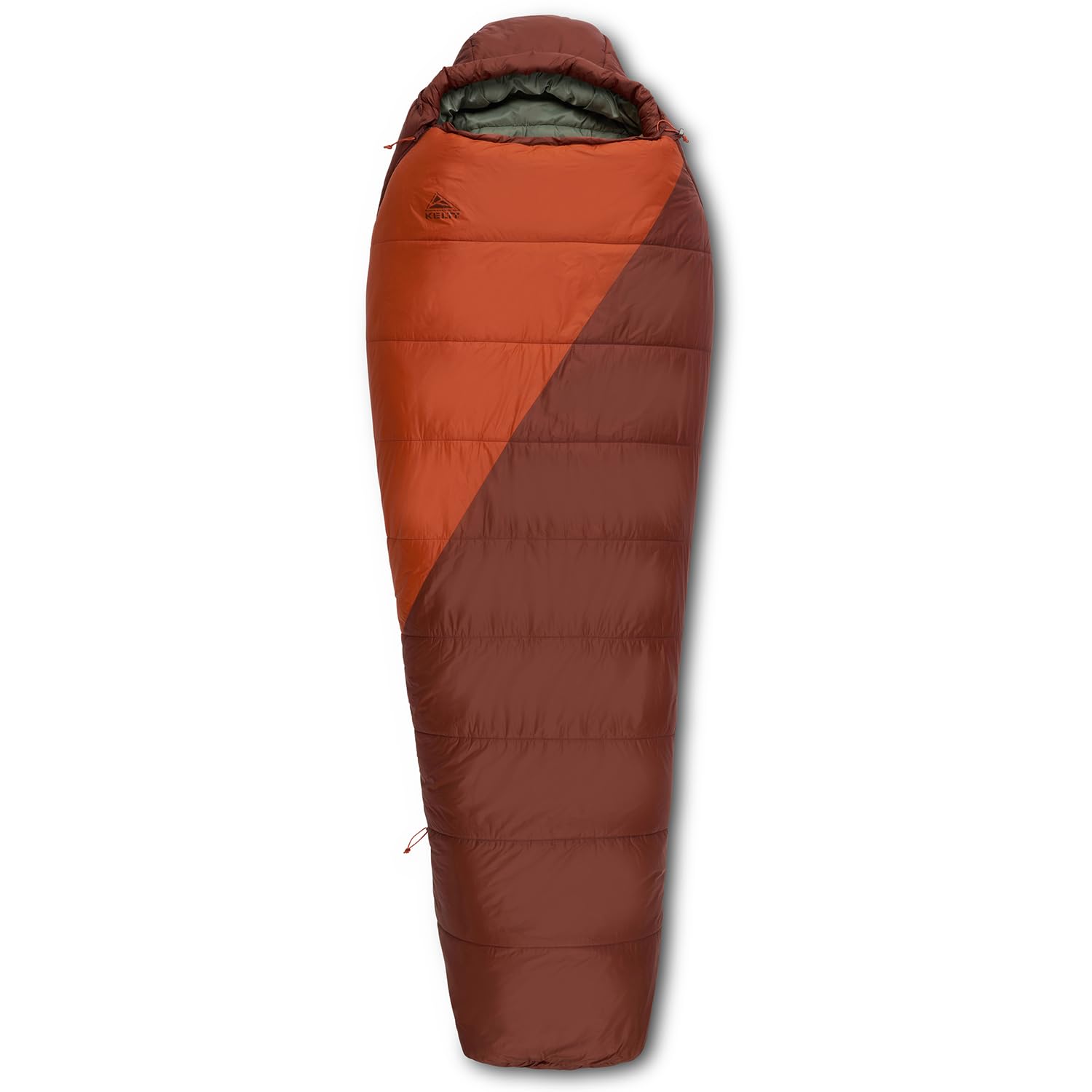
2. Kelty Cosmic Synthetic Fill 0 Degree Backpacking Sleeping Bag
Built for nights when your tent is wetter than the trail outside it.
Kelty’s Cirroloft synthetic fill is the reason this bag exists. Down loses loft when it gets damp and stops trapping heat; synthetic insulation keeps its structure through wet and cold conditions, which is exactly the failure mode that ruins winter trips in the Pacific Northwest, the Appalachians, and anywhere the humidity follows you into the tent. The overall weight lands at 5.5 pounds, so it is heavier than the QEZER down bag that shares its 0 degree rating. That weight is the price you pay for insulation that does not care about moisture.
The construction details are serious. The regular size fits sleepers up to 6 feet and carries 55 ounces of fill, which is a lot of insulation for the shell it lives in. The non-compressed stuff size measures 17 by 11 inches, and the integrated stuff sack has compression straps sewn into it, so you can cinch it down without a separate bag. A stash pocket on the exterior of the bag handles the phone or headlamp you want within reach from inside.
The trade-offs are split, and worth knowing before you buy. The shoulder width is narrow — a shoulder-heavy sleeper will feel it. And one owner received a defective unit with lopsided sewing and a puckered footbox, though the material and finish on functioning units drew praise for feeling good against the skin. That is what a lifetime warranty is for. The fill itself earned a simple verdict from a cold-weather camper in Massachusetts: “Excellent 0 degree bag! Synthetic and durable, yet lighter than the down version and toasty warm in sub-freezing temps.”
Where the value sits: a PFC-free nylon and polyester build with a lifetime warranty, priced above the budget tier but below the premium down options — reasonable when you calculate what wet-weather reliability is worth on a trip you cannot abandon.
One thing to know: the 6-foot regular length is the ceiling. If you are taller, size up or look at the QEZER 650FP bag that fits up to 6’5″.
Best for: wet-climate winter campers who value a bag that still insulates after a soaking.
Think twice if: every ounce counts on your pack list — this is the heaviest pick on the list.
3. QEZER Down Mummy Sleeping Bag, 600 Fill Power
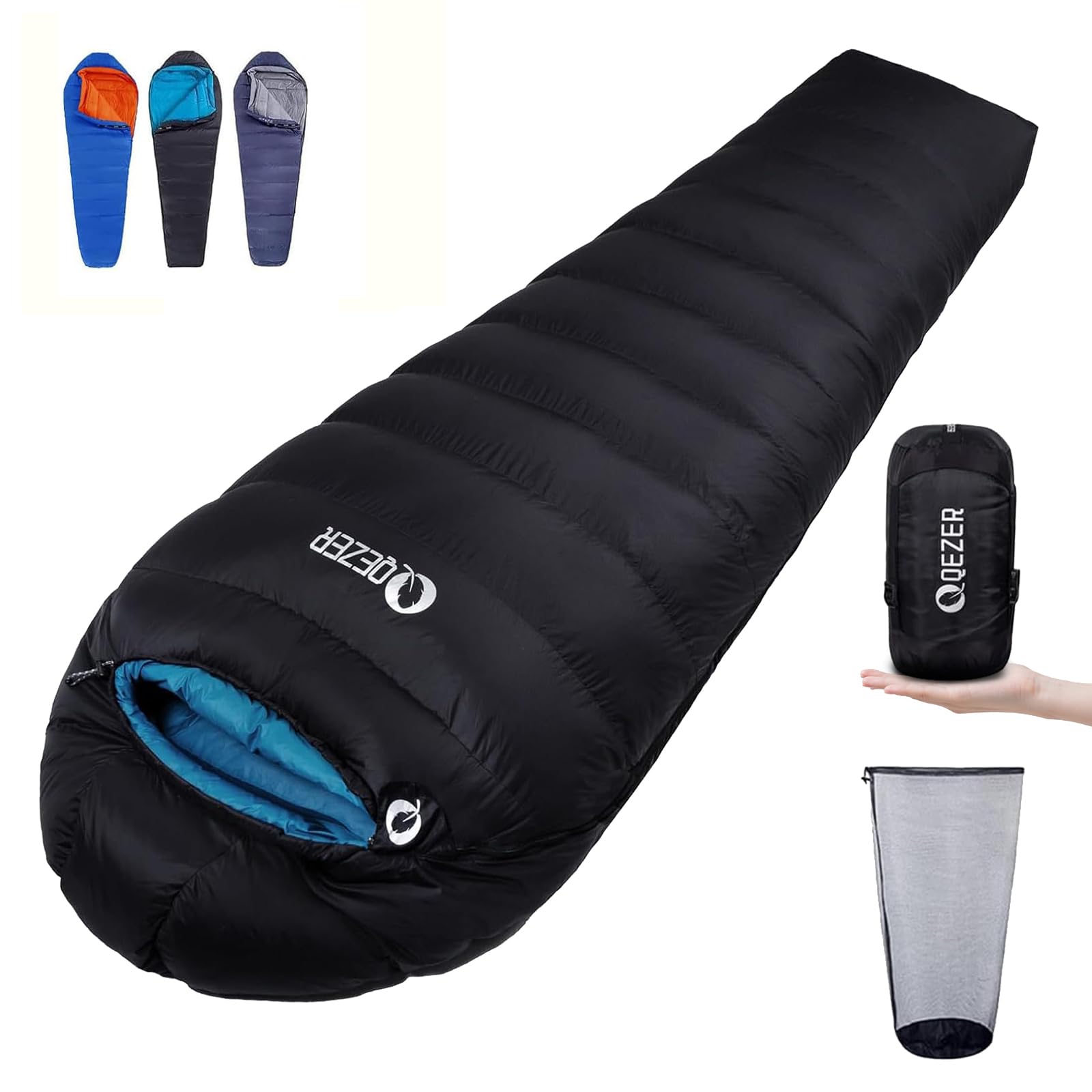
600FP down that compresses to 17.32 by 8.66 inches and still claims a 0 degree rating.
Three and a half pounds of duck down at 600 fill power is the headline, and it is a real one. The 600FP number tells you how much air one ounce of down traps — higher is warmer per ounce — and the maker literally rates it warm from 0°F to 18°F, with a limit temperature of -11°F. If you have ever carried a synthetic bag up a long approach, the difference in pack volume is what converts people to down. This bag compresses into a 17.32 by 8.66 inch storage size and 84.65 by 31.89 inch use size, giving it a longer and wider footprint than the Kelty Cosmic, which measures 68 by 30 inches.
The design favors comfort that down bags usually skip. The wide trapezoidal footbox keeps your toes from fighting a taper at 3 a.m. The 400T tear-resistant nylon on both the outer and inner shell keeps the down from working its way out and holds up to tent-floor friction. Cotton is added at the chest position specifically for extra thermal mass. Left and right zippers mean two of these bags can zip together for a pair. A small interior pocket keeps keys or a phone from disappearing into the bag.
Here is where the reviews split, and it matters. The recurring gripe is the hardware: the zipper and hood drawstring both draw complaints about feeling cheap, and heat seeps out around the zip. That is the honest weak spot. Sleepers who use it inside the 0°F to 15°F comfort band and layer a pad underneath describe it as well-insulated and free of cold spots. Below that band, add a layer between you and the zip.
The real-world read: a strong entrant in the mid-range down slot — you get premium down fill and compression without the premium-tier bulk, as long as you accept the zipper quality that comes with it.
This one suits: backpackers who want down warmth and minimal pack space and will treat the zipper gently.
Better options exist if: you expect rough hardware or need a shell built like a tool.
4. QEZER 0 Degree Down Sleeping Bag, 650 Fill Power
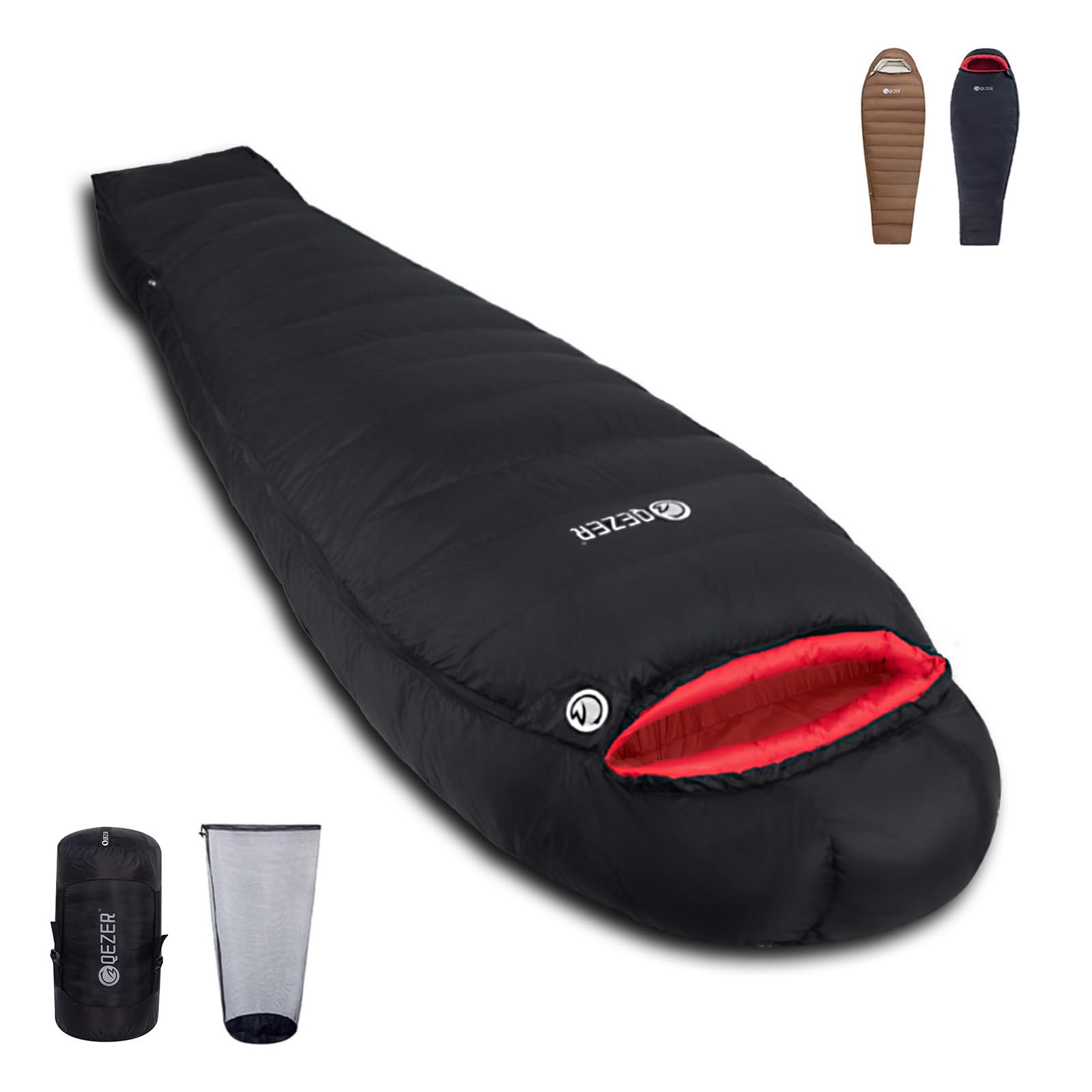
88.58 inches of length and 650FP down — the bag tall sleepers stop shopping after.
The upgraded version of the QEZER down formula, and the 650 fill power number is the first thing to notice — higher than the 600FP sibling below it. The vertical baffles inside the shell are the real engineering story: they keep the down from sliding into one corner of the bag, which is what ruins loft distribution in cheaper bags over time. A windshield flap behind the zipper blocks air convection. The saddle-shaped neck wraps tighter than a standard collar to slow heat loss at the neckline, and the ergonomic footbox gives toes a defined space rather than a pinched taper.
The length is the reason tall sleepers should start here. At 88.58 by 32.28 inches, this bag runs longer than the Kelty Cosmic, giving real room to a 6’2″ sleeper — the manufacturer states it fits up to 6’5″. The spec sheet reads 2.86 pounds of 650FP white duck down with a comfort range from 0°F to 18°F and a limit temperature of -11°F. Packed size matches the sibling at 17.32 by 8.66 inches. A mesh storage bag comes with it, so you can hang the bag between trips and let the down breathe.
The nuance here is the zipper, and it deserves a fair description. The zipper is a regular brand — not a premium hardware name — and it occasionally catches, which owners describe as needing a slow, deliberate zip. Durability is the other split. Down feathers leaking after months of regular use is the complaint that turns up, and one owner dealt with it by patching the shell and kept using the bag. Most owners find the warmth and reliability worth the maintenance. Keep a repair patch in your kit and the bag serves you for years.
The Case It Builds
- 650FP down beats the 600FP sibling on warmth per ounce
- 88.58-inch length opens the door for taller sleepers
- Vertical baffles keep the down evenly distributed for fewer cold spots
- Mesh storage bag included to preserve loft between trips
The Maintenance Reality
- Zipper catches on occasion and needs a careful pull
- Occasional feather-leak needs a patch to keep the shell sealed
- 4.1 pounds packed weight is heavier than the 600FP sibling
For you if: you are over 6 feet and want serious down warmth without premium-tier pricing.
Skip if: you want zero maintenance and never plan to carry a repair patch.
5. BUERTS 680 Fill Power XL Down Sleeping Bag
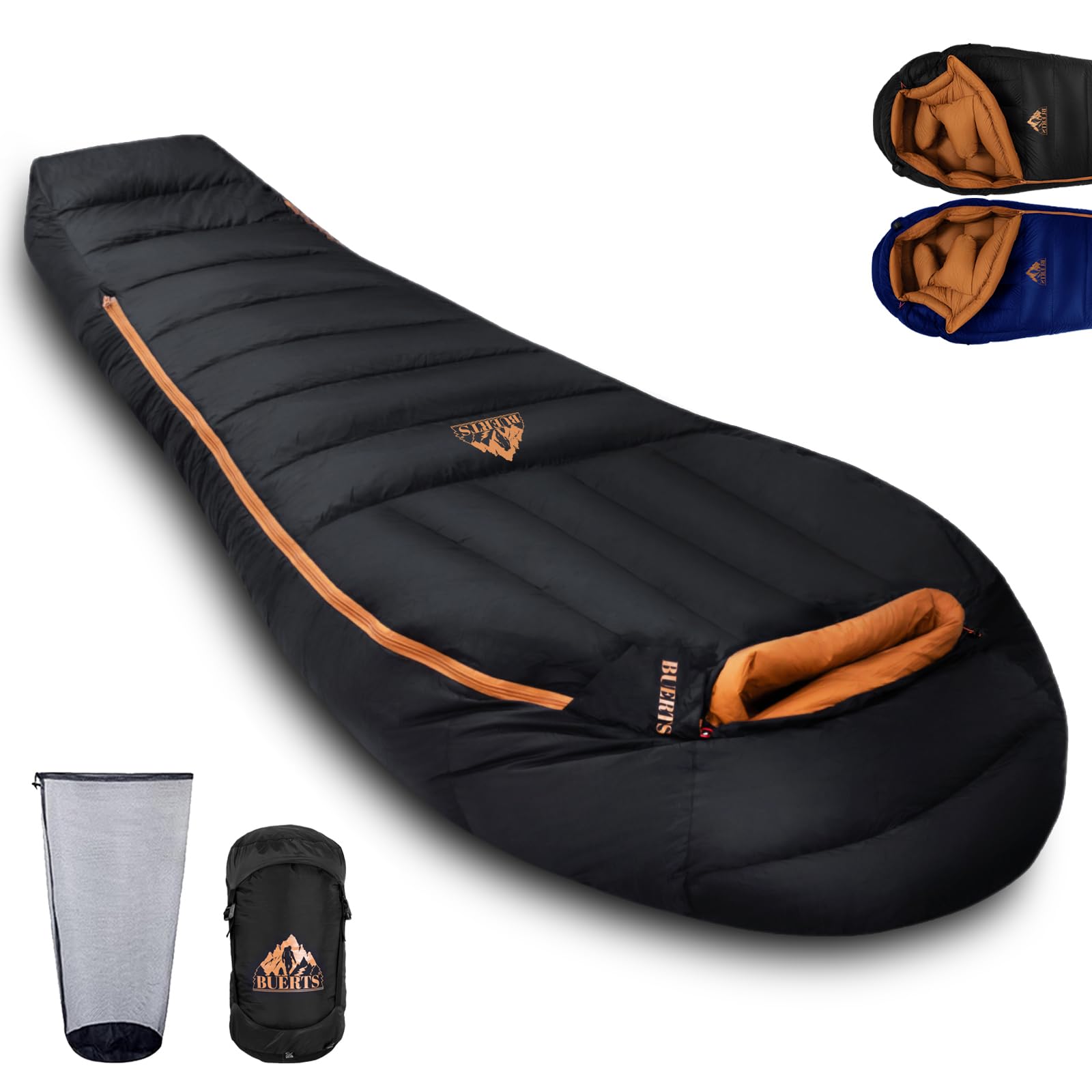
The widest bag here at 34.6 inches, with the best down in the group — and a leak issue you need to know about.
Two point four three pounds of RDS-certified traceable duck down at 680 fill power is the top insulation number on this list. RDS-certified means the down is traceable through the supply chain, and 680FP traps more warmth per ounce than the 650FP bag above it. The interior measures 88.5 by 34.6 inches — wider than the QEZER 650FP at 32.28 inches — so broad-shouldered sleepers and side-sleepers who roll get actual room to move. Widened shoulders, widened sides, and a widened foot area compound the effect. The packed size of 7.8 by 15.3 inches is the smallest on this list.
The build details are well thought out. The 400T 20D nylon shell is water-repellent, windproof, and anti-static. An interior pocket takes a phone or a small camera, and a foot-area mesh pocket handles a spare layer. The zip connects to a second BUERTS bag for a double-wide setup. It ships with both a compression sack and a mesh bag, so you have a tight carry option and a storage option for between trips. The saddle-shaped neckline wraps the neck to reduce heat loss, same concept as the QEZER bag.
Here is the honest part, and it is the reason this bag lands near the bottom of the list. Down leakage is the recurring complaint — one owner woke up looking like a plucked chicken, and a second reported feathers escaping within a few trips. The zipper also draws mixed feedback, with snagging and jamming coming up more than once. Warmth itself earns praise — an elk hunter stayed comfortable at minus 8 degrees, and a separate owner sweated at 38°F on a 5-day trip. That contrast tells you something: the fill is overbuilt for moderate cold and underwhelming in the shell that holds it.
Trail verdict: this is a premium-tier bag whose insulation earns the money but whose shell asks for gentleness in return. If feathers escaping drives you crazy, the QEZER 650FP above is a safer bet.
Ideal for: wide sleepers who want the best down on the list and will accept some feather leak as the trade.
Not for you if: a bag that sheds down over weeks is a non-starter.
Understanding the Specs
Fill Power
Fill power measures how much volume one ounce of down loft fills — typically in the range of 550 to 900 for backpacking down bags. A higher fill power traps more air per ounce of feathers, which means a bag can be lighter and compress smaller while still keeping its temperature rating. The bags on this list range from 600 to 680 fill power, and that difference shows up in packed size and total weight. Synthetic-filled bags do not carry a fill power number because the insulation is not down. If your priority is a light pack and small bulk, higher fill power wins. If your priority is a bag that survives damp conditions, synthetic fill covers a different risk entirely.
Temperature Rating and the Pad You Pair It With
A sleeping bag traps heat, but the ground underneath you pulls it out. That is why a 0 degree bag sits unused in your closet if it is paired with a summer pad — the pad has to insulate your back as much as the bag protects your top. Comfort, limit, and extreme ratings are three different numbers, and the comfort number is the one to care about for sleeping well rather than surviving. In practice, a sleeping bag rated to 0 degrees still wants a winter-rated pad underneath it in real cold conditions. Pair the two correctly and the temperature on the label starts to describe your actual night.
FAQ
What does a 0 degree rating actually mean when I sleep cold?
Is a down or synthetic 0 degree bag better for backpacking?
How heavy should a 0 degree backpacking sleeping bag be?
Will a 0 degree mummy bag fit a side sleeper?
Do I need a specific sleeping pad under a 0 degree bag?
How do I store a down sleeping bag so it keeps its warmth?
How do I stop down feathers from leaking out of a sleeping bag?
Can I zip two 0 degree bags together into one?
Are 0 degree bags too warm for 3 season backpacking?
How long does a down sleeping bag last with regular use?
Final Thoughts: The Verdict
For most cold-weather backpackers, the 0 degree backpacking sleeping bag to carry is the TETON Sports ALTOS. It carries 3.5 pounds of synthetic fill that runs hot enough to keep a cold sleeper comfortable at 20°F, and it does it without demanding the fit flexibility of a down bag or the cash outlay of premium options. If your trips put you in wet, humid cold where down becomes a liability, the Kelty Cosmic Synthetic carries 55 ounces of Cirroloft fill in a PFC-free shell backed by a lifetime warranty. And for tall sleepers who want the lightest, most compressible warmth on this list, the QEZER 650FP down bag is the one to reach for. Whichever you choose, match the bag to a winter-rated pad underneath it — that pairing matters more than any label on the shell.
How We Picked
We do not accept paid placement. Every pick is matched to a real buyer and a real use-case; we do not hands-on test units.
Sources & Methodology
Specifications: manufacturer listings and product documentation. Review insights: verified customer reviews, as of September 2026. Pricing: not shown on this page (it changes often); check the current price via the retailer link.
As an Amazon Associate, Non Toxic Blog earns from qualifying purchases. This does not affect which products we feature.