Specs are compiled from manufacturer listings and verified buyer reviews and can change over time — please confirm the key details on the product page before buying.
Zero-degree nights are where cheap bags quit — you wake at 3 a.m. cold, curl into a ball, and the rest of the trip is damage control. This guide cuts straight to the bags that actually hold their heat below freezing while still fitting in a backpack, and it tells you plainly which one suits the nights you really camp.
I’m Mo Min — the founder and writer behind Non Toxic Blog. This guide is built by comparing the manufacturers’ published specifications and the patterns across verified customer reviews, so you get each pick’s real strengths and trade-offs instead of marketing spin.
A bag that claims zero degrees and a bag you can actually sleep in are two different things. The difference depends on fill type, loft, and pack weight. Below, every pick is sorted by what it does best, so you can match one to your coldest trip with a 0 degree lightweight sleeping bag.
Our Picks at a Glance

How To Choose The Best 0 Degree Lightweight Sleeping Bag
Most buyers get burned by the same thing: they read “0 degree” and assume that is the temperature they will sleep comfortably at. On nearly every bag, that number is the limit rating — the point where you survive, not the point where you are snug. The comfort rating usually sits well above it. If you sleep cold, aim for a bag rated colder than the night you expect.
Down Versus Synthetic Fill
Down (natural feather clusters) gives you the most loft for the least weight, which is why serious backpackers chase it. The catch is that down loses its loft when it gets soaked, so a water-resistant shell matters. Synthetic fills are heavier for the same warmth but keep working when damp — a real advantage in wet, coastal, or humid conditions.
Fill Power And Loft
Fill power is a number that tells you how much space one ounce of down fills — higher means lighter and pack smaller for the same warmth. Loft (the bag’s fluffiness) is what actually traps your body heat. A bag with high loft and well-distributed fill has no cold spots, which is the single most common complaint on cheaper bags.
Weight, Stuff Size, And Fit
Weight and packed size decide whether a bag is genuinely backpacking gear or a car-camping brick. A mummy cut (tapered, snug around the shoulders and legs) saves weight but can feel tight for broad-shouldered or side sleepers. Check the bag’s length and shoulder width against your own measurements before you buy, and always pair a cold-weather bag with an insulated sleeping pad — the pad keeps ground cold from pulling heat out of your back.
Quick Comparison
| Model | Best For | Fill Type | Temp Rating | Weight | Amazon |
|---|---|---|---|---|---|
| Teton Celsius 0F★ Best Overall | Cold sleepers who want room to spread out | Polyester fiber / flannel lining | 0F (25F/20F/0F multi-rating) | 5 pounds | Amazon |
| Kelty Cosmic Synthetic 0Wet-Weather Pick | Wet-weather backpacking on a budget | Cirroloft synthetic | 0F | 5.5 pounds | Amazon |
| QEZER 600FP Down Mummy | Lightweight winter trips | 600 fill power duck down | 0F (-11F limit) | 3.5 pounds | Amazon |
| OMVMO Rectangular Down | Side sleepers who want legroom | 800 fill power goose down | 0F | 4.2 pounds | Amazon |
| QEZER 650FP Down Mummy | Deep-winter warmth in a compact pack | 650 fill power duck down | -22F (upgraded) | 3.4 pounds | Amazon |
| Teton Altos 0 Degree | Tall broad-shouldered backpackers | Water-resistant down | 0F | 3.4 pounds | Amazon |
In‑Depth Reviews
1. Teton Celsius Regular, 25F, 20F, 0F Degree Sleeping Bag
Our pick — 4.5★ from 3,500+ verified ratings; the strongest balance of quality and price.
The roomy workhorse that keeps cold sleepers comfortable below freezing.
The Teton Celsius earns its spot because it keeps you warm in real cold without squeezing you into a tight mummy shape. It is a multi-rating 0F bag (0F means it is built for nights around zero degrees Fahrenheit) with a polyester fiber fill — a synthetic insulation that keeps working even when damp. A double-layer construction and draft tubes (the fabric flaps that block air from sneaking in through the zipper) hold the heat in. A soft poly-flannel lining and a half-circle mummy-style hood keep your head warm and your pillow clean.
What wins people over is the warmth. Among the bag’s owners, warmth is far and away the most-raved-about quality, with comfort close behind — a large body of feedback that this thing keeps you snug in genuinely cold, subzero-feeling conditions. The flannel lining is a crowd favorite too: it feels like a bed rather than a slick synthetic shell, which is exactly what you want when you are tired and just want to sleep. Value is the third thing that keeps coming up — it simply feels like a lot of bag for the money.
The trade-off is weight and interior feel. At 5 pounds, this is not the bag you choose to shave grams off a fastpacking load — unless creature comfort matters more to you than the number on a scale. The size reads mixed: some owners say there is plenty of room to spread out, while others find it tight-feeling inside despite the generous 79.92″L x 33″W footprint. One matching detail — unlike the featherweight down bags further down this list, the Celsius is the pick for people who want a plush, familiar sleeping experience over cutting-edge low weight.
Where The Celsius Earns Its Keep
- Warmth is the property owners single out most — a huge chunk of the review base confirms it sleeps warm in real cold
- Soft poly-flannel lining and a half-circle hood that keeps your head and pillow covered
- Double-layer construction, draft tubes, and a durable stuff sack included for no-roll packing
- Comfort gets the second-largest block of praise — among the most comfortable-feeling bags at this price
What To Know Before You Commit
- At 5 pounds it is on the heavy side for ultralight backpacking
- Interior space is a matter of taste — some find it roomy, some find it snug
Best for: cold sleepers, side sleepers, and car campers who prize comfort and warmth over a featherlight pack.
Not for: gram-counting backpackers who want the lightest possible load on a long thru-hike.
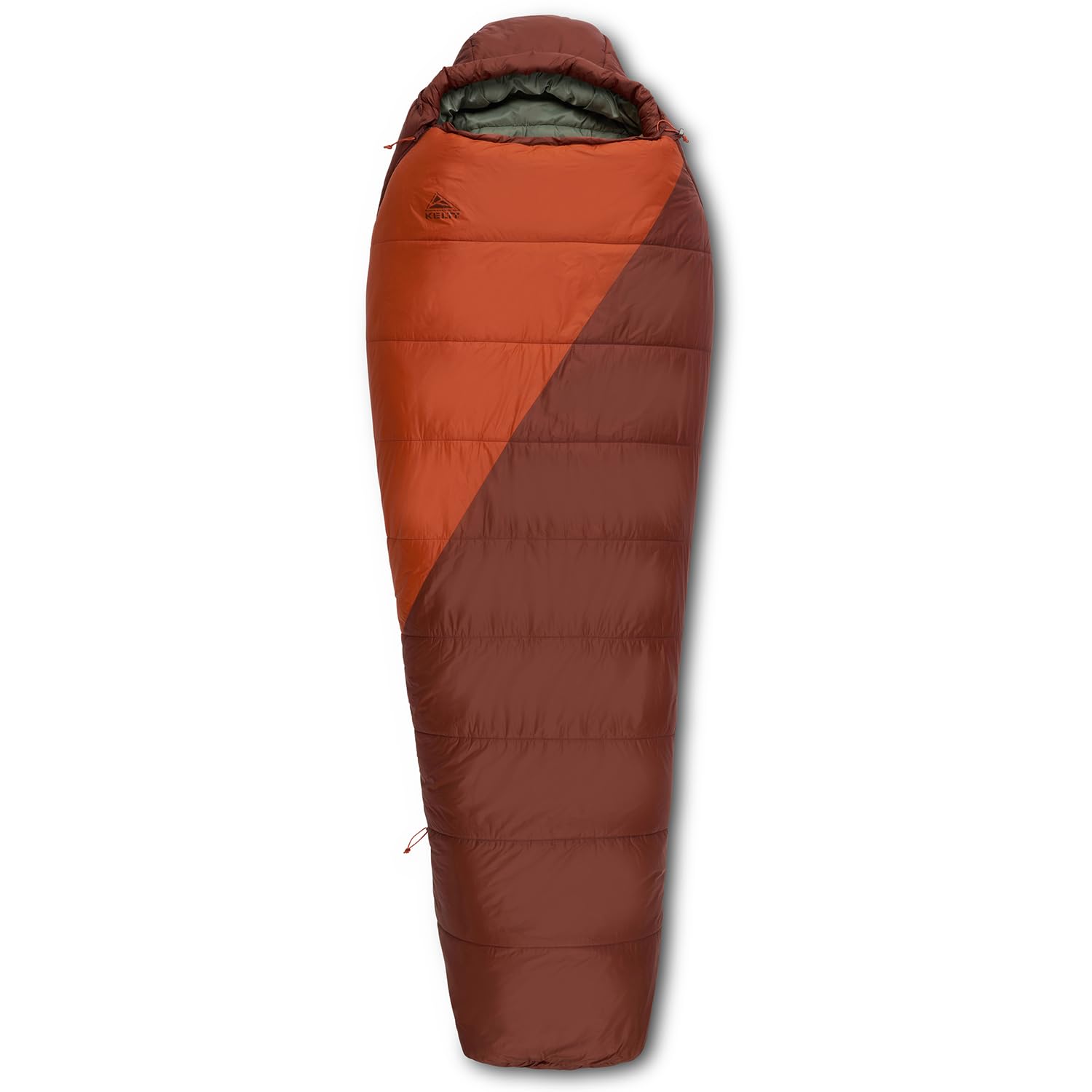
2. Kelty Cosmic Synthetic Fill 0 Degree Backpacking Sleeping Bag
The damp-weather bag that stays warm even when the sky will not let up.
Here is where the fill type earns its keep. The Kelty Cosmic uses Cirroloft synthetic insulation (man-made fibers that hold their loft when wet), which is precisely why it stays warm in the cold and damp that would flatten a down bag. It is rated to 0 degrees, fits sleepers up to 6ft in the Regular size, and packs into a stuff sack with integrated compression straps — the kind of packability that keeps backpacking loads manageable. It also carries a Kelty Limited Lifetime Warranty.
Real-world results back it up. Buyers report the Cosmic keeps them warm down to freezing and below — the bag earns praise for warmth and for its value, and several long-term users treat it as their go-to cold-season bag in a wet climate. The synthetic fill also helps here: it is more forgiving of damp than down, so a little condensation on the shell will not ruin your sleep.
The honest trade-off is pack weight. At 5.5 pounds, the Cosmic is heavier than every down bag on this list, and a few owners note that is a lot to carry on a trail. It is also narrow at the shoulders — one buyer with broad shoulders found it too snug. Compared directly to the down QEZER bag in this guide, the Kelty weighs 5.5 pounds against the QEZER’s 3.5 pounds — a real two-pound difference on your back over a long day.
Damp-weather smarts: the Cirroloft synthetic fill keeps loft in cold, humid conditions where down struggles, and the integrated compression straps make the bag genuinely packable despite its heft.
The honest catch: at 5.5 pounds, this is a bag you feel on your back — the down options further down the list shed weight the Kelty keeps.
Reach for this if: you backpack in wet, humid, or coastal conditions and want warmth that does not collapse when the shell gets damp.
Look elsewhere if: every ounce counts or you have wide shoulders that need a roomier cut.
3. QEZER Down Mummy Sleeping Bag for Adults, 600 Fill Power Backpacking
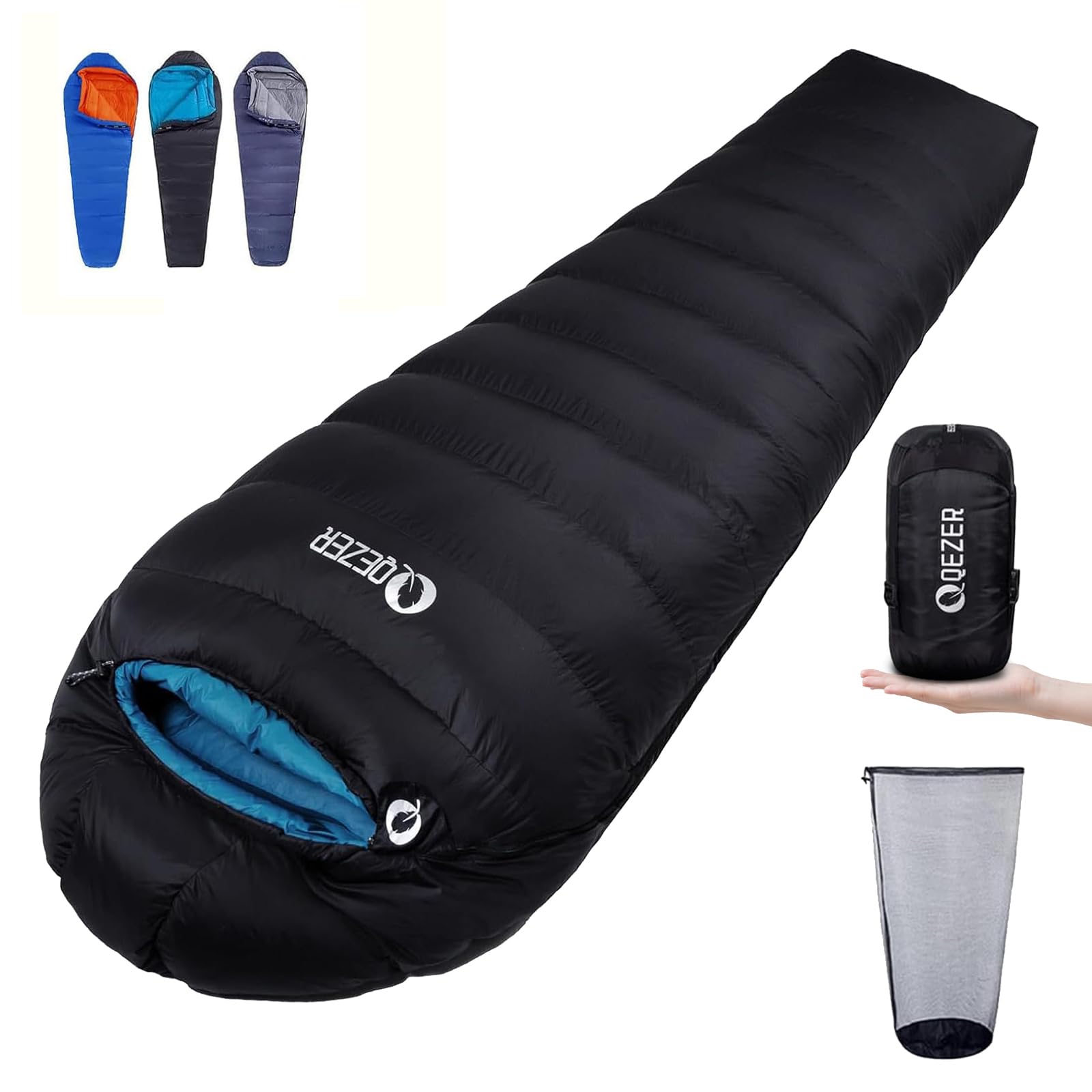
Genuine down warmth at a price that undercuts the premium bags.
The QEZER bag wins on warmth-to-weight because of its fill: 3.3 pounds of selected duck down at 600 fill power (the loft-per-ounce rating — higher down packs lighter for the same warmth). That down sits inside a 400T tear-resistant nylon shell that also keeps the down from escaping. The bag measures 84.65″ x 31.89″, packs down to 17.32″ x 8.66″, and weighs just 3.5 pounds. The chest area is boosted with extra cotton insulation, and it carries a comfort rating of 0°F to 18°F with a limit of -11°F (the coldest temperature it is built to handle).
Owners get exactly what the specs promise. Warmth and quality are what the review base talks about most, and a recurring theme is that the down loft is even, with no cold spots or clumps — the failure mode that ruins cheap bags. One reviewer noted using theirs down to 15°F and staying comfortable, and the general read is that this bag compresses small for backpacking and punches well above its price against bags that cost far more.
Know the limits before you trust the label. A few owners find the zipper and hood drawstring feel cheap, and one noted the zipper lets some heat escape. Legroom is snug for some — a taller owner said the leg space felt tight. And one owner comfortably used it to 15°F but would not push it to the full 0°F rating without more layers. It is a real lightweight down bag at a fair price, just not a survival-rated arctic setup.
The weight win: at 3.5 pounds with 600 fill power down, this is the lightest way to get down warmth in this lineup — noticeably lighter than the 5.5-pound Kelty synthetic above.
Honest caveats: the zipper and hood drawstring are the weak points, and the real usable range stops closer to 15°F than the printed 0°F for cold sleepers.
Pick this one if: you want true down lightness and warmth on a budget and mostly camp in the teens and above.
Think twice if: you expect to sleep at the full 0°F limit or want premium zipper hardware.
4. OMVMO Rectangular Down Sleeping Bag for Adults Camping Backpacking
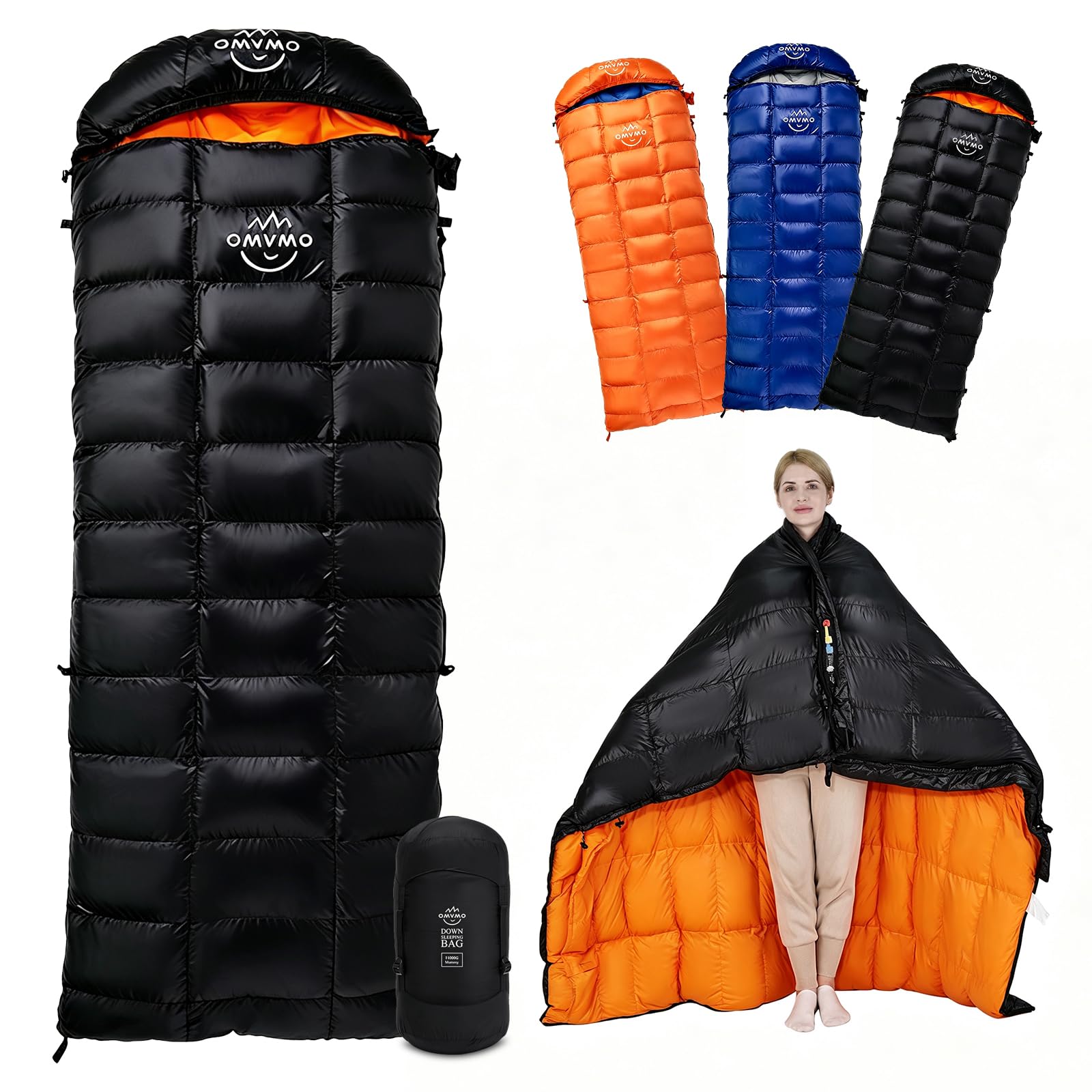
Rectangular cut, 800 fill power, and room to pull a knee up.
If you sleep on your side or you are tall, the OMVMO gives you room to move. It is a rectangular 0°F down bag with a huge 88.58″L x 35.43″W footprint — noticeably wider than the mummy bags here — so you can roll onto your side and pull a leg up without fighting the fabric. It uses over 80 independent rectangular 3D insulation lofts, filled with 800 fill power natural white goose down (a higher loft-per-ounce rating, so more warmth for less weight). It delivers that warmth at 4.2 pounds.
What sets the OMVMO apart is how many ways you can use it. It pairs with a matching opposite-zip bag to form a double sleeping bag, converts into a wearable cloak with shoulder buttons, attaches to an air pad with a buckle strap, and fully unzips into a down blanket or duvet. The shell is 400T 20D nylon with a DWR coating (a water-repellent finish), and it uses genuine YKK zippers with anti-snag sliders. Owners who took it on a 12-day Alaska moose hunt reported staying warm — some said it was even too warm — and praised how it compresses small for a bag this size.
Be realistic about the weight. It is mixed in the feedback: some owners find it lightweight for how big it is, while others note it is bulky in a backpack. That is the nature of a rectangular down bag — the comfort and room come with more fabric to carry. Also worth knowing: the draft collar sits low for some shorter sleepers, and the zipper hardware can feel confusing without instructions.
What Sets The OMVMO Apart
- Enormous 88.58″L x 35.43″W rectangular footprint that lets side sleepers spread out
- 800 fill power goose down over 80 independent 3D lofts for even, cold-spot-free coverage
- Converts to a double bag, a cloak, or a full down blanket — four functions in one
- YKK zippers with anti-snag sliders and a DWR-treated 400T 20D nylon shell
The Practical Realities
- Bulky to pack for some owners despite being light for its size
- Draft collar sits low for shorter sleepers, and the zipper setup can confuse without instructions
Best for: side sleepers, tall campers, and couples who want one versatile down bag that doubles as a blanket.
Skip the bulk if: you are packing into a tiny multi-day backpack where every cubic inch is chosen carefully.
5. QEZER 0 Degree Down Sleeping Bag for Adults, Cold Weather Backpacking
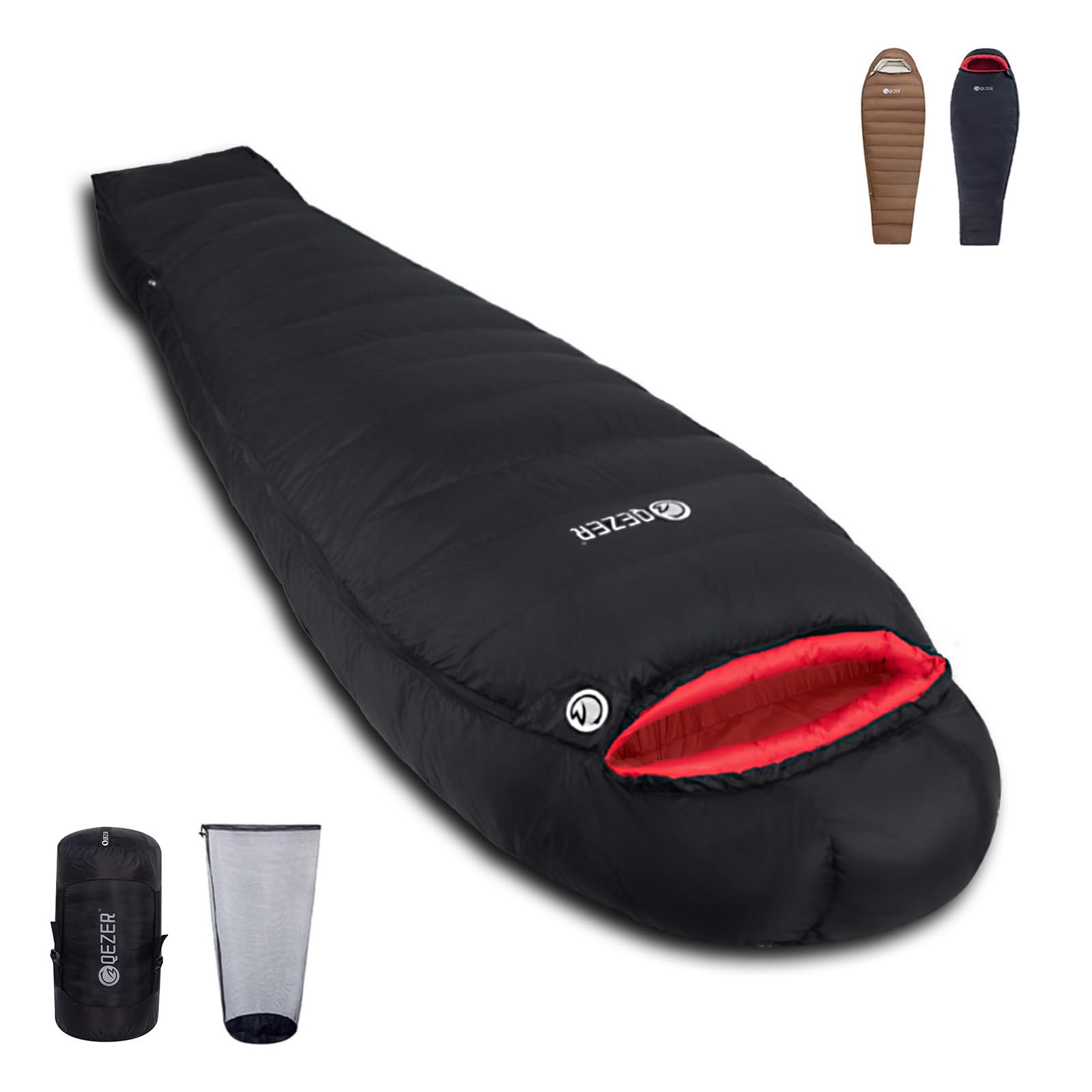
Built for the nights that scare off everyone else — down to -22°F.
When the forecast says single digits or worse, this is the bag on the list rated to match. The QEZER fills 4 pounds of 650 fill power premium white duck down into vertical baffles (the vertical compartments that keep the down from sliding and creating bare patches), and it is rated to -22°F. A windshield design at the zipper blocks air convection — the drafts that steal your heat along the closure — and the inner and outer 400T nylon fabric holds up in wet conditions. The package size is 18.11″ x 11.02″ and the bag weighs 3.4 pounds.
What owners rave about is unmistakable: this thing is warm. Warmth and quality dominate the feedback, with a fitted mummy shape, a soft warm nylon liner that warms almost instantly, and a saddle-shaped neck that wraps tight to stop heat loss. One owner took theirs across the country in a rooftop tent all winter with no heater and reported it handled low-teens temperatures with or without extra clothes. Another called it the warmest, most comfortable bag they had tried and noted it works well even for sensitive skin.
Two honest notes. The zipper is the recurring weak spot — several owners found it difficult or impossible to fully zip themselves in, and one long-term user reported a broken zipper after a few uses. Separately, some owners who sleep cold say the usable range tops out nearer 32°F rather than the full 0°F, so layer up if you are a cold sleeper. The others also mention the fabric is a bit crinkly.
Why it wins the deep-cold crowd: a -22°F rating with 650 fill power down, vertical baffles, and a windshield zipper that together hold serious warmth in a 3.4-pound package.
The real caveat: the zipper is the most-mentioned weakness — treat it gently and test it before a big trip, and cold sleepers should plan on layers below 32°F.
Go here if: you camp through real winter and need a bag rated far below freezing with down lightness.
Consider the alternatives if: zipper reliability is your top concern or you only ever camp in mild cold.
6. Teton Altos 0 Degree Sleeping Bag for Adults, Lightweight Warm Mummy Sleeping Bag
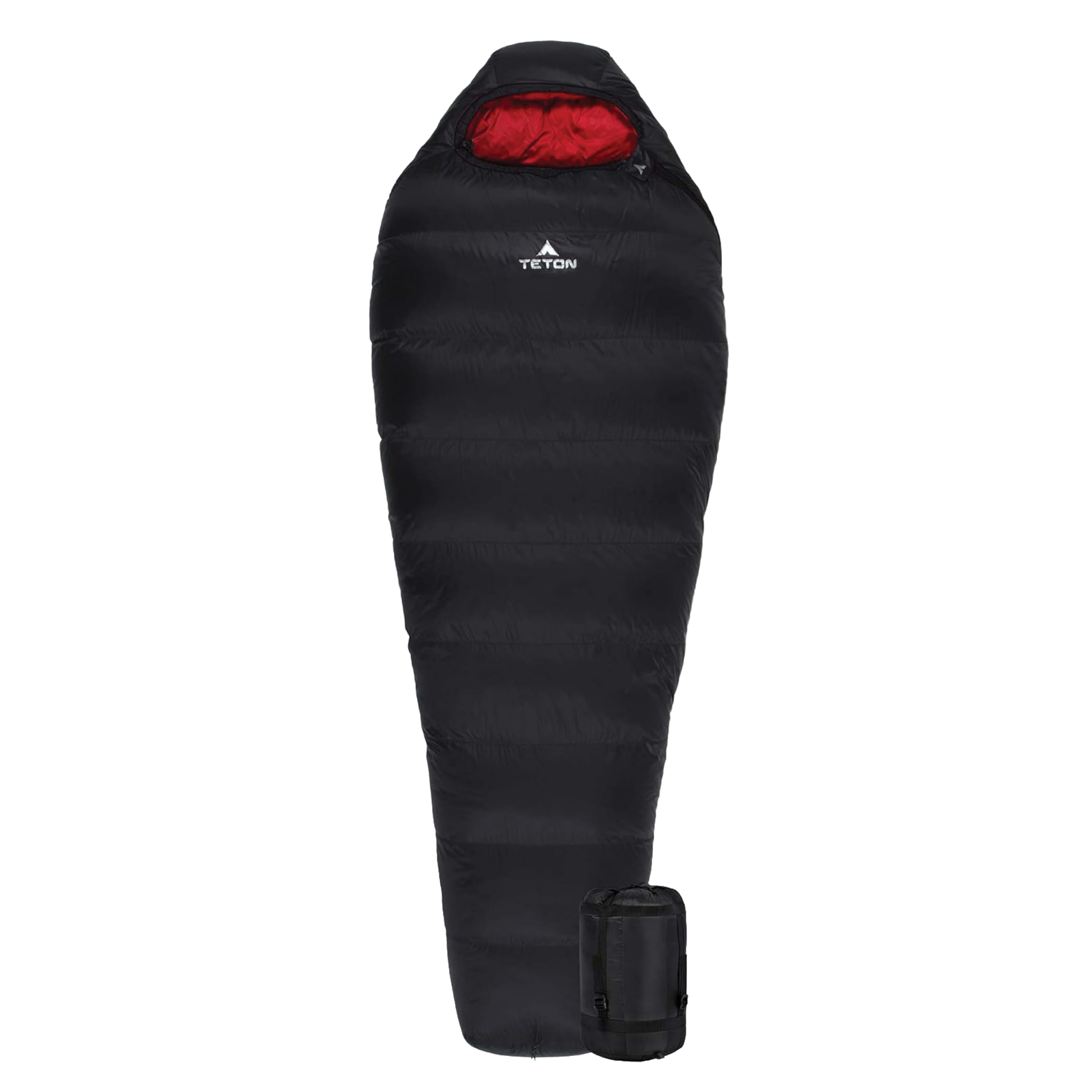
Legroom and shoulder room in a water-resistant down mummy bag.
Broad-shouldered and tall campers usually get pinched by mummy bags — the Teton Altos is built to fix that. It is a 0-degree down mummy bag with a roomier cut, a roomier shoulder and leg area, and a built-out footbox that gives your feet space instead of cramping them. The down fill is water-resistant, which helps it keep its loft if the shell gets damp, and it comes with a compression sack for no-roll packing. It weighs 3.4 pounds at 84″L x 33″W, and is recommended for sleepers up to 72 inches.
Owners confirm the fit works. One reviewer at 6’1″ and 260 pounds found room to move and said it warmed up within minutes; another noted the Altos is comfortable and adaptable for cold-weather backpacking. The water-resistant down and the roomy footbox are the two features that make it stand out in a lineup full of snug mummy bags.
Two things to weigh. The temperature rating is generous for some owners — one reported it sleeps more like 15-20 degrees than 0. And the included stuff sack is the weak link: at least one owner’s sack seam tore on the first repack, so treat the sack gently or plan on a sturdier replacement. For burly users, measure your full torso and elbow circumference first, because a too-tight cut compresses the loft and lets cold in even on a warm bag.
The fit advantage: a roomy mummy cut and built-out footbox that suit tall and broad-shouldered sleepers better than the tighter bags in this list.
Watch the details: the stated 0-degree rating runs warm for some owners, and the included stuff sack has torn for at least one buyer — buy or borrow a sturdier one.
Best for: tall, broad-shouldered, and larger-framed backpackers who need elbow and shoulder room.
Look elsewhere if: you are a very cold sleeper needing the full 0-degree rating or you want a bulletproof included stuff sack.
Understanding the Specs
Fill Power (Down)
Fill power measures how much space one ounce of down fills — the higher the number, the more loft and warmth you get per ounce, so you carry less weight for the same comfort. A 600 fill power bag and an 800 fill power bag can keep you equally warm at very different weights. Higher fill power also tends to pack smaller, which matters when backpack space is tight. The catch: down loses its loft when soaked, so look for a water-resistant shell or DWR treatment if you camp in wet weather.
Temperature Ratings: Comfort vs Limit
Almost every cold-weather bag prints two numbers: a comfort rating (the temperature a typical sleeper stays warm at) and a limit rating (the colder survival point). A “0 degree” label usually points to the limit figure, not the comfort figure — so a bag rated 0°F often feels right only down to the teens or twenties for cold sleepers. Match the bag to the coldest night you expect, then add a margin if you sleep cold. An insulated pad matters as much as the bag, because the ground pulls heat out of your back.
FAQ
Is a 0 degree sleeping bag warm enough for winter camping?
Down or synthetic fill for a 0 degree bag?
How much does a lightweight 0 degree bag weigh?
Will a mummy sleeping bag fit side sleepers?
Do I need a sleeping pad with a 0 degree bag?
Can I wash a down 0 degree sleeping bag?
What is the difference between 600 and 800 fill power down?
Do these bags work for car camping or just backpacking?
How do I keep a 0 degree bag from getting cold spots?
Final Thoughts: The Verdict
For most people, the 0 degree lightweight sleeping bag winner is the Teton Celsius because it delivers the most reliable warmth and comfort in real cold, with a roomy flannel-lined build that turns a freezing night into a good sleep. If damp weather is your reality, grab the Kelty Cosmic Synthetic, whose synthetic fill keeps its loft when the shell gets wet. And for genuine deep-winter camping, the QEZER 650 fill power bag is the one to reach for, rated down to -22°F in a 3.4-pound package.
Match the bag’s comfort rating to the coldest night you actually camp, and pair it with an insulated pad. Measure your shoulder width and torso length, then pick the bag whose cut and fill match your coldest expected night.
How We Picked
We do not accept paid placement. Every pick is matched to a real buyer and a real use-case; we do not hands-on test units.
Sources & Methodology
Specifications: manufacturer listings and product documentation. Review insights: verified customer reviews, as of September 2026. Pricing: not shown on this page (it changes often); check the current price via the retailer link.
As an Amazon Associate, Non Toxic Blog earns from qualifying purchases. This does not affect which products we feature.