Specs are compiled from manufacturer listings and verified buyer reviews and can change over time — please confirm the key details on the product page before buying.
If you want the one most buyers end up happy with, it is the Blytra 150W. It plugs straight into your cigarette lighter, needs no wiring, and starts warming your windshield within seconds of the button press. Here is the honest catch up front — every heater on this list draws its power from your car battery, not from a wall outlet, so the wattage number decides how much heat you get and how hard your electrical system works. Get the wattage wrong and you either get a weak breeze or a blown fuse.
I’m Mo Min — the founder and writer behind Non Toxic Blog. This guide is built by comparing the manufacturers’ published specifications and the patterns across verified customer reviews, so you get each pick’s real strengths and trade-offs instead of marketing spin.
Below you will find six verified 12-volt heaters, ranked so the plug-and-play favorites sit up top and the heavy-draw hardwire units sit at the bottom. For a sedan, truck cab, or UTV, the deciding spec is wattage: a lighter-socket unit tops out around 200W, while 500W and up needs hardwiring.
Our Picks at a Glance
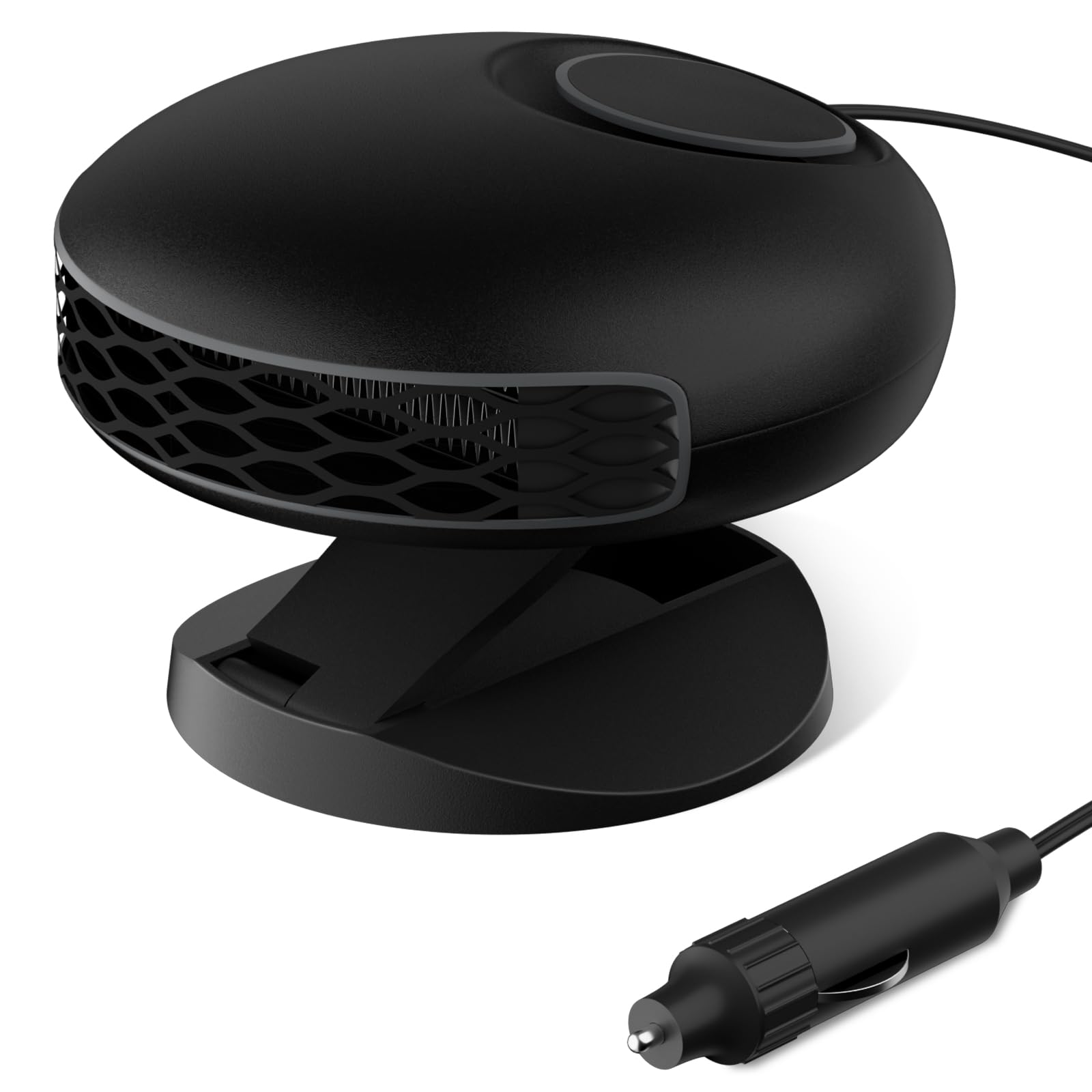

How To Choose The Best 12V Space Heater
A 12V space heater is not a small version of the heater that sits in your living room. It runs off your vehicle’s 12-volt DC system — the same electricity that powers your cigarette lighter socket. That single fact drives every decision you make. You are choosing how much of your car’s electrical headroom you want to spend on warmth, and the answer changes completely depending on whether you drive a sedan with a small alternator or a truck with a dedicated auxiliary circuit.
Start with wattage, because wattage is heat
Higher wattage means more heat, but it also means more electrical draw. The 150W units are gentle on your system and easy to plug in, while the 500W and 800W units push serious heat but demand heavier wiring. Match the wattage to what your outlet and wiring can safely feed — a lighter socket handles 150W to 200W, while 500W and up needs a hardwired circuit.
Check the amps before you plug anything in
Amperage is how much current the heater pulls while running, and it is the number that blows fuses. A standard cigarette lighter circuit usually tops out well below what a big hardwired heater needs. If your heater’s amperage exceeds your outlet’s rating, the fuse pops. This is the single most common mistake buyers make with these units.
Understand PTC ceramic versus bare coil
Most quality 12V heaters today use a PTC ceramic element — a self-regulating heating element that holds a steady temperature instead of spiking. That steadier, more controlled heat is why ceramic units tend to last longer and run safer than simple wire-coil designs.
Match the mount to where you actually drive
Dashboard units with a 360-degree rotating outlet are built for defrosting glass. Floor units with multiple outlet ports are built for warming feet and cab space. Decide if you need defrosted glass or a warm cab first, then pick the mount that does it.
Quick Comparison
| Model | Best For | Heat Output | Amperage | Power Source | Amazon |
|---|---|---|---|---|---|
| Blytra 12V 150W Car Heater★ Best Overall | Plug-and-play windshield defrosting | 150 watts | 12.5 A | Cigarette lighter (12V DC) | Amazon |
| CYDZSW 12V 800W Car HeaterMost Powerful | Maximum heat for hardwired setups | 800 watts | — | Hardwired to battery | Amazon |
| Blytra 12V 200W Car Heater | Fast defog with built-in fuse safety | 200 watts | 16.67 A | Cigarette lighter (12V DC) | Amazon |
| Portable Car Heater 12V 600W | Budget floor heat for cargo trailers | 600 watts | — | Hardwired (30 amp fuse recommended) | Amazon |
In‑Depth Reviews
1. Blytra 12V 150W Car Heater for Car Defroster Windshield Heater
Our pick — over 4.5★ from 50+ verified ratings; the strongest balance of quality and price.
The plug-and-play favorite that defrosts glass without touching your car’s wiring.
Here is the pick for the driver who wants warmth on a frosty morning and nothing more complicated than a socket. This is a heater that runs on 150 watts and draws 12.5 amps — modest numbers that let it live happily on a standard cigarette lighter circuit. It puts out 150 watts of heat through a PTC heating element housed in heat-resistant ABS hard plastic, and it heats up fast enough to start clearing frost instead of just blowing air at it. You also get two modes: a heating mode and a fan-only mode, which is what makes this usable year-round rather than just in December and January.
The part that sells people is the outlet. It rotates a full 360 degrees, so you can aim the warm air at your windshield, a side window, your face, or your feet. A self-adhesive dashboard mount holds the body in place, and by all accounts it holds firm on bumpy roads rather than sliding around while you drive. Installation is a single button and a plug — no drilling, no fuse tapping, no professional help. It fits most 12-volt vehicles, from sedans and SUVs to vans, campers, and taxis.
What actually wins people over, though, is the speed. Owners describe instant heat within seconds of flipping it on, quick defrosting of the windshield, and enough cabin warmth to matter on a cold morning. It is portable enough to move between vehicles, and it runs quiet. The honest limit comes from the physics: 150 watts is real heat, but it will not replace your car’s built-in heater on a deep-freeze morning — it is a helper, not a substitute. For a compact unit that never asks you to open the hood, that is a fair trade.
Why it takes the top spot
- True plug-and-play through the cigarette lighter — no wiring, no tools, no fuse work
- 150W PTC ceramic core heats in seconds and holds a steady temperature
- 360-degree rotating outlet aims heat at the windshield, side glass, or feet
- Heating and fan modes make it useful beyond winter
- Self-adhesive mount holds firm, and the unit moves between vehicles easily
Where it stops short
- 150 watts supplements your main heater but will not replace it in extreme cold
- Best suited to light frost and quick defogging rather than clearing thick ice
Reach for this if: you want frost-free glass and warm air from a socket, with zero installation.
Look elsewhere if: you need to bake a large cab warm from frozen — that job wants the higher-wattage hardwired units below.
2. CYDZSW 12V 800W Car Heater Battery Powered Windshield Window Defroster
The biggest heat number on the list — and the one that demands the most respect from your wiring.
If raw heat output is what you are hunting, this is the head of the class. It runs at 800 watts, which is more than five times the output of the 150W Blytra at the top of this list. That 5x gap over the 150W Blytra is why this unit shows up in forklifts and cabs that need a large temperature jump, not a nudge. Its PTC ceramic heating unit paired with an aluminum alloy body is built to heat quickly, hold a constant temperature, and — as the maker puts it — produce no flame and no burning.
Safety features are built in for a reason. There is switch overload protection and insulation protection, and the design is meant to avoid overheating your car battery. Installation is done by wiring, not plugging: you connect the red wire to the positive pole and the black wire to the negative, and the maker points to a video that walks you through it in under ten minutes. It is intended for 12V cars with gasoline engines, storage-battery cars, RVs, and similar vehicles.
This is the pick where the honest caveats matter most, and you should read them before buying. The heat output here is genuinely a mixed bag for owners — some report plenty of warmth, while others say it only blows cold air. There is also a real question of electrical compatibility: one buyer’s review warns that a hardwired 800-watt draw is too much for a standard car system. Because this unit wires directly to your battery rather than using a lighter socket, it is not a drop-in for every vehicle, and it is not the right choice if you want plug-and-play simplicity. Buy it for a truck, UTV, or work vehicle with the electrical headroom to feed it.
Power where it counts: at 800 watts this is the strongest heater here, and the aluminum alloy ceramic body is designed to heat fast and run at a constant temperature without a flame.
The catch to weigh: it hardwires to the battery with red-to-positive and black-to-negative connections, so it is not a lighter-socket heater, and owner reports on heat output run both warm and cold.
Best matched to: trucks, UTVs, forklifts, and RVs with a 12V battery and the wiring to support a high-draw heater.
Think twice if: you want something you can unbox and plug into a cigarette lighter — the two Blytra units above are built for exactly that.
3. Blytra 12V 200W Car Heater for Car Defroster Windshield Heater
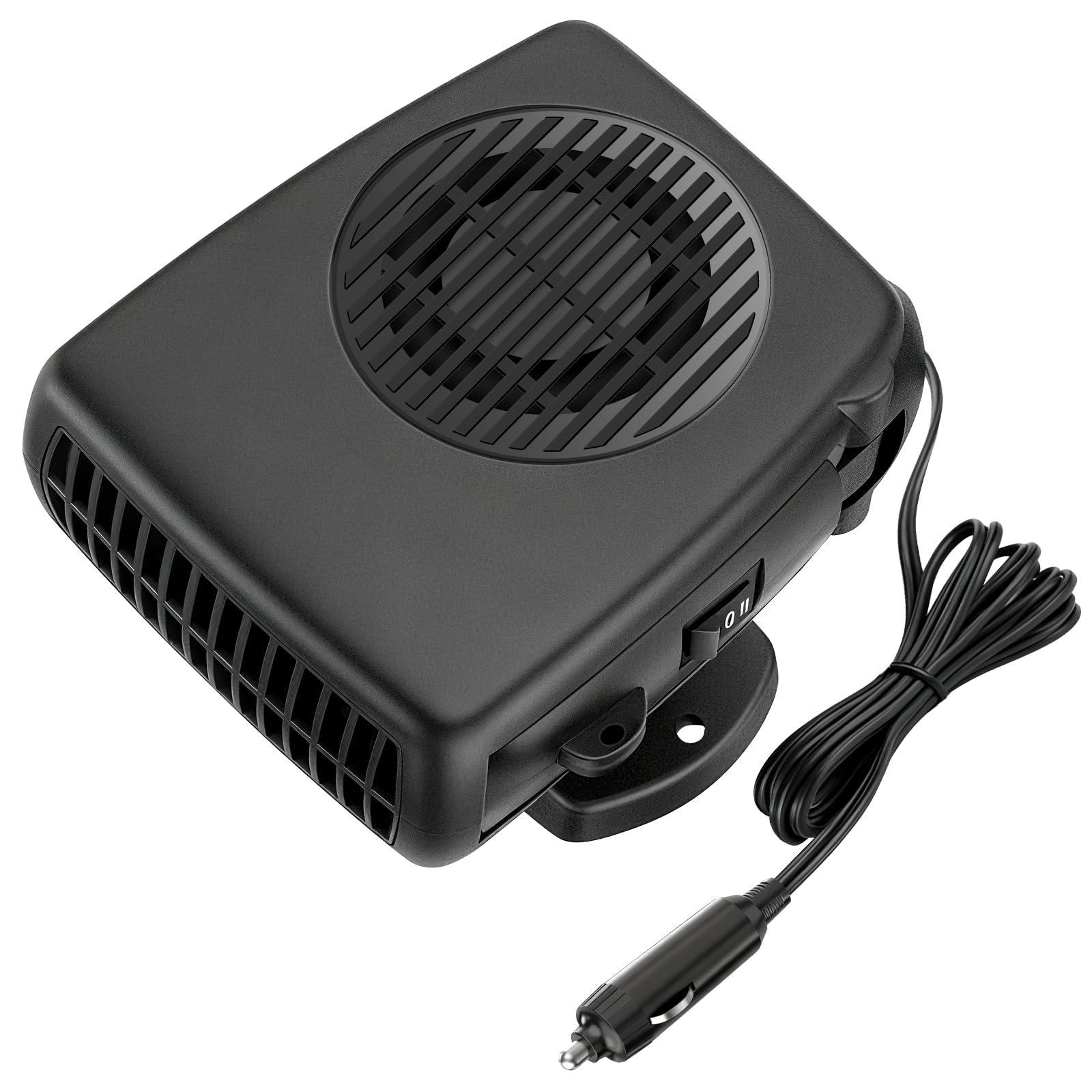
More heat than its little sibling, plus a fuse on the plug that watches your back.
This is the upgraded version of the top pick, and the upgrade is measurable. It runs at 200 watts and draws 16.67 amps — the 150W Blytra draws 12.5 amps, so this one pulls a third more current out of your socket. That extra draw buys you more heat and faster defogging, and it is still within what a well-maintained cigarette lighter circuit can feed. Inside, you get a PTC ceramic heating element for quick, stable temperature rise, wrapped in heat-resistant and wear-resistant ABS housing with premium pure copper wires.
The standout safety feature is the fuse built into the plug, which cuts power automatically if the unit overheats and lowers the electrical risk to your vehicle. The base rotates a full 360 degrees, letting you point heat at the windshield for defrosting or into the cabin for warmth, and there is a ventilation mode that keeps air moving in summer. Mounting uses a self-adhesive base that sticks to clean, dry interior surfaces — no drilling, no tools, and nothing a normal driver cannot do in a minute.
Owner experience lines up with the spec sheet here. Warm air comes through in about two minutes, it clears windshield fog in seconds, and it runs quiet. One buyer put it plainly — that it is “maybe appropriate for a small car but it’s going to take a long time to defog or de-ice.” That is the fair framing: at 200 watts this is a strong supplementary heater for quick warmups and light defogging, not a replacement for a full-size car heater on a hard freeze. For trucks, UTVs, and cold-morning commutes, it hits a good balance between power and plug-in simplicity.
Where it earns its keep
- 200W output with a 16.67 A draw — more heat than the 150W model while still plugging into the lighter
- Fuse built into the plug cuts power automatically on overheating
- Sturdy ABS housing and pure copper wiring for a longer service life
- Warm air in roughly two minutes; clears windshield fog in seconds
- 360-degree rotatable base plus a summer ventilation mode
The honest trade-off
- Still a supplementary heater — thick ice on a large windshield will take patience
- Draws more current than the 150W pick, so a tired lighter socket may complain
The smarter buy for most: if you want more heat than the base model and value the auto-cut fuse, this is the balanced middle.
Stay with the 150W instead if: your outlet is already loaded with other accessories and you want the gentlest draw.
4. DaisyInner 500W Car Heater 12 Volt Windshield Heater Kit
 Check Price on Amazon
A four-port floor heater built to spread warmth across a cab, not just a windshield.
This is a different animal from the dashboard heaters above. Where those aim a single stream at your glass, the DaisyInner unit uses a four-port design with dual switch controls on top — you can run one port or both depending on how much heat you need. It is a 12V, 500W unit, and it is built to tackle window fog and frost while also warming the space around it. The dual switches give you a low and a high setting rather than a single on/off, which is a real convenience when you want steady background warmth rather than a blast.
The physical footprint is compact at roughly 12.2 by 4.7 by 4.1 inches, so it fits a range of car models without eating dashboard space, and the maker describes it as energy efficient and quiet in operation. There is an important installation note in the listing itself: this 12V 500W heater must be matched with at least 4 square millimeters of pure copper wire, or the wire may burn out. That is not a suggestion — it is a hard requirement, and it tells you this unit expects proper hardwiring rather than a lighter socket. The listing also warns to supervise it during use, keep it away from flammables, and anchor it firmly with sturdy fasteners.
Owner feedback here is genuinely mixed, and it is worth being straight about that. Quality is the most-discussed topic, and buyers split — some find it good, others describe it as junk. Heat output draws criticism, with several reporting it does not warm properly and does not push hot air far. The flip side: some buyers report it keeps a small space tolerable, with one noting it held a Polaris Razor with a hard enclosure comfortable at around 20°F once the air was recirculating, while wishing it moved a little more air. It also drains the battery if left running while stopped — which is true of every hardwired 12V heater, not just this one. This is a niche pick for a fixed cab or small enclosure, not a daily-commuter defroster.
The design angle: four outlet ports and dual top-mounted switches let you run one side or both, spreading warm air across a cab instead of concentrating it on one spot.
Wire it right or not at all: the listing demands at least 4 square millimeters of pure copper wire, so this is a hardwired install, not a plug-and-go lighter job.
Consider this for: a sealed small enclosure, tent, or cab where you can hardwire it properly and want multi-directional floor heat.
Skip the hardwiring if: you drive a sedan and just want quick windshield defrost — the plug-in Blytra models suit that better and ask far less of you.
5. Portable Car Heater 12V 600W Defroster Fog Removing 3-Hole Electric Floor Heater

A three-hole floor heater with a big wattage number and a build-it-yourself wiring job attached.
For someone turning a cargo trailer, camper, or work vehicle into a warmer space on a budget, this is the value end of the list. It is a 12V, 600W floor heater with three air outlets and a two-gear temperature switch, and the maker lists the vent temperature at 75 degrees Celsius — the same “Three Hole Electric Floor Heater” concept you see marketed for heating feet and interior space. It uses PTC ceramic constant-temperature elements and is built from PVC and high-strength aluminum alloy. The maker positions it for gas-engine vehicles, trucks, buses, motorhomes, campers, construction vehicles, and boats.
Mounting is the flexible part. You can fix it to the workbench with self-tapping screws, tuck it into a concealed spot, or mount it at the bottom of a seat to warm your feet. That flexibility is what makes it useful in a project trailer rather than a passenger car. Just read the wiring carefully: one buyer reports you may need to add your own cigarette lighter plug, and if the plug carries a fuse, it needs to be a 30 amp one. On the two switches, the same buyer notes that flipping the first switch runs the fan high, and the second switch brings it down to low — so getting the airflow you want takes a moment to learn.
The most common theme in owner notes is that this heater performs more like a fan than a space heater — one buyer put it in their cargo trailer and wrote openly that it works better as a fan. That fits a low-cost project unit. It moves air and takes the edge off, but 600W only feels like heat in a sealed space — in a drafty trailer the warmth escapes as fast as it builds. As a piece of a bigger trailer-heating build, it earns its place. As your only heat source, it will leave you wanting more.
The value read: a 600W three-outlet floor heater with PTC ceramic elements and a 75-degree Celsius vent temp, at the least expensive end of this list — reasonable for a project cab or trailer build.
Plan the wiring: it likely needs a cigarette lighter plug added by you, and if that plug has a fuse it should be a 30 amp one — factor that into the install.
Pick it for: a cargo trailer, camper, or DIY project where you can hardwire it, add your own plug, and only need supplemental warmth.
Look past it if: you need real cabin heat on a commute — owners describe it as functioning more like a fan, so a plug-in Blytra is the better fit.
6. Portable Car Heater 12V 600W Defroster Fog Removing 3-Hole Electric Floor Heater
A three-hole floor heater with a big wattage number and a build-it-yourself wiring job attached.
For someone turning a cargo trailer, camper, or work vehicle into a warmer space on a budget, this is the value end of the list. It is a 12V, 600W floor heater with three air outlets and a two-gear temperature switch, and the maker lists the vent temperature at 75 degrees Celsius — the same “Three Hole Electric Floor Heater” concept you see marketed for heating feet and interior space. It uses PTC ceramic constant-temperature elements and is built from PVC and high-strength aluminum alloy. The maker positions it for gas-engine vehicles, trucks, buses, motorhomes, campers, construction vehicles, and boats.
Mounting is the flexible part. You can fix it to the workbench with self-tapping screws, tuck it into a concealed spot, or mount it at the bottom of a seat to warm your feet. That flexibility is what makes it useful in a project trailer rather than a passenger car. Just read the wiring carefully: one buyer reports you may need to add your own cigarette lighter plug, and if the plug carries a fuse, it needs to be a 30 amp one. On the two switches, the same buyer notes that flipping the first switch runs the fan high, and the second switch brings it down to low — so getting the airflow you want takes a moment to learn.
The most common theme in owner notes is that this heater performs more like a fan than a space heater — one buyer put it in their cargo trailer and wrote openly that it works better as a fan. That fits a low-cost project unit. It moves air and takes the edge off, but 600W only feels like heat in a sealed space — in a drafty trailer the warmth escapes as fast as it builds. As a piece of a bigger trailer-heating build, it earns its place. As your only heat source, it will leave you wanting more.
The value read: a 600W three-outlet floor heater with PTC ceramic elements and a 75-degree Celsius vent temp, at the least expensive end of this list — reasonable for a project cab or trailer build.
Plan the wiring: it likely needs a cigarette lighter plug added by you, and if that plug has a fuse it should be a 30 amp one — factor that into the install.
Pick it for: a cargo trailer, camper, or DIY project where you can hardwire it, add your own plug, and only need supplemental warmth.
Look past it if: you need real cabin heat on a commute — owners describe it as functioning more like a fan, so a plug-in Blytra is the better fit.