Specs are compiled from manufacturer listings and verified buyer reviews and can change over time — please confirm the key details on the product page before buying.
If your 10 inch flex duct keeps popping off the collar, tearing at the seam, or collapsing the moment your inline fan spins up, the problem is almost always the duct itself, not your install. A run that holds its shape, seals tight, and reaches where you need it solves nearly every headache in this category. This guide separates the runs that actually hold up from the ones that fight you the whole way.
I’m Mo Min — the founder and writer behind Non Toxic Blog. This guide is built by comparing the manufacturers’ published specifications and the patterns across verified customer reviews, so you get each pick’s real strengths and trade-offs instead of marketing spin.
Whether you are venting a grow tent, a dryer, a paint booth, or a portable AC, match the diameter, cut length, and material to your run before you compare brands. What follows is a plain-English look at the 10 inch flex duct runs worth your money.
Our Picks at a Glance


How To Choose The Best 10 Inch Flex Duct
A flex duct run is only as good as the three numbers you match to your setup: the diameter at the opening, the real usable length, and the layer count of the wall. Match all three and the duct slides onto the collar and seals on the first try. Miss one and you are taping a collar that will not seal.
Match the diameter to your fan, not the box label
A 10 inch flex duct is built to slide over a 10 inch fan, vent, or carbon filter collar. The catch is that some runs measure tighter than the label suggests, so the hose fights you onto a steel collar. If your existing ducting has an odd shape, look for a run with a reinforced opening and an adjustable rope you can cinch down to the actual passage size. That rope, usually a thick PP or polyester cord, tightens the mouth of the duct so it grips a flat-oval or oversized fitting without a leak.
Decide between aluminum foil and PVC coated
Aluminum foil ducting is the light, flexible, low-cost path, and it collapses into a compact roll for storage. It suits HVAC, dryer vents, and grow tents where you want maximum flexibility. PVC-coated ducting wraps a vinyl braided shell around the steel-wire spring, which makes it heavier and more abrasion-resistant. It is the better pick for moving hot air, welding fumes, or any run that gets dragged and handled. The trade-off: it tends to be stiffer than plain foil and can cost more.
Check the cut-to-fit length before you commit
Flex duct arrives compressed and stretches out to its rated length, and you cut it down with a wire cutter and a utility knife. If your run is long, order a length with room to spare. If your run is short or you plan to make several pieces, an eight to twelve foot length is often smarter than a full 25 foot roll you will only partly use.
Quick Comparison
| Model | Best For | Diameter | Length | Material | Amazon |
|---|---|---|---|---|---|
| AC Infinity Flexible Ducting★ Best Overall | Grow tents and HVAC exhaust | 10 inches | 25 feet | Aluminum / thermoplastic | Amazon |
| Vevor Ducting HoseTop Performer | Utility blower and air scrubber exhaust | 10 inches | 25 feet | PVC | Amazon |
| FICBXRA 10 Inch 8ft Aluminum DuctingBest Short Run | Short dryer and vent runs | 10 inches | 8.73 feet | Aluminum / PVC | Amazon |
| EXJCKLQF 10 Inch 12ft Aluminum Ducting | Attic and exhaust fan routing | 10 inches | 12 feet | Aluminum / PVC | Amazon |
| Simple Deluxe 10 Inch 25 Feet Ducting | Multi-use HVAC and solar tube rerouting | 10 inches | 25 feet | Aluminum | Amazon |
| FDTDUCT 10in PVC Flexible Duct Hose | Welding fume extraction and hanging runs | 10 inches | 16 feet | PVC | Amazon |
| Hon&Guan 10 Inch PVC Flexible Duct | Workshop and factory blower exhaust | 10 inches | 25 feet | PVC | Amazon |
| GAF Master Flow Insulated Flex Duct | Heated and cooled HVAC supply runs | 10 inches | 25 feet | Fiberglass / R6 insulation | Amazon |
In‑Depth Reviews
1. AC Infinity Flexible 10-Inch Aluminum Ducting, 25-Feet Long
Our pick — over 4.5★ from 22,500+ verified ratings; the strongest balance of quality and price.
The four-layer workhorse that stays round after you bend it
For a grow room, an inline fan exhaust, or a long attic run, the deciding number here is the four-layer wall: dual aluminum foil, a PET film, and a steel-wire spiral, all twisted into a tube that resists leaks, tears, and cuts. That spiral is the real story — it holds the duct round even after you force it through a tight corner, so airflow does not choke down at the bend. At 10 inches around and 25 feet long, it stretches out to reach across a garage or tent bay, then compresses back into a small roll when you are done.
What wins people over is how much length disappears into storage. In the review pages, buyers report it “Durable and collapsed to a very compact package. Like 2′.” You also get two stainless steel 10 inch clamps in the box, which seal the connection point at both ends so you are not improvising with tape. The aluminum-and-thermoplastic tube can be shortened with a wire cutter, so you cut it to the exact run you need rather than wrestling with a length that is too long.
The honest catch is stiffness. The drop on the wall is only material thickness: as owners put it, it is “Really well made. Very thick.” That thickness means less droop when you hang it, but it also means less give than a flimsy single-layer foil duct when you push it onto an undersized collar. Plan your cut before you commit, and keep a bit of slack at each end. It costs more than single-layer foil, and the four-layer wall is what you are paying for.
What the four-layer wall buys you
- Four-layer construction (dual foil, PET film, steel-wire spiral) resists the leaks and tears single-layer foil suffers.
- The steel spiral keeps the tube round through tight bends instead of kinking shut.
- 25 feet stretches across a large run and compresses back to roughly two feet of storage.
- Two stainless steel 10 inch clamps are included for a clean seal at both ends.
Where it asks more of you
- Stiffer to handle than thin single-layer foil ducting when fitting it onto a collar.
- Sharper, burred metal edges can catch the fabric if you do not file them first.
Go with this if: you are running a grow tent, an inline fan, or a long exhaust and want one length that stretches far and packs small.
Look elsewhere if: you need maximum softness to slip onto an odd-shaped fitting — a PVC blower hose will fight you less there.
2. Vevor Ducting Hose, 25ft PVC Flexible HVAC Duct Hosing for 10 Inch Utility Blower Exhaust Fan
A blower hose built to be dragged, hung, and cinched to odd fittings
If you are moving air through a utility blower, an air scrubber, or a portable AC, the material decides everything, and this one leans hard toward the tough end. It is a hard-wearing vinyl woven polyester shell wrapped around a carbon wire spring and sealed with industrial adhesive tape, with a smooth inside wall so air slides through without snagging. At 0.28 mm the wall is built for handling, and it includes two stainless steel rings plus four D-shaped rings for hanging the run freely on a wall or column instead of propping it up on a bucket.
The detail that saves the most frustration is the adjustable rope. Thick ropes at the mouth cinch the duct down to fit the actual opening size, so you can seal it to a blower with an odd flat-oval discharge — the reason owners keep noting how well it grips non-standard shapes. And the run itself is 25 feet of 10 inch duct, matching the AC Infinity at 25 feet and stretching out to work with the same long-reach jobs. It weighs more and resists abrasion better than plain aluminum foil ducting.
Two things to plan around. First, it runs stiffer than a simple foil duct, so tight 90-degree corners take more effort to coax through. Second, if your fan is a 10 inch unit, order thoughtfully: one owner’s tip is to size the duct a couple inches larger than the fan diameter so the same-size fit does not restrict airflow, and another ran into a mislabeled box and had to send it back. Both were fixed on reorder, but they are worth a glance at the label when it arrives.
The handling story: the vinyl-braided shell and carbon wire spring are built to take abuse a foil duct cannot, with stainless steel rings and four D-rings for hanging it out of the way.
Reach for this if: your job involves a blower, an air scrubber, or a portable AC and you want a duct you can hang and cinch to an awkward fitting.
Think twice if: you only need a soft foil run for a straight HVAC vent — this one is stiffer than that job needs.
3. FICBXRA Flexible 10 Inch 8ft Aluminum Ducting, 4-Layer Protection Dryer Vent Hose
The compact cut-to-fit run for quick dryer and vent jobs
Short runs are their own problem — you pay for length you never use and then store the leftover spool forever. This one is one 8.73 foot piece, which the listing notes you can cut into as many sections as you need with a wire cutter and a paper knife. It is aluminum foil over PET over another foil layer, finished with a black PVC outer skin, so you get the same four-layer idea the AC Infinity uses but in a much shorter package you can actually stow. At 2.9 pounds it is also the lightest run here, which matters if you are working overhead or in a tight cabinet.
Two stainless steel clamps come in the box and the listing calls them rustproof and heavy-duty, sealing the junction so the connection does not leak air out the side. The flexibility is the part buyers notice — one owner put it plainly: “Its very well made, seems to work ok.” You also get straightforward handling for a dryer vent, a bathroom fan, or kitchen exhaust, and you can bend it to any angle and tighten the hose and clamps with a screw.
Now the part you need to hear before you commit. It runs slightly smaller than advertised, which is a real friction point at the connector. That same buyer fought it onto a steel 14 inch duct and lost half an hour getting it seated with a second person helping, ending with “It’s clampable, why not make it slightly wider?!?” If your collar is already a touch oversized, this is not the duct for a friction-free fit. For a standard 10 inch opening, though, it does the job cleanly.
What the length gets right: an 8.73 foot piece is exactly the size for a single dryer or vent run, and cutting it down with a wire cutter is a two-minute job rather than a full weekend’s worth of leftovers.
Choose it for: a one-piece dryer, bathroom fan, or short HVAC run where you want enough to cut to size without buying a full 25 foot roll.
Steer clear if: your existing collar runs a little wide — this duct fits snug and can be slow to seat on an oversized steel connector.
4. EXJCKLQF 10 Inch 12ft Aluminum Ducting, 4-Layer Protection Dryer Vent Hose
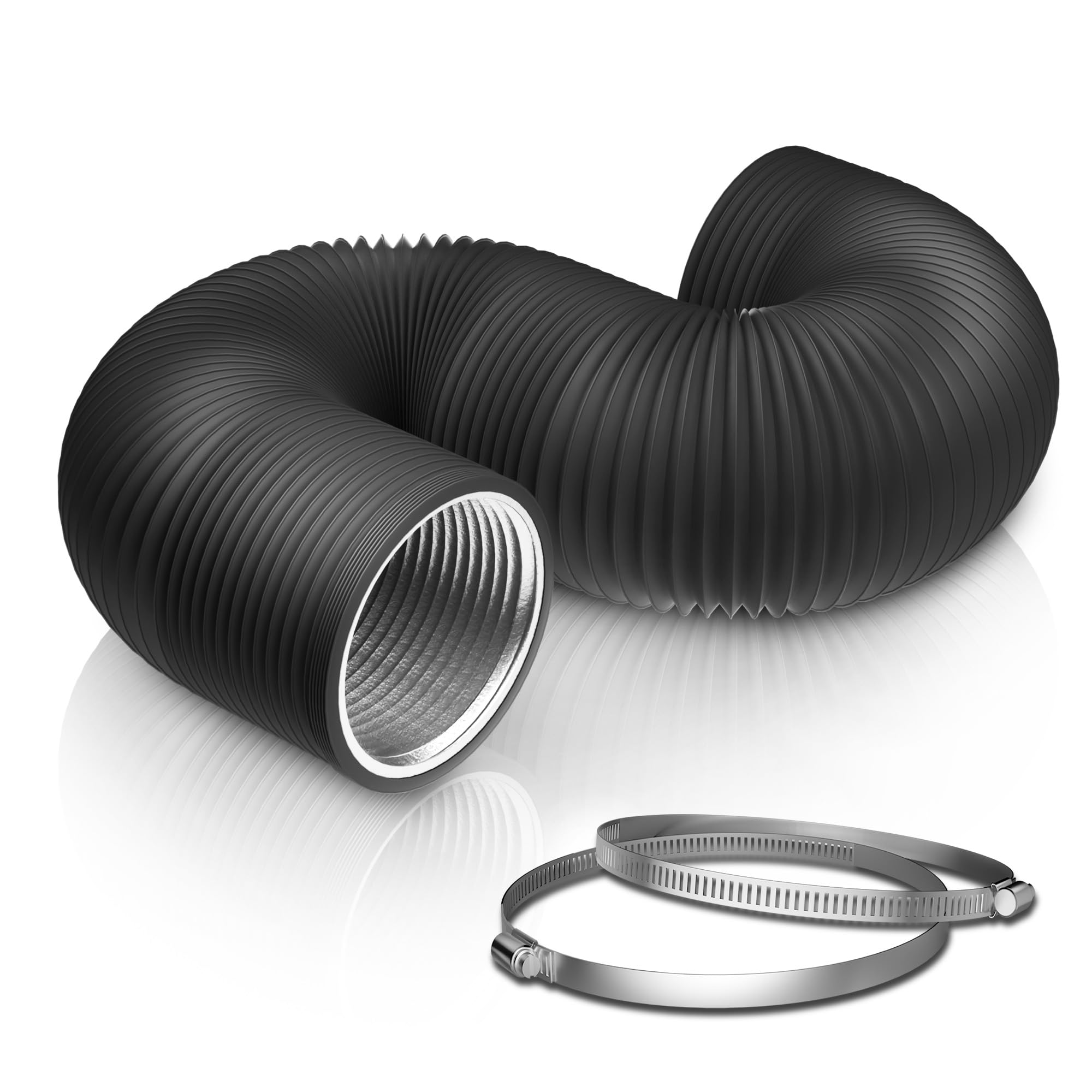
The mid-length run for routing air across a bay you cannot see
Attic and crawlspace jobs need a length that reaches without so much leftover that you are tripping over spool. This lands between the compact FICBXRA at 8.73 feet and the long 25 foot AC Infinity — a single 12 foot piece that splits the difference for routing hot air from an exhaust fan toward the eaves. It is the same four-layer recipe, aluminum foil plus PET plus foil plus a black PVC outer skin, and the same stainless steel clamps the listing calls rustproof for a smooth junction. At 3.1 pounds it hangs from a joist without sagging much.
Where owners land is on the fit. The single review that keeps surfacing says it straight: “I didn’t even open the default hose from the box store, so impressed with this 12′ version!” That is the pattern here — people reach for this over the thin default duct that ships with a kit and never look back. You can cut it with a wire cutter and a paper knife, it bends to any angle, and it tightens with a screwdriver at the clamps. For a grow tent exhaust, a bathroom vent, or a stove hood, it is a clean, unremarkable-in-a-good-way run.
One honest note on the data: a couple of the longer listing reviews describe an 8 foot duct, which is the product line, not this 12 foot piece. Rely on the 144 inch listing length as your real number. If your run is over fifteen feet, step up to a 25 foot roll instead of chaining pieces and adding a leak point at every joint.
The length that does the most: 12 feet is the balance for a single mid-length run, and cutting it down is a wire-cutter job so you are never stuck with a length that will not reach.
This is your pick for: attic, crawlspace, or garage runs that need more than eight feet but not a full roll.
Not the one if: your run exceeds fifteen feet — a 25 foot duct avoids chaining two pieces and a leak at every joint.
5. Simple Deluxe 10 Inch 25 Feet Ducting, Non-Insulated Flex Air Aluminum Foil Duct
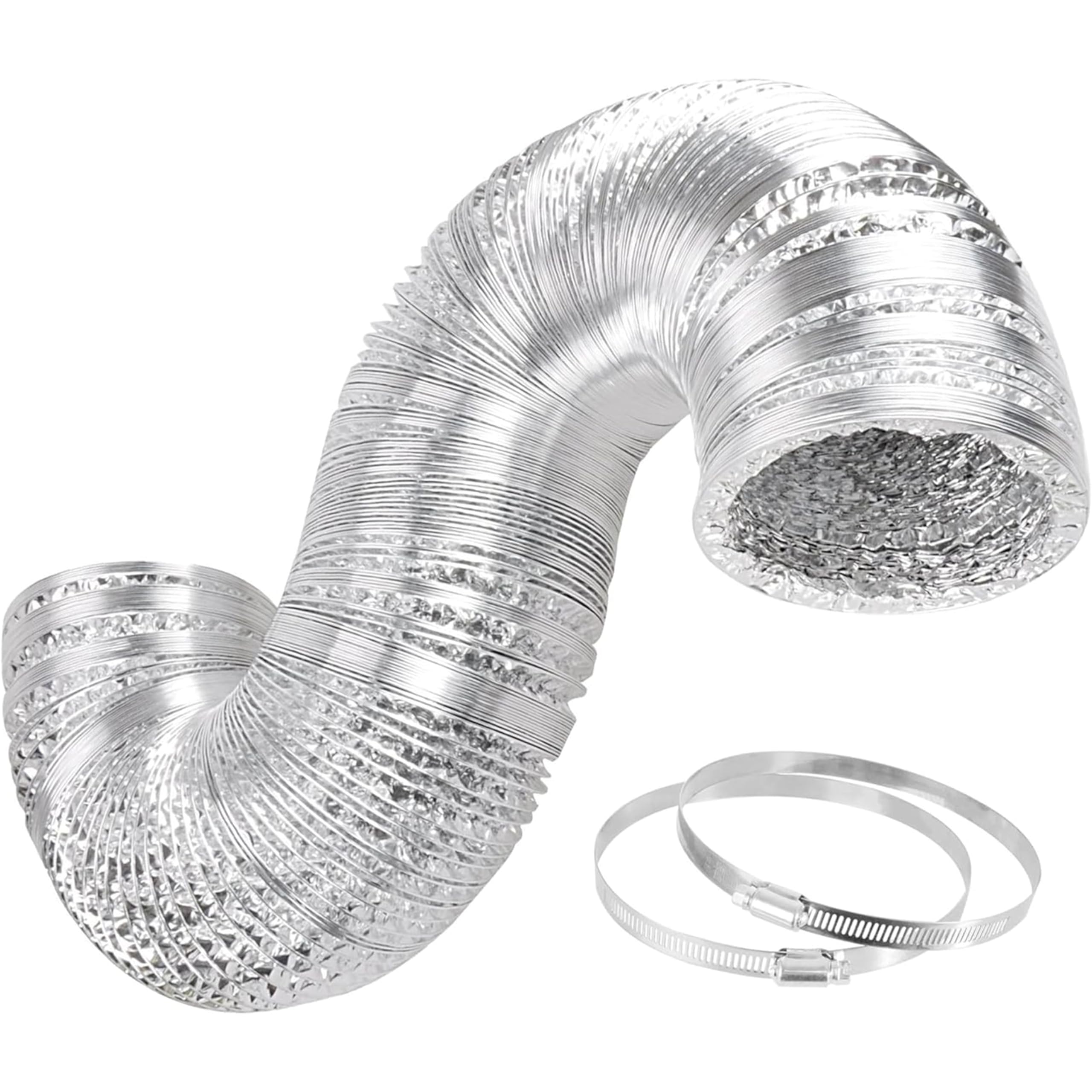
A general-purpose foil run rated for heat and priced for a long haul
This is the duct for the person happy to solve one vent today and a different one next month. The aluminum foil is flame-retardant and rated for temperatures from 0 to 185°F, so it handles warm exhaust air without complaint, and the corrosion-resistant clamps in the box are the same stainless type everyone here ships. The four-layer protection, with heavy-duty foil inside and out around the reinforcement, is what keeps it from tearing like the single-layer foil it replaces. Reach is the headline: 25 feet, matching the AC Infinity and the Vevor, so it covers the same long runs those two do.
The people who buy it mostly come away impressed by the material. It is noticeably thicker foil than the flimsy kind, holds its shape when collapsed, and in practice can be cut with a wire cutter right where you want it. The included clamps plus a short strip of aluminum tape cover most setups without a trip back to the store.
The fair warning is thinness at the wall. The four-layer build is here, but it is still a flexible foil duct, and it does not take rough handling well. The exact concern shows up in the reviews: some sample runs come through undersized, and a few owners find the foil can tear if you fight it onto a collar without tape. Use vent tape and secure the last few inches before the hose slides on, and it holds up fine. It handles a dryer vent or a solar tube reroute, but not a dragged or high-heat run.
The generalist advantage
- Flame-retardant aluminum foil rated for 0 to 185°F, so warm exhaust air is fine.
- 25 feet of reach at a friendly price covers a long run with room to cut.
- Two clamps included, and the foil cuts cleanly with a wire cutter to fit your run exactly.
- Collapses to a compact roll that holds its shape for storage between jobs.
Treat this like the flexible duct it is
- Thinner foil wall means it can tear if you force it onto a sharp or oversized collar.
- Some runs arrive narrower than the stated 10 inches, so check the fit before forcing it on.
- You will want vent tape and a secure fit at the first few inches to keep the seal tight.
Best for: a household that wants one flexible duct to solve a dryer vent, an RV heater, or a solar tube reroute without buying a specialty run for each.
Skip if: you are running high-heat or dragging the duct around — that is a job for the PVC-coated options below, not a foil run.
6. FDTDUCT 10in PVC Flexible Duct Hose, 16FT Fan Ducting

A hanging PVC run that shrugs off heat and rough surfaces
Welding fumes, car exhaust, an oven hood — these are jobs that chew up a foil duct in a season. This one is built for them: a vinyl woven polyester shell over a carbon wire spring, with an abrasion-resistant wear strip to fend off external scuffs. The temperature window is the number that stands out, running from -22° to 212°F, so it takes hot exhaust air that would degrade a plain aluminum foil run. At 16 feet and about 3.18 kg, it is heavier and shorter than the Vevor’s full 25 feet, but it trades that length for a shell built to hang and stay hung.
Mounting is the design highlight. It carries a D-ring for wall or column attachment plus three load hooks, and the head has an expanded horn with a thick PP rope you cinch to the diameter of the passage. That means you seal the mouth to nearly any fitting with a pull of the cord, which is the detail that makes it easy to attach and reattach to a movable intake. It also folds down compact for storage, and the inside wall stays smooth so air moves cleanly after a fold.
The catch is at the ends. The reinforced ring at the mouth will not slide over larger round duct adapters without some surgery: as the pages put it, “These work great only downside is they will not slide over 16 inch round duct adapters without cutting the ring in the one end.” For standard 10 inch fittings, though, it connects clean and holds up under heat — heavy use and high temps with no tearing or fraying. Just plan a little extra effort if your fan uses a stepped or oversized adapter instead of a plain collar.
Built to be handled: the abrasion-resistant wear strip and flame-retardant vinyl shell are what let this duct survive fume extraction and repeated hanging where a foil run would not.
The right tool when: you are pulling welding fumes, car exhaust, or hot air through a hanging, movable setup and need a duct that takes abuse.
Pick something else if: your fan uses an oversized round adapter — this one’s reinforced ring will not slip onto it without trimming.
7. Hon&Guan 10 Inch Heavy-Duty PVC Flexible Duct 25FT for Utility Blower Fan
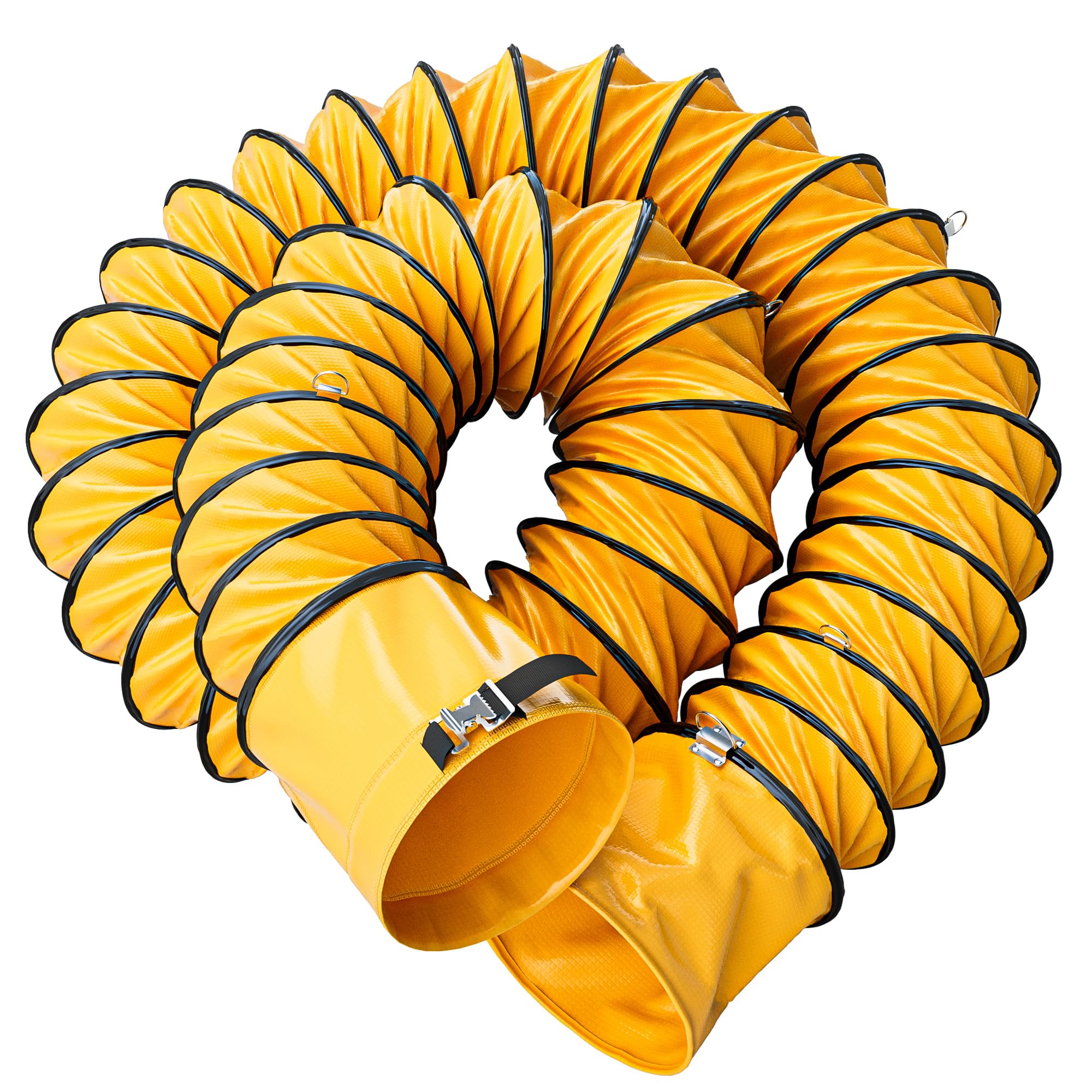
The long, hangable PVC run for factory and basement blower work
When you need full reach plus a duct that stays put overhead, this mixes the two ideas: 25 feet of run to match AC Infinity and Vevor, wrapped in the same industrial vinyl-braided polyester over a high-carbon steel spring that the other PVC options use. The fire-resistant shell handles ventilation in factories, basements, farms, and tunnels, and the reinforced wire spring keeps the tube open so a hanging run does not choke itself. Two things make it easy to live with: a D-ring for mounting to a wall or column, and an adjustable buckle rope that cinches to the opening size and locks the duct down so it does not shift while the blower runs.
Owners mostly report it does the job without fuss, and the reviews stay refreshingly varied — the same run has been drafted into service as a sturdy cat tunnel and as the body of a Fortnite bus build, which tells you the material holds its shape under non-HVAC misuse too. What the pages praise is the flexibility and construction: not too stiff, easy to maneuver into position. Folded down, it shrinks to a compact bundle, so a 25 foot run stows in a fraction of the space it occupies when deployed.
The thing to plan around is length for ambitious layouts. The full 25 feet is generous, yet for large multi-duct setups it can run short — the advice from the comments is that on a big job, step up rather than chain two runs and add a junction. Note also that the opening is more compact than a full 25 foot roll’s reach might imply, so check your connector diameter against the actual opening before you build the whole layout around it.
Where it earns its place
- 25 feet of PVC-wrapped run covers a long basement or factory layout.
- Flame-resistant shell and high-carbon steel spring keep it open under a hanging setup.
- Adjustable buckle rope locks the mouth to the opening so the duct does not shift mid-job.
- Folds to a compact bundle for storage when the job is done.
The parts to size up first
- For large multi-duct builds, a longer run may be needed rather than chaining two.
- The mounting rings and rope suit hanging; a floor-run without anchoring will want a prop or a hook.
Made for: factories, basements, and tunnel work where you need a long PVC run that hangs securely from a wall or ceiling.
Look at the others if: your layout is very large — you may need more than the 25 feet this one provides, so measure your run before you buy.
8. GAF Master Flow 10″ X 25′ Insulated Flexible Duct with R6 Insulation

The insulated run that keeps conditioned air conditioned
Every other duct on this list only moves air. This one moves air and holds its temperature, which is a different job entirely. It carries R6 insulation wrapped in a heavy-duty silver jacket, and the listing states it offers 33% more insulation than standard R4.2 products, so heated supply air arrives where it is going without bleeding its warmth through the surface first. Covering 100 square feet with R6 insulation and built from fiberglass, it is the choice for a standard heating and air conditioning system rather than an exhaust job, and it meets the UL181 standard and is ETL listed for that use.
People buy it for exactly the problem no foil duct can fix. It is the go-to when a portable AC unit’s stock 5 inch duct is not enough and the room still bakes — an insulated run cuts the radiant heat the bare duct throws into the room, working well as a replacement. It shows up in garage exhaust and grow-room humidity control too, where keeping incoming air cold matters. One owner used it to pull cool outside air into a greenhouse across a big temperature swing with no condensation, holding the incoming-air temperature steady.
Two real trade-offs to know. Fiberglass insulation can tear if you snag it, and the jacket sits separate from the inner tube, so keep the outer sleeve long enough to fully cover the clamp and do not cut the inner casing longer than the insulation. And at the widest service, this is the one that costs more up front — it earns the higher price on supply runs, but you do not need it for a plain exhaust line where R6 does nothing for you.
The insulation is the whole point: R6 over fiberglass in a silver jacket is what turns a leaky air-mover into a duct that delivers air at the temperature it started.
Worth it for: heated or cooled supply runs where losing air temperature to the duct surface is the problem you are trying to solve.
Not the one for: a bare exhaust, dryer, or fume job — plain foil or PVC runs handle those at a lower entry cost without the fiberglass handling care.
Understanding the Specs
Diameter and Inside Measurement
The nominal 10 inch figure refers to the duct opening, but the real inside diameter can run slightly small, which is why some runs fight you onto a steel collar while others slip right on. Before you order, dry-check your fan, vent, or carbon filter collar against the duct mouth. If your fitting is oversized or an odd flat-oval shape, favor a run with an adjustable cinch rope and a reinforced opening so you can tighten the seal to the actual passage size.
Layers, Material, and Temperature Range
Layer count is your shortcut to durability. A four-layer wall — aluminum foil, PET film, more foil, and often a PVC outer skin — resists leaks, tears, and pin holes better than single-layer foil. Material then sets the job: aluminum foil runs are light, flexible, and low-cost for HVAC and dryer vents, while PVC-wrapped runs with a carbon steel spring are heavier, abrasion-resistant, and better for hot exhaust and dragged, handled jobs. Match the material to your heat and handling, not just the price.
FAQ
Does a 10 inch flex duct fit a 10 inch inline fan collar?
How do I stop a flexible duct from restricting airflow at a bend?
Can I cut a 10 inch flex duct down to a shorter length?
Which is better for exhaust, aluminum foil or PVC ducting?
How do I seal the connection so the duct does not leak air?
Do I need an insulated flex duct for a standard exhaust run?
How long can I run a 10 inch flex duct without losing airflow?
Can I hang a flexible duct from the ceiling?
Is the true length the same as the number on the box?
What temperature can these flex ducts handle?
Final Thoughts: The Verdict
For most people, the 10 inch flex duct winner is the AC Infinity Flexible Ducting because its four-layer wall and steel-wire spiral hold the tube round, stretch across a long run, and compress back into a small roll. If your job involves a blower, an air scrubber, or an odd-shaped discharge you need to seal, the Vevor Ducting Hose leans tougher with its flame-retardant PVC shell and adjustable rope. And for heated or cooled supply air, the GAF Master Flow Insulated Duct is the one to reach for, since its R6 insulation keeps conditioned air at temperature instead of bleeding it into the room.
How We Picked
We do not accept paid placement. Every pick is matched to a real buyer and a real use-case; we do not hands-on test units.
Sources & Methodology
Specifications: manufacturer listings and product documentation. Review insights: verified customer reviews, as of September 2026. Pricing: not shown on this page (it changes often); check the current price via the retailer link.
As an Amazon Associate, Non Toxic Blog earns from qualifying purchases. This does not affect which products we feature.