Specs are compiled from manufacturer listings and verified buyer reviews and can change over time — please confirm the key details on the product page before buying.
If you grind your own meat, you already know the pain: a weak motor heats the meat, jams on the first bone, and turns a two-hour job into an all-day one. A true 1 horsepower (1hp) grinder fixes all three at once — it powers through bone-in chicken and whole venison without stopping, and it never warms the meat enough to spoil the texture. This guide covers nine motors that genuinely sit in or just next to the 1hp class (roughly 0.75 to 1.2 hp), so a couple of picks land slightly under or over the exact number you searched. Every pick here is a hunt-and-butcher-grade machine, not a countertop toy.
I’m Mo Min — the founder and writer behind Non Toxic Blog. This guide is built by comparing the manufacturers’ published specifications and the patterns across verified customer reviews, so you get each pick’s real strengths and trade-offs instead of marketing spin.
Every pick here earns its slot on motor strength, pounds-per-minute output, and how it holds up across a full season of butchering.
Our Picks at a Glance

How To Choose The Best 1 Horsepower Meat Grinder
A 1hp grinder is not about bragging rights. It is about whether the motor keeps turning when you drop a bone-in turkey thigh into the throat, and whether it does that for the tenth time in a row without overheating the meat. Here is what actually decides your buy.
Match the horsepower to what you actually grind
The motor rating tells you how much work the grinder can sustain. A true 1 HP (one horsepower) unit handles whole muscle meat and small bones without the strain that stalls weaker motors. If you only process boneless cuts a few times a year, you are paying for headroom you may not use. If you break down whole animals, that headroom is the whole point — it is the difference between a steady grind and a motor that quits halfway through a hog.
Watch the wording closely. Some listings quote “peak” wattage, which is a brief surge the motor can hit, not the power it runs at all day. A grinder rated at a steady working wattage will outlast one that leans on a peak number.
Pounds per minute is the number that predicts your workday
Grinding speed decides how long you stand at the table. A machine that pushes 9 to 14 pounds per minute clears a deer in minutes; a slower unit turns the same job into an hour of feeding meat by hand. Pair that with the size of the feed throat — a wide throat means less pre-cutting, and a narrow one means every piece has to be trimmed down before it goes in. For big-batch work, a foot pedal or hands-free switch matters more than most people expect, because it frees both hands to load meat.
Build material drives how long the grinder lasts
Look for stainless steel or cast-metal augers, knives, and plates. Plastic-bodied grinders flex under load and wear at the contact points; all-metal grinders hold their tolerances and stay cool enough to move meat through without warming it. The trade-off is weight — a heavier grinder is also a more stable one, and stability is what keeps the whole unit from walking across your counter when the auger bites.
Quick Comparison
| Model | Best For | Rated Throughput | Motor | Carry Weight | Amazon |
|---|---|---|---|---|---|
| Weston Pro Series 10-1201-W★ Best Overall | Rugged all-rounder for high-volume home and small-shop grinding. | 6-9 lbs. per minute | 1 HP, 750 watt | 42 pounds | Amazon |
| VEVOR 552 Lbs/H #12Best Value | Budget-minded power for hunters and weekly bulk batches. | 552 lbs/h (~9.2 lbs/min) | 750W / 1HP copper motor | 36.6 pounds | Amazon |
| ARINOO #12CTop Performer | Game processing and small-farm butchering with big hopper. | Rated up to 650W steady | 1.0 HP pure copper | 43 pounds | Amazon |
| MEAT! 1 HP #22 | Fast hands-free processing for large wild-game batches. | 11-14 lbs. per minute | 1 HP | 62.6 pounds | Amazon |
| Weston #12 33-1301-W | Everyday countertop grinding and sausage on a tighter budget. | 4-5 lbs. per minute | 750 Watt, 1 HP | 13.5 pounds | Amazon |
| KWS TC-12 | Restaurant and deli counter grinding with replacement parts on tap. | 264 lbs/h (4-5 lbs/min) | 765 watt, 1HP | 61.5 pounds | Amazon |
| LEM BigBite Dual Grind #22 | One-pass fine grinding for big batches without a second run. | About 13 lbs. per minute | 1.0 HP | 49.6 pounds | Amazon |
| Pro-Cut KG-22-W | Daily commercial counter use with washerless maintenance. | Over 1,700 lbs/hour (first grind) | 1 HP gear-driven | 134 pounds | Amazon |
In‑Depth Reviews
1. Weston Pro Series Electric Meat Grinder, Commercial Grade, 750 Watts, 1 HP (10-1201-W)
Our pick — over 4.5★ from 50+ verified ratings; the strongest balance of quality and price.
The air-cooled 9-lbs-per-minute workhorse that turns bone-in chicken into butter without breaking a sweat.
This is the pick for anyone who breaks down whole animals — a hunter with a freezer to fill, a raw dog-food feeder, or a home butcher working through a hog. Its defining strength is the combination of an air-cooled, permanently lubricated 1 hp (750 watt) motor and a rifled head with an offset throat, which together grind 6-9 lbs. of meat per minute and keep running through bulk loads without needing a cooldown. That motor is the reason it can chew chicken bones the way cheaper grinders chew soft chuck: the cooling keeps it from heating the meat, and the offset throat keeps feeding steadily instead of backing up.
Part of what wins people over is the sheer quality of the build, and that same all-metal construction shows up in the numbers — at 42 pounds it sits in the same weight class as the ARINOO #12C (43 pounds), and it carries a 9-pound capacity against the Weston #12’s 5 pounds. Buyers report it “grinds chicken bones easily; 35 lbs in <15 min with 2 people,” and cleanup runs about 5 minutes, which is quick for a machine this substantial. The trade-off shows up on a small number of units: a few owners mention it can lock up on a solid turkey thigh, and the same sheet-metal edges that keep weight high can arrive sharp enough to warrant a quick once-over with a file. It also does not move easily — the 42 pounds that makes it stable makes it a two-hand lift onto the counter. That is the honest math on a machine this size.
commercial grade motor
- Runs a true 1 hp / 750 watt air-cooled motor built for continuous grinding, not short bursts.
- Pushes 6-9 lbs. of meat per minute through a rifled head and offset throat — no pre-cutting panic.
- 9-pound capacity and a stainless body put it in a heavier, more stable class than the smaller Weston #12.
- Comes with coarse (7 mm) and fine (4.5 mm) plates plus a sausage kit with funnels in 10 mm, 20 mm, 30 mm, and 40 mm sizes.
- Backed by a limited five-year manufacturer’s warranty.
heavy and loud
- At 42 pounds, it is a permanent counter fixture — plan the lift and the storage spot.
- A few units arrive with sheet-metal edges that need a light sanding before first use.
- A solid turkey thigh can stall it; whole large bone-in birds want a slower, steadier feed.
pick for volume: you process whole animals or feed raw to a house full of pets and want one motor that laughs at chicken bones all day.
avoid for light use: you grind a couple of pounds of boneless beef once a month — the 42-pound frame and commercial build are more machine than that rhythm needs.
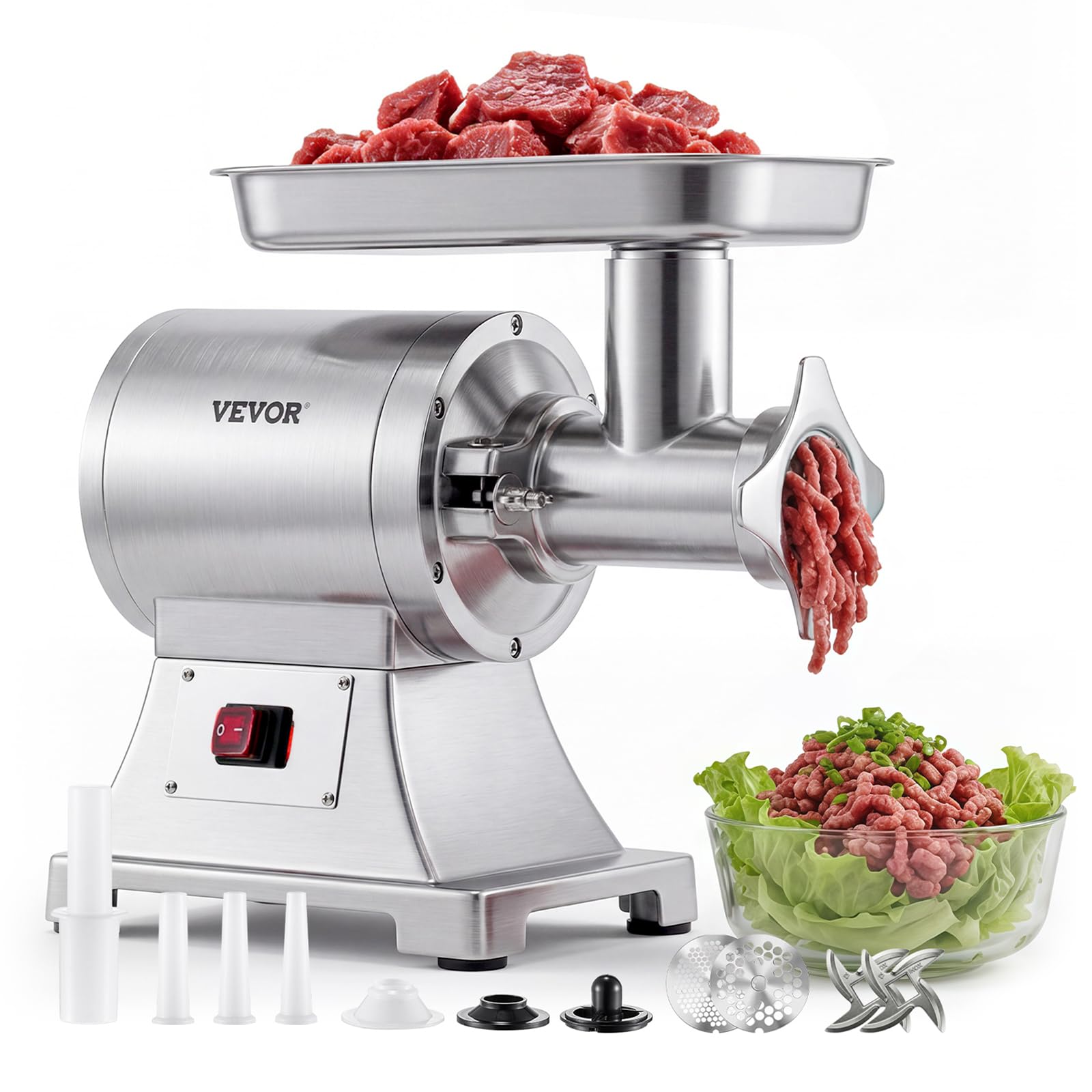
2. VEVOR Meat Grinder, 552 Lbs/H, #12 Electric Meat Mincer, 750W/1 HP Motor
A copper-motor beast rated at 552 lbs/h that clears a venison batch faster than you can feed it.
Hunters who process their own game and home cooks who grind in bulk will get the most from this one. The headline spec is the 750W / 1 HP pure copper motor paired with a 3-stage auger and a cross-sharp steel blade, rated for up to 552 lbs/h of output. That throughput is the whole story — it is fast enough that the limiting factor becomes how quickly you can load meat, not whether the motor can handle it. The included kit is genuinely complete for the job: two cross blades (one pre-installed), 6 mm and 8 mm grinding plates, a Kibbe kit, three sausage stuffing tubes in 0.3″, 0.4″, and 0.8″ sizes, and a meat pusher.
The aspects buyers point to first are performance and value for the money, and the speed claims back that up — one owner put it plainly: “it processed 16lbs of burger in less than 5 minutes.” Cleanup is nearly easy because the blades, plates, tubes, grinding head, auger, and meat pan are all dishwasher-safe; the main housing only needs a dry wipe. Two honest caveats sit on the spec sheet itself. First, the manufacturer states plainly that this unit is “not suitable for bones or frozen meat” — so if your workflow hinges on grinding bone-in chicken, this is not that machine. Second, disassembly runs into a handful of bolts that require a wrench, and a small number of units have been reported dead on arrival. For most buyers, the power-per-dollar math wins anyway.
choose for speed: the hunter or bulk grinder who wants maximum pounds-per-hour on a tighter budget and is happy to debone first.
pass for durability: your routine includes grinding chicken bones or frozen meat, or if you want a fully tool-free teardown.
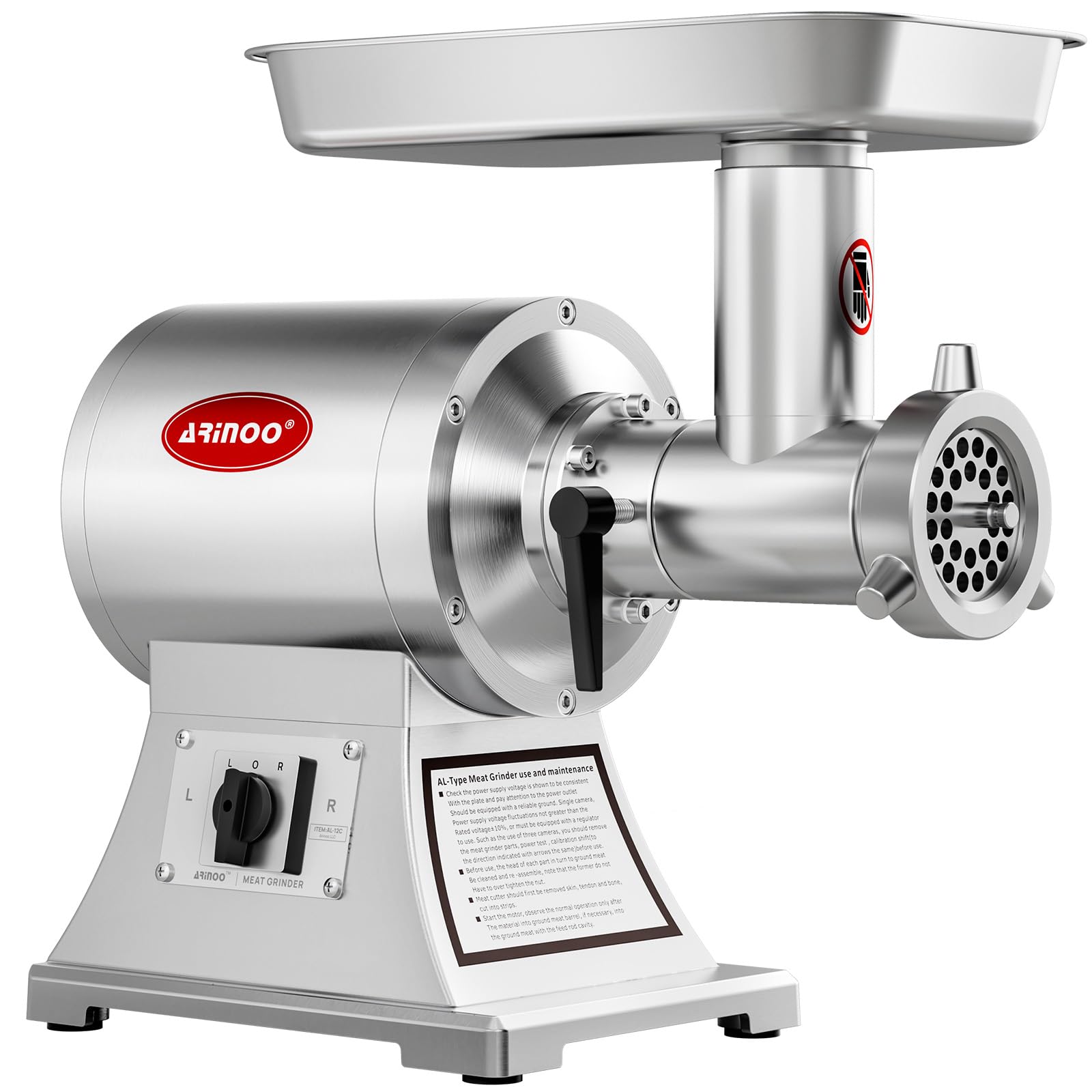
3. ARINOO Commercial Meat Grinder #12C, 0.9HP Electric Meat Grinder
An oversized-hopper #12 that plows through a whole elk without bogging or overheating.
This one is aimed squarely at hunters, small farms, and anyone buying meat in bulk — the kind of buyer who needs a single machine to run through deer, pork, and beef in one session. ARINOO rates the motor at 1.0HP with a 110-volt, 100% pure copper build, a steady normal rating up to 650W, and 1100W peak power, paired with an oversized hopper that holds a substantial pile of prepped meat so you are not reloading every few pieces. The five-year factory warranty is one of the longer terms in this group.
Customers note it will not bog down mid-batch and runs cooler than most peers over a long session. One owner committed to the workload: “Son used it first and said it worked very well,” and another noted the huge hopper as a standout for prepping a full deer. The honest trade-off is weight and storage footprint: at 43 pounds and with a footprint that is desktop, not countertop, say goodbye to stashing it in a drawer. A few units have arrived with cosmetic shipping damage — a bent meat tray is the most common report — and the six-millimeter plate is the coarsest of the two included, so if you want a very fine grind, you will source that separately.
select for small batches: whole-animal processing where you want a wide hopper, a true copper motor, and a long warranty in one buy.
skip for large jobs: you need a fine plate in the box, or you are not prepared to give a 43-pound machine dedicated counter space.
4. MEAT! 1 HP Pro-Grade Meat Grinder #22 with Coarse and Fine Grinding Plates
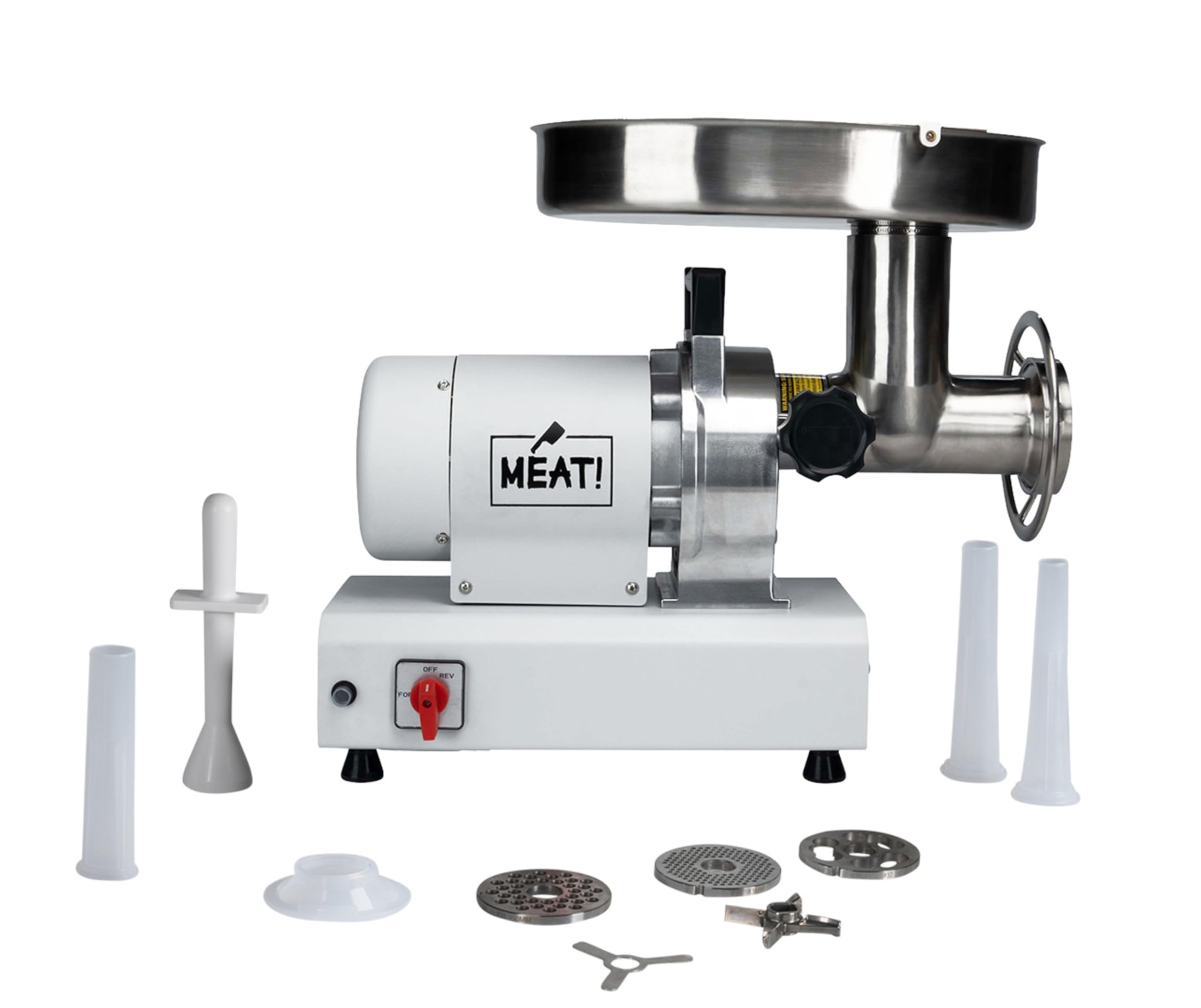
A 62.6-pound stainless beast that will outrun your hands at 11-14 pounds per minute.
Speed is the defining spec here: this grinder is rated for 11-14 lbs. of meat per minute, which puts it at the fast end of this entire group — the Weston Pro Series, by comparison, runs 6-9 lbs. per minute, so this one outpaces it for straight throughput. It is built from all stainless steel down to the last bolt, includes both coarse and fine plates, and comes with three stuffing horns for sausage work. The detail that separates it for big-batch users is the compatibility with the MEAT! Foot Pedal Switch — with both hands on meat and a foot on the pedal, you never break stride.
Buyers consistently praise the speed: one owner fed 25 lbs. of frozen venison through in about 2 minutes, another ran 30 lbs. of beef in under an hour. The stainless build also holds up well at cleanup — few surprises there given the material. The trade-offs are real and worth knowing up front. At 62.6 pounds it is a heavy machine that really wants a dedicated cart or table rather than being hauled in and out. Assembly feedback is mixed: some buyers found reassembly fiddly, and a couple reported the included plunger did not fit right, which can make loading awkward. Lighter-assembly tolerance is the price of entry for this one.
opt for coarse grinding: the big-batch grinder who wants maximum speed, all-stainless durability, and hands-free operation.
avoid for fine texture: you need a machine you can move easily or reassemble without reading the manual — this is not that grinder.
5. Weston #12 Electric Meat Grinder & Sausage Stuffer

The countertop-friendly starter that keeps 1 hp performance in a package you can actually move.
For the home cook who wants a genuine 1 hp motor without dedicating a whole counter to it, this is the natural landing spot. It runs the same 750-watt motor nameplate as the bigger machines, but in a 13.5-pound die-cast aluminum and metal-gear body you can lift with one hand. Output is 4-5 lbs. per minute, which is slower than the Weston Pro Series at 6-9 lbs. per minute, but perfectly reasonable for a household grinding a few pounds at a time. The two-speed setup is genuinely useful: the slow first speed is built for stuffing sausage, while the fast speed handles straight grinding, and the reverse function clears jams before they become a problem.
Where this earns its place is the learning curve it offers. Assembly and cleanup are easy, and both speeds mean you do not need a separate sausage stuffer. The honest catch is two-fold. First, the headlock is a cam-action design, and the front lock can wiggle during operation — reviewers point out periodically pushing it back into place. Second, and more significant: replacement parts availability. One buyer’s auger assembly failed just past the one-year mark during a lean-meat batch; others report the auger gear snapping on hard bone, and the grinder’s “ear’d” plates are only available in the 5 mm and 8 mm sizes included, so you cannot swap in the wider array of aftermarket plates that fit standard grinders. If you mostly do boneless work, neither of those is a dealbreaker. If you plan to grind bones regularly, this is the wrong grinder for that.
pick for sausage making: first-time buyers who want genuine 1 hp in a portable, easy-to-store package and stick to boneless grinding and sausage.
pass for heavy grinding: your primary use is bone-in grinding — the auger assembly is the vulnerable point under repeated hard-bone loads.
6. KWS TC-12 Commercial 765W 1HP Electric Meat Grinder

A CE-approved stainless workhorse built for restaurant counters, with heat-dispersion holes on both sides.
If you are small commercial — a deli, a restaurant prep station, or a serious home setup that sees real volume — the KWS TC-12 is built for that. The numbers are simple and honest: a 765-watt input 1 HP motor pushing 264 lbs. per hour, which works out to 4-5 lbs. per minute, with a stainless steel body and disperse heat holes on both sides to manage temperature during extended runs. Because it is designed for commercial environments, replacement parts are available, which matters when you are running it hundreds of pounds a week.
Shoppers say the 765-watt motor crushes any type of meat without straining under a big batch, and cleanup is straightforward. The honest trade-off that shows up in buyer feedback is noise. This is a loud machine — the sound level puts it in “use hearing protection for extended sessions” territory, which is a real friction point for a home kitchen. Two more use-based notes: the sausage-stuffing function requires ground meat to be near-freezing or the meat pushes back through the undersized plunger, and the suction base can lift the machine rather than hold it if the counter surface is not perfectly flat. Neither is a defect; both are just the machine’s operating parameters.
choose for power: you need commercial-rated throughput, stainless construction, and available replacement parts for regular volume use.
skip for quiet spaces: noise-sensitive home kitchens or you plan to stuff sausage in a normal-temperature room.
7. LEM Products BigBite Dual Grind #22 Meat Grinder, 1.0 HP Stainless Steel

Two grinds in one pass, so you never feed the same batch through a second time.
The LEM BigBite skips a step most grinders cannot: it does a second grind in the same pass, producing a finer, more consistent texture without running the meat through twice. That single-pass design is the reason buyers describe it as a time-saver on big batches. The 1.0 HP motor runs about 13 lbs. per minute, the head, plates, and dual-edge knife are stainless, and the noise-dampening design keeps it quieter than most machines in this class. It ships with four stainless plates — a first-grind plate, a 4.5 mm plate, a 10 mm plate, and a stuffing plate — along with a stomper, dual-blade knife, and three stuffing tubes at 1/2″, 1″, and 1 3/8″ outer diameter. A built-in storage tray keeps everything organized between sessions.
What stands out in how owners actually use it is that they do not bother pre-cutting as much: feed it once, and the dual grind delivers the fine texture that would normally take two passes. One buyer ran 450 lbs. of venison and pork through it without a flinch. The honest caveats: LEM states plainly that this machine is not intended for chicken bones, so raw bone-in feeding is off the menu here. At 49.6 pounds it is a machine you leave set up rather than lift into a cabinet. And cleaning the dual-grind head takes longer than a single-grind unit because there is more internal geometry — a small, dedicated brush plus a narrow bottle brush for the plate holes makes quick work of it. The five-year factory warranty and available replacement parts are the safety net you want at this price tier.
ideal for dual grind: hunters and high-volume home processors who want fine-texture ground meat in one pass and value quieter, heavier-duty engineering.
ignore for budget: bone-in grinding is your main use — the dual-grind head is not built for it, and cleanup takes longer than a single-plate machine.
8. Pro-Cut KG-22-W Meat Grinder, 1 hp Motor, Washerless Grinding System

A 134-pound gear-driven commercial machine rated for over 1,700 lbs/hour on the first grind.
This is the end-of-the-line pick for a butcher shop counter or a serious food-production kitchen — not a home appliance. The 1 HP motor drives a gear-driven, always-lubricated transmission rated for over 1,700 lbs. per hour on the first grind with the included 3/16″ plate, and the cabinet is stainless with an easily removable headstock. The “washerless grinding system” means there is no thrust washer to replace, which — in a shop that runs this grinder daily — reduces ongoing maintenance and extends the head’s working life. It complies with NSF and UL international standards, and the extra-large tray cuts down on how often you have to reload during a run. With 12 optional plates available separately, it can also work through salsas, purees, beans, and jellies.
Working kitchens back it up: one restaurant bought a second unit, and a high-volume buyer called it “exceeded my expectations.” What you have to weigh honestly is support when something goes wrong. A small number of buyers have reported that the shaft bent on first use and that the customer service path was slow or, in at least one case, denied because the buyer is a resident rather than a business. The overall picture is a machine that is genuinely built for what it costs, with a service experience that is best accessed through a commercial account. For a home user, the 134-pound weight and commercial-tier support model make this a fit for very different use cases than the rest of this list.
choose for easy cleaning: you run a commercial food operation and need an NSF/UL-rated machine that can hold a hot line for hours of continuous grinding.
reconsider for portability: you are a home user without a commercial account — the support model is built for businesses and the 134-pound machine is a permanent floor fixture.
Understanding the Specs
Watts vs. horsepower
Horsepower (hp) is the drag force a motor can apply continuously; wattage is how much electrical power it pulls. A grinder both called 1 HP and rated 750 watts is telling you the motor burns 750 watts while delivering a 1 hp workload. When a listing touts a much higher “peak watts,” that number is the brief burst the motor can hit, not what it sustains — it is not the same as a bigger motor. For shopping purposes, find the steady wattage or the hp rating, ignore the peak.
Rated throughput (lbs/min vs. lbs/hour)
Throughput is what determines how long your grinding session lasts. It is expressed two ways on this list: pounds per minute (a steady number, easiest to compare) and pounds per hour (a bigger-looking number that often covers a best-case run). For apples-to-apples comparison, convert the hourly figure by dividing by 60 — a machine rated at 552 lbs/hour works out to roughly 9.2 lbs/minute, placing it firmly in the mid-speed tier. Faster machines mean fewer minutes standing at the table, which matters most when you are processing hundreds of pounds.
FAQ
Is a 1 HP grinder enough to grind whole chickens with bones?
What does 750 watts mean and how does it compare to horsepower?
How much does a 1 horsepower meat grinder actually weigh?
Can I grind frozen meat with a 1hp grinder?
Will these grinders stuff sausage or do I need a separate stuffer?
What is the difference between a #12 and a #22 grinder?
How long will a 1hp grinder last?
Are these grinders dishwasher-safe?
Why is my grinder getting hot during long sessions?
Is a 1hp grinder worth it over a smaller kitchen model?
Final Thoughts: The Verdict
For most people hunting down a 1 horsepower meat grinder, the 1 horsepower meat grinder that earns the top spot is the Weston Pro Series 10-1201-W — an air-cooled 750-watt motor grinding 6-9 lbs. per minute, a 9-pound capacity, and a five-year warranty, all built into a 42-pound frame that handles whole-animal work without complaint. If you want the most pounds per dollar, the VEVOR 552 Lbs/H #12 is the value call — just confirm you are not planning to grind bones. And for raw dog-food feeders who need bone-in chicken processed fast with a reverse switch on standby, the Weston Butcher Series 09-2201-W is the specialist pick. Every machine here runs a genuine 1hp-class motor, so the real question is which shape, size, and support structure fits the way you butcher.
How We Picked
We do not accept paid placement. Every pick is matched to a real buyer and a real use-case; we do not hands-on test units.
Sources & Methodology
Specifications: manufacturer listings and product documentation. Review insights: verified customer reviews, as of September 2026. Pricing: not shown on this page (it changes often); check the current price via the retailer link.
As an Amazon Associate, Non Toxic Blog earns from qualifying purchases. This does not affect which products we feature.