Specs are compiled from manufacturer listings and verified buyer reviews and can change over time — please confirm the key details on the product page before buying.
If a slow drip from your filter housing would ruin your weekend, the Aquaboon 10×4.5 is the one to buy first. It earns that spot with reinforced polypropylene (a tough plastic that resists cracking under pressure), deep-toothed wrench teeth that grip the sump firmly, and dual pre-lubed O-rings (two rubber seals already greased) that seal without a fight. Almost every housing failure depends on three things: thread quality, seal design, and whether the housing fits the cartridges you already own. This guide covers nine housings that accept standard 10-inch cartridges, shows where each one wins and where each one needs care, and explains every spec in plain words so you can buy once and stop thinking about it. One quick note: this list uses flexible matching for 10 inch filter housing size, so it accepts standard 10-inch housings and rejects 20-inch and other sizes. That means not every pick is the exact number you typed into the search bar, but the nearest same-type size serves the same purpose.
I’m Mo Min — the founder and writer behind Non Toxic Blog. This guide is built by comparing the manufacturers’ published specifications and the patterns across verified customer reviews, so you get each pick’s real strengths and trade-offs instead of marketing spin.
Plastic threads, deep-cut grooves, and O-rings that dry out are the three quiet reasons a housing fails — and knowing which one you are buying saves you a flooded garage. The picks below sort all of that out for you, so keep reading to see which 10 inch water filter housing actually earns a spot in your plumbing.
Our Picks at a Glance


How To Choose The Best 10 Inch Water Filter Housing
A filter housing is a boring purchase that matters more than you expect. It sits on your main water line, holds the cartridge that does the actual filtering, and if it drips, you will notice every time you walk past the utility room. The housing itself does not clean water — the cartridge does. The housing is the pressure vessel (the container that holds water under pressure), the seal, and the connection point. Get those three right and the housing disappears into the background for years.
Thread material is where leaks are born
The single most common failure point on any of these housings is the threaded port where your plumbing connects. Plastic female threads — the internal threads on the housing — deform under over-tightening, and when they deform, no amount of thread tape will save you. Brass threads take more torque without stripping, which is why several picks here advertise brass inlet and outlet ports. If your plumbing is copper or PEX with brass fittings, brass-to-brass is the pairing that holds up best over time. Just remember that with any threaded connection, tape quantity matters — a few wraps too many can actually push the fitting out of alignment and cause the leak you were trying to prevent.
Port size and flow rate: what 1″ NPT buys you
NPT stands for National Pipe Thread — it is the standard taper thread used on most household plumbing connections. A 1″ NPT port is the larger size, and the reason to want it is flow. Whole-house housings with 1″ ports feed your entire home without noticeably dropping pressure at the shower. A 3/4″ NPT port is the smaller size and suits households where the feed line itself is 3/4″. The right answer depends on your plumbing, not on which one sounds better — if your existing pipes are 3/4″, a 1″ housing means adapters and extra connections, which means more places to leak. Always check what your main line already is before you order.
Cartridge size: 2.5″ versus 4.5″ diameter
Both standards accept a 10-inch-long cartridge, but the diameter changes everything. A 2.5″ diameter cartridge is the slimmer, traditional size — it costs less per cartridge and fits tighter spaces, but it holds less filtration media, so it loads up faster on dirty water. A 4.5″ diameter cartridge — sometimes called “Big Blue” — holds far more media, which means longer intervals between changes and less pressure drop as the filter loads. If you are on well water or heavy sediment, the larger diameter is usually worth the extra bulk. The trade-off is that 4.5″ housings take up real space and are noticeably heavier to wrestle onto a bracket.
Quick Comparison
| Model | Best For | Port Size | Cartridge Fit | Max Flow Rate | Amazon |
|---|---|---|---|---|---|
| Aquaboon 10×4.5★ Best Overall | Overall pick | 1″ NPT | 10″ x 4.5″ | 20 gpm | Amazon |
| Whirlpool WHKF-DWHCompact Pick | Compact spaces | 3/4″ inlets | 10″ x 2.5″ | — | Amazon |
| Pentair Pentek 150072See-Through Housing | Visual monitoring | 3/4″ NPT | 10″ x 2.5″ | — | Amazon |
| PUREPLUS FHN10BB | Brass junction sealing | 1″ NPT | 10″ x 4.5″ | — | Amazon |
| Geekpure BB-10B 1″ | Value on well water | 1″ NPT brass | 10″ x 4.5″ | 5–15 gpm | Amazon |
| Geekpure BB-10T | Sturdy clear canister | 1″ NPT brass | 10″ x 4.5″ | 15 gpm | Amazon |
| MewMore WHB10 | Sealing design | 1″ NPT brass | 10″ x 4.5″ | 20 gpm | Amazon |
| Pentair Pentek 150237 | High-flow whole house | 1″ NPT | 10″ x 4.5″ | 15 gpm | Amazon |
| iSpring HB18B | Straightforward install | 1″ NPT | 10″ x 4.5″ | — | Amazon |
In‑Depth Reviews
1. Aquaboon 10×4.5 Whole House Water Filter Housing
Our pick — 4.5★ from 900+ verified ratings; the strongest balance of quality and price.
The housing that ships with the wrench you only need once — and the seals that make sure of it
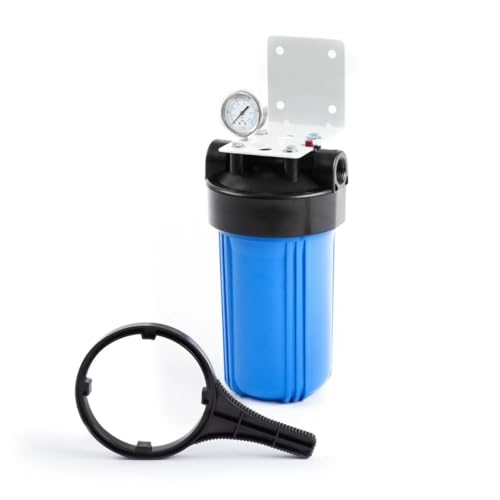
Start with what you actually get in the box: a 10″ x 4.5″ reinforced polypropylene housing with 1″ NPT inlet and outlet ports, a mounting bracket, a wrench, and a pressure gauge. The 1″ ports mean high flow — up to a 20 gpm maximum flow rate — so your shower pressure does not plummet the moment you add filtration to the main line. The dual pre-lubed O-rings are the detail that separates this from the pile: they arrive already lubricated, so they seal on the first turn without you hunting for silicone grease. That is a small thing that saves a very annoying afternoon.
The included wrench has deep teeth that grip the canister ribs firmly, which matters because hand-tightening a whole-house canister is not realistic. The housing locks into its bracket securely with no slipping, and owners consistently describe the plastic as thicker and more UV-resistant than the older Pentair and Pentek units they replaced. One more feature that earns its keep: the integrated pressure gauge lets you see your line pressure without buying a separate part, and the gauge is oil-filled so the needle does not flutter. Set it up in series — one 60-micron followed by a finer cartridge — and it handles heavy well-water sediment without choking your supply.
The honest caveat is the plastic female threads on the inlet and outlet. Buyers report the fittings seal beautifully once you know the trick: remove the brass adapter if you are using one, wrap more thread tape than feels necessary, and consider pipe dope on top of tape. As owners put it: “Works great, but the only flaw is the inlet and outlet are plastic, which gave me a little hard time to stop small leakage.” That is a real friction point, and it is the one thing standing between this housing and a perfect score. Once sealed, though, it holds pressure well above its rating — one buyer ran it at 80 psi against a 70 psi rating and reported no leaks.
What earns the top spot
- Dual pre-lubed food-grade O-rings seal on the first turn — no silicone grease needed
- 20 gpm maximum flow rate through 1″ NPT ports, so whole-house pressure holds up
- Oil-filled pressure gauge and integrated bracket included, not sold separately
- Deep-toothed wrench grips the canister ribs without slipping
- Reinforced polypropylene body built to hold up under whole-house line pressure
The friction point
- Plastic female threads need extra tape and careful torque to seal cleanly
- Canister screws on heavy — a second pair of hands helps during install
Best for: the buyer who wants one housing that does the whole job — high flow, integrated gauge, and seals that work without fussing.
Look elsewhere if: your plumbing is 3/4″ and you would rather not add adapters, or you genuinely cannot spare an extra set of hands for the initial mount.
2. Whirlpool 10″ x 2.5″ Whole House Water Filter Housing, WHKF-DWH
The slim 2.5″ housing that has quietly been protecting faucets for over a decade in some homes
If your utility room is tight, this is the housing that fits where the big ones will not. It stands just 12.25″ tall and measures 4.75″ across, so it takes up noticeably less space than the 4.5″ diameter housings here. The 3/4″ stainless steel inlets are the standout spec — stainless outlasts plastic, so you worry less about cracking the port when you tighten your plumbing connections. Rated for cold water only, it is NSF tested and certified against NSF/ANSI Standard for material safety and structural integrity (a third-party check that the materials are safe and the housing is strong). The pressure relief button on top makes cartridge changes easier by bleeding off pressure before you spin the sump off.
The groove design that holds the sump seal flat is the reason this housing seals reliably. Owners who ran it through a weekend camping trip on their water system reported no leaks at all, even after dealing with other housings from a different seller that simply would not seal. One buyer kept this same model for over ten years, replacing it only when the top finally cracked. That is a fair lifespan for a molded part under constant pressure, and it shows how well the cartridge did its sediment-catching job on municipal water.
Two things worth knowing before you buy. First, the replacement filter is not included, and Whirlpool recommends using its own genuine cartridges for the best fit and filtration results. Second, the red air relief button is the part that owners most commonly flag, and this is worth naming plainly: a red button that weeps under pressure is the recurring gripe on an otherwise solid piece of hardware. If yours drips, a fresh O-ring in the button assembly usually solves it. Households of one to four people are the target audience here, and this housing suits that size without strain.
Where it fits best: cramped utility spaces where a 4.5″ Big Blue simply will not hang, and homes with 3/4″ feed lines that do not want to adapt up to 1″.
The trade-off: a 2.5″ cartridge loads up faster than a 4.5″ on dirty water, so on well water you will change cartridges more often — that is the price of the slimmer form factor.
Easy call for: tight installs and 3/4″ plumbing, especially if you want a housing that has proven it can still be doing its job more than a decade later.
Skip past this if: you are on heavily sedimented well water and would rather trade space for longer intervals between cartridge changes.
3. Pentair Pentek 150072 Standard Clear Filter Housing
A clear window into your water — see the cartridge load up before it costs you flow
The defining feature here is the see-through sump. It is molded from clear Styrene-Acrylonitrile, and that means you can watch the cartridge darken as it traps sediment without shutting off water and cracking the housing open. For anyone on well water who has ever guessed wrong about changing a filter, that visibility alone is worth a lot. The cap is reinforced polypropylene with a factory-fitted EPDM O-ring in the groove between cap and sump, rated up to 125 psi max pressure. EPDM handles the constant wet-dry cycle of a filter housing better than a plain rubber seal, and it arrives in the groove where it belongs, not loose in the box.
Cartridge fit is universal in the best sense: it accepts all standard 10″ x 2.5″ to 2-7/8″ cartridges, so sediment, carbon block, or specialty filters from any major brand drop in without modification. The 3/4″ NPT inlet and outlet ports are reinforced into the cap, and the integrated mounting bracket is molded right into the polypropylene cap — no separate bracket to hunt down. One owner replacing a 20-year-old GE housing whose seal had flattened and started leaking found this Pentek’s thicker plastic and heftier feel immediately obvious.
One point that catches buyers off guard: the listing notes a mounting bracket, but the actual included components are the filter housing itself, and the bracket is sold separately in some listings. Owners frequently flag that the mounting hardware — the bolts, specifically — is not in the box. The other recurring note is the female threads, which run a touch loose; CPVC connections have leaked where brass sealed cleanly. Use 5 to 6 wraps of thread tape on the 3/4″ NPT ports and verify you have the right male fitting match before you commit. And heed one honest heads-up from the review pages: if you install a vented version of this housing, the vent is a known weak point that can be stubborn to stop leaking. Buy the non-vented model if you can.
Why it earns a spot
- Clear SAN sump shows cartridge condition and water flow at a glance
- Rated to 125 psi max pressure — the highest rating on this list
- Universal 10″ x 2.5″ fit handles sediment, carbon, and specialty cartridges
- Factory-installed EPDM O-ring in the groove, not loose in the box
Read the fine print
- Mounting bracket often sold separately — mounting hardware bolts may not be included
- Female threads run slightly loose; brass fittings seal better than CPVC
- Vented version has a vent that can be difficult to stop from leaking
Pick this one for: well-water systems where you want to see exactly when the cartridge is spent, and you appreciate the 125 psi ceiling on a small housing.
Think twice if: you need the mounting bracket bundled in, or you would rather not fuss with thread tape to get a tight seal on the ports.
4. PUREPLUS Whole House Water Filter Housing, 10″x4.5″

Brass where it counts — the thread junction is the one place plastic fails, and PUREPLUS swapped it out
Here is the detail that makes this housing worth a serious look: the thread junction is made of brass, not plastic. That matters because the female threads on the inlet and outlet are exactly where most housing leaks begin, and brass resists the deformation that dooms plastic ports under torque. The rest of the housing is food-grade polypropylene, rated for pressure and corrosion resistance, and it accepts all standard 10″ x 4.5″ cartridges — sediment, carbon block, pleated, or specialty. The included pressure gauge lets you monitor line pressure without buying a separate part, and the whole kit arrives with a heavy-duty steel mounting bracket, a wrench, and four screws with an O-ring.
For spacing-conscious installs, this housing runs 14.2″ tall and 7.5″ across, so measure that space before you commit. The pressure relief button on top bleeds off internal pressure before you open the housing, which makes cartridge changes safe and dry instead of a scramble with a bucket. One long-term owner reported a single PUREPLUS housing still in service after roughly 20 years on low-pressure, dirty well water. That is the kind of longevity you rarely see celebrated on a plumbing part. Another owner running a PEX system praised the leak-free assembly and the price-to-utility ratio.
The honest caveat is clogs. Under heavy sediment loads — sand, grit, high-iron well water — the 4.5″ cartridge in this housing loads up fast and can sharply reduce or even stop flow. That means frequent cartridge swaps and more maintenance than a big-media setup would need. If your water is genuinely dirty, plan on a sediment pre-filter or accept the replacement rhythm. Thread quality is the other thing to check: at least one owner had defective female threads that the vendor ultimately resolved with a full refund, so dry-fit your fittings before you torque anything down.
Where the brass pays off: if your plumbing uses brass or PEX fittings, the brass thread junction on this housing is the strongest connection point. The included gauge turns line pressure into a number you can actually read.
Know before you install: this is a 14.2″-tall housing — measure your mounting space and your line clearance before ordering, because a 4.5″ housing needs elbow room that a 2.5″ model does not.
Reach for this if: thread durability is your top concern and you want an integrated gauge plus bracket bundled in.
Look elsewhere if: your source water runs heavy sediment year-round and you would rather not change cartridges on a short cycle.
5. Geekpure 10-Inch Whole House Water Filter Housing – 4.5 x 10 Inch

Brass ports and a clear canister — the well-water workhorse that asks a fair price
Geekpure built this around 1″ NPT brass inlet and outlet ports (NPT is a standard pipe thread that seals with tape or paste), a clear sump so you can see cartridge condition, and a built-in pressure release valve for safe filter changes. It fits standard 4-1/2″ diameter cartridges, and the flow rate runs 5 to 15 gpm (gallons per minute) depending on your feed pressure. Work pressure sits between 10 and 60 psi (pounds per square inch), the housing handles feed water from 40 to 110°F, and the quoted service life is 6 to 12 months depending on how much water you run and how dirty it is. Brighter news for well-water users: this housing is explicitly made for well water use, with the recommendation to replace cartridges more frequently — every three months or more — on raw well supply.
The single most important thing to know about this housing is that it is not cross-compatible at the thread level. Different brands use different lid-to-sump threads, and Geekpure’s will not mate with another manufacturer’s top lid. If you are replacing just the sump on an existing system, you need the matching brand. That brand-lock is unusual among these picks and worth understanding before you order, because it limits you to Geekpure cartridges and Geekpure replacement parts down the line. That is the trade-off for keeping this housing at a serious value price point.
Owners mention that the housing works well as a whole-house filter and is straightforward to install, and the build quality is consistently described as solid for the money. The catch to know about is the main O-ring: hand-tightening has left some buyers with a leak at the seal, fixed by adding silicone grease to the O-ring and giving the canister a firm wrench turn. Thread tape discipline is also named specifically in the instructions — over-taping the threads can puncture them and cause the leak you were trying to avoid, so use tape sparingly and dry-fit first.
The value proposition
- 1″ NPT brass inlet and outlet ports — no plastic threads at the connection point
- Clear sump lets you monitor cartridge life without disassembly
- 5–15 gpm flow rate suits whole-house use on well or municipal water
- Built-in pressure release valve for safe cartridge changes
The honest limits
- Not a universal housing — sump threads only match Geekpure lids
- Main O-ring may need silicone grease and a firm wrench turn to seal dry
- Restricted to Geekpure replacement parts for the lifetime of the housing
Best for: buyers replacing a whole Geekpure system or starting fresh, who want brass ports and a clear housing without paying premium dollars.
Look elsewhere if: you need to reuse an existing top lid from another brand — it will not thread on here.
6. Geekpure 10 Inch Big Clear Water Filter Housing

A beefier clear canister that makes the GE housing sitting next to it look undersized
This is the bigger brother of the Geekpure housing above, and the differences are worth noting. It hits a 15 gpm maximum flow rate, uses 1″ NPT brass inlets and outlets with a pressure release button, and the canister walls are visibly thick. Owners comparing side by side against an older GE housing describe this one as noticeably beefier, with a thicker clear canister and thick cogs molded into the sump to give the included wrench solid grip. The reinforced threaded ports are a specific upgrade noted in owner feedback — the threads are machined into a reinforced collar rather than a thin wall, which materially reduces the chance of stripping on over-torque.
The single crush O-ring is the other design detail to understand. It is a one-piece seal that crushes into its groove as you tighten, and that is what creates the watertight seal. The trade-off is that this O-ring has no readily available replacement sold separately, so if you damage it, the housing becomes a problem. That makes careful installation mandatory, not optional. Owners who added silicone grease to the O-ring and the threads and tightened by hand before finishing with the wrench report consistent success. The head waterways are generously sized, so flow does not drop off as the cartridge loads — a genuine benefit when you are running a 5-micron coconut carbon filter for drinking and ice water quality.
One recurring complaint deserves a plain mention. A few customers note leaks at the ports after installation, suspecting the thread is not a true tapered NPT. The build itself is not the issue — one owner found the leak came from attempting to reuse an existing throwaway fitting rather than installing fresh connections. If you are working with existing plumbing, use new fittings and wrap carefully. That one issue aside, the reinforced body, thick walls, and included wrench bracket make this a housing that stands up to frequent cartridge swaps without flexing.
Built for the long haul: reinforced threaded ports, thick canister walls, and a 15 gpm maximum flow rate combine to make this a housing that stays rigid through cartridge changes.
One non-negotiable: the single crush O-ring has no separately sold replacement, so grease it and do not overtighten — this is the part you cannot easily order a spare for.
Right pick for: buyers who want a clear canister with real wall thickness, reinforced ports, and the confidence that comes from a housing built to be handled repeatedly.
Not your pick if: you want a replaceable O-ring you can reorder anytime, or you prefer a housing with no crush-seal dependency at all.
7. MewMore WHB10 Whole House Water Filter Housing
Double O-rings and brass ports — one manufacturer clearly studied where water leaks out
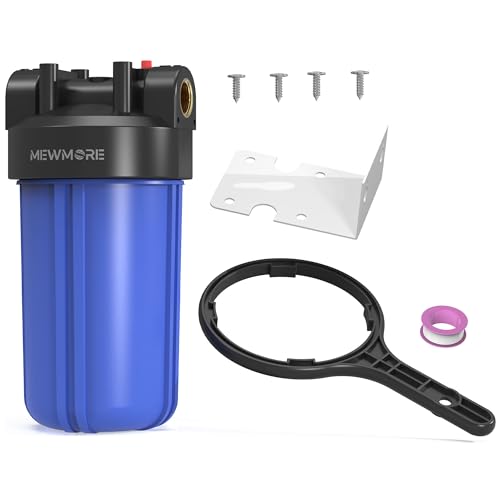
The MewMore WHB10 leads with a deceptively simple idea: seal the housing in two places. Double O-rings sit between the cap and the sump, and the inlet and outlet ports are brass with 1″ NPT threading. The seating groove on the top edge of the canister pinches the O-ring tightly against the cap, and reviewers point out the connection stays dry where a prior housing had failed. Food-grade polypropylene construction, lead-free and BPA-free, with the housing rated for 20 gpm maximum flow — enough to feed a whole house without noticeable pressure loss. The pressure relief button on the cap makes cartridge changes safe, and the whole kit ships with a heavy-duty steel mounting bracket, a wrench, and four screws.
Water quality matters, and this housing handles it without overpromising. It is rated for camp well water and city water both, and one reviewer specifically mentioned using it to filter sand and particles when filling a hot tub from a well. That is exactly the kind of real-world use a sediment housing should handle. The big blue pre-filtration design and 4.5″ x 10″ cartridge compatibility mean you can stack two or three units in series for a graduated filtration setup, mixing sediment and carbon cartridges as your water demands. One owner replacing a 25-year-old 4.5″ housing found this unit’s sizing and alignment correct for the space. The only complaint was that the 1″ brass female connections needed excessive thread tape on the first attempt.
The honest note: the threaded connections are the part buyers mention, and some report the metal threads can shred thread tape and cause slow drips. Switching to Teflon paste instead of tape solves it cleanly. If you are replacing a Pelican or another specific brand’s housing, measure carefully. One buyer found the threads on this unit were physically different from a Pelican top cap, and the failed swap cost more to refit than the housing itself. That is not a defect, it is a compatibility limit worth checking before you commit.
The sealing design: double O-rings and brass port inserts create the tightest stock seal on this list, and the food-grade polypropylene means you are not paying for the seal with a compromise on water quality.
Prepare for install: Teflon paste over tape on the threaded ports, and a careful size check if you are replacing another brand’s housing whose threads may not match.
Go for this if: you want the strongest stock sealing design here and a housing rated for both city and well water — camp water included.
Hold off if: you are visually sizing it against a Pelican or another brand’s old top cap, since those threads almost certainly will not line up.
8. Pentair Pentek 150237 Big Blue Whole House Filter Housing, 1″ NPT

The Big Blue that plumbers know by name — heavy duty, high flow, and hardware sold separately
The Pentair Pentek Big Blue earns its place in this list on spec alone. It is a 1″ NPT high-flow polypropylene housing capable of up to a 15 gpm maximum flow rate, designed for high-flow and heavy-sediment whole-house jobs, with an NSF/ANSI 42 certification for material safety. The pressure relief button on the HFPP cap is there for easy cartridge changes, and the o-ring arrives pre-lubricated rather than in its groove, so you seat it during install and know it is in the right spot. Owners describe the build quality as matching or exceeding Pentair units made 20 years ago.
Pentair’s reputation in the Big Blue category is not marketing talk — it is the reason Whole House treatments frequently start with a Big Blue stage. One long-time user has run two of these in series as a whole-house filter for over ten years. Setup is specific: 1″ NPT ports require a tape-and-pipe-dope combination to seal reliably, and the housing is heavy enough that Pentair recommends it be mounted to a wall or bracket rather than left hanging on the pipe. That mounting bracket and the housing wrench are sold separately.
The honest caveats are worth understanding upfront. Even with the 1″ ports, flow restriction can occur in the inlet and outlet area with a 5-micron cartridge installed — one owner documented a 6-9 PSI drop (from 53 down to 46-49 PSI) with a pleated filter. If you have marginal line pressure to begin with, consider whether a filter with lower restriction suits you better. And while the housing itself is very well made, the connection points need real sealing discipline: brass fittings that leaked badly for one buyer were solved with the tape-and-dope combination rather than improving the housing itself.
Why plumbers reach for it
- 1″ NPT ports and 15 gpm max flow rate suit whole-house sediment and carbon stages
- NSF/ANSI 42 certified for material and structural integrity
- HFPP cap with pressure relief button simplifies cartridge changes
- Fits all standard 10″ x 4.5″ Big Blue cartridges across brands
Prepare for install
- Mounting bracket, screws, and wrench are not included — sold separately
- Expect a measurable pressure drop with a fine cartridge installed
- Heavy — you need a wall mount, not pipe-hung installation
Reach for this if: you want the housing name plumbers know, with high-flow capacity and a proven 10-year service life pattern.
Plan ahead if: you need the bracket and wrench in the same box, or you have marginal water pressure and know a filter will eat into it.
9. iSpring HB18B Whole House Water Filter Housing
The straightforward single-stage housing with diagrams clear enough for a first-timer
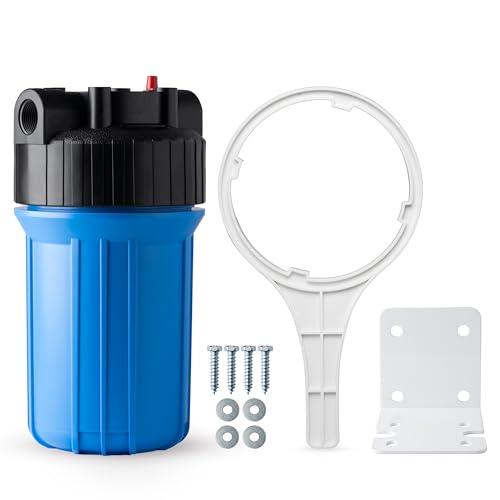
This iSpring housing does a few things very well and it does not pretend to be more. It fits all 10″ x 4.5″ cartridges, uses 1″ NPT inlet and outlet ports for high flow, and includes a pressure release button plus a wrench in the box. The reinforced polypropylene construction is rated for chemical resistance and whole-house pressure, and the reinforced polypropylene body resists chemicals and holds whole-house pressure. For anyone running a single-stage setup for the first time, the installation diagrams in the manual are specifically praised as clear and useful — rare for this category where documentation is often an afterthought. The housing is also pre-drilled for the pressure release valve, which means you do not need to modify anything to add it.
Owners use this housing across a wide range of scenarios, and it holds up in all of them. It has been used as a stage-one filter in a water conditioning system, as a supplement to an existing multi-stage RO setup, and as a standalone sediment filter for well water. One reviewer noted running it alongside additional sediment filters and a UV filter to get clear drinking water from a dirty well — done with SharkBite fittings and PEX for a straightforward install. Water pressure holds up at 1″ NPT, and the housing is large enough to house a genuine 4.5″ cartridge without cramping it.
The bracket is the one thing buyers mention as a fit nuisance. The included mounting bracket is sometimes oversized or misaligned with an existing multi-stage system’s mounting pattern, forcing removal and a re-hang. And the housing is big — check dimensions before you commit to a wall location. On the upside, iSpring’s customer service has a reputation here for responding fast when something arrives damaged, replacing housings without much friction. If something goes wrong in shipping, this is one of the brands where the replacement process is likely to be painless.
Where it shines: first-time whole-house installs, thanks to clear diagrams, a pre-fitted pressure release valve, and the 1″ NPT ports that keep flow steady.
The catch to plan for: the included bracket may not match an existing multi-stage mounting pattern, and the housing footprint is substantial — measure the wall space before you order.
Best if you want: a well-documented single-stage housing with real flow capacity and support that answers when something goes sideways.
Think twice if: you are matching this to an existing bracket layout, or you have very little wall space for a 4.5″ diameter housing.
Understanding the Specs
Port size (NPT) and what it controls
NPT stands for National Pipe Thread — it is the tapered thread standard used on most household plumbing. The port size on a filter housing is either 1″ NPT or 3/4″ NPT, and it directly determines how much water can flow through without pressure loss. A 1″ port moves more water per minute, which keeps your shower strong when the whole house is drawing at once. A 3/4″ port is the size that matches smaller feed lines and fits tighter installations. The right answer is your existing plumbing size — match it and you avoid adapters and extra leak points. If you adapt, you add a threaded connection on each side, which is the last thing a drip-prone setup needs.
Cartridge size: 2.5″ versus 4.5″ diameter
The 10-inch length standard is a near-universal fit, but the cartridge diameter splits housings into two camps. A 2.5″ cartridge is the slender, traditional size — cheaper per cartridge, fits tighter cabinets, but loads up faster on sediment because it holds less media. A 4.5″ cartridge — called Big Blue — packs more media, so it runs longer between changes and shows less pressure drop as it fills. Housings for the two sizes are not interchangeable; the canister diameter must match the cartridge. On well water or seasonal dirt, the 4.5″ size usually wins the value comparison once you factor in how often you are buying cartridges and standing over a bucket.
Pressure ratings and relief buttons
Every housing carries a maximum pressure rating — 125 psi is the ceiling on some models here while others run lower. Your home’s line pressure typically sits somewhere well below that, but spikes can happen, so the rating is your safety margin. The pressure relief button does a different job: it bleeds off the internal pressure before you open the housing for a cartridgechange, so water does not spray everywhere when you crack the sump loose. Not every housing includes one — the Pentek 150072, for example, has no relief valve by design, which some owners actually prefer because it removes a leak-prone part. If you buy a housing with a relief button, that button is your friend, but tighten it properly after every cartridge change or it becomes a slow drip you will chase for weeks.
Materials: why brass ports and EPDM O-rings matter
The housing body is almost always polypropylene, chosen for chemical resistance and pressure strength. The connection points are where materials diverge: plastic female threads are the weak link on most housings, while brass ports and brass thread inserts take more torque and hold a seal longer. The O-ring material matters just as much — EPDM handles repeated wet-dry cycles better than a basic rubber seal, and a pre-lubricated O-ring seats on the first turn instead of needing grease you have to hunt down. A double O-ring design adds a second sealing plane for extra insurance. These three details — port metal, O-ring material, and seal count — quietly decide whether your housing stays dry over the years.
FAQ
Will a 10 inch filter housing fit standard 10 inch cartridges from any brand?
What is the difference between 1 inch NPT and 3/4 inch NPT ports on a water filter housing?
How do I stop my new filter housing from leaking at the inlet and outlet?
How often should I replace the cartridge in a 10 inch whole house water filter housing?
Do I need a mounting bracket for my water filter housing?
What does a pressure relief button actually do on a water filter housing?
What is the difference between a 2.5 inch and a 4.5 inch filter housing?
Can I install a whole house water filter housing myself or do I need a plumber?
Will a whole house water filter housing reduce TDS or remove lead and fluoride?
Can I run two water filter housings in series for better filtration?
Final Thoughts: The Verdict
For most buyers, the 10 inch water filter housing winner is the Aquaboon 10×4.5 because it bundles high flow, a pressure gauge, a bracket, and pre-lubed O-rings into one package — the highest-rated, most-reviewed pick on this list. If you want the strongest stock seal design with double O-rings and brass ports, reach for the MewMore WHB10. And for a first-time whole-house install where documentation and support matter, the iSpring HB18B is the one to grab, with clear installation diagrams and a pressure release valve pre-fitted. Whichever you choose, dry-fit your fittings, apply the right amount of thread tape or paste, and mount the housing properly — that is what turns a plumbing project into a set-and-forget one.
How We Picked
We do not accept paid placement. Every pick is matched to a real buyer and a real use-case; we do not hands-on test units.
Sources & Methodology
Specifications: manufacturer listings and product documentation. Review insights: verified customer reviews, as of September 2026. Pricing: not shown on this page (it changes often); check the current price via the retailer link.
As an Amazon Associate, Non Toxic Blog earns from qualifying purchases. This does not affect which products we feature.