Specs are compiled from manufacturer listings and verified buyer reviews and can change over time — please confirm the key details on the product page before buying.
The toys a one-year-old actually keeps playing with are the ones that grow with them — the walkers they can hold onto, the cubes they can bang, the stackers they can rebuild. This guide sorts nine age-appropriate picks by what they do for a toddler learning to stand, grab, and make noise.
I’m Mo Min — the founder and writer behind Non Toxic Blog. This guide is built by comparing the manufacturers’ published specifications and the patterns across verified customer reviews, so you get each pick’s real strengths and trade-offs instead of marketing spin.
Below you’ll find how to spot the specs that matter, a fast side-by-side table, and nine honest reviews covering stability, safety materials, and what really holds a toddler’s attention. The right pick here is the one your 12 month old toys shelf can keep using well past the first birthday.
Our Picks at a Glance

How To Choose The Best 12 Month Old Toys
At twelve months, your child is in a very specific window. They can sit steadily, they can pull themselves up on furniture, and they want to put everything in their mouth. That combination rules out anything with loose small parts and rules in anything they can hold onto while they stand. The toys that earn their place on your shelf are the ones built for that exact moment.
Stability beats novelty
A toy that tips the moment a toddler leans on it will get abandoned fast, and worse, it teaches them to be cautious. Look for a wide base, anti-slip or coated wheels, and a weight that stays put when a small person yanks on it. A walker that rolls freely on carpet but brakes when the child is sitting to play is doing two jobs at once.
Materials and finishes you can trust
Wooden toys finished with non-toxic water-based paint and rounded, smooth edges are the safer bet for a child who chews everything. On plastic picks, look for BPA-free claims and reinforced stitching or shatterproof material. Any toy that names a certification or a specific material on the listing is giving you something concrete to check, and that is worth more than a vague “safe” badge.
Match the toy to the stage, not the age sticker
A toy labelled for twelve months and up can still be too advanced or too simple for your particular child. Buy something that works now and still works in three months — a cube they can bang at twelve months and puzzle over at eighteen months does more work than a single-purpose novelty. A speed switch or a removable play panel is the clearest sign a toy is built to stretch.
Quick Comparison
| Model | Best For | Age Range | Material | Weight | Amazon |
|---|---|---|---|---|---|
| VTech Sit-to-Stand Learning Walker★ Best Overall | All-round first walker | 9 Months – 3 Years | Plastic | 4.6 pounds | Amazon |
| HOLA Hammer Baby ToyBest Value | Cause-and-effect banging | 12 months – 5 years | Plastic (ABS) | 0.2 kg | Amazon |
| Fisher-Price Wood Stack & Sort AnimalsQuietest Pick | Wooden stacking and sorting | 12 months and up | Wood | 1.1 pounds | Amazon |
| Youuys Baby Tissue Box Toy | Quiet sensory play | 0 months and up | Cotton | 0.09 kg | Amazon |
| VTech Busy Learners Activity Cube | Independent sitting play | 6 Months – 3 Years | Plastic | 1.4 pounds | Amazon |
| Hapyland 3 in 1 Baby Music Mat | Floor play for two | 12 months and up | Fabric | 0.39 kg | Amazon |
| KMTJT Wooden Activity Cube | Seven games in one box | 12 – 18 months | Wood | — | Amazon |
| BQU 3-in-1 Musical Puppy | Bilingual crawling and pulling | 6 months – 3 years | ABS plastic | 0.55 kg | Amazon |
| Pithfor Wooden Baby Walker | Wooden push walker | 10 months – 3 years | Wood | — | Amazon |
In‑Depth Reviews
1. VTech Sit-to-Stand Learning Walker (Frustration Free Packaging), Blue
Our pick — over 4.5★ from 98,000+ verified ratings; the strongest balance of quality and price.
One walker that covers the whole first year — from floor play to those first wobbly laps.
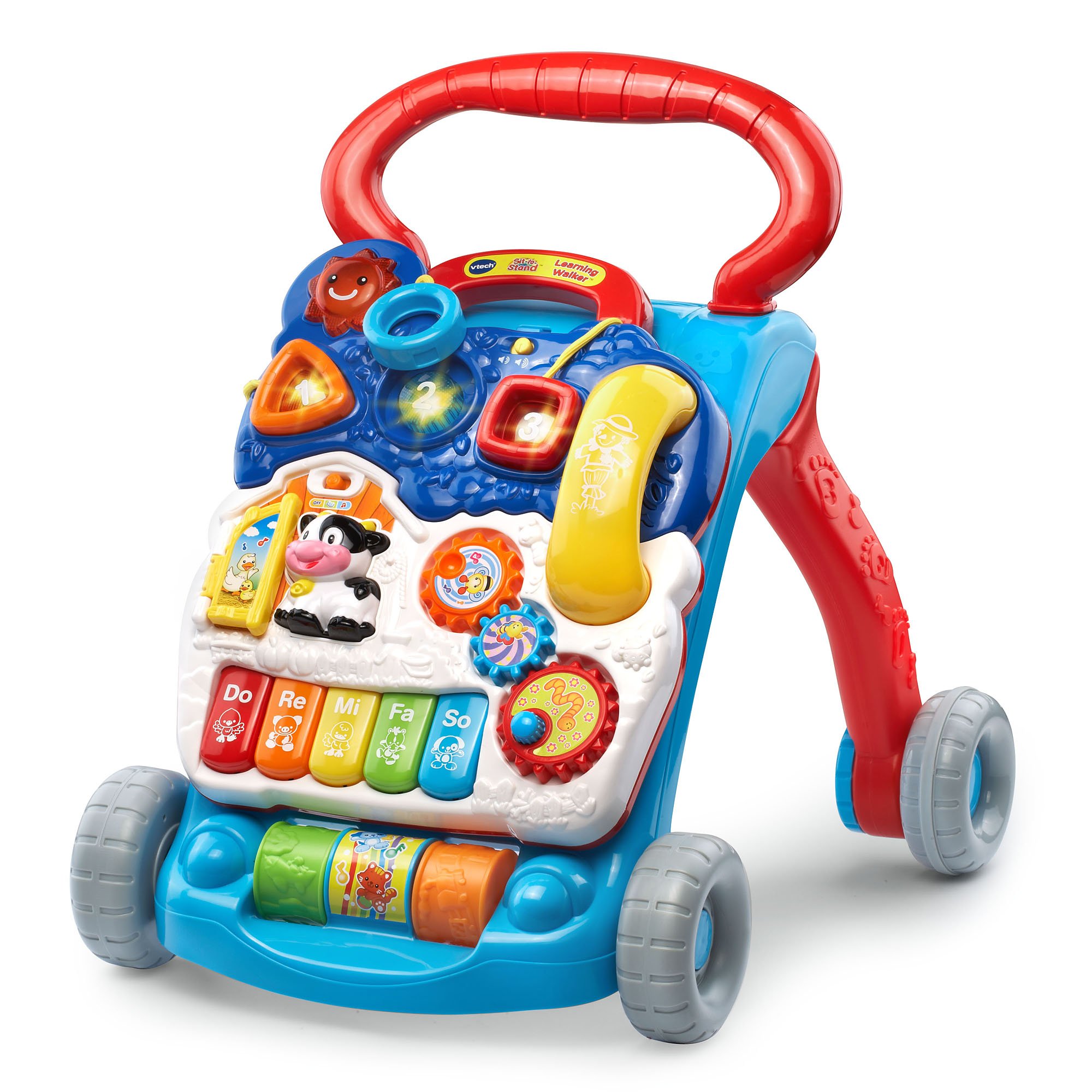
Buy this if you want a single toy that is still useful the week your child turns three. It earns its 4.8 stars across 98,000+ owners because the panel comes off. A nine-month-old who can only sit gets the activity tray on the floor; once they pull up, the same panel clicks back onto the walker frame.
The panel itself carries five piano keys, three shape sorters, light-up buttons, and colour spinning rollers, plus a phone handset that becomes a permanent favourite well before the walking starts. A two-speed control switch on the frame means the wheels start slow and speed up as your child does. It runs on carpet and bare floor, and the wheels brake when it is not being pushed in walker mode, so floor play does not send your toddler skidding across the room.
The weight is the tell: at 4.6 pounds it is heavier than the Fisher-Price Wood Stack & Sort Animals, which comes in at 1.1 pounds — a difference that matters when you are carrying it from the living room to the boot of a car. It also takes up real floor space, measured at 16.5 inches long by 14.2 inches wide by 18.1 inches high, with a maximum height of 18.1 inches and a maximum recommended weight of 35 pounds. Buyers report it held interest until about 17 months — a long run for a first walker.
What keeps kids coming back
- Detachable panel slides out for floor play and clicks back on for walking
- Two-speed switch grows with your toddler’s pace
- Wheels brake in play mode so the tray stays put
- Works on carpet and bare floors
What to weigh first
- At 4.6 pounds it is a chunk to lug around
- The sound effects divide opinion — you may want them off
Reach for this if: you want one toy that covers sitting, standing, and early steps, and you have a bit of floor space to give it.
Look elsewhere if: you need something that travels in a nappy bag or packs flat — this is a permanent fixture of the playroom.
2. HOLA Toys for 1 Year Old Boy Birthday Gift – Hammer Baby Toy 12-18 Months
The chunky hammer that teaches a one-year-old that their own hand made the noise.
His first lesson in cause and effect is a hammer he can actually swing. Tap the top and the eyes flip, the lights flash, and a count climbs to the next number — his arm strength and hand-eye coordination do the rest. The whole thing is built from shatterproof BPA-free ABS with polished, smooth edges and no small loose parts, which is exactly what you want for a child who tests everything with their mouth.
There are two modes. Entertainment mode throws out sounds and music with light flashing to hold attention for long stretches. Learning mode counts up each time the hammer lands, and runs through number sequence and simple language. It weighs just 0.2 kg, so it is genuinely small-hand friendly, and it needs two AAA batteries, which are not included — plan for that before the birthday.
Worth knowing before you buy: the handle is chunky, and very small hands struggle to grip it one-handed at first. A nine-month-old can still work it two-handed, and one reviewer noted their six-month-old grandson loved it and could trigger the music on his own. If that sounds like your child, this is the pick.
The developmental angle: tapping a hammer is real gross-motor work, not just noise — it builds grip strength and hand-eye coordination while teaching that hitting something makes something happen.
The honest caveat: the volume is louder than some parents expect, and a few buyers wish it had a quieter setting for the car.
Best for: a child who already loves banging things and needs a toy that rewards that instinct instead of punishing it.
Think twice if: you want a battery-free option — though it does work without them, since the eyes still flip on each hit.
3. Fisher-Price Wood Stack & Sort Animals Toy
Nine wooden animal blocks — no batteries, no volume knob, no regret at nine at night.
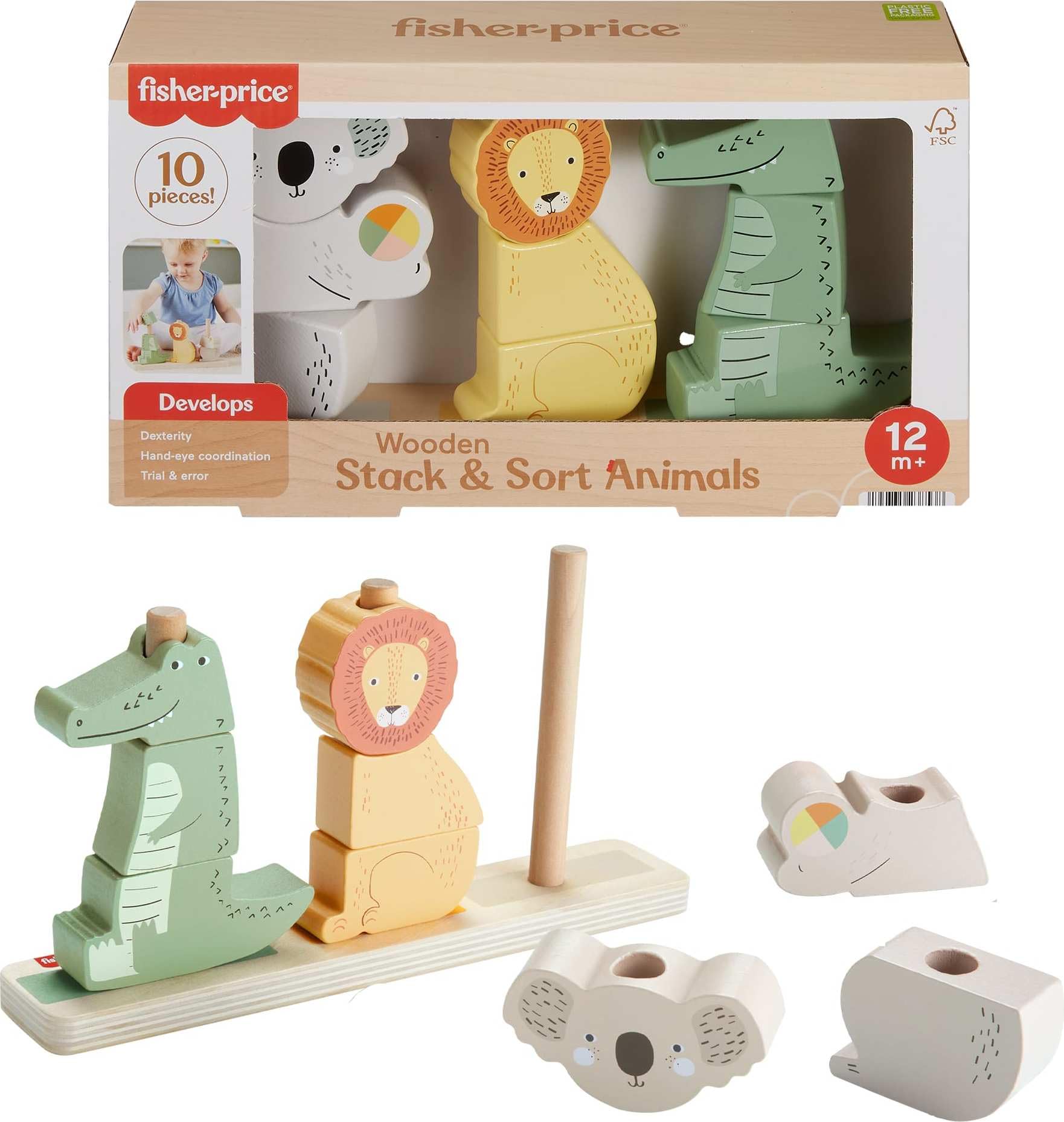
For a parent who has had enough of flashing lights, this is the reset. One stacking base, nine animal blocks decorated with non-toxic water-based paints, and nothing else. It is made with wood from Forest Stewardship Council-certified sources, which is a concrete third-party verification rather than a vague eco claim, and it helps toddlers develop fine motor skills and problem solving each time they try to balance a block that will not sit straight.
The colours are what sell it. Buyers consistently say they hold up well, and the muted palette is deliberately less overwhelming than the neon plastic equivalents — several parents described it as a stacking toy with a difference from the usual ring type. It is compact too: 2.25 inches deep by 11.37 inches wide by 6.37 inches tall, and just 1.1 pounds, so it slips into a bag for a trip to the grandparents.
The one thing to flag is the size of the individual pieces. Some are small enough to fit in a child’s mouth, so this is not a toy for unsupervised play with a determined chewer, and a couple of shoppers said it was smaller than they pictured in their head.
The reasons it earns the shelf space
- FSC-certified wood with non-toxic water-based paint
- Open-ended play — no fixed correct answer, so it ages well
- Muted colours that do not overwhelm a toddler
- At 1.1 pounds it is light enough to carry anywhere
Before you hand it over
- Some individual pieces are small enough to fit in a mouth
- The set is more compact than many parents picture from the photos
The verdict: the pick for a calm playroom and a child who likes to build rather than bash.
One condition: it wants an adult watching until your child stops testing everything with their teeth.
4. Youuys Baby Tissue Box Toy for Babies 6-12 Months

Stops the real-wipe raid — twelve soft scarves instead of a shredded box of tissues.
If your child has discovered the joy of pulling every wipe out of the packet one by one, this solves that problem without buying more wipes. Twelve soft colourful scarves and three crinkle tissues replace the paper, and the whole cube is soft woven cloth with reinforced stitching — no sharp edges, no hard parts, and no clean-up pile on the floor.
Six interactive sides mean there is something new on every turn: a baby-safe discovery mirror that is soft and shatter-proof, a high-contrast crinkling duck, textured bear hands, a tactile lion, and more. The set has passed CPC (Children’s Product Certificate) certification, which is a specific US safety standard rather than a decorative badge, and the repetitive pull-and-stuff motion is genuinely useful fine-motor work for small hands.
It weighs only 0.09 kg and folds flat at 8.07 by 6.3 by 1.97 inches, which is why it is the one in this list that goes in a carry-on without a second thought. The honest note: the fabric pieces are on the thin side and a few buyers mentioned the cube losing its shape after heavy use, so it is a toy that rewards gentle handling. Some also wish the pieces were attached so they could not wander off.
Why parents keep it in the bag: multiple textures, colours, and graspable elements keep babies engaged far longer than a single-feature toy, and the whole thing makes almost no noise.
Suits: car journeys, plane seats, and any restaurant table where you need ten quiet minutes.
skip it if: you want a toy that stays rigid and structured — this one is soft, floppy, and best treated gently.
5. VTech Busy Learners Activity Cube, Purple

A cube small enough for a car seat and busy enough to survive a whole afternoon.
This one is a sitting-up toy that doubles as a motivator to move. Five sides of play give your child 14 interactive features — four light-up buttons that introduce animal names, animal sounds and shapes, plus sliders and spinning gears. The alphabet side teaches colours and shapes, and there are 25 playful songs and melodies running throughout. A motion sensor fires off sounds when the cube gets moved, which is the clever bit: it rewards a baby for shifting it, and can even nudge them toward sitting up to reach it.
Buyers describe it as their baby’s favourite travel companion because it is only 1.4 pounds and 6.2 inches on each of its sides. Volume is adjustable and there is an auto shut-off, both of which matter more than they sound. It takes two AAA batteries, which are included for demo purposes only, and it is rated from six months up to three years.
The word to know is “smaller than expected”. That is the single most common reaction, and it cuts both ways — some parents find it perfect for little hands while others wanted a bigger presence on the floor. Sound is the other divider; you can switch it off if the songs wear thin, and after a while you will know all of them by heart.
Where it delivers
- Motion sensor turns movement into sound, encouraging crawling and sitting up
- Five sides means it never looks the same twice in a row
- Adjustable volume and auto shut-off built in
- Light enough to travel in a bag or a car seat pocket
Where it splits the room
- Smaller than most parents expect from the listing photos
- The songs get repetitive for adults long before they wear out for toddlers
The pick for: a six-to-eighteen-month-old who needs something to occupy their hands while they build the strength to sit unassisted.
Not the pick for: anyone shopping for a large floor centrepiece — this is a compact cube, and proud of it.
6. Toys for 1 Year Old Girl Gifts: 3 in 1 Baby Music Mat Toddler Toys Age 1-2
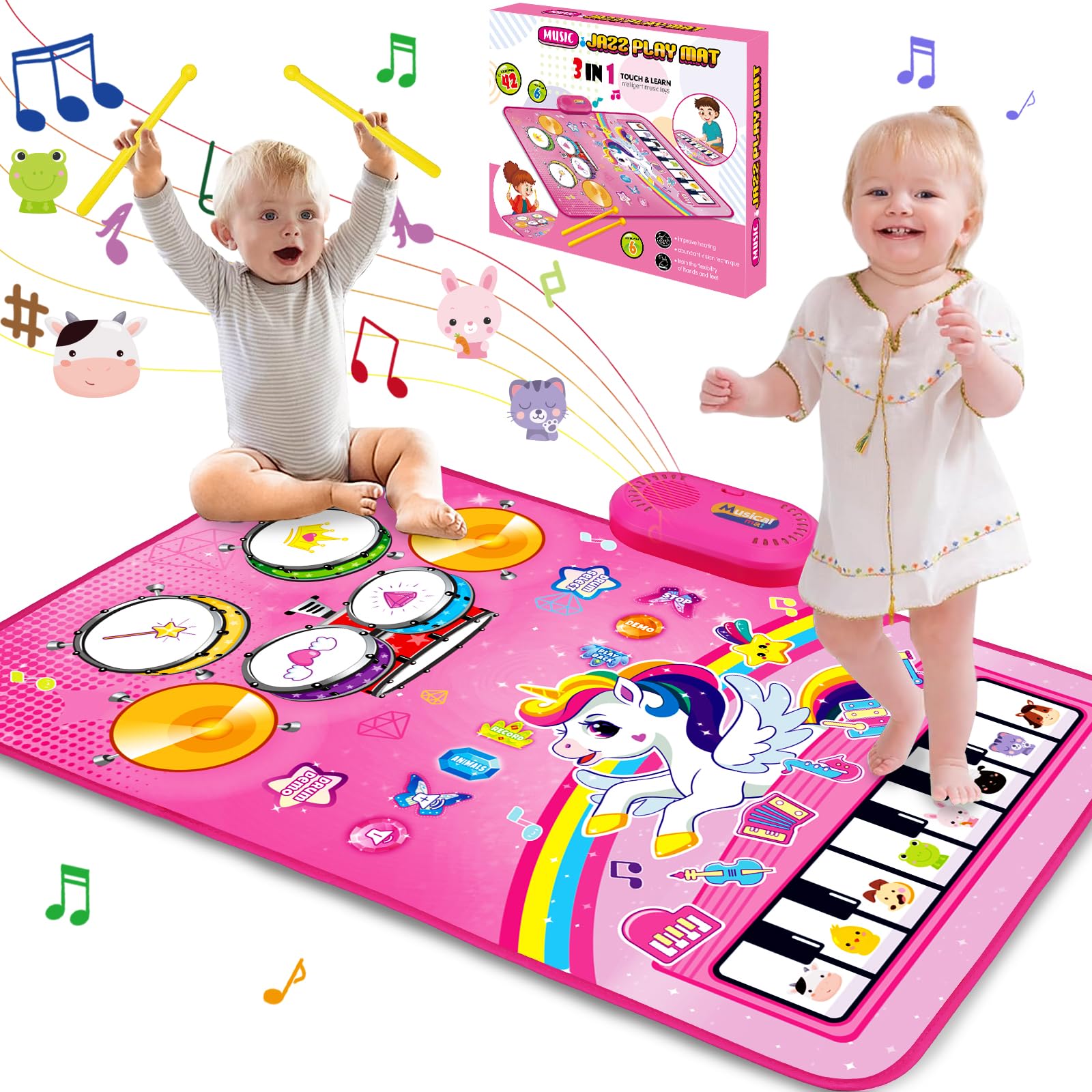
A floor piano built for stomping — six instruments and thirteen keys under bare feet.
There are 6 kinds of instrument sounds here — piano, violin, accordion, trumpet, vibraphone, guitar — spread across 13 keys, and the keys can flip into animal sounds. There is a jazz drum side with two drumsticks too, so the same mat becomes an entirely different toy depending on which way you unroll it. It plays by touch, hand or foot, so a child who is not yet steady on their feet can still make it sing.
It is designed for two players, which is the reason to pick it over the cube and the stacker. You play one side, your child plays the other, and the whole thing turns into a shared activity rather than something you supervise from the sofa. The mat is non-woven fabric, safe enough for delicate skin, folds away when not in use, and runs its batteries inside a screw-secured compartment — a small detail that matters a lot for a toy with a power source.
Two things to plan for. The size runs smaller than most buyers picture, which the reviews say plainly. And the sound and functionality ratings are genuinely mixed, so treat this as a fun £-and-giggles toy rather than a precise instrument. If that trade-off works for you, it is the most social pick on the list.
The reason it stays out: hearing music makes children want to move, and this mat rewards exactly that — jumping, stomping, and walking across the keys all produce sound, which is real exercise disguised as a game.
What to accept going in: it is a fabric mat, so it will not play like a real keyboard, and the size is modest.
Choose this if: you want a toy that pulls you onto the floor alongside your child instead of leaving them to it.
Move on if: you are after something compact and battery-free — this is a full-width floor mat that needs power.
7. Wooden Activity Cube | Montessori Toys for 1 2 3 Year Old Toddler Gifts

Seven different games sharing one wooden frame — the one that gets rediscovered every month.
A bead maze, a xylophone, a learning clock, a shape sorter, spinning gears, animal matching, and word cards, all on one cube. That is seven games in a single object, which is the real argument for this over a single-purpose toy: at twelve months your child will bang the xylophone, and at eighteen months they will start working the shape sorter. It is made from natural rubber wood with rounded edges and a smooth non-toxic water-based paint that is designed not to splinter.
The practical bit is the storage. The bead maze on top flips over to reveal the shape sorter, and all the parts — blocks, cards, everything — drop back inside the box when play is over. Teachers dealing with a room full of toddlers specifically value that the parts go away easily and the cube does not eat up floor space. It stands 7.08 inches square and 10.43 inches tall, so it is a real presence without dominating a corner.
One genuine caution: the stick used to play the xylophone keys can be chewed, and one child managed to choke on it during a chewing session. Parents simply stop handing the stick over until the mouthing stage passes. A few buyers also found the unit smaller than expected — enough that it pays to check the listed height before you order.
Why it earns seven-in-one billing
- Bead maze flips over to reveal a shape sorter underneath
- All parts store inside the box, so nothing gets lost under the sofa
- Natural rubber wood with rounded edges and non-toxic water-based paint
- Compact footprint that suits a small playroom
The care it asks for
- The xylophone stick should be kept away during the chewing phase
- Smaller than many buyers expect from the listing
Built for: a child who needs a fresh challenge every few weeks and a parent who hates hunting for loose pieces.
One to skip if: your child is still mouthing everything — wait until the stick can be handed over safely.
8. 3-in-1 Musical Puppy Toys for 1 Year Old Girl Gift (Pink)

A puppy that sings, walks, and switches to Spanish with seven fat buttons built for baby hands.
This one covers three stages in a single toy. At six months it is a sit-and-watch toy — music and colourful lights while the puppy trundles around. At nine months it becomes a crawling target, because the universal wheels let it scoot along and self-avoid obstacles, which means it does not wedge itself into a corner and give up. From twelve months it becomes a pull-along that walks and runs alongside your toddler.
Seven large colourful buttons are easy for small hands to press, and the toy teaches ABC, 123 and nine songs while switching between English and Spanish. For a bilingual household, or one where you want a second language introduced early, that is a genuine reason to choose this over the cube or the stacker. It takes three AA batteries, sold separately.
The durability record is mixed and it is worth being straight about it. The bit that holds the leash is the weak point — one buyer mentioned it breaking the same day it came from the start — and the sound has been known to stop working on some units. Everything else about it, from the size to the walking motion, lands well with toddlers.
What makes it stick: lights, music, and movement running at the same time hold a baby’s attention long enough for them to actually press buttons and learn something, and the quality feels better than the price suggests.
Right for: a six-to-eighteen-month-old in a bilingual home, or anyone who wants one toy that watches, chases, and follows.
Know before you buy: treat the leash attachment gently from day one — it is the first thing to go.
9. Pithfor Wooden Baby Walker with Activity Center

A wooden push walker with eight toys built into the frame — and wheels that stay quiet.
This is the wooden answer to the VTech walker above: same sit-to-stand idea, entirely different material. It arrives with eight activity toys on the front — a mirror, a rolling drum, a bead maze, a xylophone, spinning gears, a shape sorter, a drum, and a zig-zag track — so it works as an activity board first and a walker second. The frame is sturdy wood with anti-slip rubber wheels, which are noticeably quieter and less slippery on hardwood and tile than bare plastic, and the balanced design reduces the risk of tipping when a child leans on it.
Assembly is one thing buyers repeatedly mention as straightforward, and the finish is what sells it — the colours are genuinely handsome, which is not a small thing when the toy lives in your living room. It is rated from 10 months to 3 years, so it spans the entire window this article covers, and it comes with a user guide.
Two honest notes. A separate concern is the rear wheels, which can work loose over time — worth checking and tightening periodically, especially once your child is leaning their full weight on the frame.
The quality argument: buyers rate the wooden construction highly, and the coated wheels make it a genuinely different experience from a plastic walker on a hard floor.
Where it asks for effort: it is a premium-priced wooden walker, so if budget is the deciding factor this is the one to think twice about.
Buy this when: you want the quiet, good-looking, wood-built option and you are happy to pay for it.
Look at the VTech instead if: you want the detachable panel and two-speed control at a friendlier budget.
Understanding the Specs
Age range and why it matters more than anything else
The age range on a toy is not a suggestion, it is the manufacturer’s safety statement. A walker rated 9 Months – 3 Years has been checked for a child who can sit and pull up, while one rated 12 months – 5 years assumes a child past the worst of the mouthing stage. Match the range to your child’s current stage rather than their birthday, and you will avoid both toys that frustrate them and toys they can pull apart.
Materials, finishes, and what to actually check
Two things matter here: what the toy is made of, and how it is finished. On wooden toys, look for rounded edges and non-toxic water-based paint — the KMTJT cube and the Fisher-Price stacker both specify this. On plastic toys, BPA-free and shatterproof are the words to look for, as on the HOLA hammer. Certifications like CPC (Children’s Product Certificate) or FSC-certified wood (Forest Stewardship Council) are real third-party checks, not decoration.
Weight and portability
Weight tells you two things at once: how easy the toy is for you to move, and how easy it is for your child to tip. A 4.6-pound walker stays put when leaned on; a 0.09 kg fabric toy goes anywhere. Neither is better — they serve different jobs. Decide first whether this toy lives in one room or travels with you, and the weight question answers itself.
Power, batteries, and the volume question
Most electronic toys in this category run on AAA or AA batteries, and several ship without them. Check before the birthday. More importantly, look for adjustable volume and an auto shut-off feature — the VTech cube has both, and they are the difference between a toy you tolerate and one you hide in a cupboard. If your child is sensitive to overstimulation, a toy with a sound-off switch is worth more than one with twenty extra songs.
FAQ
Are these toys actually safe for a 12 month old who puts everything in their mouth?
Do I need a walker and an activity cube, or is one enough?
How long will a 12 month old actually play with these toys?
Are wooden toys better than plastic toys for toddlers?
What batteries do these toys need and are they included?
Is the Fisher-Price stacker too small for a one year old?
Can the tissue box toy survive a car journey and a plane?
Which of these works best for a child learning to stand and take first steps?
Do any of these toys help with fine motor skills specifically?
Should I worry that some of these are rated for children older than my baby?
Final Thoughts: The Verdict
For most families, the 12 month old toys winner is the VTech Sit-to-Stand Learning Walker, because the detachable panel means the same toy works on the floor for a nine-month-old and across the room for a toddler, and the two-speed control keeps pace with them as they get faster.
If wooden toys and a calmer playroom are your priority, the KMTJT Wooden Activity Cube gives you seven games in one frame with everything storing back inside. And if you simply want a first-birthday gift that lands every time, the HOLA Hammer Toy is small, tough, and rewards the banging instinct that every one-year-old has.
How We Picked
We do not accept paid placement. Every pick is matched to a real buyer and a real use-case; we do not hands-on test units.
Sources & Methodology
Specifications: manufacturer listings and product documentation. Review insights: verified customer reviews, as of September 2026. Pricing: not shown on this page (it changes often); check the current price via the retailer link.
As an Amazon Associate, Non Toxic Blog earns from qualifying purchases. This does not affect which products we feature.