Specs are compiled from manufacturer listings and verified buyer reviews and can change over time — please confirm the key details on the product page before buying.
Here is the short answer: the number that decides whether a portable AC keeps you cool is the SACC rating (the government-required real-world cooling figure), not the larger ASHRAE BTU number printed in giant letters. Every unit here is rated around 14,000 BTU ASHRAE, and I only compare same-class machines in the 13,000 to 15,000 BTU range. That is why several picks here list a 9,600 or 10,000 BTU SACC figure against a 14,000 BTU ASHRAE number — same cooling class, compared honestly. Every pick below is a real machine with a verified review history, and each earns its spot for a different reason.
I’m Mo Min — the founder and writer behind Non Toxic Blog. This guide is built by comparing the manufacturers’ published specifications and the patterns across verified customer reviews, so you get each pick’s real strengths and trade-offs instead of marketing spin.
A portable AC lives or dies on three things: how much of the room’s air it can actually cool, how loud it gets while doing it, and whether you are dragging a bucket to the sink every day. Get those three right and the unit works as advertised. This breakdown of the 14000 btu portable air conditioner field separates the genuinely quiet, efficient machines from the ones that just print a big number on the box.
Our Picks at a Glance
How To Choose The Best 14000 BTU Portable Air Conditioner
Most people buy a portable AC on the BTU number alone, then wonder why a hot bedroom still feels muggy three hours later. The fix is knowing which spec-sheet numbers map to your room size, your window type, and how loud you can tolerate at night. Here is the short version of what matters.
Read SACC First, ASHRAE Second
SACC stands for the cooling figure measured under real test conditions, and it is usually much smaller than the ASHRAE number printed in giant letters on the box. A 14,000 BTU ASHRAE unit typically lands around 9,600 to 10,500 BTU SACC. If a seller only lists ASHRAE, ask for SACC before you trust the coverage claim — that figure is what actually cools your space on a 95°F afternoon.
One Hose Or Two
A single-hose unit pulls room air in, cools it, and dumps the hot exhaust out a window — which means it also pulls hot outside air back in through every gap. A dual-hose system separates the intake and exhaust so your room pressure stays balanced and the cold air stays cold. Upgrading from a single-hose machine, the pressure balance is the first difference you notice.
Inverter Compressor Or Fixed Speed
A fixed-speed compressor is either roaring at full tilt or silent, which is why the room swings hot and cold. An inverter compressor slowly dials its output up and down, so the temperature stays steady and the noise floor drops. It draws less power at part load, which is why inverter-rated units tend to run cheaper over a whole summer.
Draining: Automatic Or Bucket
Cooling mode creates condensate, and how the machine handles it decides your daily routine. Many modern units pull moisture from the air and evaporate it back out the exhaust, so you rarely touch a drain. In very humid rooms above 85% relative humidity, even self-evaporating units can need a hand drain. Check whether the drain outlet sits low at the base or higher on the back — a higher outlet is far less of a crouch to reach.
Where The Hose Goes
Window kits vary widely, so measure your opening before you buy. Hoses usually run about 59 inches, and if your window sits higher than that, the fix is to raise the unit on a small stand rather than add an extension hose — extensions add resistance and cut cooling power. Sliding and double-hung windows are the easiest fit; casement and horizontal styles may need an adapter.
Quick Comparison
| Model | Best For | BTU (ASHRAE / SACC) | Noise (lowest) | Coverage | Amazon |
|---|---|---|---|---|---|
| Gasbye Dual Hose★ Best Overall | Whole-room efficiency | 14,000 / 10,500 | 45dB | 500–550 sq ft | Amazon |
| TOSOT AOMI SeriesCompact Pick | Bedrooms and offices | 14,000 / 9,600 | 54dB | 600 sq ft | Amazon |
| Tanoxo 14000 BTUBest Coverage | Big open rooms | 14,000 / 10,000 | — | 700 sq ft | Amazon |
| BLACK+DECKER BPT10HWTB | Year-round heating | 14,000 / — | — | 700 sq ft | Amazon |
| Temprium 4-in-1 Smart | Silent sleep | 14,000 / — | 41dB | 750 sq ft | Amazon |
| Westinghouse 14,000 BTU | Heating + dehumidifying | 12,000 / 8,150 | 52dBA | 700 sq ft | Amazon |
| ZAFRO Smart Inverter | Dual-hose value | 14,000 / 10,000 | 42dB | 700 sq ft | Amazon |
| DREO 516S | Smart voice control | 14,000 / 10,000 | 45dB | — | Amazon |
| Whynter ARC-1230WN | Large apartments | 14,000 / — | — | 600 sq ft | Amazon |
| Midea Duo 14,000 BTU | Whole-home replacement | 14,000 / 12,000 | — | — | Amazon |
In‑Depth Reviews
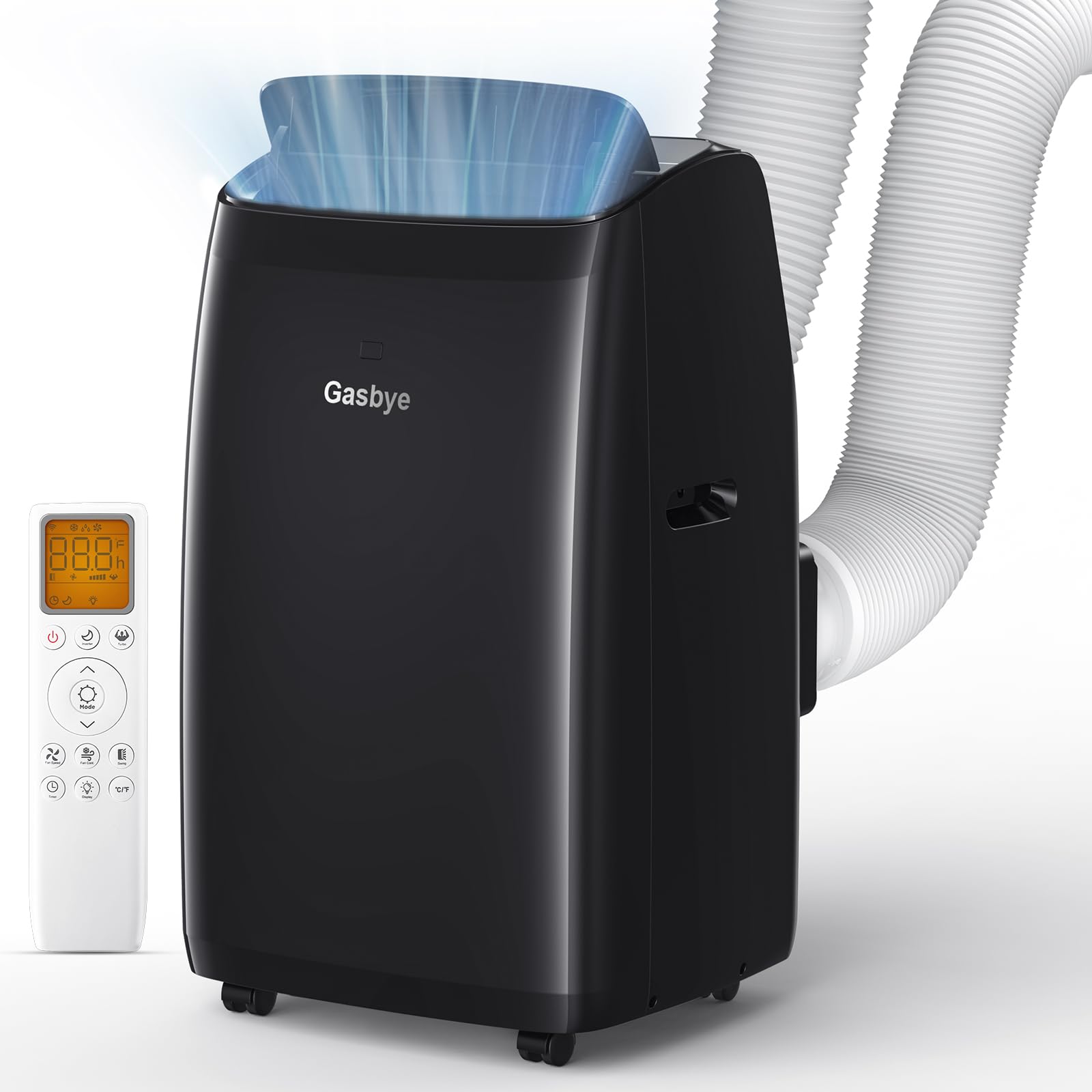
1. Gasbye Dual Hose Portable Air Conditioner, Full DC Inverter, 14,000 BTU
Our pick — over 4.5★ from 450+ verified ratings; the strongest balance of quality and price.
The dual-hose inverter that turns a hot room cold without pressurizing your house
If you have ever owned a single-hose portable AC, you already know the specific misery: it cools the air it can reach, then sucks hot air back through every gap in the room to replace what it pushed out. This Gasbye solves that with a dual-hose design that pulls its intake air from outside instead of from your living room, so the cooling you paid for does not leak back out a window seal. That is the single biggest reason it earns the top slot here.
The efficiency story backs it up. Air Flow Efficiency of 13.6 cubic feet per minute per watt is a CEER rating (a number the DOE verifies to show how much cooling you get per unit of electricity) — 13.6 CEER puts it at the top of its class for energy use. Annual energy consumption lands at 442 kilowatt hours per year, and against the TOSOT AOMI Series at 1500 kilowatt hours per year, the Gasbye runs on a fraction of the electricity to cool a comparable room. The inverter compressor drops to 50% output within two minutes of the compressor firing, which pulls its noise level down to about 45dB — the gas-engine hum of a dishwasher across a kitchen, not the rattling roar of a fixed-speed unit. Its cooling output is 14,000 BTU ASHRAE and 10,500 BTU SACC, and it is rated for 550 square feet.
The thing owners love is raw cooling performance — a dual-hose 14,000 BTU machine that consistently delivers, and with 4.8 stars across 476 ratings, that love is not a fluke. There is heavy use logged here: a buyer ran three-day stretches without a hiccup, another swapped out two years of window units, and a third dropped the room to 61°F at night where the old window unit bottomed out at 66°F. A Florida household used it as a full replacement during an AC failure and saw lower electric bills for a year. Where it falls short is the fit: hoses run 59 inches, so a high window means the unit itself needs a small stand to reach. The remote is basic, and the hoses run on the thin side — a wrap sleeve is worth the small cost. And if you’re in very humid air above 85% relative humidity, you will still need to hand-drain occasionally, though the drain outlet sits higher on the back so it is easier to reach than most.
Dual hose full DC invert
- Dual-hose design keeps room pressure balanced — no hot air drawing back in
- 13.6 CEER and 442 kWh/year make it among the most efficient units on this list
- 45dB inverter operation is genuinely sleep-friendly
- Three-year quality coverage, brand-new replacement units not refurbs
Bulky window kit
- Clearly a full-size unit — the dimensions are larger than a “mini” model that inflates its BTU claim
- 59-inch hoses require a small stand for high windows
- Thin hoses benefit from an insulation sleeve
- High-humidity days may still need manual drainage
Pick for large rooms: you want the most efficient cooling for a whole room and noise actually matters to you at night.
Pass on tight windows: your window sits high and this machine has to be raised on a stand to meet its own hoses.
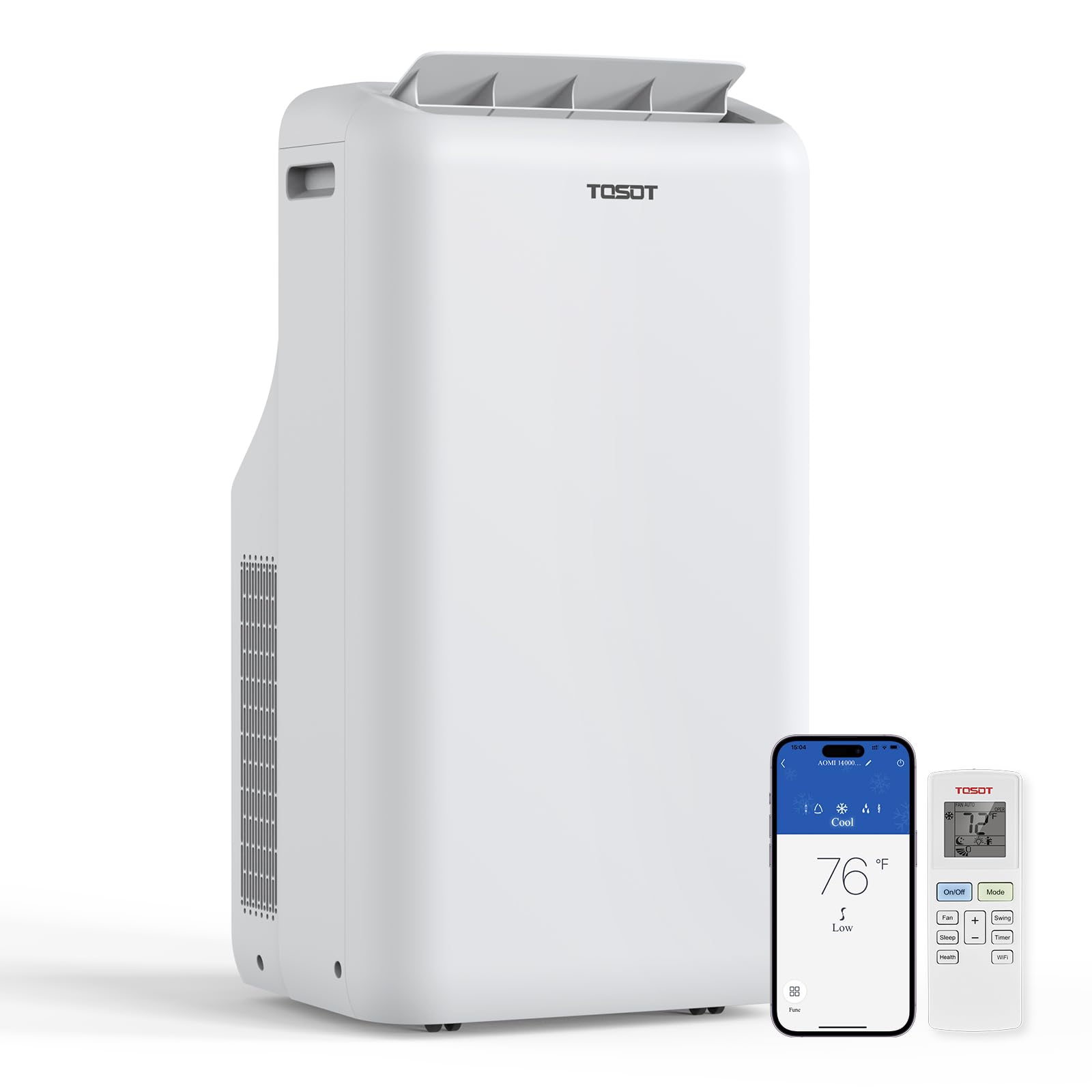
2. TOSOT 14,000 BTU WiFi Portable Air Conditioner, AOMI Series
The small-floor-footprint pick that also warms the room when the season turns
For a bedroom or office where floor space is tight, the AOMI Series stands out on one thing: it is the most compact footprint on this list, which is why it keeps landing in rooms people describe as cramped. It runs four modes — cooling, dehumidifying, fan, and heat — so one machine covers both seasons. Cooling output is 14,000 BTU ASHRAE and 9,600 BTU SACC, rated for up to 600 square feet, with a noise floor of 54dB at its lowest fan setting. That 54dB is noticeably louder than the quietest dual-hose machines here; against the Gasbye at 45dB, its lowest-speed output sits higher, and the recurring theme in owner feedback is that this is a loud-running machine — the kind of steady hum you notice on a bedside table. Its thermostat has a quirk too: several owners found they had to set it several degrees below the target to reach the temperature they actually wanted.
The good news is what it does well. Air movement and cooling are strong for its size, and the smart features are a real convenience upgrade — the free Gree+ app lets you pre-cool the room from your phone before you get home, and the sleep mode runs its own temperature curve so the room does not get too cold overnight. The four modes switch cleanly, and the dehumidify setting is useful on sticky days when the air feels heavy. It draws 1500 kilowatt hours per year — the least efficient figure on this list, so run it thoughtfully if you care about the bill. Its rating sits at 4.2 stars across 592 ratings, with the loudness a fair split.
WiFi AOMI control: A small footprint plus heat mode makes this the practical pick for a bedroom that gets used year-round, and the app control beats walking over to change settings.
Noisy at night: 54dB at the lowest setting will be audible in a quiet room, and the thermostat often needs to be set lower than your target temp to actually reach it.
Reach for smart homes: floor space is tight and you want one machine that cools in July and warms in January.
Look elsewhere for quiet: a quiet bedroom is your line in the sand — the 54dB floor will be heard.
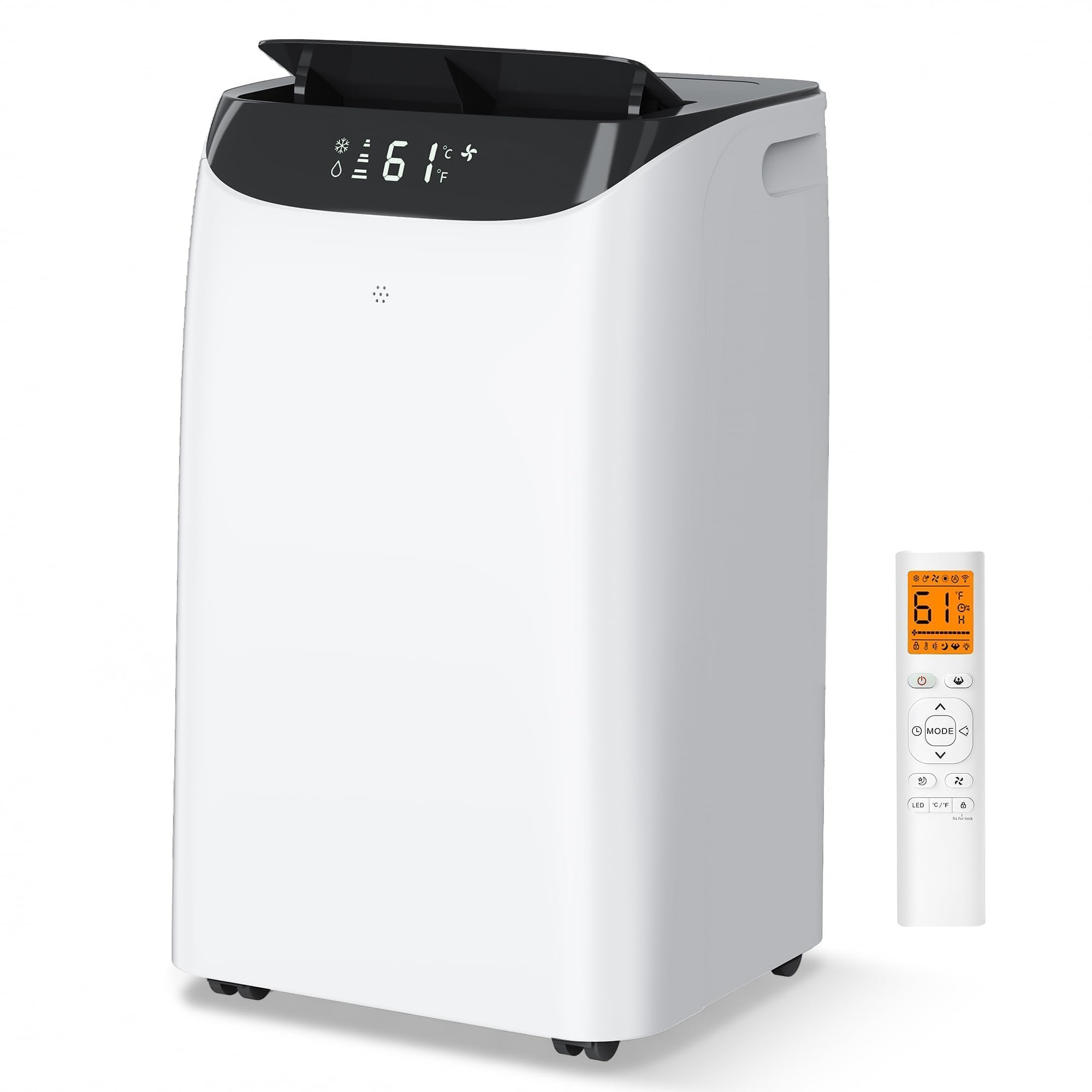
3. Tanoxo 14000 BTU Portable Air Conditioner, 3 Modes, 700 Sq.Ft.
Aimed at open-plan floors, with a remote that reaches almost anywhere in the room
Open-plan living rooms, garages, and basements are the hard jobs for a portable AC, and this is the pick sized for them — it claims coverage up to 700 square feet, the largest footprint claim here alongside the BLACK+DECKER. Its cooling output is 14,000 BTU ASHRAE and 10,000 BTU SACC, and the three-mode setup (cooling, dehumidifying, fan) covers most of the summer. What really stands out in daily use is the LED-backlit remote with a 23-foot range, so you can adjust the temperature from the opposite end of a long room without getting up. Smart Mode auto-switches between cool and fan based on the room’s own temperature, which is a small mercy when you stop fiddling with settings.
The 360° casters and a recessed handle make it easy to roll between rooms, and the auto-oscillating vent spreads cold air instead of pointing it at one spot. Its cooling reaches as low as 61°F, and the fan adjusts across three speeds with 1°F increments for fine control. The self-draining system reduces bucket duty when humidity stays below 85%, but above that threshold you will still need to drain by hand. At 4.2 stars across 207 ratings, most owners are satisfied — one buyer used it as a stopgap when the central AC died and cooled roughly 700 square feet from 85°F to 75°F in around half an hour.
The honest caveat is that a 700-square-foot claim comes with real-world limits. In a genuinely large open space across multiple rooms, cooling gets stretched thin, and one review reported the unit blowing warm air instead of cold. In practice, this shines in a single large room rather than a whole floor. Its smart mode and self-drain reduce the fiddling considerably, but the machine still needs a reasonably sealed room to work as advertised.
The pick for bedrooms: one big open room — garage, basement, or open living space — where you want it cold fast and easy to move around.
Think twice for damp rooms: you are hoping one unit can cool several connected rooms at once, not just one large one.
4. BLACK+DECKER BPT10HWTB Portable Air Conditioner with Heat, 14,000 BTU

A four-in-one that heats, cools, and dehumidifies — but the heat runs weaker than you’d hope
If you live somewhere with a real winter and a stuffy summer, the appeal of one machine that does both is obvious — this BLACK+DECKER combines an air conditioner, a heater, a dehumidifier, and a fan in one cabinet, rated for rooms up to 700 square feet, with a 12,000 BTU heating output alongside its 14,000 BTU cooling output. That dual role is its headline feature. The Follow Me remote is a genuinely useful addition: it turns the remote itself into a mobile thermostat, so the machine reads the temperature where you actually are rather than at the unit.
Where it gets complicated is heating. Owners love the cooling — it can pull a 400-square-foot room very cold, and several found it handles extreme desert heat without strain. The heater, though, is a weaker performer, and that is the single most common note in the feedback: for a lot of owners it warms the room but never really reaches the cozy level you would want from a primary heat source. Treat heating as a backup to your main system rather than a replacement. Cooling gets mixed reviews too, though those happy with it are enthusiastic — plenty of buyers report it cooling whatever room they put it in.
Practical points worth knowing before you commit: this is a heavy unit, the drain port fills quickly, and several owners found the included hose can work loose, so a clamp on the barb goes a long way. The remote interface is on the complicated side. At 4.1 stars across 503 ratings, it is a solid buy if you want one unit that handles both seasons — just do not expect the heater to carry your winter alone.
The fit for year round: a mild-climate home where you want summer cooling and occasional backup heating from one machine.
Skip if you rent: you need a sturdy primary heat source for cold winters — the heating output is weak for that role.
5. Temprium 14,000 BTU Portable Air Conditioner, 4-in-1 Smart AC with WiFi

The whisper-quiet one — 41dB in Silent Mode makes this the bedroom-friendly pick
Silence is the entire pitch here, and the number backs it up: 41dB in Silent Mode, which sits below the Gasbye’s 45dB floor and well under the TOSOT’s 54dB. For a bedroom or home office where fan noise kills your focus, that gap matters more than specs on paper. Its cooling output is 14,000 BTU with a powerful dual motor compressor and 400 CFM airflow (cubic feet per minute — how much air it moves each minute), cooled for rooms up to 750 square feet, the largest claim on this list. The 4-in-1 modes cover cooling, drying, fan, and dehumidifying, so it works across seasons, and turbo mode kicks in for fast relief when you first walk into a hot room.
Smart control is where it flexes: app control, Alexa, and Google Assistant voice, plus a physical remote and a touch panel, so you have four ways to run it. The no-drill window kit fits frames between 20.5 and 50 inches, which makes it a genuinely renter-friendly install — no fixing hardware, no landlord friction. Sleep Mode dims every light on the panel. The honest downsides: this is a single-hose machine, so it will not balance your room pressure the way the dual-hose picks above do, and that means some hot air can seep back through gaps. Reliability shows up as one mixed note in the feedback, and its thermostat can run a little off from your set target, a common portable AC quirk. At 4.2 stars across 328 ratings, it lands as a strong value play for a quiet room.
Four in one smart: 41dB Silent Mode and a no-drill window kit that fits a huge range of frames, plus voice control through Alexa and Google.
Clunky app setup: as a single-hose unit it cannot balance room pressure like the dual-hose picks, so seal your window gaps well.
Ideal for tech users: a renter or anyone who needs a genuinely quiet bedroom — the 41dB ceiling is the quietest on this list.
Pass if you want simple: you want dual-hose pressure balance and prefer to avoid single-hose hot-air seepage.
6. Westinghouse 14,000 BTU Air Conditioner with Heat Mode, WiFi

A four-in-one that moonlights as a serious dehumidifier pulling 90 pints a day
Its cooling output is 12,000 BTU ASHRAE and 8,150 BTU DOE (DOE is the tighter, more realistic figure), rated for rooms up to 700 square feet, with heating output as well for cool evenings. It runs at a low of 52 dBA — roughly a normal conversation’s volume — with a 3-speed fan and a programmable on/off timer.
Control options are wide: remote control with a 20-foot range, the smartphone app, and a touch panel on top. Owners rave about the heating here — one used it to keep a mobile home comfortable when the furnace went out over winter and called it a life saver, and several appreciate that it packs four functions into a single unit. The verdict most owners land on is that it cools and heats better than the price suggests.
Two things to weigh. First, the heat is strong enough that a large bedroom holds its setpoint well, but the internal water tank is small — a common owner gripe is that it fills fast in high humidity, and running a continuous drain hose becomes necessary rather than optional. Second, some owners find it noisier than hoped once the compressor is running. At 4.0 stars across 179 ratings, it earns its place as a versatile machine for people who want heat, cool, and serious dehumidifying from one box.
Made for cold snaps: humid-climate homes that want strong dehumidifying plus four-season heating and cooling from one unit.
Consider this instead if handy: you want to low-maintenance — the small internal tank pushes you toward a permanent drain hose.
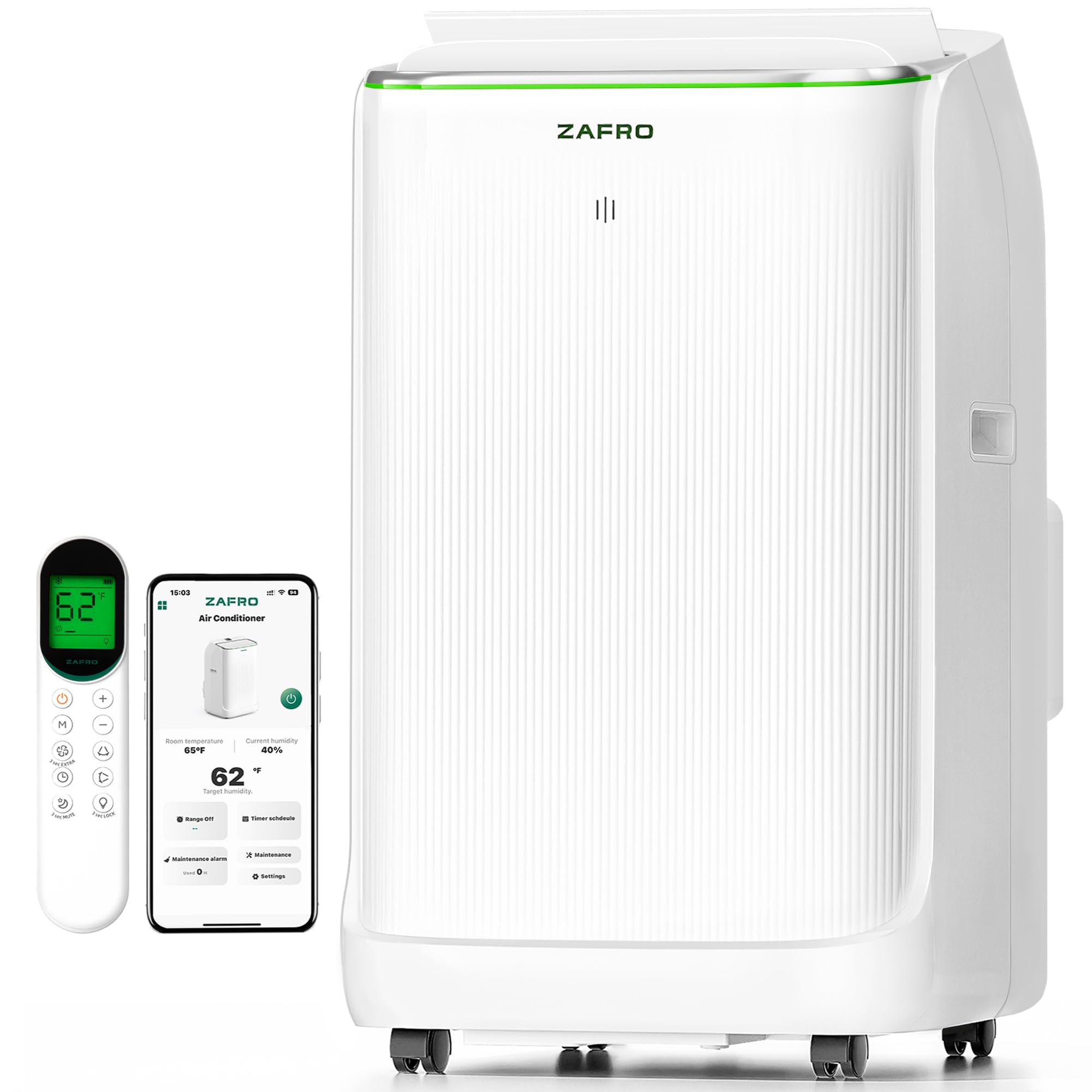
7. ZAFRO Smart Inverter Portable Air Conditioner, 14000 BTU
Dual-hose cooling with an efficiency rating that punches above its class
The ZAFRO packs the same dual-hose setup that makes the Gasbye so effective — balanced room pressure, no hot-air influx — but it adds a CEER of 12.8 (a verified efficiency figure well above the standard 7.83) and self-evaporating drainage that runs up to 72 hours without a manual empty in humidity below 90%. That combination puts it right alongside the top pick on raw efficiency and drains the same or better. Cooling is 14,000 BTU ASHRAE and 10,000 BTU SACC, with high airflow of 480 cubic meters per hour, rated for 700 square feet.
Quiet is the other ace: it runs as low as 42dB, close to the Gasbye’s 45dB and the Temprium’s 41dB, and the six operating modes — cool, dry, fan, sleep, extra, and eco — combine with four-way oscillation to spread air both vertically and horizontally. The 24-hour timer lets you pre-cool or pre-set a shutdown, and the app gives you full remote control of temperature and schedules. Owners consistently describe the room cooling in minutes even in serious heat, and the app earning several mentions as the preferred way to run it. Its one common note is that the included hoses and the window adapter can be fiddly to seat — a proper seal makes all the difference.
Smart inverter quiet: Dual-hose efficiency plus a 12.8 CEER rating and 72-hour drainage-free cooling — a strong combination for people who want low bills and low fuss.
Slow to cool: the multi-piece hose and window bracket assembly rewards careful sealing; get it right and the payoff is fast, quiet cooling.
Go for this if patient: you want top-shelf dual-hose efficiency at a mid-tier spot, and you hate emptying drain buckets.
Look at the gasbye instead if : you want a longer hoses run or a longer track record of build quality under daily use.
8. DREO Portable Air Conditioner 516S, 14000 BTU
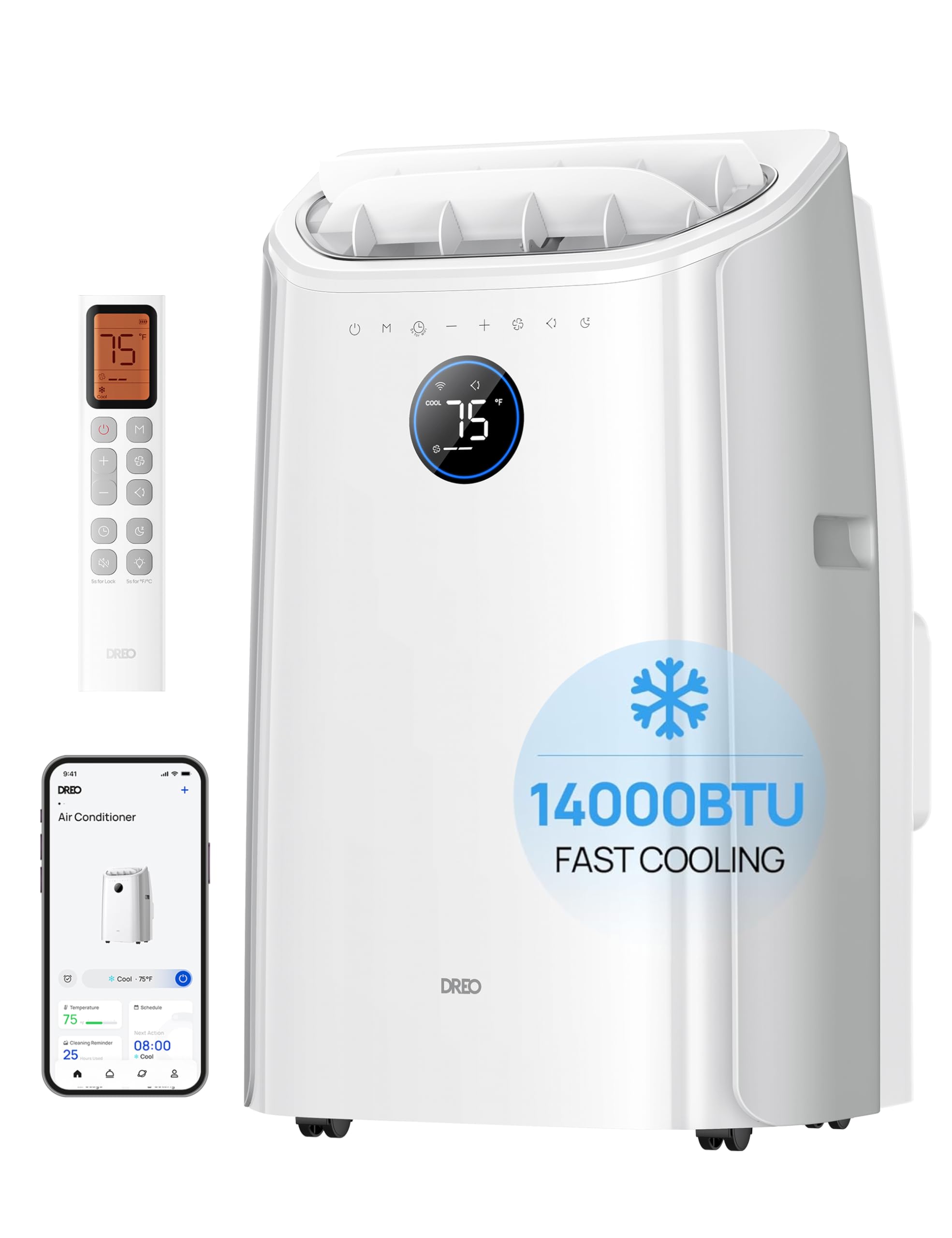
Voice control across Siri, Alexa, and Google plus real drainage-free cooling
Smart-home integration is the differentiator here. This is the only pick on the list that works with Siri, Amazon Alexa, and Google Home, so if your living room is already wired for voice, this is the portable AC that fits right in. Its DREO app adds a sleep curve function — you set how the temperature should drift through the night rather than holding one flat number — and lets you monitor both temperature and humidity from your phone. Cooling output is 14,000 BTU ASHRAE and 10,000 BTU SACC, keeping the room between 61°F and 86°F, with a patented noise isolation system that brings the compressor and turbulence to a 45dB floor. Its drainage-free system uses a pump, sensors, and a control algorithm to evaporate condensate automatically when humidity stays below 90%.
What wins people over is speed and control — the rooms cool quickly, the app is intuitive, and the wheels make it easy to move. It draws 1500 watts per year — on the higher side, comparable to the TOSOT — so run it smartly if energy cost matters to you. Durability shows up as the mixed aspect here: a small number of reports mention older units developing an issue over time, which is a real consideration on a multi-year purchase, though a large majority of owners mention strong performance and easy setup.
DREO 516S airflow
- Works with Siri, Alexa, and Google Home for hands-free control
- Drainage-free operation below 90% humidity thanks to the pump system
- Sleep curve function lets the temperature drift instead of holding flat
- 45dB floor with a real noise isolation design
Drain hose needed
- Energy draw sits on the higher end of this list
- Durability shows mixed long-term notes in a small share of feedback
- Heavier unit needs casters and a reasonably flat floor
- Drainage-free depends on staying under 90% humidity
Best for open plans: smart-home households already using Siri, Alexa, or Google who want voice control and a sleep curve for overnight cooling.
Not the one for dorms: buyers who want the lowest energy draw or the longest reliability track record on this list.
9. Whynter Portable Air Conditioner Inverter 14000 BTU ARC-1230WN
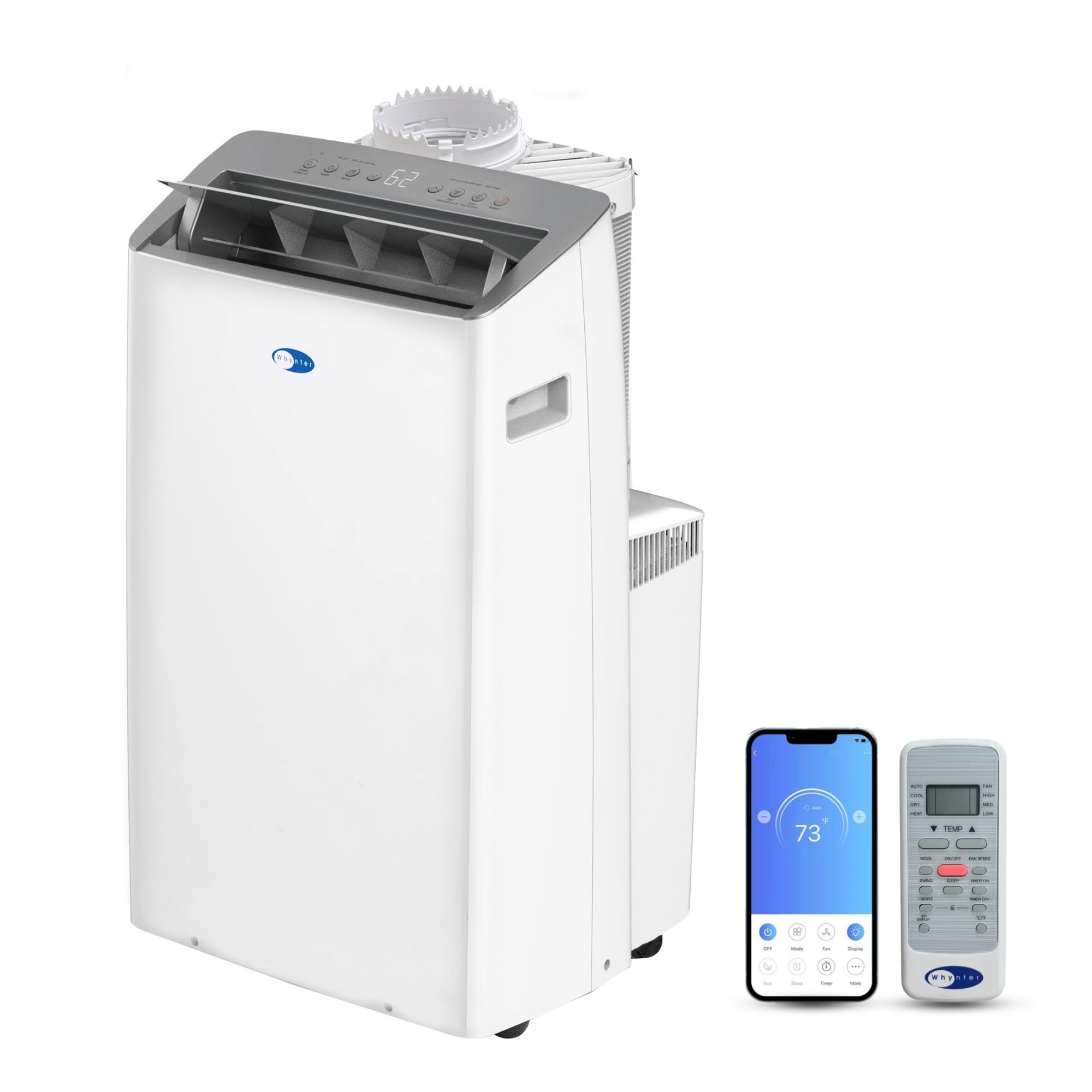
A dual-hose inverter built for large apartments, backed by a string of awards
This is the model that keeps showing up in best-of lists — it was named Forbes Vetted’s “Best Portable Air Conditioner Overall.” For a large apartment or open living and dining area, that reputation shows: the Whynter uses a dual-hose system that intakes and exhausts outdoors, with a hose-in-hose design that runs up to 47 inches to prevent heat leaking back in. The inverter technology is where it shines: it offers 20% more cooling and 40% more efficient use, with a built-in dehumidifier that automatically exhausts up to 87 pints per day of condensate — so no bucket wrangling in normal use. Its cooling output is 14,000 BTU, covering up to 600 square feet, with thermostatic control from 60°F to 86°F.
Setup is a strong point. The unit stands up and rolls into place, the window installation kit runs up to 82 inches, and the washable filter pulls out for a quick rinse. The NetHome Plus app lets you control everything over WiFi, and Alexa and Google Home are both supported. At 4.2 stars across 628 ratings, owners are happy, with a sizable crowd praising the quiet running, the fast cooling, and the easy install.
The honest caveats worth knowing: rain can seep through the hose onto the floor in some conditions, so it is worth removing the hose when rain is forecast, and a few owners note the Alexa voice control can turn the unit off but not on. The drainage-free claim assumes moderate humidity — in high humidity, expect to drain. For a large apartment where cooling power and efficiency matter more than price, this is a very solid performer.
Great fit for studios: a large apartment or open-plan space that needs heavy-duty cooling with strong efficiency and easy setup.
Mind the details on filters: disconnect the hose in rain, and expect hand-draining in very humid weather.
10. Midea Duo 14,000 BTU Portable Air Conditioner with Heat, Inverter

The heat-pump overachiever that owners use as a full HVAC replacement
If you want to know what a serious portable AC looks like when it grows up, this is it. The Midea Duo uses Midea’s dual hose-in-hose design to intake and exhaust outdoors through a single hose bundle, which is why it can cool a room fast and hold temperature steady. An inverter compressor drives the whole thing, and its 14,000 BTU cooling output combines with a heat-pump mode that heats and cools, rated from 41°F to 86°F. Owners describe the cooling as fast and the inverter quiet — one review likened the multiple units to replacing a full HVAC system for a fraction of the cost.
The self-evaporating system means no bucket in normal cooling use, and the washable filter comes out easily for a rinse. Controls run the gamut: app, voice via Alexa and Google Assistant, and physical buttons. Its heating is a real function, not an afterthought, and owners with baseboard heat note the heat pump runs far more efficiently than old-school electric resistance heat.
Set-up is not plug-and-play — expect around 30 minutes to seat the hose and window kit properly — and a few customers note the included hose is short, so measure your window height first. The bigger caveat is around sealing: some reviews report air leaking back through gaps around the hose, which hurts efficiency if not addressed. At 3.9 stars across 221 ratings, this is a strong performer for anyone who wants one machine that genuinely heats and cools and is willing to install it carefully.
Midea Duo heat
- Heat pump works in both directions — real cooling and heating
- Hose-in-hose design draws in outside air and prevents heat seepage when sealed well
- Inverter compressor keeps the noise floor low and steady
- Self-evaporating means no bucket in normal cooling conditions
Pricey upfront
- Install takes around 30 minutes and needs a tight window seal
- Included hose runs short on tall windows
- If hoses and vents are not sealed, outside air can leak back in
- Heat mode below freezing is limited — the heat pump has a floor
Right for you if heating: you want one capable machine to replace both summer cooling and shoulder-season heating, and you will take the time to seal the install properly.
Choose another pick if budget: your windows are tall or awkward and you need a hose that fits without improvising an adapter.
Understanding the Specs
ASHRAE BTU vs SACC BTU
ASHRAE BTU is the big number on the box, measured under controlled conditions, while SACC BTU is the real-world figure the government requires to show how much cooling you actually get in a hot room. A 14,000 BTU ASHRAE unit usually delivers around 9,600 to 10,500 BTU SACC — same-class machines can differ widely even when the ASHRAE number looks identical. When you compare units, compare SACC to SACC, or the numbers tell you nothing useful.
CEER and Kilowatt Hours Per Year
CEER is the efficiency rating that shows how much cooling you get from each watt of electricity, and annual energy consumption in kilowatt hours per year is the long-run figure that decides your summer bill. A unit with a CEER in the twelves will use meaningfully less power than a unit in the sevens, so if you run the machine all day, this is the number that earns back its own cost over a few summers.
Decibels (dB) Ratings
Decibel ratings measure the noise level of the unit at its lowest fan speed. Every 3dB increase is roughly double the sound you perceive, so the gap between a 41dB machine and a 54dB machine is enormous in a quiet bedroom. If you sleep in the same room as the AC, prioritize the lower number and confirm it applies to the sleep or silent mode, not just the lowest fan setting with the compressor off.
Dual-Hose vs Single-Hose
A single-hose unit pulls room air in to cool it, then pushes the hot exhaust out a window — which means hot outside air gets drawn back in through gaps. A dual-hose system separates the intake and exhaust so the room’s air pressure stays balanced and the cold air stays where it is. This is why dual-hose machines tend to feel more comfortable even when the raw BTU rating is similar.
Inverter vs Fixed-Speed Compressors
A fixed-speed compressor runs at full blast or not at all, which swings the room’s temperature and makes the noise pulse. An inverter compressor adjusts its output smoothly, holding the temperature steady and dropping the sound floor and power draw at partial load. Inverter units typically cost more upfront, but they run quieter and use less electricity over a hot season.
Self-Evaporation and Drainage
In cooling mode the unit pulls humidity from the air, and self-evaporating systems recycle that moisture out the exhaust so you rarely need to empty a bucket. In very humid rooms above about 85% relative humidity, even self-evaporating units can need a manual drain — so check that the drain outlet sits at a reachable height, and expect to run a drain hose if you live in a damp climate.
FAQ
How many square feet will a 14000 BTU portable air conditioner cool?
What is the difference between ASHRAE BTU and SACC BTU on a portable AC?
Is a dual-hose portable air conditioner worth it over a single-hose unit?
How loud is a 14000 BTU portable air conditioner in a bedroom?
Does a 14000 BTU portable air conditioner need to be drained?
Will a portable air conditioner cool an entire apartment or just one room?
How much electricity does a 14000 BTU portable air conditioner use?
Can a portable air conditioner with heat mode replace my furnace?
What size window does a portable air conditioner window kit fit?
Why does a portable air conditioner keep turning on and off?
Is it cheaper to run a portable air conditioner than central AC?
Final Thoughts: The Verdict
For most people buying a 14000 btu portable air conditioner, the Gasbye Dual Hose Full DC Inverter is the pick that gets the whole package right: dual-hose pressure balance, a verified 13.6 CEER, a 45dB floor, and a three-year quality coverage. If quiet is your priority, the Temprium 4-in-1 Smart AC runs at 41dB and installs with a no-drill kit that fits a broad window range. And for a large apartment that needs heavy-duty cooling, the Whynter ARC-1230WN delivers the same dual-hose, inverter-driven performance with award-level credentials behind it. Whichever you pick, match the SACC number and your room size first, check the dB floor if you sleep next to it, and confirm your window can take the hose kit — those three checks save more regret than any other spec on the box.
How We Picked
We do not accept paid placement. Every pick is matched to a real buyer and a real use-case; we do not hands-on test units.
Sources & Methodology
Specifications: manufacturer listings and product documentation. Review insights: verified customer reviews, as of September 2026. Pricing: not shown on this page (it changes often); check the current price via the retailer link.
As an Amazon Associate, Non Toxic Blog earns from qualifying purchases. This does not affect which products we feature.