Specs are compiled from manufacturer listings and verified buyer reviews and can change over time — please confirm the key details on the product page before buying.
If your trail camera dies mid-season, you already know the worst part is the drive out to swap batteries. A 12V solar panel with a built-in battery keeps that camera topped up from the sun instead, so you set it up once and let it work. This guide sorts the real 12V-with-battery kits from the ones that quietly quit after a month, and it tells you which one fits your camera, your climate, and how far away you live from it.
I’m Mo Min — the founder and writer behind Non Toxic Blog. This guide is built by comparing the manufacturers’ published specifications and the patterns across verified customer reviews, so you get each pick’s real strengths and trade-offs instead of marketing spin.
Trail camera owners are the biggest buyers here, but security cameras, deer feeders, and off-grid projects all run on the same 12V setup. Below you will find the [12V Solar Panel with Battery] picks that actually hold a charge outdoors, plus how to match voltage and plugs before you buy.
Our Picks at a Glance

How To Choose The Best 12V Solar Panel with Battery
The fastest way to get this wrong is to buy the biggest panel you can find and assume the rest takes care of itself. What matters more is whether the kit includes a battery, whether the voltage matches your camera exactly, and whether the plugs fit the port on the back of your device.
Match the voltage to your camera first
A trail camera that wants 12V will not run happily on a 5V feed, and a small security camera built for 5V can be damaged by pushing 12V into it. Many kits solve this with a slide switch or a button that lets you pick your output. Some only ship with one fixed output, so check that first.
Panel wattage and battery capacity work as a team
A 10W panel with a 10400mAh battery and a 20W panel with a 24000mAh battery look like different products, but they are sized differently on purpose. The bigger pair stores more energy for cloudy stretches, which matters if your camera shoots video and uploads to cellular. A smaller panel is fine for a camera that only snaps stills.
Waterproofing and mounting decide how long it survives
Your panel lives outside through rain, snow, and summer heat, so look for an IP rating (a standard number that grades how well a device resists dust and water) and a mounting bracket that tilts toward the sun. A fixed mount in shade is the single most common reason a solar camera kit underperforms.
Quick Comparison
| Model | Best For | Panel Power | Battery Capacity | Output Voltage | Amazon |
|---|---|---|---|---|---|
| SPYPOINT Solar Panel (SPLB-10)★ Best Overall | SPYPOINT trail cams | — | 2.31 amp hours | 12V, 9V, 6V | Amazon |
| 10W Solar Panel with 10400mAh BatteryBiggest Battery | 5V and 12V cameras | 10 watts | 10400mAh | 5V and 12V | Amazon |
| Wildgame Innovations Sol-PakBest for Hunters | WGI cellular cams | — | 3000 mAh | 12V | Amazon |
| Elusive Wildlife Reaktor | Most trail cams | 3 watts | 3000 mAh | 12V and 6V | Amazon |
| 20W Solar Panel Kit with 24000mAh Battery | Heavy-cellular cams | 20 watts | 24000mAh | 5V and 12V | Amazon |
| 15W Solar Panel Kit (LIFEMOI) | Multi-voltage projects | 15 watts | 16000mAh | 5V, 6V, 9V, 12V | Amazon |
| Topsolar 100W 12V Kit | RV and off-grid | 100 watts | — | 12V | Amazon |
| ECI Power 100W 12V Kit | Small off-grid builds | 100 watts | 20Ah LiFePO4 | 12V / 24V detect | Amazon |
| ExpertPower 200W 12V Kit | Larger off-grid loads | 200 watts | 20Ah LiFePO4 | 12V / 24V detect | Amazon |
In‑Depth Reviews
1. SPYPOINT Solar Panel for Trail Camera with Internal Battery (SPLB-10)
Our pick — 4.5★ from 450+ verified ratings; the strongest balance of quality and price.
The panel and the lithium battery live in one sealed shell, so there are no wires strung between two boxes on a tree.
If your camera is a SPYPOINT, this is the kit that removes the whole chore. The panel and its lithium-ion battery ship as a single unit, so you strap one thing to the tree and plug one cord into the camera. No separate battery box, no loose cabling, no guessing which wire goes where. The internal battery is rated 2.31 amp hours, and a 45 g lithium-ion cell keeps the pack itself light enough to hang without sagging.
SPYPOINT did not lock it to its own brand, either. Alongside the 12V output for trail cameras, the kit carries 9V and 6V outlets, which is what opens the door to deer feeders and other gear that runs on lower voltage. That versatility is a large part of why this is the crowd favorite in the category, sitting at 4.5 stars across 470+ owners.
What wins people over is how little there is to think about. Buyers report running panels alongside a lit22 battery pack that held a trail camera at 100% charge for two months, and the recurring theme in the review pages is cameras that stopped behaving on disposable batteries snapping back to life the moment the panel went on. The one honest caveat: a few owners have found the pack stops taking a charge once it runs fully flat, so keep the camera powered rather than letting the battery bottom out.
What holds up in the field
- Panel and battery combined into one unit — one mount, one cable, no clutter
- Three output voltages (12V, 9V, 6V) cover trail cameras and deer feeders
- Compact 8.86 x 2.68 x 8.58 inch shell is easy to hang out of sight
- Long cord reaches the camera port without a separate extension
Where you should pause
- Best results come with SPYPOINT cameras, where the connector is a straight fit
- If the internal battery is allowed to fully drain, some owners have seen it stop charging
Reach for this if: you run SPYPOINT cameras and want the simplest possible solar setup with no loose wiring.
Look elsewhere if: your camera needs a voltage this kit does not offer, or you want a battery you can swap out yourself.
2. 10W Solar Panel with 10400mAh Battery for Security Cameras
A 10400mAh reservoir behind a 10W panel gives this kit the staying power to coast through a run of grey days.
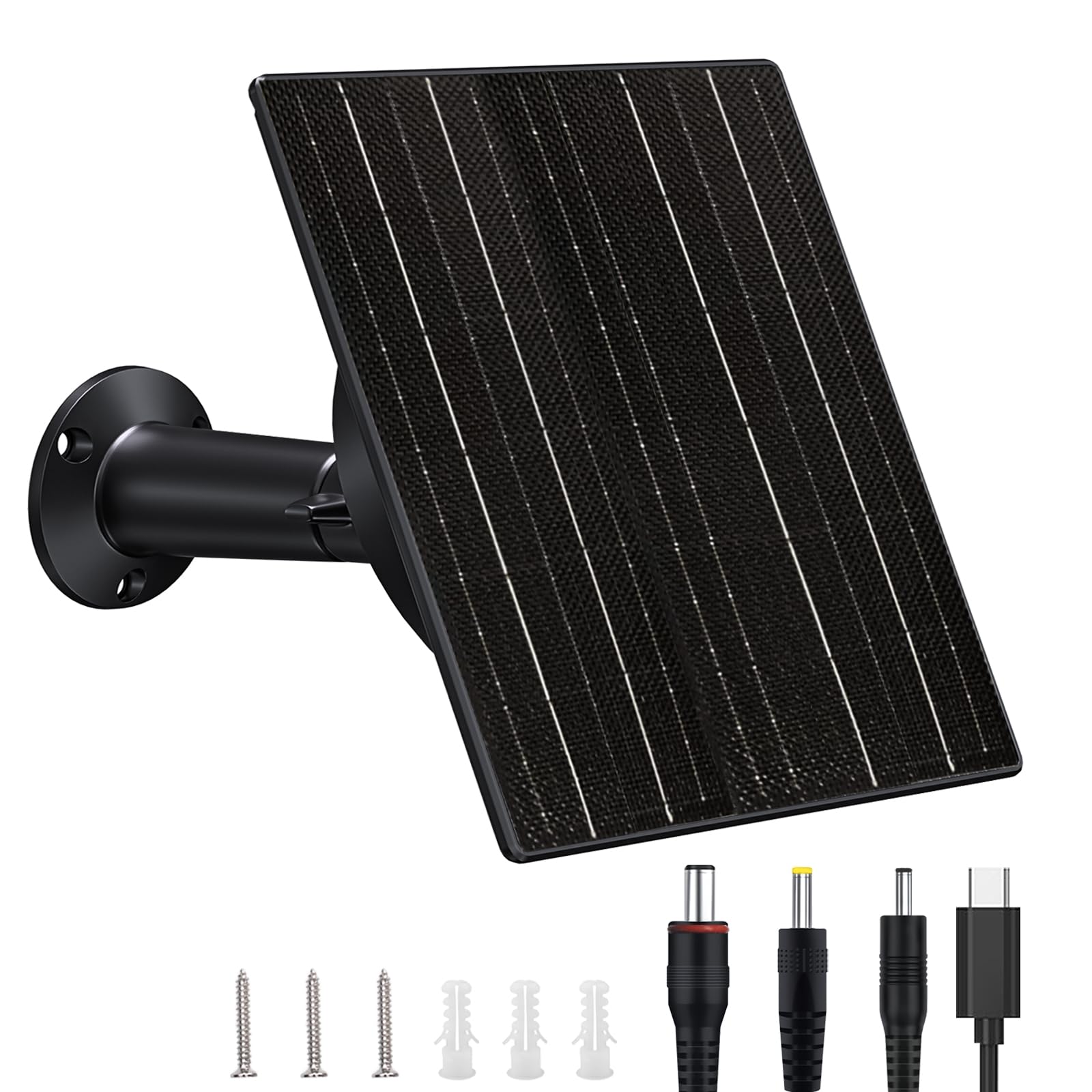
The number to start with is 10400mAh, the capacity of the built-in rechargeable battery. That reserve carries a battery-powered security camera through the night and a run of grey days. The panel itself is a 10W monocrystalline unit, the type that converts sunlight more efficiently than older panel designs, and it measures 9.37 x 8.77 x 1.57 inches. Set it beside the Wildgame Innovations Sol-Pak at 7.5 x 3 x 7.9 inches and this VUEBEE panel takes up a noticeably larger footprint on the mount.
Flexibility is the other draw. A slide switch flips the output between 5V and 12V, so the same kit can feed a 5V security camera or a 12V cellular trail camera. It arrives with USB-C plus three DC plugs (5.5 x 2.1mm, 4.0 x 1.7mm, and 3.5 x 1.35mm) to fit different camera ports, and the mount swivels a full 360 degrees so you can angle it at the sun. The whole thing is rated IP66, meaning it shrugs off heavy rain, and it is built to operate from −20°C to 70°C.
The field reports are strong where it counts. Owners mention testing a panel against a GardePro X66 on an overnight run and watching the camera climb from 20% to 99% without any pre-charge, and another owner says the same rig kept recording through heavy canopy and still held the camera at 100% after hundreds of clips. Budget-tier kits often fumble the mounting hardware, and this one has had a few boxes arrive short a plastic insert for the universal joint. It is a small part that is easy to replace, so it should not sway the decision on its own.
Where the value sits: a 10W panel paired with a 10400mAh battery and a 360° mount is a lot of capability for an entry-level kit, and the multi-plug bundle means you likely will not need to buy adapters separately.
One thing to do first: the maker advises fully charging the battery through USB-C before the panel’s first trip outside, so plan a wall charge before you mount it.
Best for: anyone mixing 5V security cameras and 12V trail cameras who wants one kit that handles both.
Think twice if: you mount your panels on a tree and want the hardware to be flawless on arrival.
3. Wildgame Innovations Durable Sol-Pak Solar Battery Pack (WGI-SOLPAK)
Purpose-built to stop the battery swap trips that ruin a hunting season.
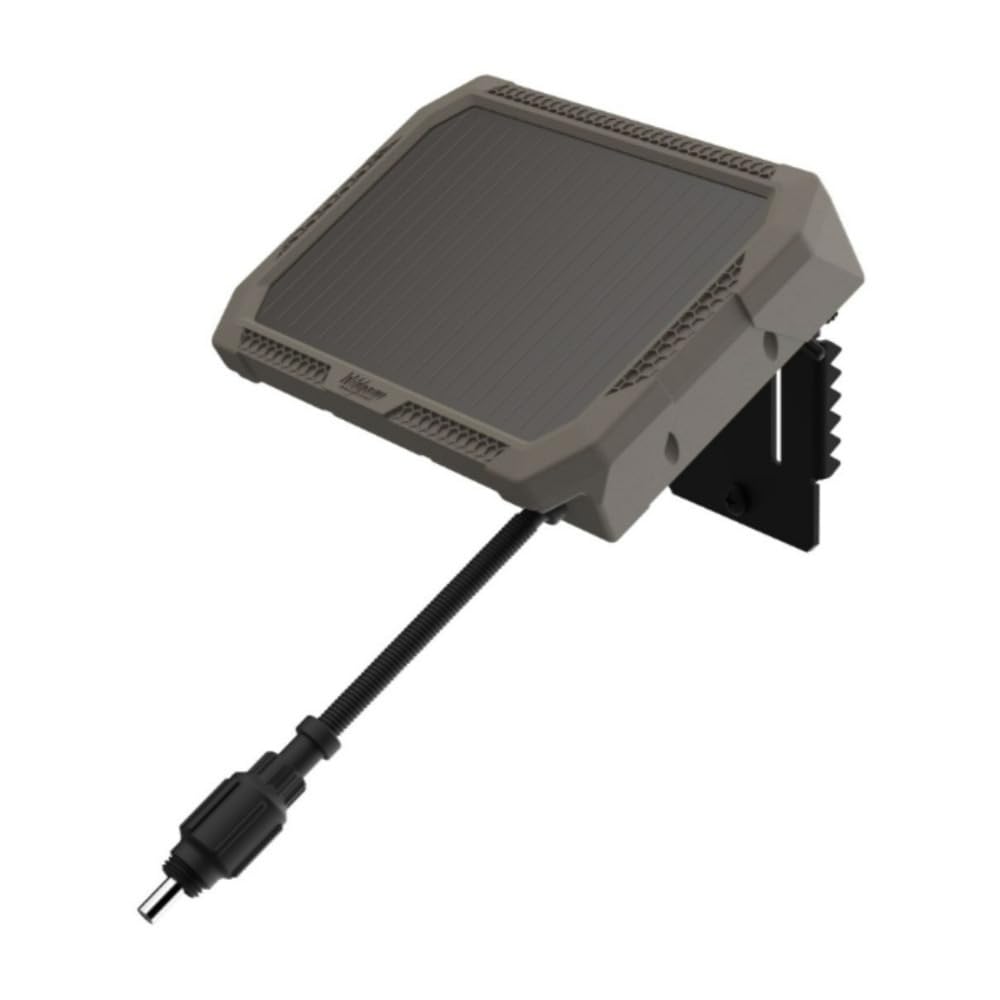
Wildgame Innovations designed this for its own cellular cameras, and the connector tells you so. It uses a 12-volt DC jack, which is the plug on WGI wireless and cellular trail cameras, so it drops straight into the brand’s ecosystem without adapters. The internal cell is rated 3000 mAh, enough to carry a camera through the gaps between sunny days, and the whole unit weighs 8.8 ounces and measures 7.5 x 3 x 7.9 inches.
The practical details are aimed at people who are not near their cameras often. A 3-ft insulated power cable gives you slack to route the cord cleanly around a trunk. An LED battery indicator lets you glance at remaining power without unplugging anything. A USB-C charging port is built in too, so you can top the pack off from a power bank before it goes in the woods, though the cable is not included.
Owners describe the payoff in terms of trips saved. One buyer put it plainly: “Saved me changing batteries out from six or seven times a year to just a couple.” Cutting battery-swap trips is the whole point of this category. The one real complaint is security — there is no lock point, so on public land the panel is as stealable as anything else you leave unguarded.
What you are buying: a weather-resistant housing built to handle wind and rain, complete with mounting hardware and a panel strap for setup.
The honest catch: with no built-in way to lock it down, this is best kept on private property where you can control who walks past.
A confident pick if: you run Wildgame cellular cameras on your own land and want fewer battery changes through the season.
Skip this one if: you hunt public land and need a panel you can cable-lock to a tree.
4. Elusive Wildlife Reaktor Universal Solar Power Pack
A small 3W panel that squeezes usable power out of ambient light, not just direct sun.
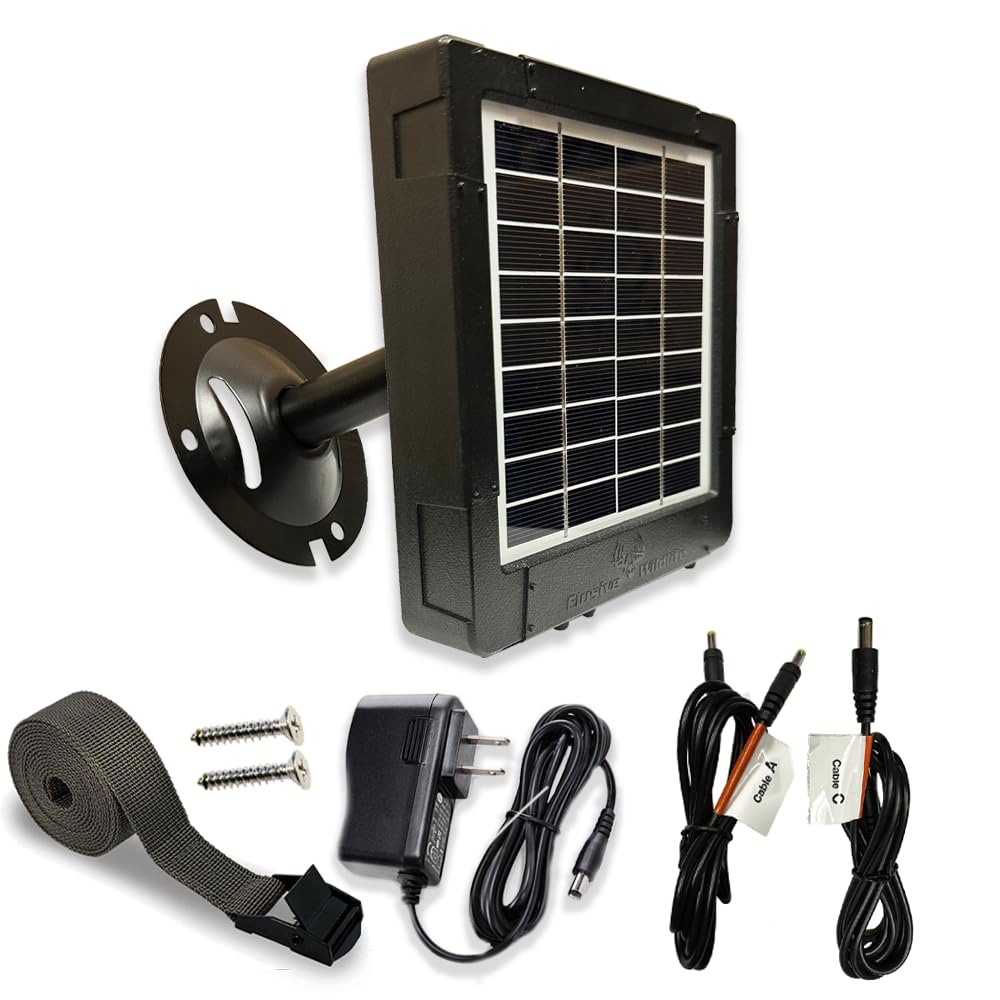
The Reaktor leans on low-light performance instead of raw size. Its 3W monocrystalline panel is built to charge in ambient light, which the maker says lets it work on cloudy days and in semi-shaded spots. It pairs that with a 3000 mAh lithium battery that stores the energy and keeps feeding your camera after dark. For a hunter whose camera sits on a north-facing ridge that only catches a slice of sun, that low-light tolerance is the feature that matters.
Compatibility is deliberately broad. The kit puts out both 12V and 6V and includes a wall adapter for AC charging when you want to fill the battery from an outlet before it goes out. Two power cables ship in the box to match different camera voltages and connection ports, and an adjustable mounting bracket lets you aim the panel for the best light. The package rounds out with a mounting strap and a swivel mount.
Owners who keep it in the weather have run these for a long stretch. One turned in a Moultrie edge 2 camera that sat from November through late September and still held 97%. The trade-off to know about is sealing: the housing is described as weather-resistant rather than fully sealed, and a small number of owners have found water inside after a season. Set it somewhere it drains rather than pools, and give the cables a little slack.
Why owners keep buying more: owners praise its build quality, and the unit’s reliability is what brings them back for more
Note before you mount it: check the seal around the housing and orient the panel so water runs off rather than collecting near the cable entry.
Pick this if: your camera sits in shade or partial sun and you want a small panel that still produces a charge through the day.
Consider a sealed alternative if: your setup sits in heavy, driving rain with no natural drainage.
5. 20W Solar Panel Kit with 24000mAh Battery, 5V and 12V
The biggest battery in the group, paired with a 20W panel for cameras that eat power.
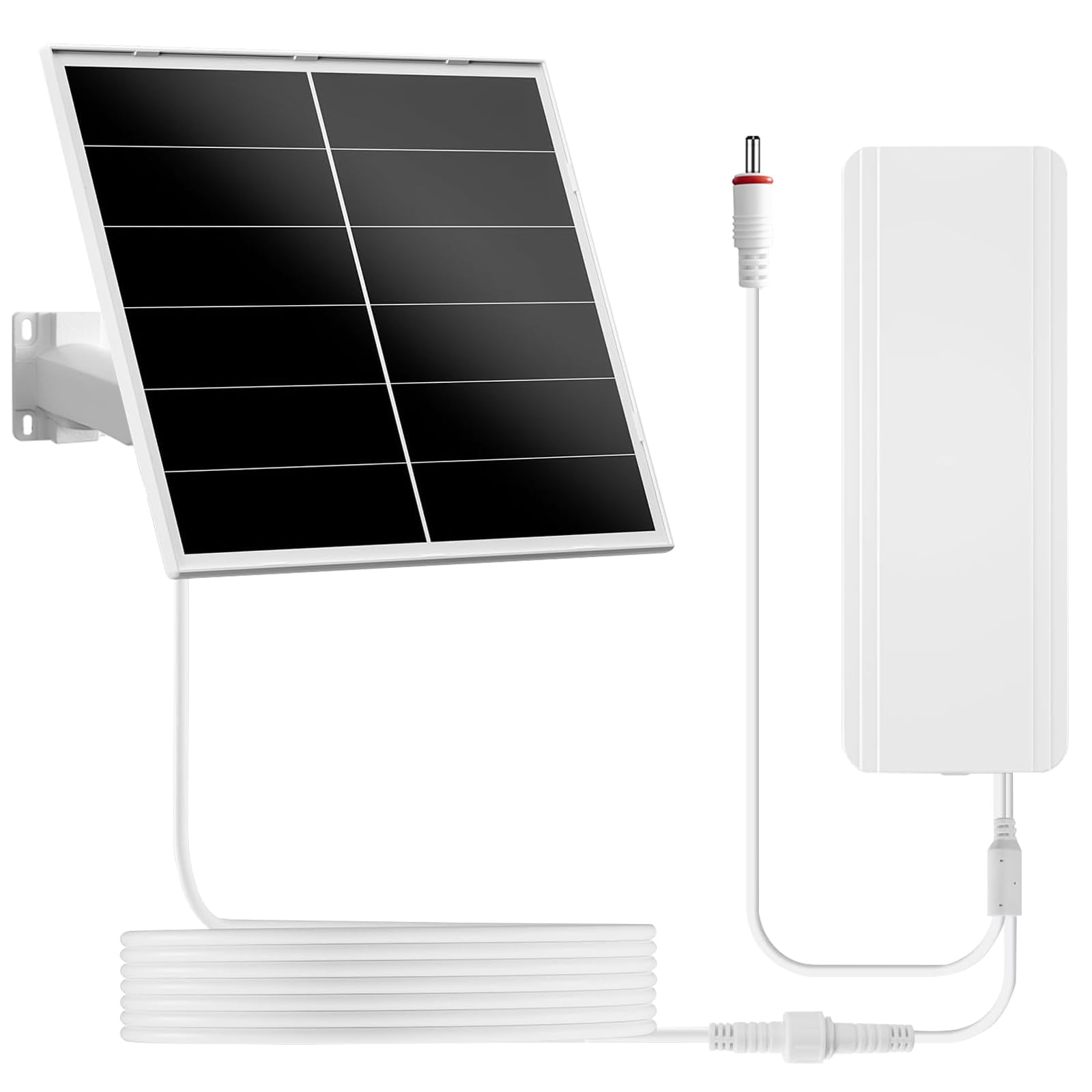
If your camera records video and uploads it over cellular, this is where the spec sheet earns attention. The panel is a 20W monocrystalline unit, which the maker describes as delivering high light transmittance and conversion efficiency, and it feeds a 24000mAh energy storage battery. That pairing suits a camera that records and uploads video all day, not one that snaps the occasional still. The battery’s slide switch selects 5V or 12V output, and the box includes DC 5.5 x 2.1mm, 4.0 x 1.7mm, and 3.5 x 1.35mm plugs plus a USB-C cable.
Two mounting routes are included, one wall bracket and one post bracket with adjustable metal rings, straps, and screws, so the same kit can go on a rooftop, a tree, or a pole. It is rated IP66 for rain and snow protection and works in an operating range of 0°C to 45°C (32°F to 113°F).
Owners who get a good unit describe it as exceeding what they expected. One replaced a smaller solar doorbell charger and found this one kept the battery at 100% on every setting, charging even on dark days. That said, this is the pick where reliability is genuinely mixed across the review pages — some units have stopped working after several months and a few never fully charged, so it is worth testing yours on a sunny wall for a week before trusting it on a remote camera.
The strong case for it: owners consistently call it good value, and a 20W panel with a 24000mAh battery backs that up
The fit note: reliability is the most-discussed topic in the reviews, and the honest read is that this kit rewards a short trial period before it goes into the field long-term.
Best matched to: high-drain cellular cameras in a spot with reliable sun, where the 24000mAh reserve can carry the load.
Not the safest first buy if: your camera sits months from the nearest road and you cannot easily swap a failed unit.
6. 15W Solar Panel Kit with Built-in 16000mAh Battery (LIFEMOI)

Four selectable voltages, five ports, and a 16000mAh bank for projects that do not fit one category.
The stand-out here is choice. This 15W monocrystalline panel pushes 1.5A at each of four voltages — 5V, 6V, 9V, and 12V — and ships with five power interfaces: USB-C, Micro-USB, DC 5.5 x 2.1mm, DC 4.0 x 1.7mm, and DC 3.5 x 1.35mm. If you are powering a locator, a camping light, a tracker, a security camera, or a deer feeder, that spread covers a lot of ground. The built-in battery is rated 16000mAh, backed by a power indicator light, a battery level display, and a voltage readout on the panel itself.
The panel is built for outdoor life, with an IP65 waterproof rating and a high-transparency glass surface. Inside, a smart protection circuit guards against overvoltage, overcurrent, overcharge, over-discharge, short circuit, and reverse polarity, which is what keeps a lithium pack alive through repeated daily cycles. A 3-meter charging cable gives you real reach to the device. The manufacturer covers it with a 1-year warranty.
Owners describe it as doing exactly what the listing promises. One calls it perfect for powering a remote outdoor camera, noting the ability to pick 5, 6, 9, or 12 volts alongside a large battery. The design quirk to learn is the control scheme: you press and hold the button for three seconds to enter voltage selection, then hold one second to pick a level and release, with output starting after a few seconds. It is not obvious without the booklet, so plan on a few minutes of reading before your first setup.
The strongest pitch: one kit, four voltages, five ports, and a 3-meter cable covers a wider range of devices than most single-purpose panels.
Worth knowing before you buy: this is Li-ion rather than LiFePO4 chemistry, and the button sequence takes a read of the instructions to get right the first time.
A smart pick for: builders running mixed devices, from trail cameras to remote sensors, who want voltage flexibility in one box.
Consider simpler options if: you want a set-and-forget panel for one camera and prefer not to learn a button sequence.
7. Topsolar 100W 12V Solar Panel Kit with 30A Charge Controller

A full off-grid kit for bigger batteries than a trail camera ever holds.
This is the point where the 12V world stops being about trail cameras and starts being about cabins, campers, and shed power. The panel is a 100W monocrystalline unit with an anodized aluminum frame and tempered glass coating to survive weather, and it measures 46.5 x 21.8 x 1.37 inches. A 12V/24V intelligent charge controller is included to prevent overcharge and over-discharge, and the box brings two 16ft MC4 cables plus two 5ft O-ring cables for the battery connection.
The beauty of the setup is that it handles the thinking. Owners who hooked up a battery and then the panel found it started charging on its own, no programming required, with one reporting a Class A engine battery back to full in four hours. The kit also found a niche charging a DIY generator’s deep cycle battery, where it produced a steady output across a full day of sun.
The honest catch is the small parts. Mounting is the aspect buyers mention most, and it is genuinely mixed — some customers note missing brackets or bolt holes that do not line up, and a few have had to drill through the aluminum frame to make it work. That is manageable for anyone comfortable with basic tools, but it is worth opening the box and counting the pieces before you head out to install it.
Why it earns the price: it moves roughly the same energy as far pricier name-brand panels, and for occasional off-grid use the value is hard to argue with.
The trade-off: this is a mature, no-frills kit, and the mounting hardware and instruction sheet are the parts that occasionally fall short.
Works best for: RV owners, campers, and shed builders who want a complete 100W system with the controller and cables already in the box.
Only skip it if: you want a strict, pre-assembled mounting system where every hole is drilled to spec from the start.
8. ECI Power 100W 12V Solar Power Kit with 20Ah LiFePO4 Battery

Everything you need to start an off-grid 12V system, battery included, in one box.
The headline difference from a plain panel kit is the battery. This ships with a 12V 20Ah LiFePO4 lithium battery, a safer, longer-cycle chemistry than the lead-acid cells it replaces. The maker rates it for at least 2000 cycles at 80% depth of discharge, and up to 5000 at 50%. The kit pairs that with a 100W monocrystalline panel, a 10A PWM charge controller, one pair of 10ft 12AWG MC4 solar cables, one pair of 6ft 12AWG battery cables, and mounting brackets.
Setup is intended to be nearly automatic. The charge controller detects 12V or 24V systems on its own, then uses a CC-CV charging algorithm matched to the LiFePO4 battery, adjusting as the temperature changes so charging stays appropriate in the cold or the heat. A display screen shows state of charge and battery health at a glance, and the controller guards against overcharge, over-discharge, overload, and short circuit.
Owners use it on small jobs and get exactly the scale of power the kit implies. It powers a backyard fountain around the clock for one owner, and another calls it a great small starter kit that later led them to expand their home solar. The scale warning is honest and worth repeating: it is a starter system for a light or a fan rather than anything big, and the battery voltage will swing more in winter cold than you might expect.
What the kit does well: the panel and controller quality stand out, with installs described as easy with wiring and connectors that hold up outdoors.
Know the ceiling: 20Ah is a starter battery, so plan on a light, a fan, or a small pump rather than a full cabin load.
Made for: beginners who want their first off-grid 12V system complete with a lithium battery and a smart controller.
Not for you if: you need to run heavy draws, where a larger battery and panel are a better match.
9. ExpertPower 200W 12V Solar Power Kit with 20Ah LiFePO4 Battery

Double the panel power of the starter kits, for projects that need to claw back charge fast.
Where the ECI kit falls short for some owners, this one answers with more panel. It carries two 100W monocrystalline panels for a combined 200W, a 20A PWM charge controller, and the same 12V 20Ah LiFePO4 battery. The battery itself is built to a higher standard than most: a built-in Battery Management System guards against overcharge, deep discharge, overloading, overheating, and short circuit, and it holds enough charge for up to a year of storage without a top-up. A built-in low-temperature cutoff stops charging below 23 °F (−5 °C), protecting the battery in a cold shed.
The kit arrives complete for a multi-panel build, including two sets of mounting brackets and a Y-branch adapter cable to combine the panels. The 20A controller detects 12V or 24V systems automatically and manages charging with a CC-CV algorithm matched to the LiFePO4 battery, adjusting with ambient temperature. Its display shows state of charge and battery health without needing a separate meter.
Owners put this to work on real loads. It lit a barn for one buyer with a straightforward install, and another runs a wildlife pond motor off it, noting the controller came pre-programmed. The weak link in the reviews is the controller quality, which some owners rate below the panels and battery, and the manual is thin — one owner wished for written instructions beyond the diagrams. If you are comfortable in a basic DC setup, the value is there.
Where it wins: two 100W panels and a 20A controller make this the pick for anyone charging a battery in a spot with limited sun hours.
Keep in mind: the controller is the part with the most mixed feedback, and the assembly instructions are light, so expect to lean on your own basics.
Reach for this if: you want maximum panel wattage in one purchase for a pond, barn, or remote property with electric needs beyond a camera.
Hold off if: you want detailed written instructions and a controller that earns the same praise as the panels and battery.
Understanding the Specs
Panel wattage (W) and what it means for charging speed
Wattage measures how much power the panel can pull from the sun in ideal conditions. A 3W panel will trickle-charge a camera and keep it level, while a 200W setup can push real current into a battery. Match the panel to the load: a camera snapping stills needs far less than one streaming video or running a pond pump.
Battery capacity (mAh) and the days it buys you
Milliamp-hours (mAh) is the size of the storage tank behind the panel. A 3000 mAh battery keeps a camera going overnight, while 24000mAh can carry it through cloudy days. Bigger capacity means more reserve for grey weather, but also a larger and heavier kit to mount.
Output voltage (V) and why you must match it
Voltage is the pressure of the power you send to your device. Cameras typically want 5V, 6V, 9V, or 12V, and feeding the wrong one can stop it working or damage it. Switchable kits solve this by letting you pick the exact voltage before plugging in.
IP rating and surviving the outdoors
An IP rating (Ingress Protection) tells you how well a device keeps out dust and water. IP65 means it handles rain spray, and IP66 means it handles heavy rain. A higher second number means better water resistance, which matters most on a panel that lives outside year-round. Look for a rating if the panel will be exposed, and place it so water drains rather than pools.
FAQ
Will a 12V solar panel with battery work with my trail camera?
How long does the built-in battery hold a charge without sun?
Can I use a solar panel kit to power 12V devices other than cameras?
Do I need a charge controller for a 12V solar panel with battery?
Is LiFePO4 better than the other battery types used in these kits?
How much sunlight does a solar panel kit need each day?
Will the panel keep working through rain and snow?
What is the difference between a 5V and 12V output on these kits?
Do I need to fully charge the battery before using the solar panel?
Can one solar panel kit charge more than one device at once?
Final Thoughts: The Verdict
For most people, the 12v solar panel with battery winner is the SPYPOINT Solar Panel (SPLB-10) because it merges the panel and battery into a single, weather-ready unit with 12V, 9V, and 6V outputs, so setup is one mount and one cable. If you need one kit that handles both 5V cameras and 12V cameras, grab the 10W Solar Panel with 10400mAh Battery. And for off-grid power beyond a camera, the ECI Power 100W Kit bundles a 100W panel with a 20Ah LiFePO4 battery and a smart controller in one box.
How We Picked
We do not accept paid placement. Every pick is matched to a real buyer and a real use-case; we do not hands-on test units.
Sources & Methodology
Specifications: manufacturer listings and product documentation. Review insights: verified customer reviews, as of September 2026. Pricing: not shown on this page (it changes often); check the current price via the retailer link.
As an Amazon Associate, Non Toxic Blog earns from qualifying purchases. This does not affect which products we feature.