Specs are compiled from manufacturer listings and verified buyer reviews and can change over time — please confirm the key details on the product page before buying.
If you are shopping for a 150 CFM bathroom fan, the thing that decides whether you will love it or hate it is not the airflow number on the box. It is the duct size your house already has. A fan rated at 150 CFM is sized for a fairly large bathroom, so it needs a wide path for all that air to leave through. If the duct is too narrow, even a great fan strains and gets noisy. This guide sorts out which picks actually match real-world ductwork and which ones make you open up a ceiling first.
I’m Mo Min — the founder and writer behind Non Toxic Blog. This guide is built by comparing the manufacturers’ published specifications and the patterns across verified customer reviews, so you get each pick’s real strengths and trade-offs instead of marketing spin.
Noise is the second half of the story, and it is where most buyers get surprised. A fan can be rated whisper-quiet on paper and still rattle your morning. Below you will find picks that genuinely run calm, plus the duct and cutout requirements you need to check before you order a 150 cfm bathroom fan.
Our Picks at a Glance


How To Choose The Best 150 CFM Bathroom Fan
Before you pick, know that this list covers the 150 CFM airflow class with some flexibility. We include fans rated roughly 140 to 160 CFM, and we leave out the 50, 80, and 110 CFM units entirely. So not every fan below is stamped with the exact number you typed in. Each one does the same job for the same kind of room, and we tell you up front so you are never misled.
Sones: The Number That Decides Your Mornings
A sone is a loudness rating — the lower the number, the quieter the fan sounds to your ear. Half a sone is close to silence; 1.5 sones is a soft hum you notice in a quiet house. The catch is that quieter almost always costs more and often demands a wider duct. If your bathroom sits next to a bedroom, spend your money on low sones first and airflow second. Both numbers matter, but only one of them wakes people up.
Duct Diameter: Where Most Installs Go Wrong
Airflow capacity is measured in CFM, or cubic feet per minute — how much air the fan pushes out every minute. A 150 CFM fan moves a serious volume of air, and that air has to exit through your duct. Many houses are built with 4-inch duct, which chokes a high-capacity fan and turns it loud. A 6-inch duct lets the fan breathe and hit its rated quietness. Check your existing duct before you buy, because a fan that wants 6 inches and finds 4 will never sound like the spec sheet promised.
Ceiling Cutout and Attic Access
Every fan needs a hole in your ceiling of a specific size, and swapping a fan almost never means the old hole matches the new housing. Some units are built to slide into tight framing without touching the structure; others are deeper and need room above the ceiling to sit. If you have attic access, your options open wide. If you are working from below with no attic, choose a fan designed for shallow joists and a cutout that matches what is already there.
Quick Comparison
| Model | Best For | Airflow | Noise (Sones) | Duct Size | Amazon |
|---|---|---|---|---|---|
| Amico Bathroom Exhaust Fan★ Best Overall | No-attic installs and tight joists | 160 CFM | 1.5 | 4-inch | Amazon |
| KAZE APPLIANCE SEP150Quietest Airflow | Quietest airflow per sone | 150 CFM | 0.5 | 6-inch | Amazon |
| Air King AK150LSBest For New Builds | New builds with 6-inch ducting | 150 CFM | 0.8 | 6-inch | Amazon |
| Consciot Bathroom Exhaust Fan with Light | Replacing a light-and-fan combo | 160 CFM | 1.0 | 6-inch | Amazon |
| OREiN 3-in-1 Bathroom Exhaust Fan | Hands-free humidity control | 160 CFM | 1.0 | — | Amazon |
| Panasonic WhisperChoice | Large rooms that also need light | 150 CFM | 0.8 | 6-inch | Amazon |
| Broan-Nutone QTXE150 | Continuous-operation retrofits | 150 CFM | 1.4 | 6-inch | Amazon |
| Panasonic FV-1115VQ1 WhisperCeiling | Adjustable speed in one unit | 110 / 130 / 150 CFM | under 0.3 | 6-inch | Amazon |
| Panasonic FV-1115VQL1 WhisperCeiling + Light | Silent ventilation with a night light | 110 / 130 / 150 CFM | under 0.5 | 6-inch | Amazon |
In‑Depth Reviews
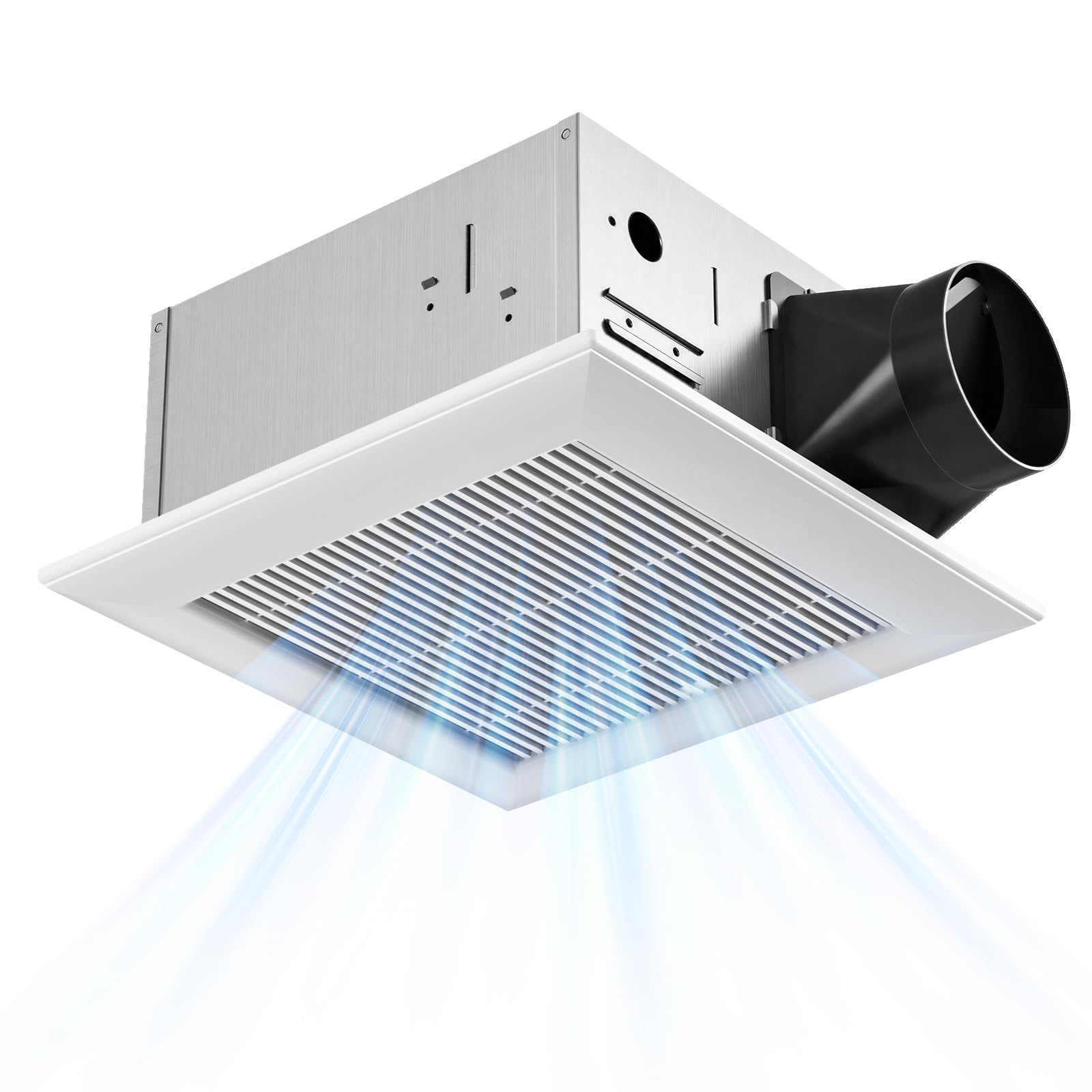
1. Amico Bathroom Exhaust Fan, 1.5 Sones, 160 CFM, No Attic Access Needed
Our pick — 4.5★ from 250+ verified ratings; the strongest balance of quality and price.
The shallow-joist fan you install from below, without ever crawling into the attic.
Most high-airflow bathroom fans demand a trip into the attic and a fat duct you may not have. This Amico skips both. It runs on a 4-inch duct — the size already sitting in a huge share of older homes — and its housing is 10.3 x 10.3 x 5.7 inches, shallow enough to slot between tight ceiling joists. That combination is rare at this airflow level, and it is exactly why it tops the list. Nothing else here fits the same cramped ceiling and old duct at the same time.
Airflow lands at 160 CFM, the highest on this page alongside the Consciot, which is more than enough for the manufacturer’s suggested 160 to 200 square feet. Noise sits at 1.5 sones. That is louder than the 0.5-sone KAZE, so if you are chasing near-silence this is not that fan — but it is quiet enough that it fades into the background during a shower. The grille covers 13 x 13 inches over a recommended 10.7 x 10.7-inch ceiling cutout, so it hides minor gaps from an old install. It carries ETL and FCC electrical listings.
The install is the headline. Brackets let you mount straight between joists or screw the body directly to a single joist, and if your duct turns out to be 3 inches, the company offers a free 4-to-3-inch reducer. Build quality leans solid — metal and polycarbonate, painted finish, push-button control. Buyers consistently call out how quietly it runs and how compact it is as a replacement. One trade-off to know: at 1.5 sones it is not the library-quiet pick, so a bedroom-adjacent bathroom may want a lower-sone model.
Why This One Wins
- Fits 4-inch duct and shallow joists with no attic access needed
- 160 CFM clears the manufacturer’s 160-200 sq ft range with room to spare
- Exposes well with a 13 x 13-inch grille that hides old cutout gaps
- Free 4-to-3-inch reducer if your ductwork runs narrow
Where It Gives Ground
- 1.5 sones is noticeably louder than the 0.5-sone KAZE or 0.8-sone Air King
- Grille and housing footprint is larger than compact builder-grade fans
- Push-button control, so no humidity automation from the start
Grab this if: you have no attic access and 4-inch duct already in the ceiling — this is the pick that installs without a remodel.
Think twice if: silence is your top priority and you can run a 6-inch duct, because the KAZE at 0.5 sones will be calmer.
2. KAZE APPLIANCE SEP150 | 150 CFM | 0.5 Sone Ultra Quiet | Energy Star Certified
Half a sone at 150 CFM, with a six-inch duct that actually lets it breathe.
Quiet and airflow pull against each other on every fan, and this KAZE is the clearest proof. It moves a 150 CFM column of air at just 0.5 sones — three times quieter on the sone scale than the Amico’s 1.5, while still covering rooms up to 150 square feet. That combination is the reason it sits near the top. The Amico edges it on raw numbers at 160 CFM versus 150, and that gap is small, but on calm the KAZE is in a different class entirely.
This fan moves air with a squirrel-cage blower — a wheel-shaped fan that spins air steadily rather than chopping at it — and it needs a 6-inch duct line with a back-draft damper (a flap that stops outside air creeping back in). That 6-inch duct is the deal-breaker here. The Amico runs on standard 4-inch duct; the KAZE effectively wants 50% larger pipe. If your walls already hide a 6-inch run, you get the quiet. If they hide a 4-inch one, you will need a reducer or a duct upgrade, and the noise will never match the spec.
Install needs attic access, and the slidiing hanger bars let you position the housing accurately between framing joists up to 24 inches apart and across framing types. The removable 6-inch duct adapter makes service easier too. The honest caveat here is noise feedback — some owners find it super quiet, others call it noisy, and that split almost always tracks duct quality. Feed it a clean 6-inch run and it whispers; choke it with a reducer and you will hear the difference.
The quiet math: 0.5 sones at 150 CFM is the best silence-per-airflow pairing on this page, and it is Energy Star certified for lower power draw.
Know before you order: the ceiling opening has to be 11 3/8 x 10 1/2 inches, so if your old fan hole is a different size you will be cutting drywall.
Best match: a 6-inch duct already in place and attic access for the install — then this is the calmest high-airflow fan here.
Look elsewhere if: you are stuck with 4-inch duct and no attic, because this one wants both a 6-inch line and room above the ceiling.
3. Air King AK150LS Energy Star Deluxe Quiet Series Bath Fan
A big-bodied 150 CFM workhorse built for rooms around 150 square feet.
This Air King is the largest-bodied fan on the list by a wide margin — 14.5 x 14.5 x 10.38 inches — and that bulk is the trade you make for a five-year limited warranty and straightforward, powerful airflow. It is rated 150 CFM at 0.8 sones, which sits squarely between the whisper-quiet KAZE and the louder Amico. It is Energy Star qualified (meets the government’s energy-efficiency standard) and ships with adjustable hanging brackets plus a contoured grille that softens the look on the ceiling.
The size is the real story. Against the KAZE’s 11.38 x 10.5 x 7.63-inch housing, this Air King takes up meaningfully more ceiling footprint and stands noticeably taller inside the joist bay. If you are replacing a fan in an existing ceiling, that extra depth is what forces the awkward work — mounting from below is tight, and the deep housing wants room above. Buyers who install it during a build or a full remodel describe the job as easy with push-in connectors and plenty of clearance. Retrofit owners have a rougher time.
Worth knowing: it requires a 6-inch exhaust duct, not the standard 4-inch, so older homes often need a new roof vent to match. Owners say it clears heavy steam in a large bathroom and moves serious air, though a few find it noisier than the 0.8-sone “quiet” label suggests. The 0.8-sone rating is honest on paper; real-world noise depends on how well your duct is run. With a clean 6-inch line, most people call it barely audible.
Where it shines: purpose-built for roughly 150 square feet with the longest warranty here at five years, and a grille you can leave white or repaint to match your ceiling.
The honest catch: that 6-inch duct requirement plus the deep housing means this is a fan for new construction or a full bath remodel far more than a quick swap.
Reach for it when: you are building or gutting the room anyway and can run a 6-inch duct and give it clearance above the ceiling.
Skip the retrofit if: you are swapping a fan in a finished ceiling with limited joist depth, because the housing footprint and depth will fight you.
4. Consciot Bathroom Exhaust Fan with Light, 160 CFM, 1.0 Sones, 1500lm Dimmable LED

Two jobs in one fixture: strong ventilation and a 1,500-lumen light you can tune.
If your bathroom has one hole in the ceiling doing double duty, replacing a dying fan-and-light combo with two separate fixtures is a headache. The Consciot keeps it to one unit. It pairs 160 CFM of airflow with a 1,500-lumen LED panel — bright enough to light a whole bathroom — and lets you pick the color temperature with a switch: 3,000K for a warm glow, 4,000K for neutral, or 5,000K for crisp daylight. A separate nightlight mode handles the 2 a.m. trips without blinding you.
Noise sits at 1.0 sones, quieter than the Amico’s 1.5, and matches the OREiN. You also get two fan speeds to dial airflow up or down, controlled by a wall switch, and the unit runs on a standard North American 3-prong plug. The airflow at 160 CFM ties the Amico for the highest here, and it clears the mirror fog that owners specifically call out — several mention no condensation and no fogging after a shower. It carries a square, mountable fan-light form factor and the 3CCT selector (a switch that picks one of three color temperatures) is the feature that separates it from the single-tone Air King.
The catch that keeps coming up is installation. The unit is bigger than the old builder fan it usually replaces — owners describe it as roughly twice the size of the original — and it needs a 6-inch hose, not the standard 4-inch. Some owners found the fit needed improvisation even for handy types. Budget time for that cutout work. Once it is in and running, owners describe it as an excellent upgrade that clears steam quickly and looks good on the ceiling.
What Buyers Praise
- 160 CFM ties the Amico for the most airflow on this list
- 1,500lm LED with three color temperatures plus a nightlight
- 1.0 sones is quieter than the Amico’s 1.5 sones
- Handles ventilation and lighting in a single ceiling cutout
What To Plan For
- Needs a 6-inch hose, so a 4-inch duct setup requires adaptation
- Housing is larger than many old fans, so the cutout often needs enlarging
- Install is fiddlier than a straight fan-only swap, per owner reports
Ideal for: a bathroom that needs both light and airflow and only has one ceiling opening to work with.
Be ready for: cutting a bigger hole and running a 6-inch hose, since this is not a drop-in replacement for a small builder fan.
5. OREiN 3-in-1 Bathroom Exhaust Fan with Light & Humidity Sensor, 160 CFM, 1.0 Sone

The fan that turns itself on when the air gets damp, so you never forget to flip a switch.
Everyone forgets to run the fan. The OREiN solves that by sensing humidity and kicking in automatically once it climbs above 60%, with a green LED confirming the sensor mode is live. That hands-free behavior is the whole reason to choose it. In practice owners describe it clearing steam and keeping mirrors fog-free without ever touching a switch, and it runs at 1.0 sone so the auto-start is not jarring.
On the numbers, it matches the Consciot: 160 CFM, 1.0 sone, ideal for bathrooms up to 160 square feet. The light is a 1,500-lumen LED tunable between 3,000K, 4,000K, and 5,000K, plus a soft 2,200K night light for nighttime. It is Energy Star, HVI, ETL, and FCC certified, and it carries a five-year limited warranty. One compatibility note the specs spell out clearly: dimmers and timer switches will not work with this fan, so plan your wall controls around that.
The one practical warning is mounting weight. Owners note the unit is heavy enough that it must be anchored on both sides — mounting it improperly can tear through drywall. Installed by the manual with both sides secured, owners say it works perfectly and appreciate the auto-on sensor. The hardware list is complete, with the housing, light grille, mounting bracket, cut-out template, screws, and manual all in the box, so there is no last-minute run for a template.
What wins people over: the humidity sensor and its auto-on at 60% — you set it and the fan handles the rest.
One spec to respect: no dimmers or timer switches, and the housing is heavy enough that it needs anchoring on both sides to avoid drywall damage.
Made for: households that want humidity control handled automatically, with bright tunable light and a night light in the same unit.
Not the pick for: anyone planning to wire it to a dimmer or timer switch, since the specs warn those will not work.
6. Panasonic WhisperChoice 0.8-Sone 150-CFM White Bathroom Fan Energy Star

Two airflow settings and a built-in dimmable light, tuned for large bathrooms.
The WhisperChoice gives you a choice most fans do not: run it at 130 CFM for 0.5 sones of near-silence, or push to 150 CFM at 0.8 sones when the room is full of steam. That dual-speed flexibility suits rooms of about 130 to 150 square feet, and it is the feature that makes this pick feel premium. The difference between this and the Amico is telling — both clear a large bathroom, but the Panasonic gets there while running calmer and quieter.
The build is the other half of the story. A 10W dimmable LED chip panel at 3,000 Kelvin warms the room with a soft white light, and there is a separate night light under 0.1W that has to be wired on its own circuit. It fits in 2 x 8-inch joists or larger with a 7-3/8-inch housing depth, and it is UL Listed for installation over a tub or shower enclosure when on a GFCI-protected circuit. Owners describe it pulling moisture out of the room quickly and ramping to full power over a few seconds rather than jolting on.
Plan the install carefully. This fan wants a 6-inch duct for the quietest result, so a 4-inch line will need an adapter and can introduce a bit of flutter. Owners installing it in existing construction found the tricky part was fitting the side piece into the attic first, then mounting the unit flush below the drywall. Run on a clean 6-inch duct, owners say it clears steam and odors in about a minute and ends the damp walls a weak old fan left behind.
Why it earns the premium label: switchable 130 and 150 CFM speeds, a dimmable 3,000K LED panel, a wired night light, and UL listing for over the shower.
What to prepare for: a 6-inch duct for full quiet, a sometimes-fiddly attic-first install, and the night light needing its own wiring.
Best for: a large bathroom that needs both strong ventilation and good light from a single, calm-running fixture.
Less suited to: a quick, no-attic replacement, since the deep 7-3/8-inch housing and 6-inch duct want space above the ceiling.
7. Broan-Nutone QTXE150 Ultra-Silent Ventilation Fan, 1.4 Sones, 150 CFM
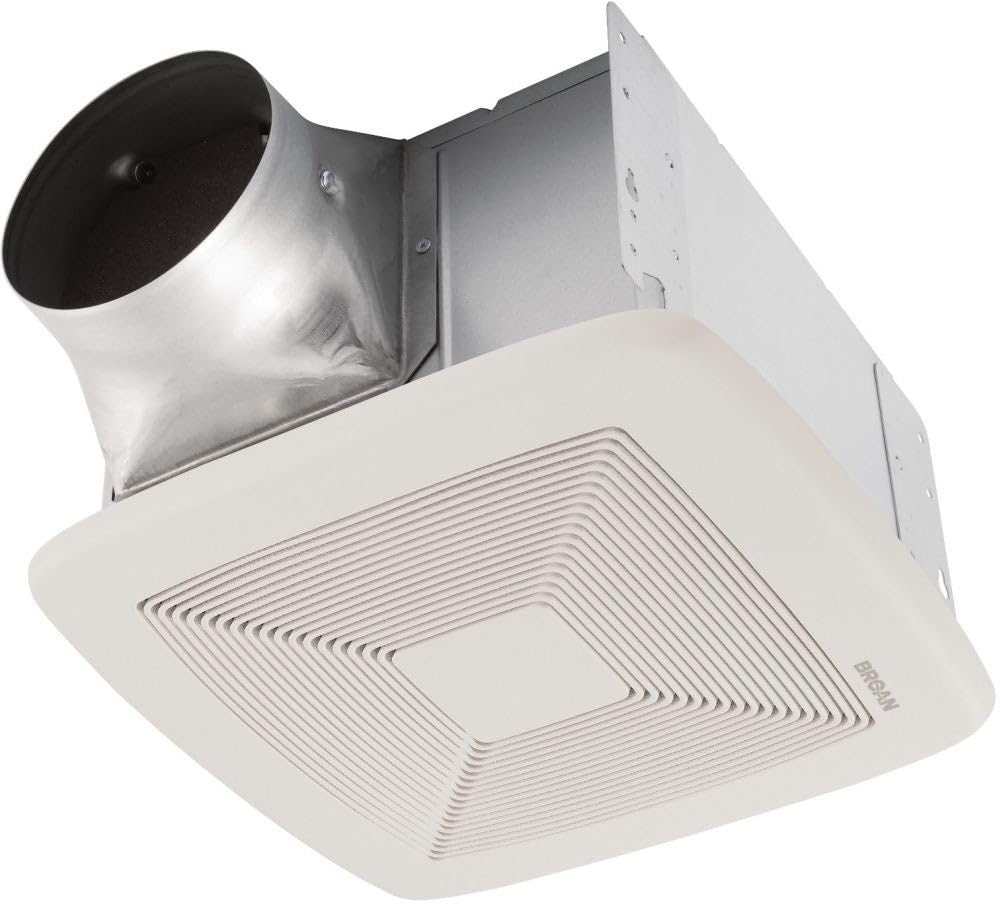
A continuous-duty 150 CFM fan made to keep running, room after room.
Some fans are built for the occasional shower; this Broan-Nutone is motor-engineered for continuous operation. If you want a fan that can stay on for long stretches to keep a whole-house air exchange going, that engineering is the reason to pick it. It runs 150 CFM at 1.4 sones across rooms up to 140 square feet, and it ships with 6-inch ducting and hanger bars for a fast install in 2 x 8-inch construction spaces. It is ENERGY STAR certified and UL listed for use over a tub or shower on a GFCI circuit.
The paintable polymeric grille is a small but real win — if your ceiling is not white, you can match it rather than live with a mismatched panel. That is the kind of detail that separates a fan you tolerate from one you are happy to look at. Against the calmer picks, 1.4 sones makes this the second-loudest fan here, behind the Amico. For a utility or laundry room, that is fine. For a quiet master bath, the 0.8-sone Air King or the 0.5-sone KAZE will feel gentler.
Buyers report it clears foggy mirrors and keeps mildew at bay where older fans failed. The install is where experiences split. Retrofit owners describe the work as challenging: insufficient clearance, a hole that needed resizing, and a 6-inch duct that required a reducer to meet a smaller line. One recurring gripe is the back-draft damper, which is flimsy and occasionally arrives broken. Treat that part gently and the fan itself holds up well.
The standout: a continuous-operation motor built to run long hours, plus 6-inch ducting and hanger bars included in the box.
Fair warning: installation is harder in a finished ceiling — expect to resize the hole and adapt the duct — and the back-draft damper is the weak link to handle with care.
Pick it for: a room you want ventilated continuously, where a long-running motor matters more than near-silent operation.
Choose differently if: you want the calmest possible master-bath fan, because at 1.4 sones this one is audibly louder than the quiet-tier picks.
8. Panasonic FV-1115VQ1 WhisperCeiling Bath Fan, 110-130-150 CFM
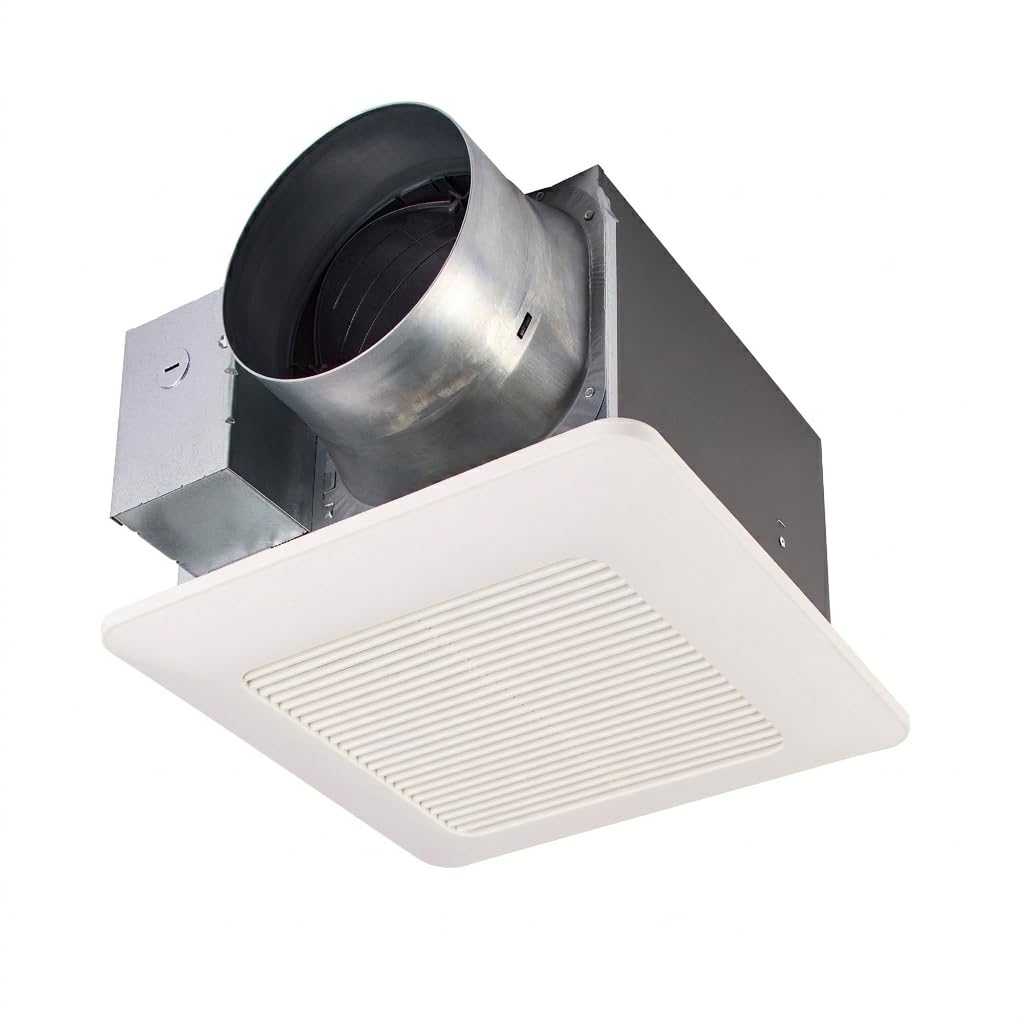
Dial the airflow to your room with a switch, then forget the fan is even running.
The Pick-A-Flow selector is what sets this WhisperCeiling apart: you choose 110, 130, or 150 CFM with a single selector, so one fan fits a range of room sizes instead of forcing you to guess your airflow at purchase. Airflow capacity on the spec sheet reads 150 CFM, and it delivers that while staying under 0.3 sones on the quieter settings. An ECM motor — a brushless, electronically controlled motor that runs efficiently and lasts — drives the whole thing. If you are unsure exactly how much airflow your bathroom needs, this adjustable approach is the safest buy.
Panasonic pairs that with a Flex-Z fast installation bracket and a 6-inch duct adapter, and the housing is 7-3/8 inches deep. Owners describe the ECM motor as genuinely whisper quiet — some worry about forgetting it is on and leaving it running. The oversized grille is a design touch several appreciate. It is the calmest fan on this page, and owners recommend it for master bathrooms and larger spaces where you want airflow without the noise.
A few honest points. It is not silent — one owner compared the sound to water moving through pipes, a soft background tone rather than nothing. The larger footprint means it needs a generous cutout, though the included template helps you get a gap-free fit. And install feedback is mixed: owners working over a cabinet on a ladder found it harder than expected, and the bracket and fan edges are sharp enough to warrant gloves. Run a straight 6-inch insulated duct and you get the quietest result.
Why it leads on quiet: a Pick-A-Flow 110/130/150 CFM selector plus an ECM motor keeps this under 0.3 sones, the calmest spec here.
What to watch: the footprint is large and the metal edges are sharp, so give yourself room and a pair of gloves during install.
Best match for: a master bath or larger room where you want to set the airflow once and enjoy near-silent operation afterward.
Think twice if: you are squeezing a fan into a tight joist bay, because the oversized housing and sharp edges make a cramped retrofit harder.
9. Panasonic FV-1115VQL1 WhisperCeiling Bath Fan + Light, 110-150 CFM
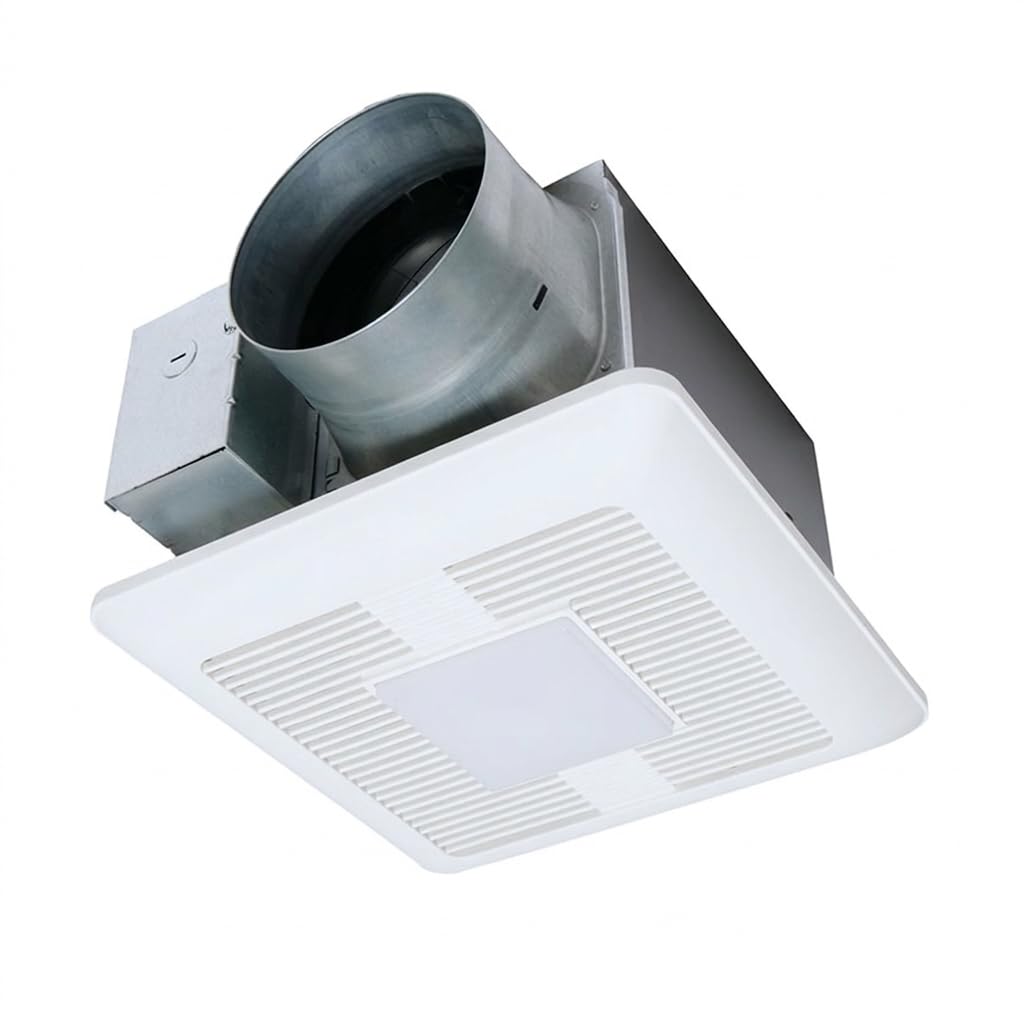
The silent WhisperCeiling, now with a 10W LED panel and a soft night light built in.
This is the same Pick-A-Flow platform as the fan-only model above, but with lighting folded in. You still get the 110, 130, or 150 CFM selector and the ECM motor, and airflow capacity reads 150 CFM. The addition is a 10W LED chip panel plus a night light under 1W. Noise stays under 0.3 sones on the quieter settings and up to 0.5 sones at the top 150 CFM setting. If you want the quietest ventilation and a built-in light from one fixture, this is the one to weigh.
On calibration, consider where this beats the fan-only WhisperCeiling. It trades a touch of silence for the light — the third speed reaches 0.5 sones versus staying under 0.3 on the fan-only version — but it adds a full LED panel and a dedicated night light you would otherwise wire separately. Owners describe it running nearly silent even at 150 CFM and ventilating a small bathroom well, with the Pick-A-Flow speed selector a favorite feature. A 6-inch duct adapter and 7-3/8-inch housing depth carry over, so the duct planning is the same.
Two practical quirks stand out. The adjustable output is real, but some owners note the airflow feels light for the rated number, especially on a long duct run — one installed a 25-foot 6-inch run and initially found it weak, then reported it handled both heavy and moderate steam well once expectations settled. The other is wiring: the vent and the bright light share one switch, so you cannot run them separately. Plan your wall wiring with that in mind before you close up the ceiling.
Perfect when: you want the quietest ventilation plus a built-in LED and night light in a single fixture, and you are fine running them together on one switch.
Reconsider if: you need the light and fan on separate switches, since this unit wires them to a single switch and air movement feels light on a long duct run.
Understanding the Specs
What CFM Actually Means For Your Room
CFM stands for cubic feet per minute — the volume of air the fan pushes out every minute. A 150 CFM fan is built for larger bathrooms; the Amico and Consciot both rate at 160 CFM and the manufacturer sizes them for rooms of about 160 to 200 square feet, while the KAZE and Air King cover up to roughly 150 square feet. Match the CFM to your room size, and pick the highest airflow you can pair with a duct wide enough to carry it. Too small a fan leaves steam behind; too big a fan on a narrow duct just gets loud.
Sones, Duct Size, and Why They Travel Together
A sone is a loudness rating — lower is quieter, and 0.5 sones is close to silence while 1.5 sones is a soft, noticeable hum. Quiet fans almost always want wider duct: the KAZE runs 0.5 sones on a 6-inch duct, while the Amico manages 1.5 sones on a standard 4-inch line. If you want the near-silent options, plan on a 6-inch duct run and, in most cases, attic access to install the housing. Match those two before you order, and the fan will sound like its spec sheet promises.
FAQ
Will a 150 CFM fan fit over my existing bathtub or shower?
My house has 4-inch duct but I want a quiet fan. What are my options?
Do I need attic access to install a 150 CFM bathroom fan?
What is the difference between a fan with a humidity sensor and one without?
How loud is 1.5 sones compared to 0.5 sones?
Can I put a 150 CFM fan on a dimmer or timer switch?
What ceiling cutout size does a 150 CFM fan need?
Do I need a 6-inch duct for 150 CFM, or is 4-inch enough?
Are these fans Energy Star certified?
How long should a bathroom fan run after a shower?
Which is better for a large bathroom, a 150 CFM fan with or without a light?
Final Thoughts: The Verdict
For most people shopping for the best 150 cfm bathroom fan, the winner is the Amico Bathroom Exhaust Fan because it pairs 160 CFM of airflow with the two things that trip up most installs — a standard 4-inch duct and a shallow housing that needs no attic access. If near-silent operation matters and you can run a 6-inch duct, reach for the KAZE APPLIANCE SEP150 at 0.5 sones. And if you want humidity control handled for you, the OREiN 3-in-1 turns itself on at 60% humidity so you never shower in a steam-filled room again. One nudge worth acting on: the Amico pairs a strong feature set with a solid track record across hundreds of owners, so it is the safest single fan to order first.
How We Picked
We do not accept paid placement. Every pick is matched to a real buyer and a real use-case; we do not hands-on test units.
Sources & Methodology
Specifications: manufacturer listings and product documentation. Review insights: verified customer reviews, as of September 2026. Pricing: not shown on this page (it changes often); check the current price via the retailer link.
As an Amazon Associate, Non Toxic Blog earns from qualifying purchases. This does not affect which products we feature.