Specs are compiled from manufacturer listings and verified buyer reviews and can change over time — please confirm the key details on the product page before buying.
You lower a well pump down a pipe, wire it up, and hope it still pumps clean water years later. Every pump below is rated 1/2 HP, and each earned its spot on published head and flow numbers. Short answer: the Hallmark MA0343X-4 is the safest buy here, with owner reports past a decade of daily use and a 150-foot head and 25 GPM flow that cover most household wells. The rest of the list splits by job — deep well, shallow well, off-grid solar, or a cistern feeding one cabin — and the head rating is what separates them.
I’m Mo Min — the founder and writer behind Non Toxic Blog. This guide is built by comparing the manufacturers’ published specifications and the patterns across verified customer reviews, so you get each pick’s real strengths and trade-offs instead of marketing spin.
Head and flow are the two numbers that decide whether a pump fills your pressure tank on the first try or burns itself out trying. Every pick here names both, plus the voltage it needs and the well depth it is built for. That way you can match a pump to your own well depth and voltage before you buy. This breakdown of the 1/2 hp well pump market pairs each pump’s real head and flow numbers with the jobs it actually handles.
Our Picks at a Glance

How To Choose The Best 1/2 HP Well Pump
Start with one question: how far down does the water sit? That distance, plus the height water must rise to reach your pressure tank, is what a pump’s head rating has to cover. A pump that can lift 150 feet handles a well that is, say, 100 feet deep with room above ground for the run to your house. A 179-foot pump handles deeper. Picking by horsepower alone is the common first-time mistake — among 1/2 HP submersibles, the unit with more impeller stages and a higher head rating out-lifts the weaker one on the same pipe.
Head and flow, in plain terms
Head is the tallest water column the pump can push against. Flow, measured in GPM, is how fast water actually moves at your pressure. You need both numbers because they trade off — a pump working near the top of its head range delivers less flow than the same pump running closer to the surface. A 28 GPM pump pushing against a light load fills a tank fast; the same pump against a heavy lift drops to a trickle. That is why a “28 GPM max flow” rating always ships with a separate “167 ft max head” figure — read them as a pair.
Submersible or jet — match it to your well
A submersible pump sits underwater in the well casing and pushes water straight up from the bottom. It handles deep wells and long runs, and it is what you want for anything past roughly 25 feet of standing water. A jet pump sits at the surface and pulls water up through suction, so it only works on shallow wells — usually down to about 25 feet. If your water level sits deeper than about 25 feet, a jet pump loses prime and runs dry, the most common cause of early pump failure.
Voltage and wiring — check before you buy
Pumps here run on either 115 volts or 230 volts, and the two do not swap unless the pump is dual voltage. If you are replacing an existing pump, match the voltage of the old one or you will rewire the circuit. A 2-wire pump carries its control electronics inside the motor, so it needs no control box on the wall. That saves a wall box and a wiring run, and removes one more component that can fail. Off-grid setups also need to know the running watts, because an inverter has to supply both the steady draw and the brief startup surge.
Quick Comparison
| Model | Best For | Max Head | Max Flow | Voltage | Amazon |
|---|---|---|---|---|---|
| Hallmark MA0343X-4★ Best Overall | Everyday household wells | 150 ft | 25 GPM | 115V | Amazon |
| VEVOR 0.5HP 230V 28GPMDeep Lift Pick | Deep lifts, 230V wiring | 167 ft | 28 GPM | 230V | Amazon |
| VEVOR 1/2 HP 115V 28GPMBest Value | High flow on 115V | 167 ft | 28 GPM | 115V | Amazon |
| Hallmark MA0343X-4A | Replacing a 230V pump | 150 ft | 25 GPM | 230V | Amazon |
| WASSERMANN 4″ 179FT | Deep wells on 115V | 179 ft | 28 GPM | 115V | Amazon |
| Red Lion PWJET50 | Cottages, one-bath homes | 145 ft | 7.4 GPM | 115/230V | Amazon |
| Flotec FP4012-10 | Shallow wells, cisterns | 25 ft | 10 GPM | 115/230V | Amazon |
| WAYNE SWS50 | Cabin and seasonal wells | 25 ft | 375 GPH at 50 PSI | 120/240V | Amazon |
| WAYNE CWS50 | Convertible jet, 25–90 ft wells | 80 ft | 6.8 GPM | 115/230V | Amazon |
| Red Lion RL12G05-2W2V | Deep wells, no control box | 212 ft shut-off | 12 GPM | 230V | Amazon |
| Goulds J5S | Long-life shallow well installs | 25 ft | 16.5 GPM | 115/230V | Amazon |
In‑Depth Reviews
1. Hallmark Industries MA0343X-4 Deep Well Submersible Pump
Our pick — 4.5★ from 850+ verified ratings; the strongest balance of quality and price.
The pump owners keep buying a second time as a backup, then leave running for eleven years.
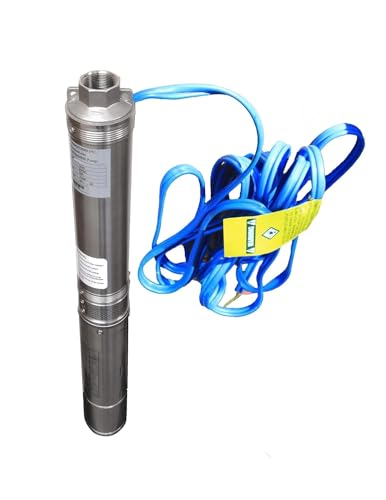
The number to lead with is 150 — that is the maximum head, the tallest water column this Hallmark will push against, measured in feet. Paired with a 25 GPM max flow rating and a 0.5 hp motor running on 115 volts at 6.5 amps, that covers the ordinary household well: a submersible body slim enough for a 4-inch casing that lifts water a long way and still delivers a usable flow at the top. It weighs 25 pounds, which matters on install day when you are lowering it by hand down a well. Compared with the VEVOR 0.5HP 230V unit, which lists 21 pounds and a shorter 32.3-inch body length, the Hallmark is the heavier, longer pump — the kind of heft you feel as build quality in a stainless steel and thermoplastic body.
What wins people over here is the reliability read: the pump just keeps running. Owner reports stretch across eight years of off-grid service on a 2000W pure sine inverter drawing 700W, and one well owner reports running the same pump for 11 years at 100 feet in a 200-foot well. Buyers report the Hallmark holding its prime with no PSI or GPM drop after three years at 44 feet down. Lawn irrigation is another common use, with a standard outdoor faucet pushing 10 GPM at 61 PSI. That is a long service history for a pump at this price tier, and it is why this pick sits at the top.
Mind the plumbing on the way in. The outlet is 1.25 inches, which is not universal and has caught buyers who assumed a standard fit — the fix is an adapter, but know it up front. The other honest note is sediment: a well with grit or small rocks can lock the impeller, and one buyer had to fit a stainless hose clamp over the screen tab gap to keep debris out. Hallmark covers the pump with a one-year manufacturer’s warranty on parts and labor. The crowd verdict here is strong — 4.5 stars across 850+ owners — and the price tier sits comfortably mid-range.
Where It Earns Its Keep
- 150 ft max head and 25 GPM max flow cover standard household wells
- Owner service reports stretch from 8 to 11 years on daily duty
- Stainless steel and thermoplastic body resists corrosion underground
- Runs on 115V at 6.5 amps, a modest electrical load
The Parts Buyers Wish They’d Known
- The 1.25-inch outlet needs an adapter on some existing setups
- Grit and small rocks can jam the impeller without a screen clamp mod
- Heavier at 25 pounds than the VEVOR 0.5HP 230V at 21 pounds
Buy it for: a standard household well where you want a pump that runs for years without babysitting.
Watch the plumbing: budget for a 1.25-inch adapter before install day, and screen the intake if your well runs silty.
2. VEVOR Deep Well Submersible Pump 0.5HP 230V 28GPM
A 230V deep-well workhorse with five impeller stages and a stainless steel frame.
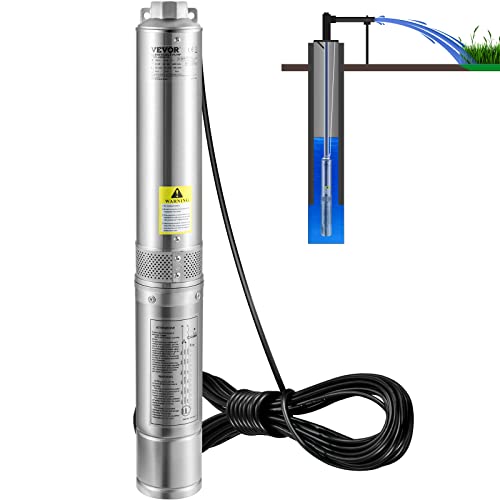
If your well is deeper than standard and your house is already wired for 230 volts, this is the pick that pushes the hardest. The 0.5 hp copper motor drives five-stage thermoplastic impellers — stacked pump sections that add lifting power in steps — for 28 GPM max flow against a 167 ft max head. Compare that to the Hallmark’s 25 GPM, and the VEVOR pulls ahead on rated flow by a little. It measures 32.3 inches long and weighs 21 pounds, so it is noticeably lighter than the Hallmark on install day. The build is all stainless steel, including the outlet and connecting components, and it carries an IP68 waterproof grade — the top rating for continuous underwater use — with the maker claiming an 8- to 10-year service life.
The extras are the parts that save weekend headaches. A 33-foot electric cord comes attached with a US plug, so you are not splicing your own lead. There is a built-in check valve to stop back-flow, plus an overheat protection circuit that shuts the motor down if it gets stuck or hits an abnormal condition. The stainless steel filtration mesh strains impurities before they enter the impeller. For a new drilled well with heavy granular sediment, the maker suggests laying a layer of gauze in front of the intake. One warning worth repeating: never run this pump dry or at low water level — idle running is what burns out submersibles.
Honest shape of the reviews: reliability is the most-discussed topic, and it cuts both ways. Some owners mention the pump doing exactly what they need for months on end, while a smaller share report units that quit early or had trouble with the built-in check valve (a one-way valve that stops water from flowing back down). One message from the review pages, as buyers put it, sums up the worst case: “Don’t bother purchasing will not lift 10′ of water out of a well.” Treat this as fit, not fate — this pump rewards a clean, well-matched install with correct voltage and an external check valve added for insurance. Weighing 21 pounds and rated for 230V, it is the lighter, higher-flow option versus the Hallmark, but it needs the right wiring to earn its keep.
What the spec sheet buys you: 167 ft of head, 28 GPM of flow, and a stainless body that resists corrosion after years underwater — a strong package for deep lifts on 230V.
Reach for this if you have 230V service and a deep well that needs the extra head.
Look elsewhere if your home only runs 115V, or you want a longer proven service record.
3. VEVOR Deep Well Submersible Pump 1/2 HP 115V 28GPM
The same deep-well flow as its 230V sibling, in a body that connects to standard household 115V power.
This is the version of the VEVOR submersible for homes that only have standard 115V outlets to work with. It keeps the full spec sheet: 0.5 hp copper motor, five-stage thermoplastic impellers, 28 GPM max flow, and 167 ft max head. The stainless steel frame includes the outlet and connecting components, and the same IP68 waterproof rating applies. It measures a slim 4 by 4 by 28 inches and weighs 21 pounds, a compact package that drops into a 4-inch or larger well casing. Against the Hallmark at 25 GPM, the VEVOR 115V holds a small flow advantage — the trade is that the Hallmark has the longer record of daily service behind it.
Owners put this pump to work in ways you might not expect. One camper-dwelling buyer runs it from a brook to fill a 275-gallon IBC container, and reports the real-world payoff: the pump fills the 275-gallon container in under 20 minutes where a traditional pump took over 1.5 hours. Another described replacing a jet pump in a 55-foot well and having it running clean, with the motor’s thermal cutout kicking in when a hose leaked and overheated, then restarting fine once it cooled. A third wired two of them into a solar setup and had to partly close a flow valve to stop PVC hammering. That is a wide spread of uses for one pump.
The recurring gripe is the built-in check valve and the plug-and-play expectations around it. Some setups need an extra check valve downstream to stop short cycling, and one buyer struck trouble getting pressure past 40 PSI on a pressure tank before calling the install itself into question. Match the pump to a correctly sized pressure tank, add the external check valve the maker recommends, and most of that disappears. This pick carries the stronger of the two VEVOR scores — 4.5 stars — and lands in the value tier, which makes it the safest of the VEVOR pair to start with.
The real-world read: for a mid-deep well with existing 115V wiring, this VEVOR delivers 28 GPM of flow at a friendly price point, provided you pair it with a good pressure tank.
Best for: a 115V home with a mid-deep well that eats into pressure-tank cycling.
One caution: plan for an external check valve to prevent short cycling on shallow water levels.
4. Hallmark Industries MA0343X-4A Deep Well Submersible Pump 230V
The 230V twin of the top pick — same body, different voltage, for homes already wired that way.
This Hallmark is the same stainless-steel submersible design as the MA0343X-4, but it runs on 230 volts at 60 Hz instead of 115. That makes it the natural drop-in for a home already set up for 230V power — you skip any circuit rewiring and swap the pump in place. The rest of the spec sheet matches its sibling: 0.5 hp, 25 GPM max flow, 150 ft max head, stainless steel body, and a one-year manufacturer’s warranty on parts and labor. The included components are a pump, a splice kit, and a manual.
The people who love this pump tend to be repeat buyers. Owners describe installing their third unit, with the earlier two running 6 years and 5 years before replacement — a pattern that says as much about the design as any single review. One owner reports constant pressure even with a washing machine running, and notes that local quotes for a comparable pump ran into the hundreds. For a 230V house that already has the wiring in place, that ease of replacement is the whole appeal.
Where the reviews get honest is durability, and it is the one topic worth weighing carefully. Several customers note units that lasted about four years at full strength, and one noted a failed unit at the one-year mark with a cracked check valve. Those cases cluster around wells deeper than roughly 45 feet and around the wire gauge (the thickness of the electrical wire) in the pump. The takeaway: match this pump to the well depth it was designed for and it performs; push it past its balance and you will shorten its life. Make sure your well water level and depth sit inside the 150-foot head rating before you commit.
Why Owners Come Back To It
- Drops into 230V homes without rewiring — simple in-place swap
- Repeat reviewers point out 6 and 5 years of service on prior units
- Same 25 GPM flow and 150 ft head as the 115V sibling
- Constant pressure reported even with high-demand appliances on
What To Watch
- Durability reports vary — some units last about four years
- Not built for wells deeper than its 150-foot head rating
- A failed starting capacitor can require swapping the whole pump
Fits best when you are replacing a 230V pump and want the same format in stainless.
Check first: confirm your well depth sits within the 150-foot head rating to get the long service owners describe.
5. WASSERMANN 4″ Deep Well Submersible Pump 1/2HP 179FT Head

The deepest head rating on this list, and it keeps its control electronics inside the motor.
Two numbers define this pump: 179 ft max head and 28 GPM max flow, running on 115 volts at 60 Hz (the standard U.S. wall current). That 179-foot ceiling is the tallest head on this list — higher than the Hallmark’s 150 feet and the two VEVOR units at 167 feet — so it is the pick for a genuinely deep well on a 115V circuit. The body is stainless steel with an SS304 pump head, and the motor is a 100% copper, oil-immersed design — oil-filled and sealed to shed heat while running. The motor is hermetically sealed (airtight) and thermally protected against overheating. The included kit covers a deep well pump, electrical tape, a use manual, and waterproof tape.
Setup is simpler than most submersibles: this is a 2-wire pump (two wires plus a ground) with the control box built in, so no external control box is needed. That saves a wall box and a wiring run — and it means one less component to fail down the road. The stainless filtration mesh strains impurities before they reach the impeller, and the maker suggests the same gauze layer trick at the intake for new drilled wells with heavy sediment. The 4-inch body fits 4-inch and larger well casings, with a 1-1/4″ FNPT outlet.
Feedback skews positive but short on longevity data — the pump is newer to market and most owners have had it in service for months, not years. The typical report is “so far, so good,” with one owner noting it running flawlessly after a few months. The standout comment is about support: one owner had an issue with a first unit and reported the brand shipping a replacement that worked great. The one install quirk to expect is wire-color labeling that ran reversed against the chart on at least one unit — check connections by the manual, not the label, before you drop the pump. This is the deepest-reaching option here, and it earns that spot cleanly.
Standout spec callout: at 179 ft of head on 115V, this is the deepest-reaching 1/2 HP pump on the list, and it drops in without a control box.
Pick it for a deep well on 115V where every extra foot of head counts.
Install note: verify wire colors against the manual, since labeling has been reported reversed on some units.
6. Red Lion PWJET50 Shallow Well Jet Pump

A surface-mounted jet pump for shallow wells, cottages, and homes with a single bathroom.
This is the first pick on the list that sits above ground rather than down a well. It is a jet pump, meaning it pulls water up by suction from a shallow well, and the maker rates it for wells down to 25 feet. The 1/2 HP motor runs on either 115 or 230 volts — selected to match your incoming power — with 6.6 amps draw at 115V and 3.3 amps at 230V. Peak flow is 7.4 GPM at 30 PSI with a 5-foot suction lift, and the maximum head is 145 feet. It ships with a factory pre-set 30/50 pressure switch that produces a working maximum of 50 PSI, and it is CSA listed and certified for potable water. The casing is cast iron with a glass-filled thermoplastic impeller and diffuser.
The people who run these tend to keep them a long time. One owner used it for sump pit drip irrigation for 9 years, moving more than 250,000 gallons since 2017, and notes that repair parts are available. Another reports it pumping smoothly and quietly from an above-ground tank into a pressure tank and house. Both point out the same practical installation detail: it needs a 1-1/4-inch external check valve on the suction side, while the 1-inch discharge needs none. This is a well-known format — you get two mounting feet at the flange and a Square D-style pressure switch you can adjust yourself.
The honest reads split into two camps. It is quiet and pressure-strong, but buyers regularly flag two things: the noise level draws mixed reviews — some call it reasonably quiet, others describe it as very noisy — and the pressure switch tube has occasionally arrived brittle and leaked at the nipple during install. The fix is a replacement poly tube, but it is worth checking before you fill. There is also a known labeling trap — one owner found the sticker said 230V while the unit was internally set to 115V, so remove the top cover (four screws) and confirm the voltage switch before powering up. Do those two checks first and this pick comes through reliably.
The value case: cast iron construction, dual-voltage flexibility, and a CSA potable-water certification in a well-known shallow-well format.
Reach for this if your water level is 25 feet or shallower and you want a surface pump that installs simply.
Skip the surprise: verify the voltage switch position and the pressure switch tube before your first fill.
7. Flotec FP4012-10 1/2 HP Shallow Well Jet Pump

A surface jet pump for shallow wells that trades brute force for quiet, steady delivery.
The Flotec FP4012-10 is built for shallow wells with a pumping level of 25 feet or less, and it is rated for 10 GPM at 40 PSI and a maximum head of 25 feet. That flow rating tops the Red Lion PWJET50’s 7.4 GPM, so if you feed a cistern or a small irrigation zone, this pump moves more water at pressure. The body is fiberglass-reinforced thermoplastic — a material choice that resists corrosion and sandy water — and a dust-proof cover shields the electrical components from dust and insects. It measures 22.81 by 11.2 by 10.48 inches and weighs 23.1 pounds.
What owners consistently value is the way it runs day to day: quiet operation and steady pressure maintenance are the two things it gets praised for most. One owner reports it outperforming a pricier Simer unit — more pressure and a faster bladder tank fill for about half the cost — and notes that easy DIY installation was a plus. Others mention it working well on cistern systems and delivering the pressure they needed without drama. It is a straightforward format: cast-style plumbing in and out, and it fires up without the drama of priming quirks that some jet pumps carry.
The honest caveat is the housing. Durability gets mixed feedback — while some shoppers say it running reliably for many years, a smaller share raise concerns about the pump housing’s durability. There is also a small startup quirk: a couple of the front plugs have leaked on startup for some owners, and re-applying Teflon tape fixes it every time. Both issues are minor relative to what the pump delivers, and both are the kind of thing a careful installer catches on day one. For a shallow-well setup that wants quiet pressure with less fuss, the Flotec is a strong fit.
What Buyers Appreciate Most
- Runs quietly — a standout trait for a surface-mounted jet pump
- 10 GPM at 40 PSI, higher flow than the Red Lion PWJET50
- Fiberglass-reinforced thermoplastic resists corrosion and sandy water
- Dust-proof cover protects the electrical components
Where It’s Slightly Less Sure
- Housing durability gets mixed reports over long service
- Front plugs have occasionally leaked at startup — re-tape them
- Limited to shallow wells with a pumping level of 25 feet or less
Best for: a shallow well or cistern setup where low noise and steady pressure beat raw power.
One thing to expect: re-tape the front plugs before first startup to head off a small leak.
8. WAYNE SWS50 1/2 HP Cast Iron Shallow Well Jet Pump

A cast iron shallow-well jet pump built for cabins, seasonal wells, and 25-foot water levels.
The WAYNE SWS50 targets shallow wells with a pumping level of 25 feet or less, and its dual-voltage square flange motor runs on either 120V or 240V — factory set for 240V. The cast iron volute (the pump body that forms the water chamber) includes a dedicated priming port for filling it before startup. The pressure switch is pre-set at 30-50 PSI for automatic operation. The discharge connection is 3/4-inch NPT with 1-1/4-inch suction. The build is heavy-duty cast iron, assembled in the US with foreign and domestic parts, and it carries a 3-year manufacturer’s warranty — longer than most in this price range.
What people notice fast is how quietly it runs for a cast iron jet pump, and how easy it is to prime on install. One owner had it primed in about seven minutes — long enough to fill an empty suction pipe — and had the whole installation done in an hour. Another replaced a 30-year-old Wayne unit that had finally lost prime, and found the new one just as willing to hold. The same owner notes that this 1/2 HP pump builds pressure and cycles on and off in under a minute, where a competing 3/4 HP unit ran much longer. That short cycle time and quiet operation are the practical wins here.
The two honest wrinkles are worth knowing before you buy. The factory pressure switch can arrive misconfigured — running 40 PSI off and 30 PSI on, which causes short cycling — and the fix is a quick reset to 50 PSI off and 30 PSI on. Second, the output connection is 7/8-inch NPT, not the 1-inch some owners assumed, so an adapter may be needed on an existing system. Neither issue is a dealbreaker, and both are caught in the first ten minutes of setup. With a quiet cast iron body and a 3-year warranty, this is the shallow-well pick for a seasonal cabin or low-demand home.
Where it shines: quiet operation, easy priming, and a pressure switch you can dial in yourself — a low-hassle shallow-well pump with a 3-year warranty.
The right pick when you want a quiet cast iron pump for a cabin or shallow well with a longer warranty behind it.
Set it up right: verify the pressure switch settings and have an adapter on hand for the 7/8-inch NPT output.
9. WAYNE CWS50 1/2 HP Cast Iron Convertible Jet Well Pump

A convertible jet pump for wells from 25 to 90 feet — one pump, two ways to configure it.
The word to know here is “convertible.” This WAYNE can run as a shallow-well jet pump or, with a jet assembly kit, as a deep-well setup — which is why it covers wells from 25 to 90 feet deep. Rated flow is 6.8 GPM, and the maximum head is 80 feet. It runs on dual voltage (115V or 230V), set at 115V from the factory, with a pre-set 30-50 PSI pressure switch (pounds per square inch, the force that pushes water through your pipes) for automatic operation. Connections are 1-inch NPT discharge, 1-1/4-inch NPT suction, and a 1-inch drive. The cast iron volute (the pump’s water chamber) has a dedicated priming port, and the pump is assembled in the USA and warrantied for 3 years.
One thing to buy alongside it: the jet assembly is sold separately. Because this is a convertible design, the jet kit is what changes it from a shallow to a deep configuration — so plan for that if you are pushing past the shallow range. For owners who get that right, the pump does its job. One user reports swapping a 110V setup to 220V for a two-pipe deep-well configuration on a 35-foot well with a 17-foot water level, and getting 50 PSI — enough for household and garden use. Another reports it priming easily and running quiet on a 98-foot well.
Quality is the mixed thread here. Plenty of owners describe it as well-made and easy to install. A smaller share report problems — one buyer found the pump casing not fully bolted on a new unit and questioned whether it had been sold as used stock. Set that against a 3-year warranty and a wide depth window, and this is a good fit for someone who wants one pump to grow with their well depth. Just price in the jet kit and confirm your well’s depth profile before choosing shallow or deep mode.
Why it earns a look: 25-to-90-foot well coverage and dual-voltage operation in one cast iron convertible frame, backed by a 3-year warranty.
Suits you if you want one pump that can be reconfigured as your well depth changes.
Budget for it: the jet assembly is required and sold separately — factor that into your setup.
10. Red Lion RL12G05-2W2V Submersible Well Pump 1/2 HP 230V

A 2-wire deep-well submersible rated for 212 feet of shut-off, with the control box built into the motor.
This Red Lion is the deepest-rated submersible on the list, with a 212-foot shut-off head and a 12 GPM flow rating at 30 PSI from a 40-foot depth. That combination makes it the pick for a genuinely deep well where other pumps run out of lifting power. It is a 2-wire (plus ground) pump — the switch mechanism lives inside the motor, so no control box is needed on the wall. Inside are a built-in check valve to prevent rapid cycling and a built-in suction screen to keep debris out of the impellers. It is NSF/ANSI 372 certified for potable water, UL listed and CSA listed in the US and Canada, and rated at 6 running amps on 230 volts with a 1-1/4-inch FNPT discharge. The 3.9-inch-diameter body drops into 4-inch or larger wells.
Feedback lands where you would hope for a deep-well pump: functionality and pressure. One owner reports it maintaining two houses at 70 PSI — enough delivery to run two separate pressure systems off one pump. Another, working at a 100-foot well with the pump at 50-foot depth, reports it delivering its rated volume and that the included waterproof splice kit (not always listed in the description) made wiring clean. Its 2-wire design meant no control box was needed at all, which the owner called out as the reason to avoid boxed pumps. The wiring comes pre-stripped and sealed with long leads — no field splicing required.
The honest trade is durability. Reviews are split — while some buyers report it running continuously for 7 days without issue, others note failures at around six months. Those failures cluster on shallow or under-cooled installs; a deep-well submersible needs enough water flow over its housing to stay cool, and running one too shallow can shorten its life. Set against the 2-wire design, the built-in protections, and the NSF/ANSI 372 drinking-water certification, this is the premium pick for a deep well where correct installation is worth the effort. Get the mounting depth right and it delivers.
Why deep-well owners pay more: 212-foot shut-off head, 2-wire no-control-box simplicity, NSF/ANSI 372 potable-water certification, and a 3-year warranty in one package.
The premium pick for a deep well where 12 GPM at 230V and a control-box-free install matter most.
Install carefully if: your well is shallow — a deep-well submersible needs correct mounting depth to run cool.Budget for it: plan a stainless steel safety cable for installation, as owners recommend.
11. Goulds Pump J5S Shallow Well Jet Pump

A cast iron shallow-well jet pump built to outlast whatever it replaces, at 16.5 GPM of flow.
The Goulds J5S is a surface-mounted jet pump for shallow wells down to 25 feet, and it comes with the kind of spec sheet that signals a long service life. It runs on 115 or 230 volts as a capacitor-start single-phase motor turning at 3500 RPM, with 16.5 GPM of flow — the highest jet-pump flow on this list, well past the Red Lion PWJET50’s 7.4 GPM. It has a built-in overload reset, a stainless steel shaft, and a pressure regulator included. The pressure switch is pre-set at 30-50 PSI, and the body is heavy cast iron. It is NEMA standard, UL778 listed, with 1-1/4-inch NPT suction and 1-inch NPT discharge connections.
What sets this pump apart in owner experience is how long people report it running. One owner frames the J5S as averaging 15 to 22 years of service across installs he has run — the kind of number that changes the math on a premium pump. Others describe it as a straight replacement with fast installation when the existing plumbing matches. The most telling comment comes from an owner who bought a cheaper pump first, found it could not push pressure above 10 PSI, returned it, and says the Goulds “worked like a champ.” That is a comparison of two real experiences on the same well.
The one durability thread to weigh is the mounting bracket: a smaller share of owners mention issues with broken brackets. Beyond that, the J5S is quiet, easy to install, and comes with a stainless steel shaft that resists the wear and tear of constant pressure cycling. It carries a premium price relative to the other jet pumps here, and that is anchored in one thing — the cast iron build and the 15-to-22-year service horizon owners describe. If you are installing a shallow-well pump once and want it to stay put for a decade or more, this is the one that earns the long view.
The Case For Paying More
- Customers note a 15-to-22-year service horizon on prior installs
- 16.5 GPM flow — the strongest jet-pump delivery on this list
- Cast iron body with a stainless steel shaft resists wear
- Quiet operation with UL778 listing and NEMA standard build
The One Wrinkle
- Mounting brackets have occasionally broken for a few owners
- Premium price tier — budget accordingly
- Limited to shallow wells of 25 feet or less, like other jet pumps
The long-view choice when you want a shallow-well pump that owners describe running for 15 to 22 years.
Worth considering if: the mounting bracket has been a failure point on your last pump — inspect the bracket hardware on arrival.
Understanding the Specs
Max Head (feet)
Head is the tallest water column the pump can push against, measured in feet. It is not the depth of your well by itself — it is the total lift from the water level to the top of your pressure tank, plus any elevation the water has to climb. A pump rated at 150 feet handles a fair bit of that, while one rated at 212 feet handles more. Read the head rating first, because a pump that runs past its head limit simply will not deliver flow at the top.
Flow Rate (GPM)
GPM is gallons per minute — how fast water arrives at your pressure. A higher GPM fills a pressure tank or a sprayer faster. You see figures like 28 GPM max, 25 GPM, 12 GPM, and 7.4 GPM across this list. Important detail: the max flow is reached at the top end of the pump’s range and drops as the head load rises. For irrigation or a multi-fixture house, aim higher; for a single cabin faucet, a lower flow still works fine.
Submersible vs Jet Configuration
A submersible pump sits underwater inside the well and pushes water upward, which works for deep and shallow wells alike. A jet pump sits at the surface and pulls water up by suction, which limits it to shallow wells — usually 25 feet or so. A convertible jet pump can be configured either way with a separate jet assembly kit. Check your well’s water level before choosing between the two formats.
2-Wire vs 3-Wire, and Voltage
A 2-wire pump carries its control electronics inside the motor, so no external control box is needed. A 3-wire pump typically needs a control box mounted somewhere above ground. Voltage matters too: many pumps here run on 115 volts, others on 230 volts, and some run on either. Match the voltage of your existing wiring, or plan to change the circuit.
FAQ
Will a 1/2 HP well pump handle a 100-foot well?
Is a submersible pump or a jet pump better for my well?
Do 1/2 HP well pumps run on 115V or 230V?
What does the head rating on a well pump mean?
Do I need a control box with a 2-wire well pump?
How much flow do I need for a house and garden?
Can a 1/2 HP well pump run off a solar or inverter setup?
Should I add an external check valve to my well pump?
What happens if a submersible pump runs dry?
How long does a 1/2 HP well pump last?
What size well casing do these pumps fit?
Final Thoughts: The Verdict
For most people, the 1/2 hp well pump worth buying is the Hallmark MA0343X-4 — its 150-foot head, 25 GPM flow, and stainless steel body cover the standard household well, and owners keep buying them as backups because the first one keeps running. Its 4.5-star score across 850+ owners makes it the safest single buy here. If you have a genuinely deep well and 230V wired in, the VEVOR 0.5HP 230V pushes the extra head at 167 feet. If you are on 115V and want the deepest reach available, the WASSERMANN 4″ tops the list at 179 feet. And for a shallow well, cistern, or a seasonal cabin, the Flotec FP4012-10 runs quietly at 10 GPM with the least fuss.
One honest nudge: the winner holds the top pick because its service record speaks for it, and every pump on this list rewards a well-matched install over the biggest rating. Match head to your well depth, pick the right voltage, and screen out sediment — the rest takes care of itself.
How We Picked
We do not accept paid placement. Every pick is matched to a real buyer and a real use-case; we do not hands-on test units.
Sources & Methodology
Specifications: manufacturer listings and product documentation. Review insights: verified customer reviews, as of September 2026. Pricing: not shown on this page (it changes often); check the current price via the retailer link.
As an Amazon Associate, Non Toxic Blog earns from qualifying purchases. This does not affect which products we feature.