Specs are compiled from manufacturer listings and verified buyer reviews and can change over time — please confirm the key details on the product page before buying.
For most homes, the Kidde low-maintenance C3010 is the safest bet. Its sealed lithium battery is rated for the alarm’s full ten-year life, so you never change a battery. That sealed power supply is the whole point of a ten-year detector.
I’m Mo Min — the founder and writer behind Non Toxic Blog. This guide is built by comparing the manufacturers’ published specifications and the patterns across verified customer reviews, so you get each pick’s real strengths and trade-offs instead of marketing spin.
Every detector here is a sealed or ten-year unit, so the only real question left is where you plan to put it. A carbon monoxide alarm that plugs into a wall outlet behaves differently from one that screws to a ceiling, and that choice matters more than any brand badge.
Below you will find a breakdown of the 10 year carbon monoxide detector options that make sense for bedrooms, basements, and rentals.
Our Picks at a Glance

How To Choose The Best 10 Year Carbon Monoxide Detector
Carbon monoxide is a gas you cannot see, smell, or taste, which is why the alarm is doing all the work for you. The ten-year figure is the working life of the electrochemical CO sensor inside, and most manufacturers seal the battery to match it.
Sealed battery or replaceable battery backup
A sealed battery is built into the alarm and cannot be taken out. That is the point. It stops anyone from pulling the battery to silence a nuisance chirp and forgetting to put it back. A plug-in unit with a ten-year backup works differently — it draws wall power day to day and only leans on the battery during an outage. Both approaches are legitimate; sealed suits a hallway, plug-in suits a bedroom outlet where you already have power.
Where you mount it decides more than you think
Carbon monoxide comes from fuel-burning appliances, so a detector near the furnace, water heater, fireplace, or an attached garage will pick up a leak sooner than one on the far side of the house. Wall or ceiling mounting keeps it out of reach and away from furniture. A plug-in model needs a standard outlet, which usually means the hallway or the bedroom rather than the utility room.
Should you get a CO-only unit or a combo alarm
Combo units detect both smoke and carbon monoxide in one housing, which saves ceiling real estate and simplifies your replacement schedule. CO-only units are smaller, cheaper, and useful for adding a second layer of protection where a smoke alarm already sits. If you have no smoke alarm in a bedroom hallway, the combo does double duty.
Quick Comparison
| Model | Best For | Detection | Power | Alarm Output | Amazon |
|---|---|---|---|---|---|
| Kidde low-maintenance C3010★ Best Overall | Set-and-forget hallways | CO only | Sealed 10-year lithium | Visual LED + 4 short beeps | Amazon |
| Siterlink A4602A-7Best for Travel | Travel and rentals | CO only | AC plug-in + 10-year backup | Audible alert | Amazon |
| First Alert CO710A | Reading live CO levels | CO only | Sealed 10-year lithium | Audible + digital display | Amazon |
| Kidde KN-COP-DP-10YL | Utility rooms and basements | CO only | 120V plug-in + 10-year backup | 85 dB + LED display | Amazon |
| X-Sense SC06 (3-Pack) | Whole-home smoke and CO cover | Smoke + CO | Sealed 10-year lithium | LCD display + alarm | Amazon |
| X-Sense SC01-W (3-Pack) | Multi-floor homes | Smoke + CO | Sealed 10-year lithium | 85 dB, all units sound | Amazon |
In‑Depth Reviews
1. Kidde low-maintenance Carbon Monoxide Detector Alarm with 10 Year Sealed Battery | Model C3010
Our pick — over 4.5★ from 750+ verified ratings; the strongest balance of quality and price.
The hallways-and-bedrooms detector that fires up the second you clip it in — and then goes quiet for a decade.
For anyone who has ever stood on a chair at 3 a.m. hunting a chirp, this Kidde answers the whole problem. Its lithium power supply is sealed inside the housing, so there is no battery tray to open and nothing to remove — the alarm simply uses it up over the ten-year life of the unit. The spec sheet rates the battery at 87600 hours, and the ten-year limited warranty covers the alarm itself.
What wins people over is how little there is to do. Clip the bracket to the wall, slide the unit on, and it powers up by itself — no pairing, no app, no code entry. Owners overwhelmingly point to installation as the easiest part of owning one of these, and it shows in the design: it weighs just 4 ounces, so it sits on drywall without anchors in most spots.
You can read the signals once you learn them. A green LED (a small indicator light) flashes every 30 seconds while everything is fine. If carbon monoxide shows up, the red LED pulses alongside a pattern of 4 short beeps, 5 seconds of silence, then 4 more beeps, cycling for 4 minutes before dropping to a slower rhythm. There is also an event memory: the red LED flashes every 60 seconds for 14 days after a past CO event, so you know if something happened while you were away — a genuinely useful feature if you own a rental.
Buyers report one more thing worth knowing: this model replaced seven-year Kidde alarms that ran on three AA batteries, and the mounting screw pattern matched, so swapping was a direct fit. The recurring trade-off is volume — the alarm is piercing when it sounds, which is exactly the point, but it is not subtle. skip it if you specifically want a live CO readout, because this version has no digital display.
Where It Earns Its Keep
- Sealed lithium power supply rated 87600 hours — no battery replacement for the alarm’s 10-year life
- Self-activating — the alarm powers on the moment it clicks onto the mounting bracket
- 14-day event memory recalls whether CO was detected while you were out
- 4 ounces and compact, so it mounts on drywall and low-clearance spots easily
Where It Draws The Line
- No digital display, so you never see a live parts-per-million CO reading
- The alarm pattern is loud by design — a small room amplifies it
- One sealed battery means the whole unit is retired at end of life, not just the cell
Reach for this if: you want one alarm you can mount near a furnace or bedroom door and forget exists until its ten years run out.
Look elsewhere if: you want to watch CO numbers climb on a screen in real time.
2. Siterlink Carbon Monoxide Detectors Plug in, 10 Year Replaceable Battery
The one that folds flat and disappears into a carry-on, then stands guard in a hotel room you have never seen before.
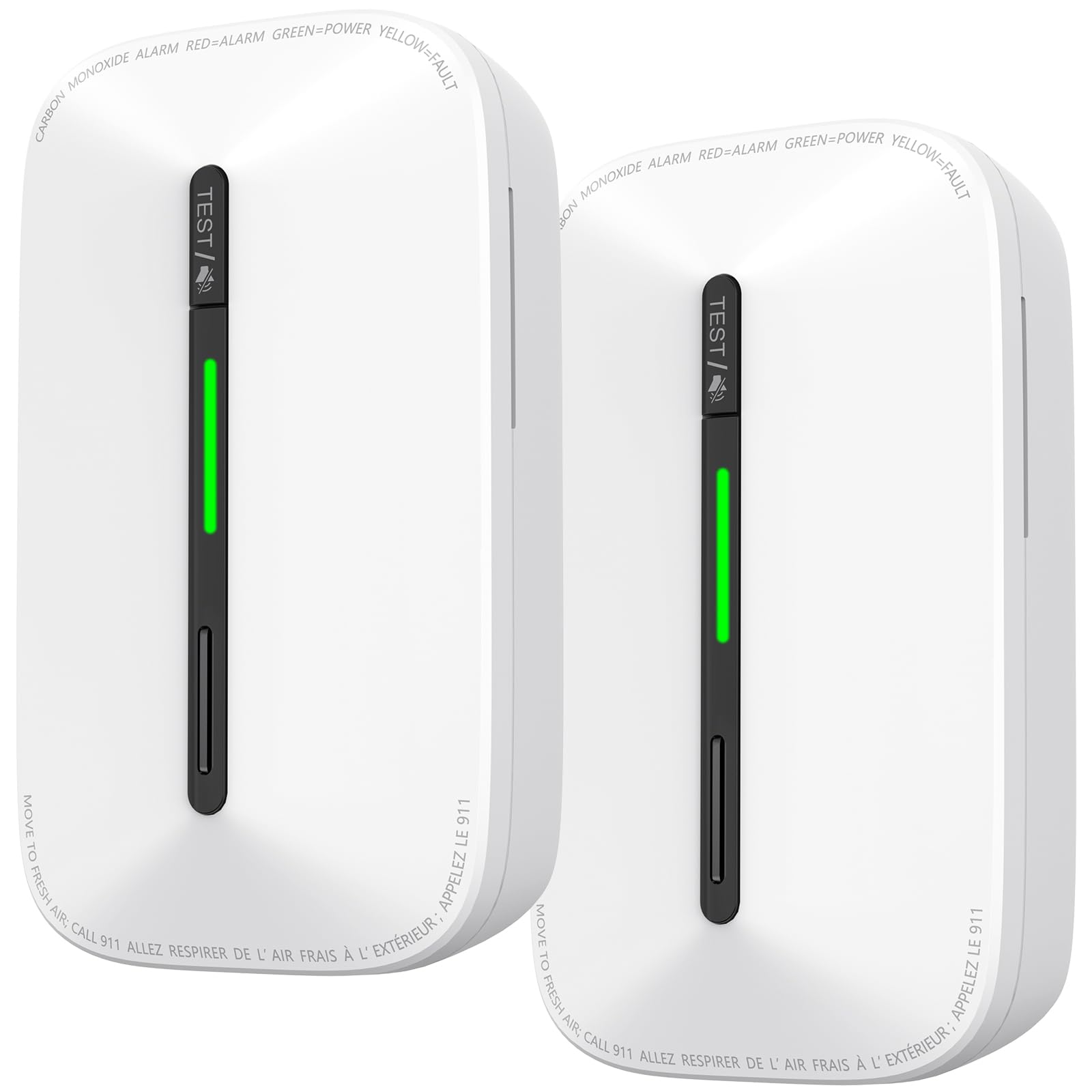
If your carbon monoxide worry travels with you — rental cabins, hotels, a relative’s spare room — this Siterlink is the pick that actually fits the job. The plug folds down against the body, so it slides into luggage next to a charger rather than tangling cords around everything. It then draws power from any standard outlet, with a ten-year battery backup behind it for outages.
The sensing side uses a newly electrochemical sensor, the kind that reacts to carbon monoxide chemically rather than by combustion, which the maker says is engineered to cut down on nuisance alarms. It carries red, yellow, and green status indicators, and the full alert legend is printed inside the battery compartment so you are not hunting for a manual mid-panic. Setup takes under five minutes by most accounts, and the whole housing is ABS plastic.
That backup battery is the honest caveat. Unlike the fully sealed Kidde above, this one takes a replaceable cell, and owner feedback on battery life is genuinely split — some report it stretching months, others expect more from a ten-year claim. What everyone does agree on is how easy it is to live with: soft, breathing-style green light instead of a hard glow, so it does not light up a dark bedroom.
The case for it: portability is the entire pitch here, and it is done properly — foldable prongs, compact body, and true plug-and-play with no installation step at all.
The honest catch: a plug-in needs an outlet, which many utility rooms and basements simply do not have where you need one.
Your pick if: you move between homes, hotels, and rentals and want protection that packs like a phone charger.
Think twice if: your target spot has no reachable outlet, because the wall power is the primary source here.
3. Carbon Monoxide Detector, Temperature Display, 10-Year Battery

Two readouts in one small housing: current carbon monoxide level and the temperature of the room it is sitting in.
Choose the First Alert CO710A if you like seeing numbers rather than guessing what a blinking light means. Its backlit digital display (a screen you can read in the dark) toggles between live CO levels and ambient room temperature, and there is a peak level feature that retrieves the highest concentration of carbon monoxide the unit has measured — so if it caught something at 4 a.m., you can read the number afterward. Power comes from sealed ten-year lithium batteries, so there is nothing to swap out.
The modern, compact housing works either flat on a tabletop or screwed to a wall, which gives you flexibility the plug-in units above cannot offer. The sensor is electrochemical, the same sensing approach as the Siterlink, and this one is a CO-only unit — no smoke detection — so it belongs alongside a separate smoke alarm rather than replacing one.
Here is the part you need to know before ordering. Owners mention that the temperature display is in celsius and cannot be changed, and at least one buyer in the United States returned it specifically because the listing images showed Fahrenheit and the unit did not offer it. If room temperature is a bonus for you rather than the reason you are buying, this is a non-issue; if you want to glance at a familiar number, budget for doing the conversion in your head.
The reason to pick it: a peak-level memory plus a live CO readout is more diagnostic information than any visual-only alarm here gives you.
Plan around this: the temperature readout is fixed in celsius on every unit, so treat it as a bonus feature, not the buying reason.
Worth it for: the detail-minded owner who wants to see what the sensor saw, not just whether it beeped.
Pass if: you need the temperature to read in Fahrenheit, because it simply will not.
4. Kidde Carbon Monoxide Detector, Plug In Wall with 10-Year Battery Backup, Digital LED Display, Test-Hush Button, 3rd Edition

Plugs straight into a standard 120V wall outlet and keeps a ten-year lithium cell behind it for the night the power drops.
Utility rooms, basements, and laundry corners are where this Kidde makes its case, because those are the spots with an outlet and the appliances that produce carbon monoxide in the first place. You plug it into a standard 120V outlet and it runs on wall power day to day, drawing on its ten-year lithium backup, rated 87600 hours, only when the power goes out. The digital LED display shows the level of carbon monoxide the alarm is sensing and reports parts per million, so you get a number rather than a mystery.
Buyers keep mentioning the safety record: the 85-decibel alarm (about as loud as a garbage disposal) sounds alongside the ppm readout, and the reliability of the unit itself is the most-discussed strength in owner feedback, with one long-running theme of units that simply keep working year after year. The peak level memory records the last time carbon monoxide was detected or the unit was last tested, and the no-chirp design means a low battery will not wake you at 2 a.m.
Where it falls short of the sealed C3010 above is battery serviceability — the backup here is non-removable, so if you were used to pulling the cell in summer to stretch its life, that trick is gone on this generation. The other recurring note is a low-battery warning turning up sooner than owners expect on some units, which is worth watching in the first year. It is UL listed (tested to the Underwriters Laboratories safety standard) with a 10-year limited manufacturer warranty on the alarm itself.
Why It Holds Its Place
- Reads carbon monoxide in parts per million on a digital display, not just a color code
- 85-decibel alarm paired with the numeric readout for a clear severity picture
- Test-Hush button tests the unit or temporarily silences a low-battery chirp
- Peak level memory logs the last detection or test event
What To Weigh
- Needs a standard outlet, so it will not help a room without one
- Battery warnings have shown up earlier than expected on some units
- The backup cell is non-removable, unlike the prior generation of this model
Pick it when: your furnace or boiler sits near a wall outlet and you want a real number to look at during an event.
Leave it if: your risk area has no outlet within reach of the appliance.
5. X-Sense Smoke & Carbon Monoxide Alarm, SC06, 3-Pack
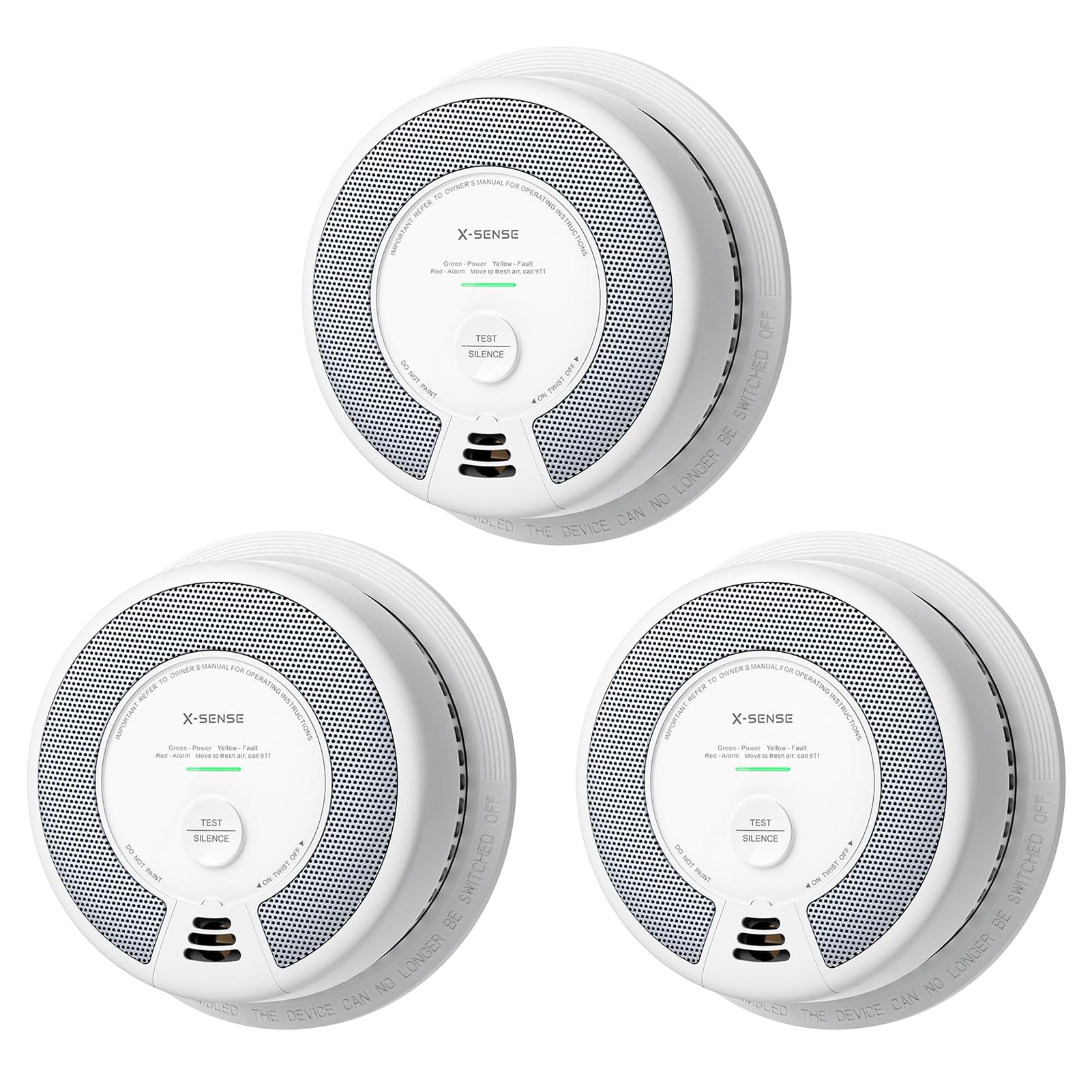
One housing that watches for smoke and carbon monoxide at once, in a three-pack sized to cover a whole apartment.
Two sensors share one ceiling footprint here: a photoelectric smoke sensor for smoldering fires and an electrochemical CO sensor for gas, both feeding the same alarm. For anyone replacing old detectors who does not want two separate devices screwed to the same hallway ceiling, this is the compact answer. It meets the UL 217 and UL 2034 safety standards and is ETL listed, and the ten-year sealed lithium battery means the same no-chirp, no-ladder promise as the CO-only picks above.
Installation is deliberately plain: no rewiring, just the included mounting bracket, screws, and anchor plugs on any wall or ceiling. The large LCD display (a screen that shows numbers and text) shows real-time CO levels, battery level, and working status together, so a glance tells you everything. Owner sentiment on quality runs strong, and what people notice first is that the housing looks and feels more substantial than the price tier suggests, with one buyer pointing out that the non-replaceable battery is the safety win — when it dies, the unit prompts you to replace the whole alarm.
The honest trade-off is reliability reporting, which is genuinely mixed rather than clean. A buyer here and there has received a unit that arrived dead, with no green light and a test button that does nothing — a quality-control miss rather than a design flaw, and worth a quick test on arrival. Check all three units the day they land, and you sidestep the one scenario that would otherwise waste your time.
What sells it: smoke and CO detection in a single sealed-battery housing across a three-pack, which is the most ground covered per dollar of ceiling space on this list.
The fit note: these are CO and smoke units only — they do not hardwire or interconnect with each other, so each one alarms on its own.
A good match for: an apartment or single-floor home that needs smoke and CO cover without two separate device types.
Not the one if: you need alarms that trigger each other across floors — that is the SC01-W below.
6. X-Sense Interconnected Smoke and CO Detector Combo, SC01-W, 3-Pack

When one of these sounds, every unit in the group sounds — so a basement alarm reaches the bedroom.
For a house with more than one floor, this is the feature that separates the SC01-W from the SC06 above. When any alarm in the group detects smoke or carbon monoxide, all the connected alarms sound at once, which means an event in the basement does not stay in the basement. That matters most overnight, when a distant alarm on another floor is easy to sleep through. The battery is the same sealed ten-year lithium across the group, and setup requires no rewiring.
Detection is dual: a photoelectric smoke sensor plus an electrochemical CO sensor in each unit, and the set meets the UL 217 and UL 2034 standards. The 85 dB alarm is loud enough to carry through walls. What owners talk about most is how painless the linking process is — connecting a set of six to a set of three worked smoothly, and the three-pack arrives pre-synced, which saves the pairing step on day one.
Two real-world quirks come up again and again. First, the LCD screen stays blank in normal operation; only a small green LED blinks about once a minute to confirm the unit is alive, so do not read the dark screen as a dead alarm. Second, reaching the TEST and RESET button is awkward if you mount it high on a ceiling or wall, and the screen is small when you are looking up at it. The recurring theme in owner feedback is the occasional false alarm, so give each unit a proper test after mounting.
Why it leads on coverage: whole-home wireless interconnection in a sealed-battery combo alarm is the strongest safety configuration on this list, since every bedroom hears what the basement hears.
Worth knowing: mounting hardware expects specific screws, and a drop-ceiling or non-standard surface may need adapting before it will hold.
Choose this for: any home where the sleeping floor is separated from the furnace or kitchen floor.
Overkill if: you live on a single level, where the much simpler SC06 above covers the same ground for less.
Understanding the Specs
Why “10-Year” Means the Sensor, Not Just the Battery
The ten-year figure on these alarms comes from the electrochemical sensor — the chemical cell that reacts to carbon monoxide in the air. That cell drifts out of calibration as it ages, which is why the whole alarm is retired at the ten-year mark rather than just the power source. A sealed battery is matched to that lifespan because it makes no sense to ask you to keep feeding an alarm that will be thrown away. The practical takeaway: write the install date on the back of the unit with a marker, because you will not remember it in ten years.
Sealed Battery, AC Plug-In, and What Each Means for You
A sealed battery alarm carries its own power and goes anywhere — hallway wall, bedroom ceiling, a closet shelf. An AC plug-in model draws from a standard outlet for continuous operation and keeps a ten-year battery backup behind it, so it survives an outage but needs a reachable socket. Neither is safer than the other; the deciding factor is where you plan to mount it. A utility room with no outlet wants sealed. A bedroom wall outlet you never use can host a plug-in unit and free up the ceiling.
Reading the Alarm Signal on a CO-Only Unit
Carbon monoxide alarms do not use the same shrill continuous tone as smoke alarms. Many pattern the alert in timed beeps — the Kidde C3010 runs four short beeps, a five-second silence, then four more, cycling for four minutes before slowing. That pattern is deliberate, because a CO alarm needs to get you out of the house, not just startle you. Learn your unit’s pattern from the manual on day one so you know what you are hearing when it happens.
What ppm on a Digital Display Actually Tells You
Parts per million (ppm) is the concentration of carbon monoxide in the air the sensor is sampling, and it is the number that separates the display models from the visual-only ones. A backlit display that shows ppm — like the Kidde KN-COP-DP-10YL and the First Alert CO710A — lets you see a reading climbing before the alarm hits its threshold, and a peak level memory keeps the highest number recorded for later. That is useful when you want to know whether a boiler is leaking slowly or whether the alarm caught a one-time event.
FAQ
How long does a 10-year carbon monoxide detector actually last?
Can I put a battery-powered CO detector on the ceiling?
Will a plug-in CO detector still work during a power outage?
Is a CO-only detector or a combo smoke and CO alarm better?
What does ppm mean on a carbon monoxide detector display?
Do interconnected alarms need Wi-Fi or a hub to work together?
Where should I mount a carbon monoxide detector in my home?
How do I test a sealed-battery carbon monoxide alarm?
Can I take a plug-in carbon monoxide detector on a trip?
What should I do if my carbon monoxide alarm keeps going off with no obvious source?
Final Thoughts: The Verdict
The best 10 year carbon monoxide detector for most homes is the Kidde low-maintenance C3010, because its sealed lithium power supply is rated for the alarm’s full 87600 hours and it powers on the moment it clicks onto the bracket. You mount it and forget it. If you want a live parts-per-million readout and a peak level memory, the Kidde KN-COP-DP-10YL gives you both in a plug-in body. And for a multi-floor house where a basement event needs to reach a bedroom, the X-Sense SC01-W links every alarm together with no hub. Whatever you choose, test each unit the day it arrives and note the install date on the back — that single habit is what makes a ten-year alarm actually last ten years.
How We Picked
We do not accept paid placement. Every pick is matched to a real buyer and a real use-case; we do not hands-on test units.
Sources & Methodology
Specifications: manufacturer listings and product documentation. Review insights: verified customer reviews, as of September 2026. Pricing: not shown on this page (it changes often); check the current price via the retailer link.
As an Amazon Associate, Non Toxic Blog earns from qualifying purchases. This does not affect which products we feature.