Specs are compiled from manufacturer listings and verified buyer reviews and can change over time — please confirm the key details on the product page before buying.
A quick heads-up before you scroll: this list treats “110W” as a class, not a strict number. Panels from roughly 100 to 120 watts do the same job — charging a power station, topping a battery, or running an off-grid shed — so the nearest same-type size earns its spot here. That means not every pick on this page says exactly 110 watts on the box, and you deserve to know that upfront.
I’m Mo Min — the founder and writer behind Non Toxic Blog. This guide is built by comparing the manufacturers’ published specifications and the patterns across verified customer reviews, so you get each pick’s real strengths and trade-offs instead of marketing spin.
The three specs that actually decide your satisfaction are cell type, real-world output, and how the panel handles shade. This breakdown of the 110w solar panel class separates honest wattage from marketing wattage.
Our Picks at a Glance

How To Choose The Best 110W Solar Panel
Solar panels in this size class all look alike in photos, which is exactly why so many buyers end up disappointed. The differences that matter are invisible until you’re standing in your driveway with a multimeter. Four things separate a panel you’ll love from one you’ll resell.
Cell Type: N-Type vs Older PERC
N-Type cells (a newer silicon recipe that resists power loss better as the panel heats up) are what almost every strong pick on this list runs on. A low temperature coefficient means the panel loses less output on a 100°F roof, so a summer afternoon doesn’t quietly gut your charging speed. Older PERC panels work fine in mild climates but fade faster in desert heat.
Real Output vs Rated Output
A 100W or 110W rating is a lab number taken at a fixed test condition. In genuine midday sun with a proper charge controller, a good panel lands in the 60 to 90 percent range of that figure. The panel’s own efficiency rating (25%, 23.5%, 23%) tells you how much of the sunlight hitting its surface actually turns into electricity — higher is better, but shade tolerance matters just as much.
Mounting and Portability
Rigid panels bolt down permanently and reward you with decades of service, but they live where you install them. Foldable panels ride in the trunk and set up on kickstands in seconds. Rigid glass handles hail and snow loads; a folding panel is a camping companion, not a roof fixture. Pick the form factor that matches how you actually use power.
Quick Comparison
| Model | Best For | Rated Power | Efficiency | Weight | Amazon |
|---|---|---|---|---|---|
| Renogy 100W N-Type 16BB★ Best Overall | Rigid rooftop and ground mounts | 100 watts | 25% | 13 lbs | Amazon |
| ECO-WORTHY 100W N-Type BifacialBest Value | Off-grid battery banks | 100 watts | 25% | 11.7 lbs | Amazon |
| Callsun 100W N-Type 16BBCompact Pick | Tight roof and rack spaces | 100 watts | 25% | 11 lbs | Amazon |
| MHPOWOS 110W Portable | Charging power stations outdoors | 110 watts | 23.5% | 8.5 lbs | Amazon |
| VTOMAN VS110 | VTOMAN Jump power stations | 110 watts | 23% | 12.5 lbs | Amazon |
| EBL 100W Portable | Camping and RV fridge duty | 100 watts | 23% | — | Amazon |
| ZOUPW 110W Portable | Direct phone and laptop charging | 110 watts | 25.6% | 8.02 lbs | Amazon |
| Renogy ShadowFlux 120W | Shaded rooftops and tree cover | 120 watts | 25% | — | Amazon |
| EF ECOFLOW 110W | EcoFlow power station owners | 110 watts | 23% | — | Amazon |
In‑Depth Reviews
1. Renogy 100 Watt Solar Panel N-Type, 16BB 25% High-Efficiency
Our pick — over 4.5★ from 150+ verified ratings; the strongest balance of quality and price.
The rooftop workhorse that kept its output above its own rating in the driveway
If your plan is bolt it down once and forget it for a decade, this is the panel to buy. Its 25% conversion efficiency comes from grade A+ N-Type cells, paired with 16BB cell technology — 16 thin metal ribbons per cell that shorten the path electricity travels and cut down on hot spots. The payoff is 5.31 A of amperage capacity, and it is one of several counts where this Renogy outworks the ECO-WORTHY below — 5.31 A to 4.69 A.
This panel is built to shrug off bad weather, not to look good on a spec sheet. Its IP67 rating (dust-tight and able to survive a rainstorm) comes from low-iron tempered glass and a corrosion-resistant aluminum frame, and it carries ratings for 2400Pa wind loads and 5400Pa snow loads. It measures 34.1 by 22.8 by 1.2 inches and weighs 13 pounds. Buyers report it hitting the top of its spec and staying there: as one owner put it, “Saw up to 110 watts and up to 7 amps to battery.” Cloud cover still shuts output down — that part never changes with any panel of this size.
N-type 16BB cells
- 25% efficiency from grade A+ N-Type cells, and it tests at or above its 100W rating in full sun.
- IP67 shell with 2400Pa wind and 5400Pa snow ratings — this is a panel you mount once.
- The 25-year guarantee keeps it at 80% output, with degradation held to 1% or less in year one.
rigid frame only
- Anything shading one corner drops output sharply — treat shade as an on/off switch.
- At 13 pounds and 34.1 inches long, it is a fixed-mount panel, not a pack-along.
- The 10-year workmanship window is shorter than the 25-year output promise.
buy it if: you want a permanent RV, van, or shed panel that hits its numbers and holds them for decades.
look past it if: your setup moves week to week, or part of your mounting spot sits in tree cover — the ShadowFlux later on handles that shade far better.
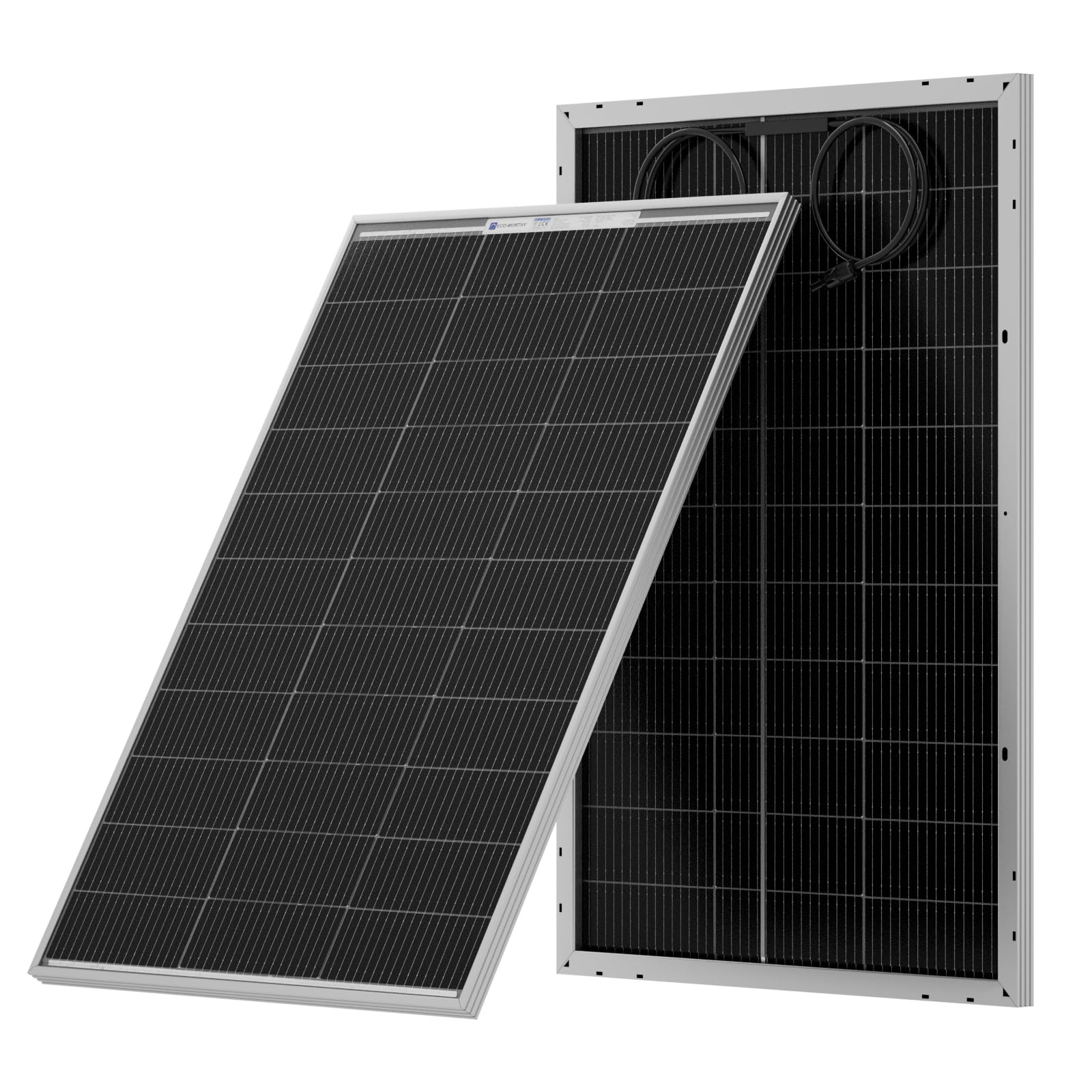
2. ECO-WORTHY 100 watt Solar Panel N-Type, 18V Monocrystalline
The dual-sided panel that grabs light bouncing off the roof beneath it
A bifacial panel collects energy from both its front and its back face, so light reflecting off a white roof or pale gravel adds to your total. ECO-WORTHY rates that backside bonus at up to 15% extra output. Set against the Renogy above, this one trades raw amperage for a lighter frame and a smaller floor plan — 11.7 pounds versus 13, and 35.63 by 23.03 by 1.18 inches versus 34.1 by 22.8 by 1.2 inches. The N-Type cells handle dawn, dusk, and cloud cover with less waste, which is exactly when a fixed off-grid array needs every watt it can get.
If you run a real battery bank, you can buy these in multiples because the wiring supports it. Four 100AH batteries staying topped off is a normal story here, and one owner summed the group build this way: “4 panels power off-grid shed. Full sunlight produce well over 20 amps, keep two 100AH batteries fully charged.” The aluminum frame, 3.2mm tempered glass, and IP68 shell (dust-tight and protected against sustained water contact) carry the same 2400Pa wind and 5400Pa snow ratings as the Renogy. Pre-drilled holes mean mounting is a drill-and-bolt job, not a fabrication project.
The price-to-output ratio is the real story, and it is why this panel carries the value label. The recurring gripe in owner feedback is single-panel output that lands short of the advertised wattage, especially on units tested one at a time from the start. Test each panel before you install it, and order a spare if your array is large — the brand’s replacement service resolves genuine underperformers without much friction.
18V monocrystalline output: 25% conversion from advanced N-Type cells, with 16BB busbars cutting the risk of hot spots and micro-cracks over years of sun exposure. That places it squarely in the modern-cell tier, not the discount rack.
reach for this if: you’re building a multi-panel off-grid bank and want the best output per dollar in the group.
think twice if: you need a single guaranteed-nameplate panel — verify output on arrival and you’re fine, but test it early.
3. Callsun N-Type 16BB 100 Watt Solar Panel, 25% High Efficiency
Small enough for a trailer roof, still running past 98 watts in Phoenix heat
Space is what kills most van and trailer builds, and this panel is built around that problem. It measures 31.1 by 22.7 by 1.1 inches and weighs 11 pounds — the smallest rigid panel on this list, and the maker rates it 15% smaller than traditional panels. Despite the trim size, it carries the same 25% efficiency claim and the same 16BB busbar design as the two picks above, with a low temperature coefficient of -0.3%/°C (a figure describing how little output it sheds as the panel heats up). In Phoenix at 112°F, owners mounting these at a near-vertical angle recorded more than 98W each — above what a hot panel usually makes.
What stands out for a rigid panel is how well it handles shade. Owners running six panels in a 2s3p configuration (six panels wired as two groups of three in series, then joined in parallel) on a travel trailer report steady charging through partial cover, and one build describing eight 100W panels split between a Victron MPPT controller and a power station logged 321W, 383W, and 456W peaks across three panels on a March day. VOC readings on paired panels sat within 0.10V of each other, which is quality-control territory most budget panels don’t reach.
25% efficiency cells: a panel in a multi-pack can arrive with a dented metal trim while the glass stays intact and the panel keeps working — worth a look before you install.
the right fit: tight roof racks, small trailers, and sailboat mounts where every inch of real estate counts.
less ideal: ground arrays where a bigger footprint costs you nothing — a larger panel in the same class will work just as well for less hassle.
4. MHPOWOS 110W Portable Solar Panel for Power Station IP67 Waterproof Solar Charger
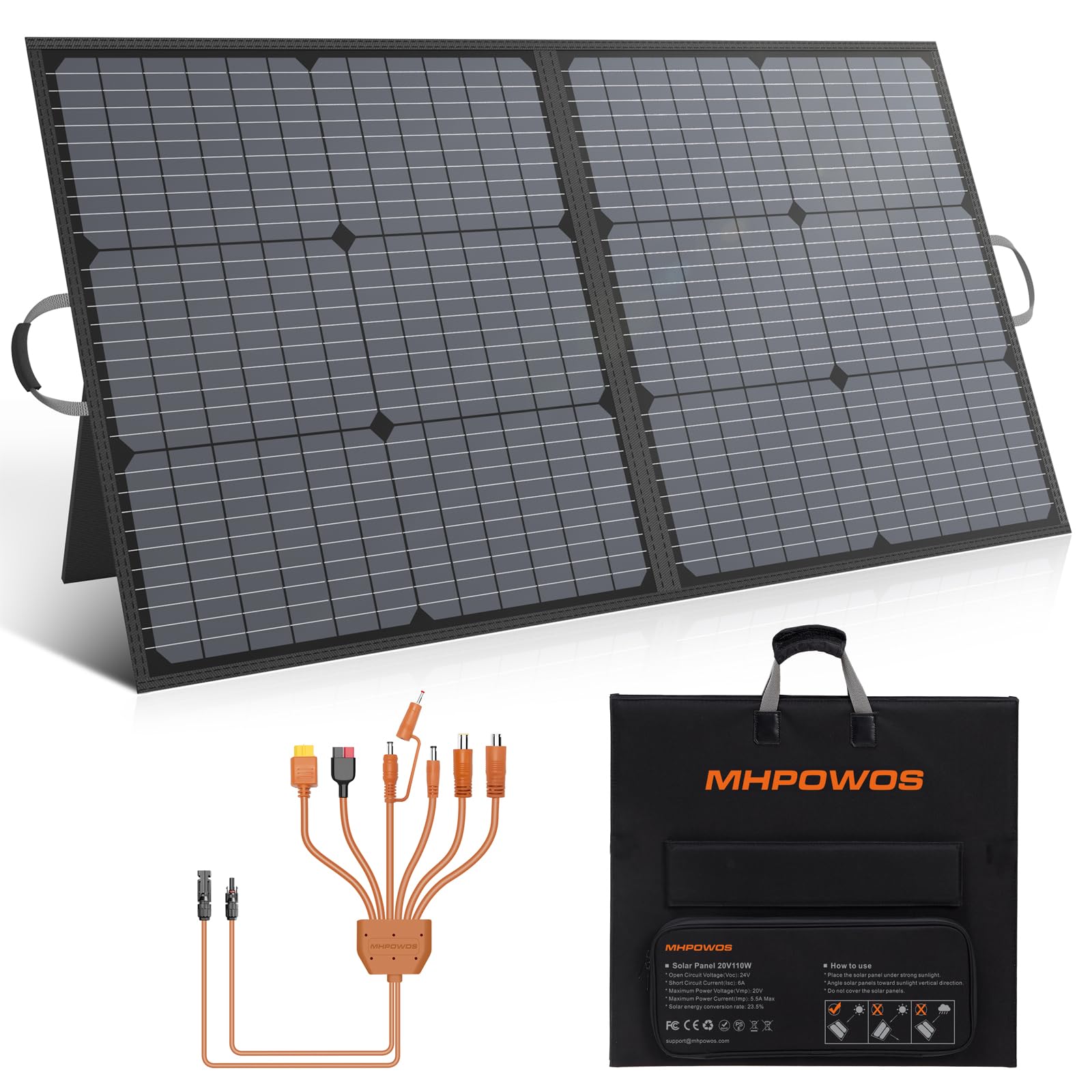
Folds down to the size of a briefcase and tops off a power station all afternoon
If you never want to touch a drill, this is the panel for you. It folds to 23.46 by 21.25 by 1.57 inches, weighs 8.5 pounds, and carries a thickened handle so one person can move it from the truck bed to a picnic table in a single trip. Monocrystalline cells deliver a 23.5% conversion rate, and the 110W rating is the true number in this class — the full advertised figure, unlike the 100W panels in this guide that need a hot day to hit their ceiling.
Where this panel earns its keep is the cable setup. It ships with a solar extension cable running to a 4-in-1 interface covering Anderson, XT60, DC7909, and DC5521 plugs, which means it connects to most power stations without a shopping trip for adapters. A pair of kickstands props it up on any flat surface. In full sun, owners measure it landing around 82 watts — the honest ceiling for any folding panel of this size.
IP67 waterproof build: check your power station’s maximum input limit. Some stations cap incoming power below what this panel can deliver, and that cap — not the panel — will be your actual charging speed.
made for: car campers, tailgaters, and anyone charging a portable power station on weekend trips.
skip the idea of using it for: low-light or shaded charging — in dim conditions it drops to close to nothing, and no folding panel at this size escapes that rule.
5. VTOMAN Portable Solar Panel for Solar Generator, 110W 19V Folding Solar Charger (VS110)

Plug-and-play power for anyone already running a VTOMAN Jump station
If a VTOMAN power station is already in your garage, this is the simplest match you can make. The VS110 runs at a 19V working voltage with MC-4, Anderson, XT60, and DC5521 interfaces, and it plugs straight into the Jump 600X, Jump 1000, Jump 1500X, and Jump 1800 stations. It is not compatible with the FlashSpeed 1500, so check your model before ordering. The panel itself is a 110W unit built from monocrystalline cells at 23% conversion efficiency, and it draws 6 A of amperage capacity — the highest amp rating in this whole group, ahead of the MHPOWOS at 5.5 A.
You can have this panel set up in under a minute. Two adjustable kickstands angle the panel on the ground, and four circular holes let you hang it from a balcony rail or RV ladder. Folded, it measures 25.6 by 23.7 by 1.4 inches and weighs 12.5 pounds. Owners test it against real loads rather than specs: one logged a 102W peak and roughly 700Wh across a week of mixed weather, and the same setup pushed about 200Wh on a cloudy day with light rain — proof the panel keeps working when the sky isn’t cooperating.
The build is the most-praised part of this panel, and it shows in the frame and hinges rather than the spec sheet. A 2-year warranty backs it, which is shorter than the material guarantees on the rigid panels above, so factor that into how hard you plan to use it.
best when: a VTOMAN Jump station is your battery, because the cables mate without adapters and the voltage lines up exactly.
overkill when: you own a different brand’s station — a broader-compatibility panel will serve you better for the same job.
6. EBL Solar Panel 100W Portable Solar Panel for 300/500/1000 Power Station
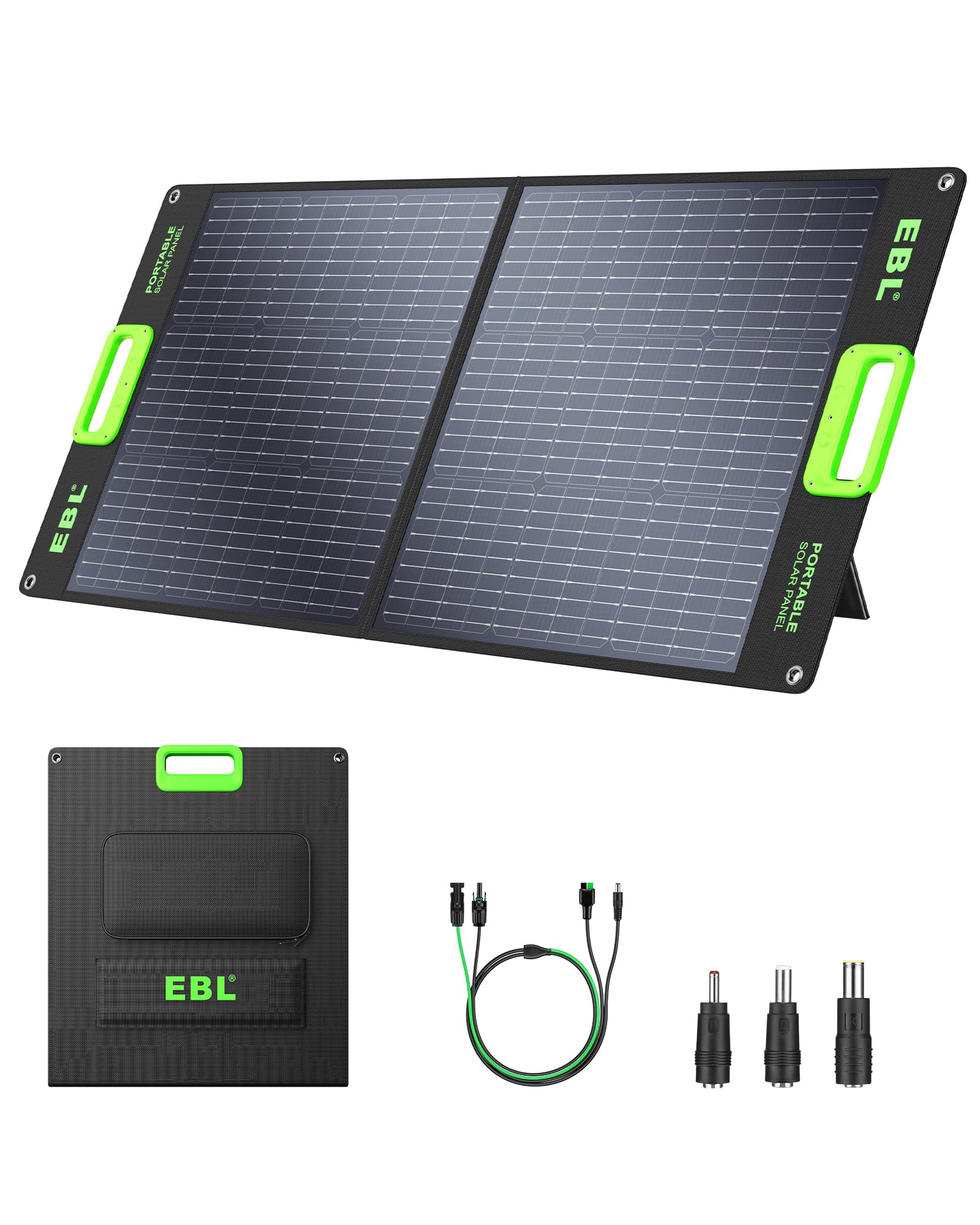
A folding panel with a stiff spine that stands up to wind instead of flapping
Most folding panels feel like a tarp with wires; this one has a rigid plastic frame that owners specifically praise for holding its shape on windy days. The 100W of monocrystalline cells run at 23% efficiency, and the surface is laminated with ETFE (a tough transparent film that resists yellowing better than plain plastic). Its kickstands lock at a 45° angle, which the maker says pulls in 20% more sunlight than laying the panel flat.
The output numbers here run hot and cold depending on who’s testing. In peak sun, owners have logged 148 watts at 4pm in a central Ohio summer, with one recording a 191W max — well above the 100W nameplate. In a perfect-sun Florida test, the low end landed around 65W, so expect your result to depend heavily on angle, season, and controller. The panel charges through MC4 and Anderson connectors, ships with a full set of adapter plugs, and includes a 6-foot cable. Owners charged a 1kW power station running a fan, phones, and a CPAP machine for two days and kept it above 69% capacity.
fits 300 to 500Wh: this one is IP65-rated for splashes, not submersion — it should not be left out in the rain or soaked in water, so plan to pack it in when clouds roll through.
pick it for: camping and RV trips where you’re charging a mid-size power station and want a rigid frame that won’t flog itself apart in wind.
heads-up: output varies widely with conditions, so if you need guaranteed watts in bright sun, buy the panel type that hits its rating more consistently.
7. ZOUPW 110 Watt Portable Solar Panel for Power Station, 25.6% Efficiency
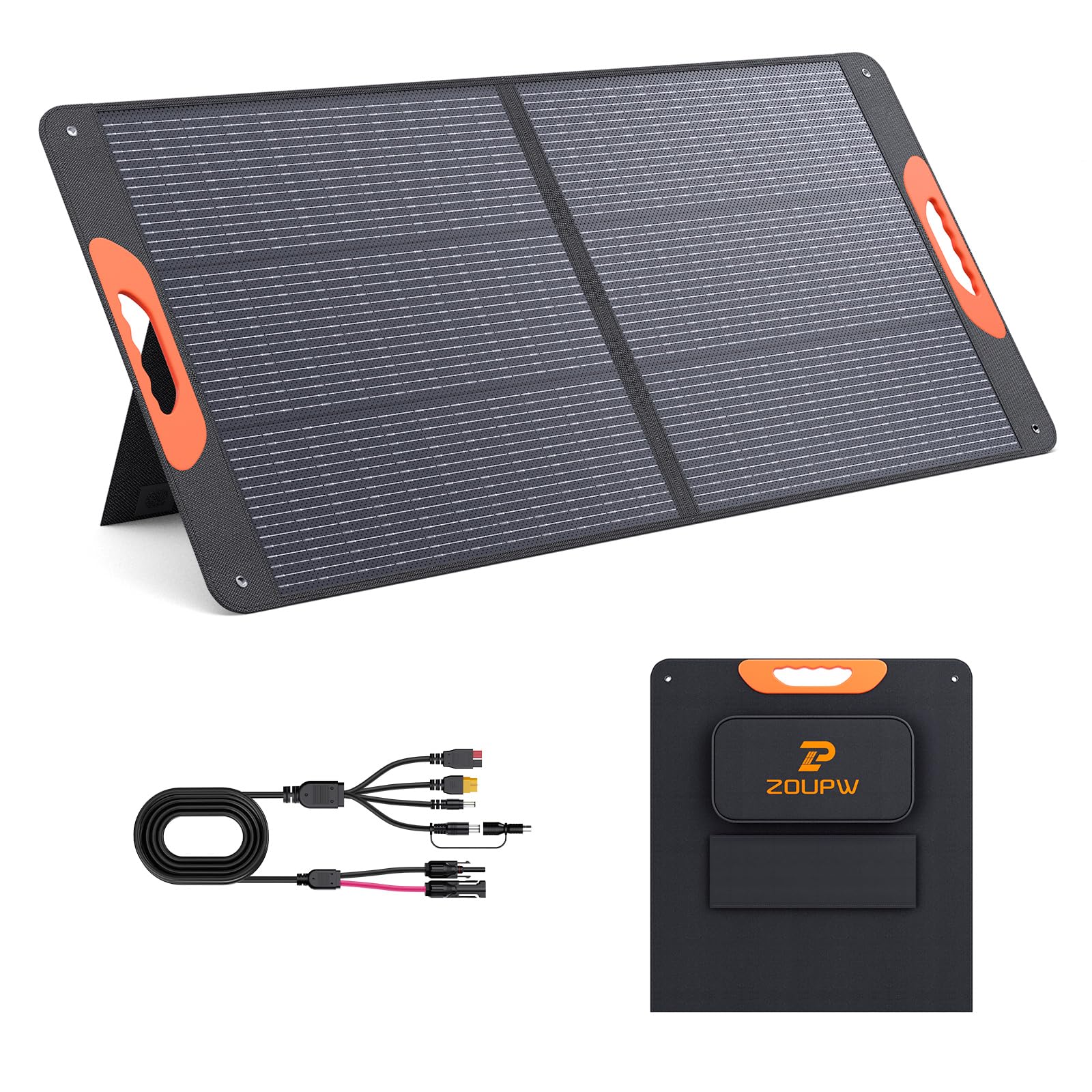
The one folding panel here that charges your phone without a power station in the middle
ZOUPW builds a small output hub straight into the panel: one USB-C port with power-delivery fast charging and two USB-A ports. You can plug a phone, a drone battery, or a laptop directly into the sun and skip the battery brick entirely, which matters on a lightweight trip where the station stays home. That makes this the most useful panel on this list for short beach days and car-camping overnights.
It is also the efficiency leader of the group. Grade A+ N-Type cells with 16BB busbars hit 25.6% conversion — the highest figure on this page, edging the 25% panels from Renogy, ECO-WORTHY, and Callsun. Two kickstands angle it at 45° to gain up to 25% more sunlight than flat laying, and the panel keeps drawing when light is weak. At 8.02 pounds with a magnetic carry handle, it folds to roughly 24.45 by 22.99 by 1.57 inches. The 5-in-1 cable covers DC8020, XT60, Anderson, DC7909, and DC5521, so it fits the major power station brands without an adapter purchase — a genuine upgrade over the standard 4-in-1 cables on the MHPOWOS and EBL above.
Owners use it in places a roof panel never reaches. One setup ran it in a bedroom window powering a generator through a full workday, another took it to the beach to charge everything the family brought. The durable ETFE coating and IP67 body handle splashes with the controller and cables tucked inside a zippered pocket. The trade-off is that its peak output is more modest than an equivalent rigid panel — the 110W rating is honest, but a folding panel of this class always gives up some raw wattage to the sunlight angle.
ideal for: campers and remote workers who want to charge gadgets straight from the sun, with no separate station required.
consider alternatives if: you’re building a fixed off-grid battery bank — a rigid panel in this class will deliver more output per surface area for less.
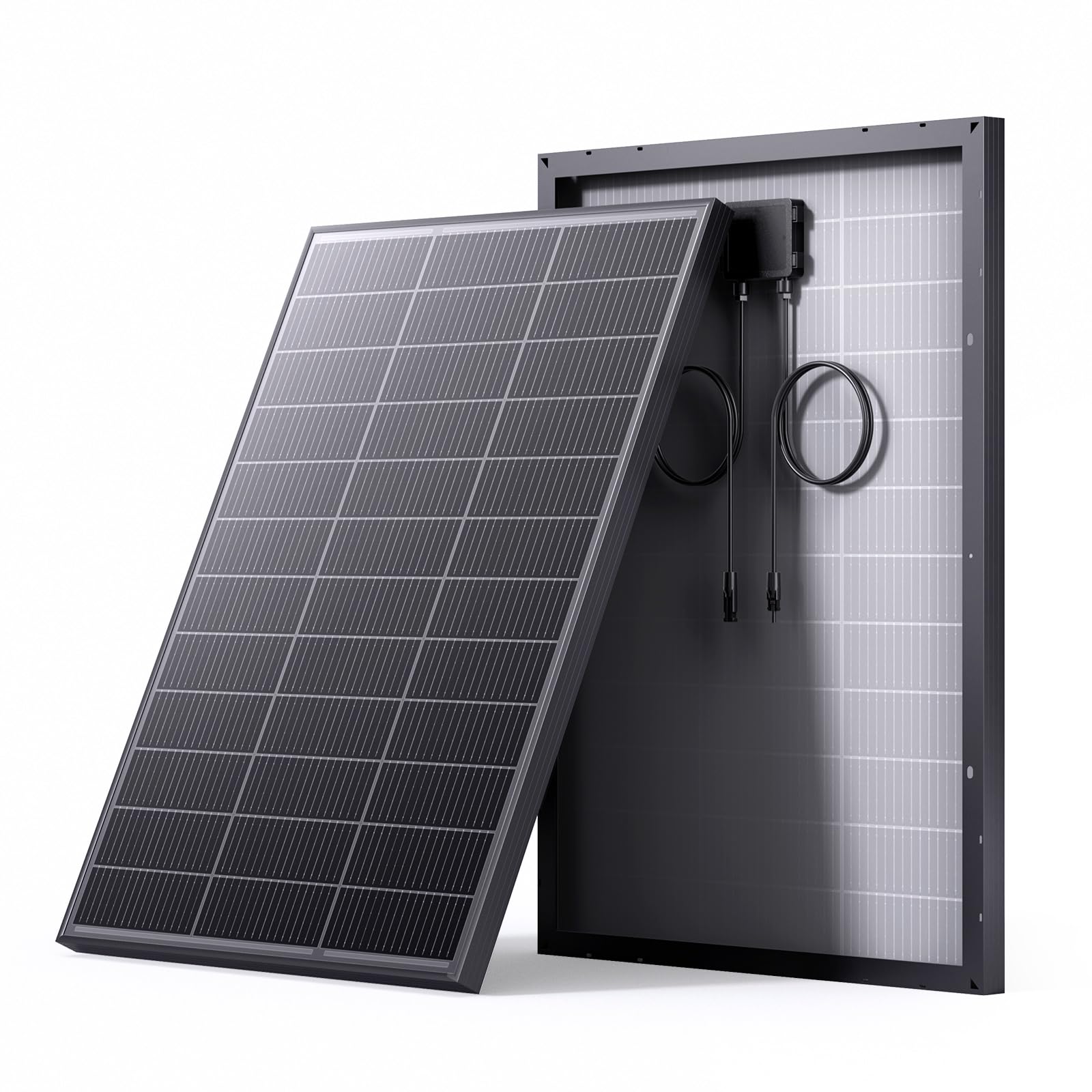
8. Renogy ShadowFlux Solar Panel 120 Watt, N-Type 25% High-Efficiency

Built to keep generating when branches and buildings throw shade across the glass
Shade is the number-one reason solar setups disappoint, and this panel is Renogy’s direct answer to it. Its ShadowFlux anti-shading technology, plus 16BB N-Type cells at 25% efficiency, keeps output flowing even when buildings, plants, or stains block part of the array — the exact condition that cripples most panels in this class.
The big upgrade over the standard-issue Renogy panels here is the bypass diode design plus high maximum voltage, which lets the panel route around sections that are shaded rather than losing the whole string. It’s a 120W panel running at 33.69 volts and 4.57 A, and it’s rated IP67 to shrug off snow, rain, and small hail. The 25-year guarantee promises 80% output, though the shorter 5-year materials and craftsmanship window is note before you commit to a rooftop install. At 41.4 by 22.8 by 1.2 inches, it also folds more surface area into less rooftop than most panels of this output.
The real-world numbers back up the marketing. On a roof rack with branch shade, owners measured over 158W from the start in hazy, dappled conditions, and a partly covered panel dropped only to 142W — versus 70W for a standard panel in the same test. Paired with a good MPPT controller, these panels behave like a much larger array in partial shade, which makes them worth their premium for anyone mounting near trees.
built for: rooftop, carport, and tree-adjacent installs where partial shade is a fact of life, not a rare event.
skip if: your mounting spot gets unobstructed sun all day — a standard panel will do the same job for less money.
9. EF ECOFLOW 110W Portable Solar Panel, Foldable with Carry Case

The premium folding panel with a carry case that doubles as its own kickstand
EcoFlow owners pay more for one reason: everything clicks together without fuss. The panel runs at 23% conversion efficiency and 110W, and it plugs into most EcoFlow power stations with MC4 connectors, so the charging setup is genuinely plug-and-play. The IP68 rating (dust-tight and sealed against water) is the highest on this list, and the included carry case folds open into a kickstand you can angle toward the sun for faster charging.
Build quality is where this panel’s reputation comes from. Owners describe the frame and connectors as top-tier and durable, and it holds up to repeated trips in and out of storage. In full sun, real-world output lands around 80% of the rated figure — a touch under 110W, but within range for a folding design. It charges an EcoFlow River quickly enough that owners have timed a full top-up in about three hours of steady sunshine, which makes it a solid emergency-backup companion for outages.
Two quirks show up repeatedly in owner experience. The cables exit the front of the panel rather than the back, which can throw a shadow across part of the array if you don’t route them carefully. And the 4-clip stand takes more fiddling to set up than the fold-in kickstands on the MHPOWOS or VTOMAN panels above, though it holds its angle once it’s locked in.
worth it if: you already own EcoFlow gear and want the panel that pairs with it cleanly and survives real camp use.
less appealing if: you’re chasing maximum watts per dollar — the cheaper folding panels on this list deliver similar output with less polish.
Understanding the Specs
Conversion Efficiency and Cell Type
Efficiency tells you how much of the sunlight landing on the panel actually turns into electricity. N-Type cells (a newer silicon formulation that resists heat-related losses) sit at the top of this list at 25% and 25.6%, while 23% marks the solid-but-standard tier. Higher efficiency means more power from a smaller surface area — useful when you’re mounting on a tight RV roof or carrying the panel on your back.
IP Ratings and Real Weather Protection
The IP number has two parts. The first digit covers dust, the second covers water. IP65 handles splashes only, so a panel with that rating should come inside when rain starts. IP67 and IP68 tolerate much more water contact, but even the highest-rated folding panels have open connectors and controller pockets that want protection in a downpour. A high rating buys you confidence, not a permanent outdoor installation.
Fixed Mount vs Folding
A rigid glass panel bolts down and lives on a roof or ground frame for years, with the durability ratings to match. A folding panel trades some peak output for the ability to pack into a car trunk and charge wherever you park. Your choice here is about how you use power, not which panel is objectively better.
Connectors and Charge Controllers
Panels in this class ship with solar connectors and a set of adapter plugs for the major power station brands — Anderson, XT60, DC7909, DC5521, and the newer DC8020. If you’re charging a power station, the panel’s cable needs to match its input. If you’re charging a bare battery instead, you need a separate charge controller to manage the voltage.
FAQ
Will a 100W panel actually produce 100 watts?
Does a 110W solar panel charge a power station fast enough to matter?
What is the difference between N-Type and older PERC solar cells?
Can I leave a portable solar panel outside in the rain?
What is a bifacial solar panel and is the extra output real?
Do I need a charge controller with a 110W solar panel?
How badly does shade hurt solar panel output?
Can I chain several 110W panels together?
What does the amperage capacity number actually tell me?
Is a rigid panel or a folding panel better for RV use?
Final Thoughts: The Verdict
For most people, the winner is the Renogy 100 Watt Solar Panel N-Type, because it pairs 25% efficiency and a 16BB cell design with IP67 durability ratings that hold up through real weather and a 25-year output guarantee. It is the panel you mount once and trust for years. If you are building a budget off-grid bank with multiple panels, the ECO-WORTHY 100 watt Solar Panel is the smart value play, and its bifacial design pumps out extra from reflected light. For a fixed install under tree cover, the Renogy ShadowFlux 120 Watt earns its premium whenever branches throw shade on the roof. And if you want to charge gadgets straight from the sun with no power station in between, reach for the ZOUPW 110 Watt Portable and its built-in USB-C port.
One last nudge: the Renogy N-Type carries the group’s highest owner score, 4.7 stars across 160+ ratings.
How We Picked
We do not accept paid placement. Every pick is matched to a real buyer and a real use-case; we do not hands-on test units.
Sources & Methodology
Specifications: manufacturer listings and product documentation. Review insights: verified customer reviews, as of September 2026. Pricing: not shown on this page (it changes often); check the current price via the retailer link.
As an Amazon Associate, Non Toxic Blog earns from qualifying purchases. This does not affect which products we feature.