Specs are compiled from manufacturer listings and verified buyer reviews and can change over time — please confirm the key details on the product page before buying.
The short answer: a 115-volt mini split lets you cool and heat one room or a converted garage without paying an electrician to run a new 240-volt line. That single fact is why these units exist, and it is the first thing to check before you buy anything. Get the voltage wrong and the compressor simply will not start. The picks below are all confirmed 115V ductless systems, sorted by how well they actually perform once the box is on your wall — and by how honestly their listings describe the install you are signing up for.
I’m Mo Min — the founder and writer behind Non Toxic Blog. This guide is built by comparing the manufacturers’ published specifications and the patterns across verified customer reviews, so you get each pick’s real strengths and trade-offs instead of marketing spin.
A 115V ductless unit sidesteps the panel work, and the right one runs on a standard circuit with almost no noise. This breakdown of the 115v mini split market separates the units owners keep praising from the ones that quietly disappoint after a year.
Our Picks at a Glance

How To Choose The Best 115V Mini Split
Three things decide whether a 115V mini split makes you happy or drives you up the wall: the BTU rating against your actual room size, the efficiency rating on the listing, and how honest the brand is about who installs it. Get them wrong and you end up with a system that short-cycles, leaks, or fries a breaker.
Match BTU to the room, not to the marketing
The BTU number is the amount of heat the unit can move in an hour — 12,000 BTU is the most common size at 115V. That usually covers a garage, sunroom, or small open-plan living space. Buying far more capacity than the room needs makes the unit cool too fast and shut off repeatedly, which wastes power and wears the compressor. Buying too little means it runs flat out all afternoon and never quite wins.
Read the SEER2 number like a fuel economy sticker
SEER2 (Seasonal Energy Efficiency Ratio, the current efficiency score for cooling) tells you how much electricity the unit uses per unit of cooling. Higher is better, and it is the number that shows up on your power bill every month. A 22 SEER2 unit and a 19 SEER2 unit can look identical on the shelf and behave very differently over a hot summer. Inverter compressors are what make those high numbers possible, because the compressor ramps up and down instead of slamming on and off.
DIY kit or licensed installer — decide before you order
Some of these systems ship with pre-charged, quick-connect lines and no vacuuming required, which a capable homeowner can handle in an afternoon. Others explicitly require a licensed HVAC technician to keep the manufacturer warranty valid. Both routes work. What does not work is buying a pro-install system and then discovering you need a vacuum pump, gauges, and a technician’s license number before the warranty means anything.
Check the low-temperature heating limit
Every heat pump has a floor — the outdoor temperature below which heating output falls off. Some of these units keep working in severe cold, others stop being useful well above freezing. If you live where January bites, that single spec matters more than any fan speed setting.
Quick Comparison
| Model | Best For | Cooling Power | Efficiency | Coverage | Amazon |
|---|---|---|---|---|---|
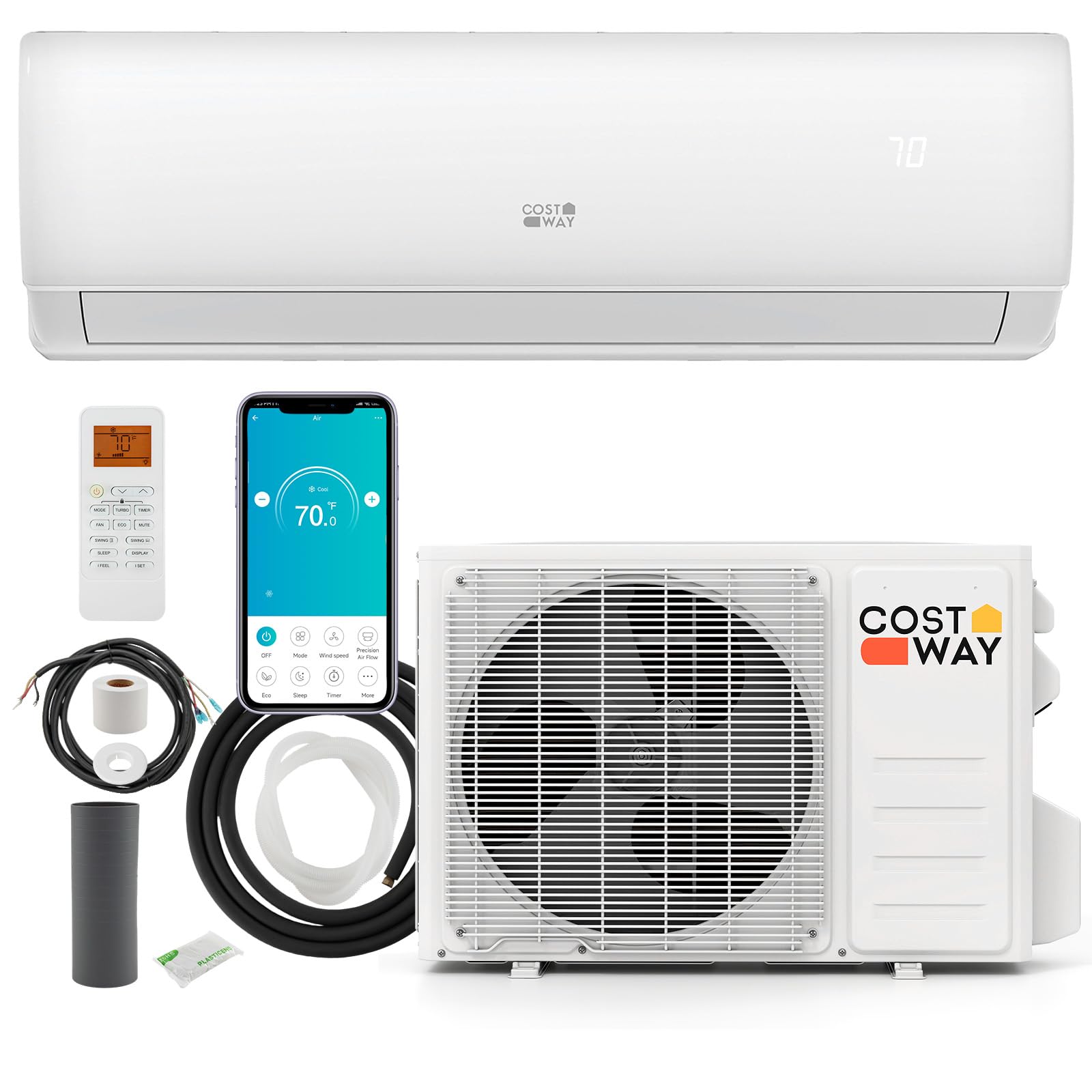
| COSTWAY 11500 BTU Mini Split Air Conditioner★ Best Overall | Small shops and sunrooms | 11500 BTU | — | 750 sq ft | Amazon |
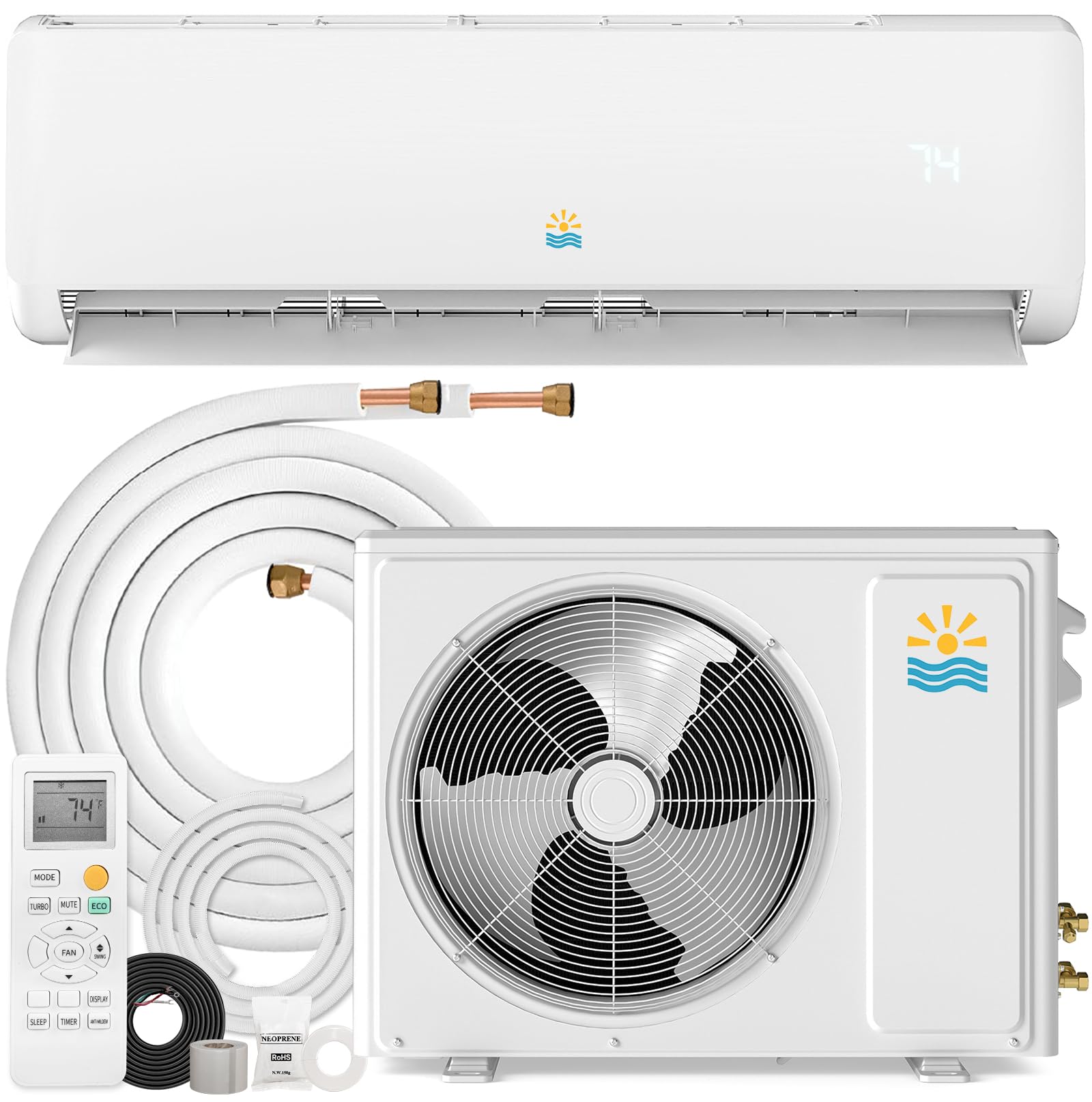
| 12000 BTU Mini Split AC & Heating System, 19 SEER2Quietest Pick | Quiet bedrooms and nurseries | 12000 BTU | 19 SEER2 / 8.5 HSPF2 | 750 sq ft | Amazon |
| ROVSUN 12000 BTU Wifi Enabled Mini SplitSmart Control Pick | Voice and app control | 12000 BTU | 20 SEER2 | 750 sq ft | Amazon |
| COSTWAY 12000 BTU Mini Split with Heat Pump | Cold-climate garages | 12000 BTU | 22 SEER2 / 9 HSPF2 | 750 sq ft | Amazon |
| Mini Split Ac/Heating System, 12000 BTU | RVs and tiny homes | 12000 BTU | 19 SEER2 / 8.5 HSPF2 | 550 sq ft | Amazon |
| Albott Easy DIY Series 12,000 BTU | No-vacuum DIY installs | 12000 BTU | 18 SEER2 | 750 sq ft | Amazon |
| TURBRO 12,000 BTU Ductless Mini Split Inverter | Fast heating in deep cold | 12000 BTU | 23 SEER2 | 750 sq ft | Amazon |
| Albott 12,000 BTU DIY Mini Split with Pro Fast-Fit Set | First-time DIY installers | 12000 BTU | 18 SEER2 | 750 sq ft | Amazon |
| DELLA Motto Series 12000 BTU 20 SEER2 | Long line runs and tall ceilings | 12000 BTU | 20 SEER2 | 550 sq ft | Amazon |
| DELLA Optima Series 9,000 BTU Hyper Heat | Smallest rooms and offices | 9000 BTU | 24 SEER2 / 10 HSPF2 | 400 sq ft | Amazon |
| Cooper & Hunter MIA 12,000 BTU | Whole-home multi-room setups | 12000 BTU | 21.2 SEER2 | 550 sq ft | Amazon |
In‑Depth Reviews
1. COSTWAY 11500 BTU Mini Split Air Conditioner
Our pick — 4.5★ from 150+ verified ratings; the strongest balance of quality and price.
The 115V workhorse that turns a garage or shop into living space without a panel upgrade.
If your room is a converted shop, a sunroom, or a detached garage you actually want to use in August, this is the one to start with. It moves 11500 BTU of cooling — the amount of heat it can pull out of the air per hour — which lands it right in the bracket that covers up to 750 square feet. That is the same 750-square-foot ceiling the 12000 BTU EXNOS unit claims, and the two are close enough in capacity that the price gap buys you efficiency elsewhere rather than raw power.
The compressor is a rotary scroll type, the smooth-spinning design that runs continuously instead of kicking on and off, and it is what lets this thing hold a temperature instead of swinging around it. R32 refrigerant keeps the system compliant with ETL and AHRI standards, and COSTWAY ships a 13 ft copper connection pipe for both the air and liquid lines plus a 19 ft communication wire, so the install kit directions are already covered before you buy anything extra.
What wins people over is the cooling itself — the temperature control and the raw effectiveness of the thing come up again and again in owner feedback, and the recurring image is a shop or tiny house that finally holds its set point through a brutal summer. One buyer’s note sums up the mood: “This mini split kept my tiny house warm in the Winter and cool during TN 100 degree summer.” Noise stays low enough that sleep mode with the screen off genuinely works in a bedroom.
What earns its keep
- 11500 BTU covers up to 750 sq ft on a 115V circuit
- Inverter compressor adjusts speed instead of hard-cycling
- R32 refrigerant, ETL and AHRI compliant
- Wi-Fi plus Alexa and Google Assistant voice control
- 7 modes and 7 fan speeds with 4D auto swing
What to plan around
- COSTWAY states a licensed HVAC professional is required for install
- The remote and the bundled accessories split opinion among owners
- No smartphone-free manual power button on the unit itself
Reach for this if: you want proven 115V cooling for a shop, sunroom, or tiny home up to 750 sq ft with app and voice control built in.
Plan for this: you will be hiring a licensed tech — COSTWAY’s own listing states professional installation is required, so budget that cost alongside the unit.
2. 12000 BTU Mini Split AC & Heating System, Heat Pump, 19 SEER2, 115V
Whisper-quiet cooling for a nursery, bedroom, or office where noise actually matters.
A mini split in a room where someone sleeps lives or dies on one number, and here that number is 26dB — roughly the sound of rustling leaves, quiet enough that you forget the unit is running. That is the headline, but the capacity story matters too. This system delivers 12000 BTU of cooling and 12500 BTU of heating, and against the COSTWAY 11500 BTU model above, that is a 4% edge in cooling and a 9% edge in heating output. Both still cover 750 square feet, so the extra heating capacity is what you feel on a cold morning.
The efficiency story is the other reason to pick it. A 19 SEER2 cooling rating and an 8.5 HSPF2 heating rating (HSPF2 measures how efficiently the heat pump makes heat rather than burns it) mean the unit typically sips power rather than gulps it, and the ECO mode trims consumption further without shutting comfort off. Annual energy consumption runs 1367 kilowatt hours per year. TURBO mode pushes airflow around 350 CFM to hit your set temperature fast.
Owners describe this one as instant — several minutes to cool a 15 by 16 sunroom, running quietly all day, and cool enough to tame a coffee trailer with the serving window open in summer heat. The recurring note is that even after a month of daily use there is no noticeable bump in the power bill. The one honest caveat sits in the reading: the outdoor unit needs ambient temperatures above 19°F for proper heating, so this is not your deep-winter workhorse.
Where it shines: the combination of 26dB sleep operation, 19 SEER2 efficiency, and 350 CFM turbo airflow makes it the most bedroom-friendly pick in this lineup.
The trade-off: 19°F is the heating floor — below that, you are asking the heat pump for something it will not deliver.
Suits you best if: the room is a bedroom, nursery, or home office and you want the machine to be heard less than the refrigerator.
Look elsewhere if: your winters drop well below 19°F and you need the heat pump to carry the load.
3. ROVSUN 12000 BTU Wifi Enabled Mini Split Air Conditioner & Heater with Inverter
The app-first 115V split that starts cooling before you pull into the driveway.
If you want to open an app on the drive home and walk into a cool room, this is built for exactly that. The ROVSUN pairs a phone app and Alexa or Google Assistant voice control with a 12000 BTU cooling system and a 12,600 BTU heating pump, covering up to 750 square feet in cooling and heating modes that run from 61°F to 88°F. There is a dehumidification mode too, which matters in humid climates where dry air feels cooler than the number on the thermostat suggests.
Efficiency here is a 20 SEER2 inverter setup — that is the compressor speed adjusting automatically to indoor temperature swings instead of lurching between full blast and off — and the listing claims up to 35% energy savings from that frequency adjustment. Mute mode runs at 28dB. The kit ships with 16.4 ft copper lines and a signal cord, plus a pre-charged condenser; budget for an extra power cord, since the listing notes one is needed separately.
HVAC professionals writing about this unit describe the build as equal to or better than the big-name competition, easy to install, strong on airflow, and quiet enough to forget. Long-run buyers report the same: a 12K unit that has run around the clock in an Arizona garage set to 77°F with no loss of efficiency, plus next-day email support when something needs sorting. The honest wrinkle is refrigerant — this one uses R454B, so if you ever add line length, you need gauges made for it, not generic R410A tools.
The installer’s verdict: tradespeople who have opened this unit describe the internals and the airflow as competitive with far more expensive split systems, and the app makes scheduling painless once you get it on your 2.4GHz network.
Read the fine print: the app setup only works on a 2.4GHz Wi-Fi band, and line-set work needs R454B-compatible gauges.
Best fit for: anyone who wants remote app control, voice commands, and smart scheduling on a 115V circuit without wiring changes.
Think twice if: your Wi-Fi router cannot broadcast a 2.4GHz band, or you plan to run long lines and only own R410A gauges.
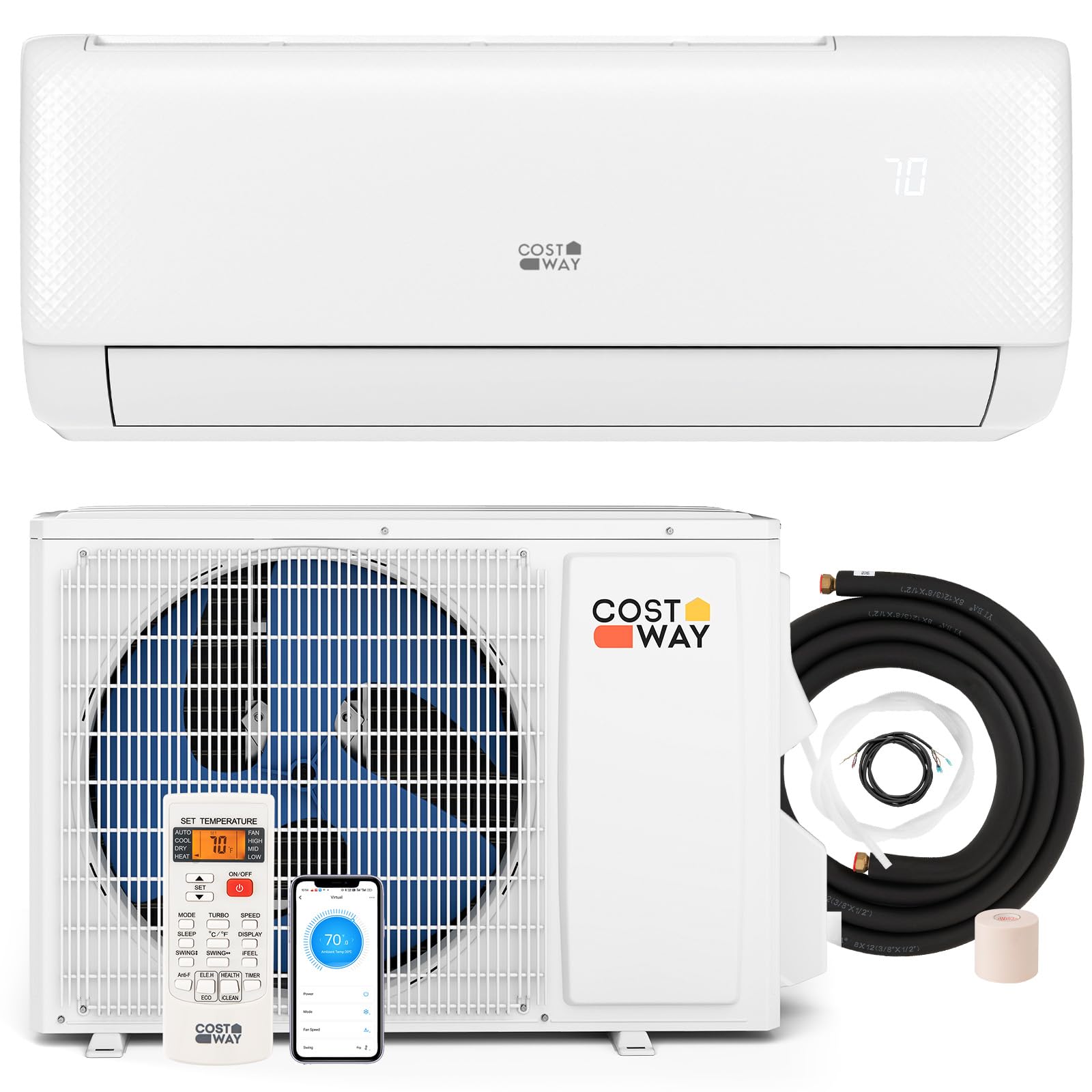
4. COSTWAY 12000 BTU Mini Split Air Conditioner, with Heat Pump
Built for the garage you actually want to work in through January.
This is the second COSTWAY on the list, and it steps the specs up rather than repeating them. Cooling and heating both hit 12000 BTU class with a heating capacity of 12300 BTU, the window stretches from a cool 60°F up to 90°F, and the efficiency jumps to 22 SEER2 with 9 HSPF2. That efficiency rating is the highest of any COSTWAY unit here, and it is the number that keeps a 750-square-foot garage from turning into a monthly expense you resent.
Where this one earns its keep is in weather that would sideline a lot of 115V systems. COSTWAY built in an auto-defrost cycle and a 137°F self-clean function that bakes moisture off the coil so the unit drains instead of icing. R32 refrigerant, ETL and AHRI certification, and a warranty that covers 5 years of parts replacement plus 8 years of compressor coverage round out a package built for the long haul.
Owner feedback reads like a rotation of seasonal tests: a poorly insulated old house that stayed cool all summer and warm through freezing snaps when paired with the existing furnace, a 20 by 40 room with a 12-foot ceiling that dropped to 69°F without strain, and a 460-square-foot garage apartment that has simply kept running since January. The recurring maintenance note is the filter — this one wants weekly cleaning, and the removable, washable design makes that quick. One owner reports success running three units at once across different buildings.
Why it holds up
- 22 SEER2 and 9 HSPF2 — the strongest efficiency in the COSTWAY range
- Auto defrost and 137°F self-clean keep the coil working in cold weather
- 5-year parts and 8-year compressor warranty
- 4D auto swing distributes air evenly across a whole room
- App, remote, and Alexa or Google Assistant control all included
Worth knowing first
- COSTWAY specifies a licensed HVAC installer for setup
- Weekly filter cleaning is part of owning this one
- Temperature control draws mixed reviews — set it and give it time to settle
Go this route if: your room sees real cold, you want the best efficiency COSTWAY makes, and a weekly filter rinse is a habit you will actually keep.
Skip the DIY plan if: you were hoping to install it yourself — COSTWAY’s own instructions call for a licensed HVAC installer.
5. Mini Split Ac/Heating System, 12000 BTU Mini Split Air Conditioner
The slim install for campers, tiny houses, and rooms where floor space is precious.
This OYLUS unit is aimed at the buyer who lives small. It pushes 12000 BTU of cooling and 12500 BTU of heating at a SEER2 19 rating with an HSPF2 8.5, covering up to 550 square feet and swinging between 61°F and 88°F, and the whole thing mounts on the wall — no window unit blocking your view and no footprint on the floor. For an RV, a 16 by 40 tiny house, or a converted cabin, that wall-hung form factor is the entire point.
The listing claims up to 36% less energy use than traditional models, with ECO mode cutting consumption further overnight. Four fan speeds (high, medium, low, and auto) plus an up-and-down swing give you control over where the air actually lands. Sleep mode runs at 42dB and nudges the temperature gradually through the night so you do not wake up shivering at 4 a.m.
Owners with small living situations report the same experience: an RV that finally feels cold after installation, a 16 by 40 tiny house that stays comfortable, and quiet operation from both the indoor and outdoor units. Installation runs about 3 hours for a confident self-installer. The mixed-signal part of the data is the functionality reviews — some units arrive working perfectly, and a minority arrive dead on arrival, so keep the return window in mind.
The small-space read: 550 square feet of coverage, a wall-mounted cabinet, and a 3-hour self-install path make this the cleanest fit for RV and tiny-home builds.
What to watch: a small fraction of units show up defective from the start, so buy where returns are painless and test on arrival.
Made for you if: you are outfitting an RV, a tiny house, or a sub-550-square-foot room and want the cooling off the floor and out of the window.
Hold off if: your room is over 550 square feet — step up to a 750-square-foot unit instead.
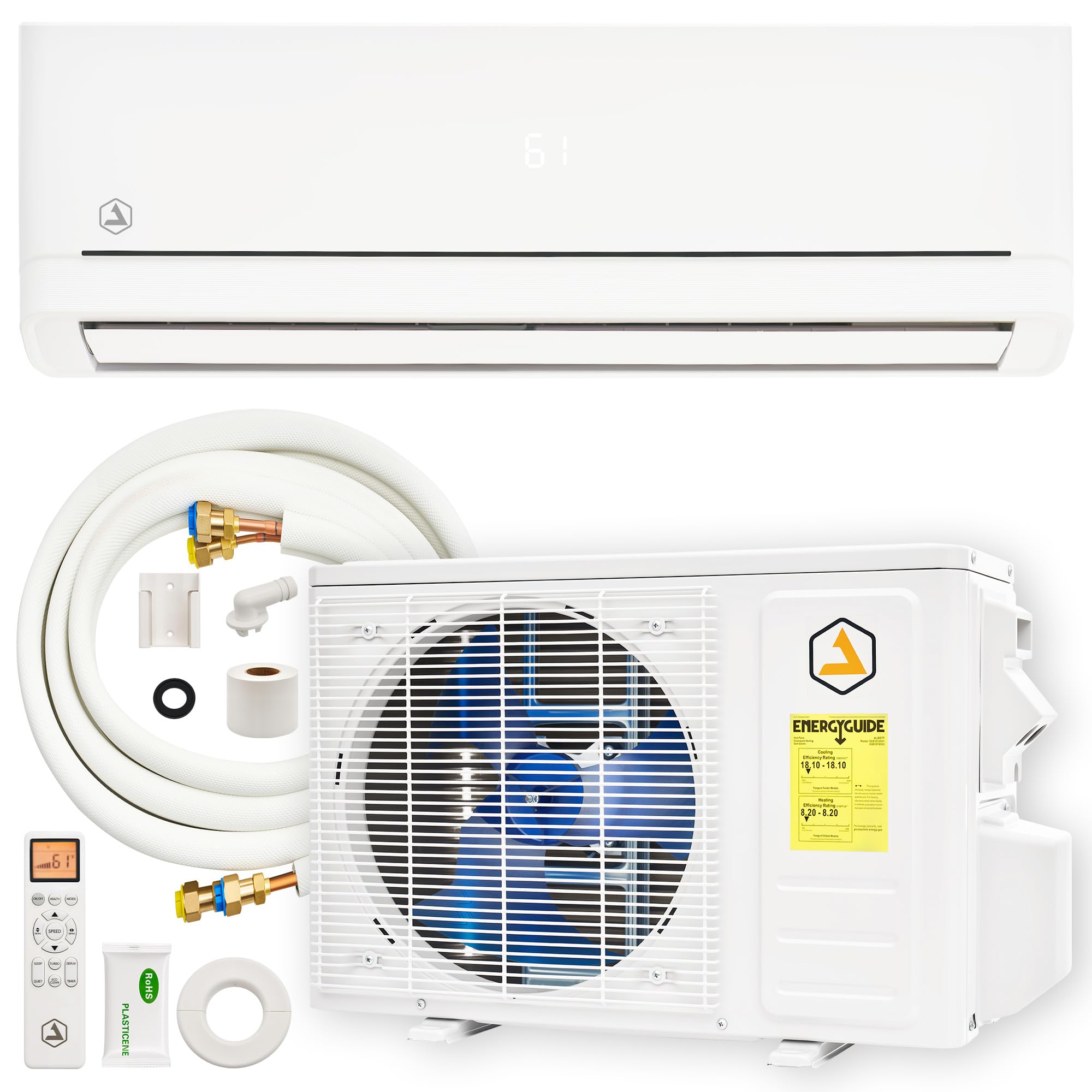
6. Albott Easy DIY Series 12,000 BTU 115V Mini Split AC & Heat Pump, 18 SEER2
The fixed-speed workhorse that trades efficiency for rock-bottom cost and reliability.
Here is the honest framing up front: this is the classic entry-tier 115V mini split — a 12000 BTU unit with a SEER2 rating of 14 instead of the high-teens or twenty-plus scores the newer inverter units post. It cools and heats competently and costs less, which is exactly why it keeps landing in garages and workshops. Coverage is 750 square feet, with a range of 61°F to 90°F, sleep mode, a 24-hour timer, and a self-cleaning cycle plus removable filters and detachable air blades so maintenance does not need a technician.
Where the cost shows up is flexibility. Because the compressor runs at fixed capacity rather than modulating, it cycles on and off instead of holding a steady line, and the fan speeds cannot tune the output the way an inverter can. On the plus side, fewer moving parts and simpler electronics mean less to break, and the simplicity is why so many units in this tier keep working for years with nothing but filter rinses and an occasional outdoor coil spray. The listing backs it with a 5-year compressor warranty and a 7-year parts warranty.
Owner reports from shops and garages are the story here — this is the pick for someone who wants cool air over a workbench in July without overthinking it. Installers with vacuum pump experience can have it running in a couple of hours, though the intake on the outdoor unit is tight enough that a few owners describe struggling to fit the line set through. No smartphone app, no voice control, no frills — just a compressor, a remote, and a set of modes.
Why the simplicity sells
- Lowest-cost 115V entry point in this lineup
- 14 SEER2 fixed-speed compressor with far fewer failure points than an inverter
- Self-clean cycle, removable filters, detachable air blades
- 5-year compressor and 7-year parts warranty
- 750 sq ft coverage with 61°F–90°F range
Where the savings show
- 14 SEER2 efficiency is a step below the inverter units here
- No app or voice control — remote only
- Compressor cycles rather than modulating, so temperature drifts more
The case for it: you want proven 115V cooling for a workshop or garage at the lowest entry cost, and you care about fewer electronics than about peak efficiency.
Step up if: a quiet bedroom, app control, or a lower monthly power bill matters more to you than the lowest sticker price.
7. TURBRO 12,000 BTU Ductless Mini Split Inverter AC with Heat Pump 23 SEER2
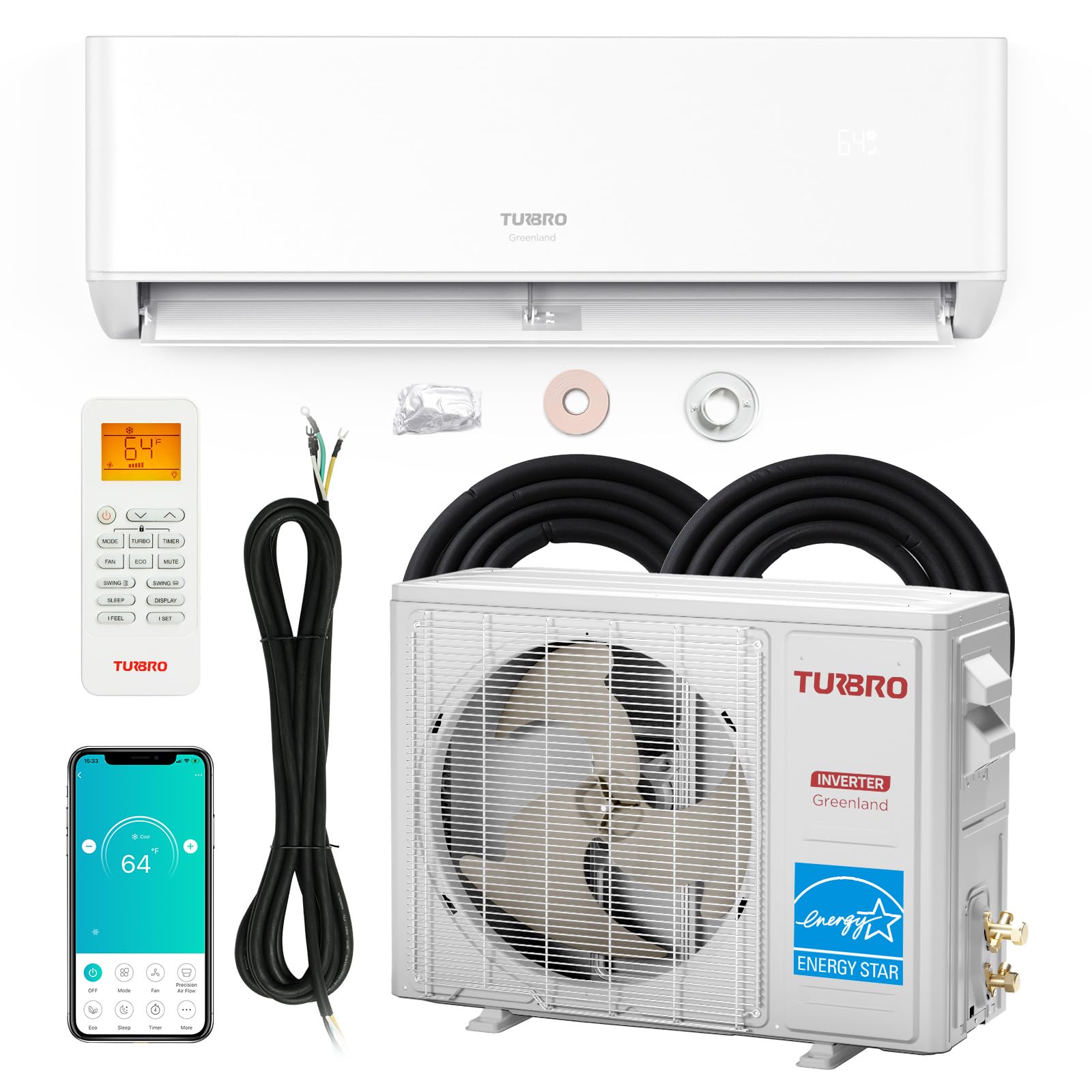
Thirty-second cooling and sixty-second heating, even when the outdoor air hits minus thirteen.
The Greenland is the only unit here that dares to print a heating floor of -13°F, and it pairs that with the highest efficiency rating on the list at 23 SEER2. The high-frequency inverter drives cooling in as little as 30 seconds and heating in as little as 60 seconds, which is the kind of speed that changes a cold morning — you turn it on and feel it before you have finished making coffee. Cooling maxes out at 131°F ambient, so summer heat waves are not a concern either.
The 23 SEER2 score qualifies this unit for federal tax credits under the current efficiency standard, and the listing estimates a cooling-season electricity bill low enough to offset the higher upfront price. A large drum-shaped impeller fan pushes air farther than a standard split, and its dynamic balance reduces noise while extending the fan’s service life.
In the field, owners put it in three-car garages and report being able to feel the air from 20 feet away while barely hearing the unit run. One owner had the thermostat parked at 70 with no noticeable bump in the electric bill. Support runs by email only, and the response time is typically 12 to 24 hours — fine for a non-emergency, less ideal if you need an answer that day.
The deep-cold standout: -13°F heating, 131°F cooling, and 23 SEER2 together make this the most extreme-weather-capable unit in the lineup.
Reality check: email-only support means you want to test the unit thoroughly in the first few weeks, before you are chasing a response in the middle of a heat wave.
Worth the stretch if: your climate swings hard in both directions and you want the heating to keep up when the mercury drops well below freezing.
Consider another pick if: you need same-day phone support or you have no tolerance for email-only service.
8. Albott 12,000 BTU DIY Mini Split AC & Heating System with Pro Fast-Fit Set
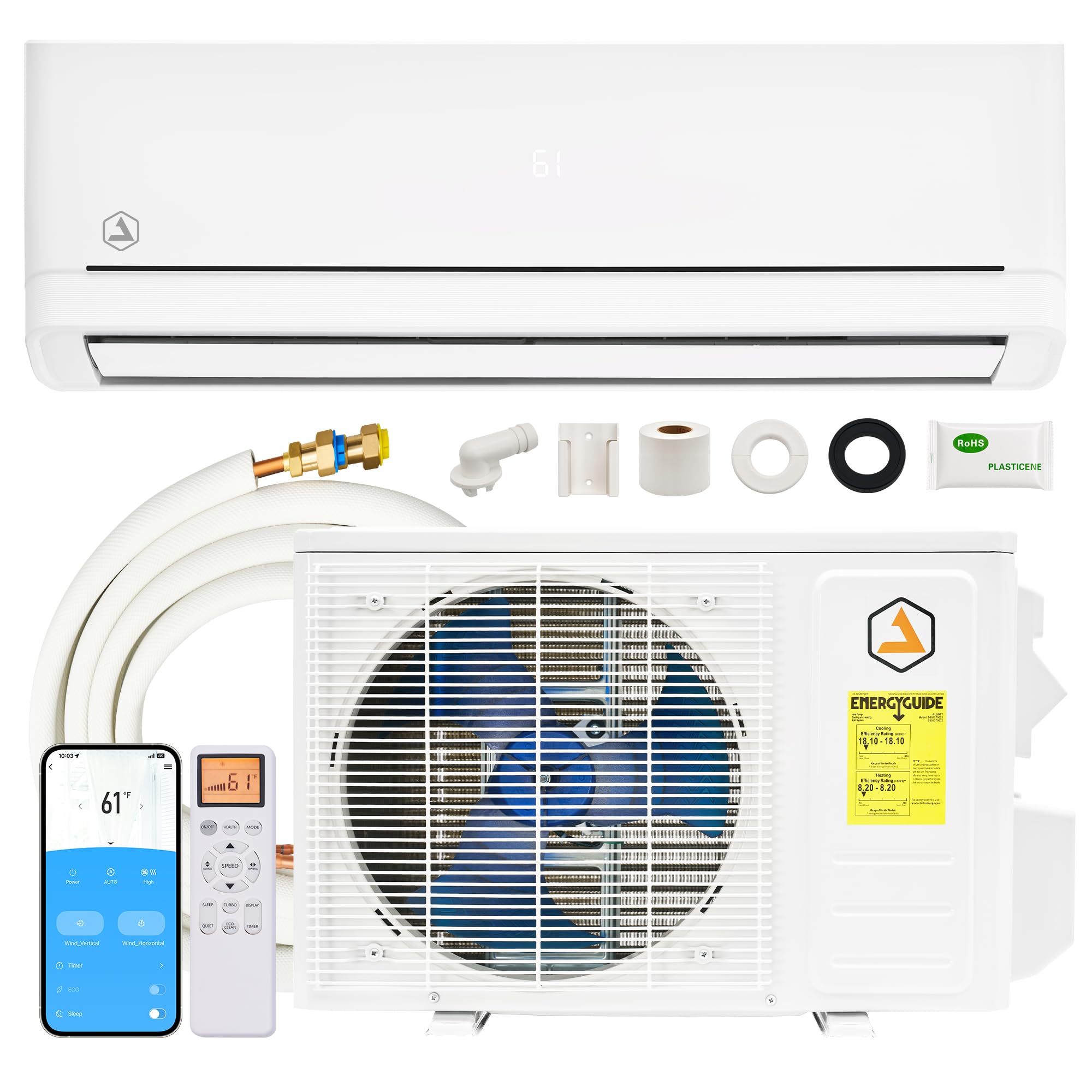
Pre-charged lines and pre-wired indoor unit — the closest thing to a plug-and-play split.
This Albott is the one to buy if the phrase “vacuum pump” makes you want to call a contractor. The indoor side arrives fully pre-wired and the quick-connect lines are pre-charged, so there is no vacuuming step and no refrigerant handling in your garage on a Saturday. Albott calls it a Pro Fast-Fit set, and the 18 SEER2 inverter keeps efficiency respectable at 18 — well above the fixed-speed units and within reach of the 20-plus tier.
The rest of the package is built for comfort rather than show. Temps run from 61°F to 90°F, the coverage is up to 750 square feet, and the system claims operation from 5°F to 122°F outdoors. Whisper-quiet operation under 29dB means it belongs in a living room or bedroom without being noticed. Self-cleaning, removable filters, and easy-to-clean air blades keep maintenance simple, and the warranty is 5 years on the compressor and 8 years on parts.
DIY owners of varying experience levels run this unit successfully in Colorado living rooms, sunrooms, and RVs, with the most notable install taking around 4 hours for a first-timer and firing up correctly on the first try. The recurring quirk is the Tuya app, which has a habit of displaying Celsius even when you have it set to Fahrenheit, and the temperature tracking can be 3 to 4 degrees off from the display — nothing fatal, but worth knowing so you calibrate your expectations before you trust the number on the screen. One note: the power cord is not included, so check your run before ordering.
Why beginners love it
- Pre-charged, quick-connect lines — no vacuum step needed
- Pre-wired indoor unit cuts install time and on-site wiring
- 18 SEER2 inverter efficiency with app and remote control
- Under 29dB operation for bedrooms and living rooms
- 5-year compressor and 8-year parts warranty
Small print to catch
- Smart app defaults to Celsius and needs a settings workaround
- Displayed temperature can read 3 to 4 degrees off the actual room temp
- Power cord is not included in the box
Made for the first-timer: you have basic tools, you want to skip the vacuum pump entirely, and a couple of degrees of app quirk will not bother you.
Think twice if: you need dead-accurate temperature readout on the remote — the display and the room can disagree by a few degrees.
9. DELLA Motto Series 12000 BTU 20 SEER2 115V Mini Split AC
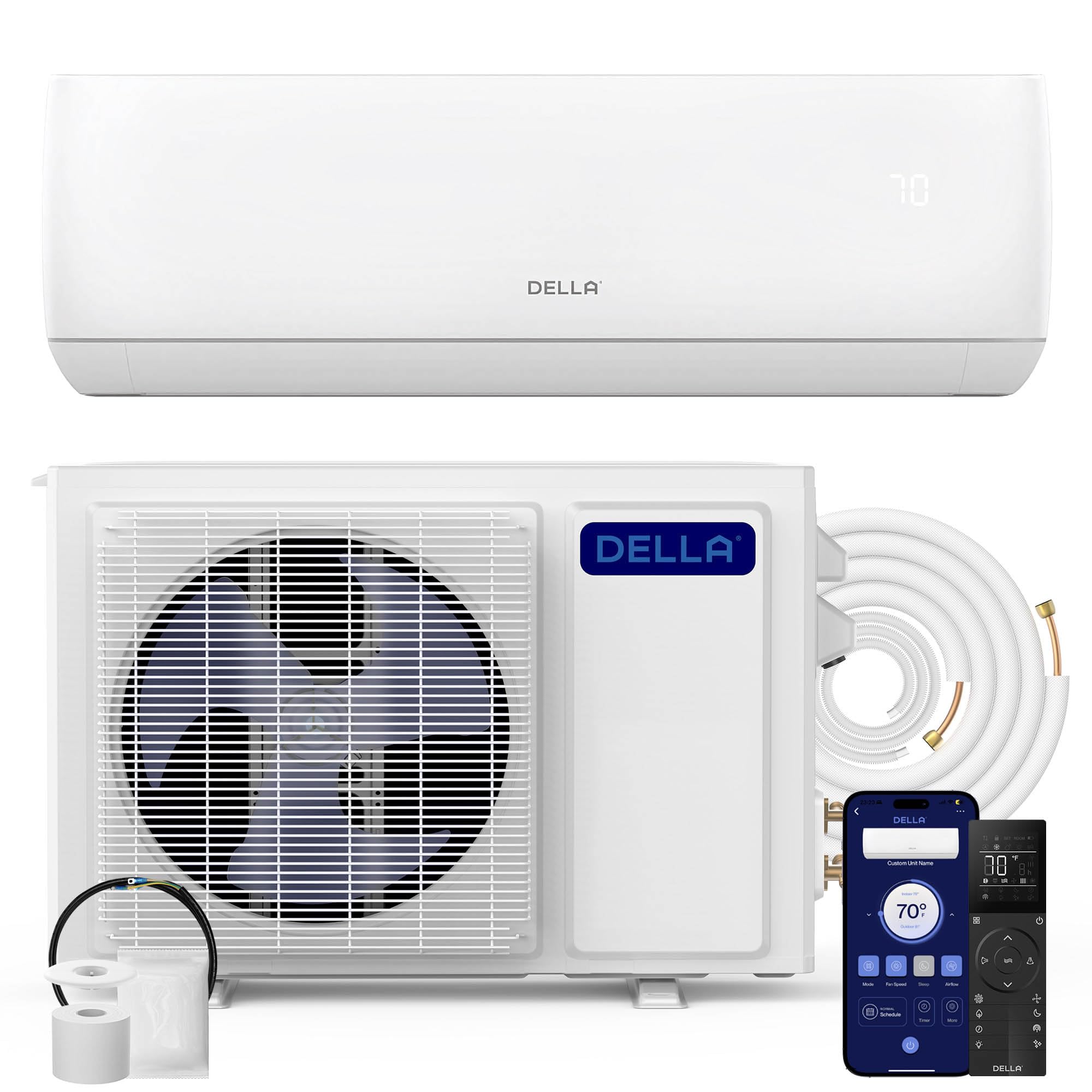
A 16-foot bundled copper kit for installs where the outdoor unit lives far from the wall head.
Line length is the spec that quietly kills a lot of installs, and the Motto Series solves it from the start with a full 16 ft copper line set and a 6.56 ft drain pipe. That is the distance from the indoor head to an outdoor pad that is not right outside the wall — the case for anything mounted through an interior hallway, over a finished foundation, or on a remote side of a garage. Cooling and heating land at 12000 and 12300 BTU/h, coverage hits 550 square feet, and the unit runs 60°F to 90°F.
Efficiency is 20 SEER2 with DC inverter technology, which DELLA pegs at up to 30% power savings, and R-32 refrigerant has a lower global warming potential than older blends. The outdoor condenser ships with an upgraded bottom heating element so the compressor keeps working in cold weather down to a claimed 5°F. Inside, the spec sheet is generous — 4D air flow (up-down and left-right), I Feel mode that reads temperature from the remote rather than the wall unit, a 24-hour timer, sleep mode, eco mode, multiple fan speeds, turbo, and heating, cooling, dehumidifying, and dry modes.
Owner reviews read like a mix of confident DIY and professional installs. The self-installers talk about halving their barn’s electric bill versus a portable AC, measuring total draw around 800W, and finding it whisper quiet even at the extremes. The one recurring report worth flagging is setpoint overshoot — a few owners see the room drift around 5 degrees past the number they asked for, so if you want 70, setting 68 is the pragmatic move.
The line-length win: a 16 ft pre-charged copper line set included with the kit is the difference between a straightforward install and a refrigerant shortage headache.
Know the quirk: setpoint overshoot of roughly 5°F is the most common owner note — compensate by dialing in a degree or two lower than your target.
Choose this if: your install needs the extra line length and you want a modern R-32 system with 20 SEER2 efficiency and a generous mode list.
Hesitate if: you need the display and the actual room temperature to track in lockstep — this one can overshoot by a few degrees.
10. DELLA Optima Series 9,000 BTU Mini Split AC, Hyper Heat to -13°F

The high-efficiency specialist for a single small room that needs serious quiet and serious cold-weather heat.
This one does not try to cover the whole garage; it is designed to cover 400 square feet beautifully. The Optima runs 9000 BTU of cooling with 10000 BTU/h of heating, boasts a 24 SEER2 rating (the highest on this list except for the TURBRO’s 23 in a different size class), and hits 10 HSPF2 heating efficiency, so the per-hour running cost is as low as it gets in this lineup. It is Energy Star rated, ETL listed, and AHRI certified, which is what makes it rebate-eligible in a lot of states.
The hyper heat cold-weather performance is the real headline — 9000 BTU of heat pump output functional down to -13°F — which means this thing keeps producing warm air in weather that would send most 115V splits into defrost cycles. A 0.75 ton pre-charged heat pump lives in the outdoor unit, and a gold-plated FIN coating protects the coil from freezing and rust, which is the kind of durability detail that matters on a unit you expect to own for a decade or more. The outdoor unit’s 24 SEER2 rating pairs with a 6-mode user interface — cooling, heating, dry, auto, dehumidifying, and fan — plus 4D airflow, eco mode, sleep mode, timer, and I Feel.
Owner reports land on efficiency, quiet, and install. First-time DIY buyers describe saving thousands versus professional bids, cooling a west-facing room from 98°F down to 63°F, and mobile app control for precision airflow. The honest limitation: DELLA’s own listing states the system requires professional installation and is not a DIY mini split, though plenty of confident owners install it anyway. If you want the warranty uncomplicated, hire the tech.
Why efficiency hunters pick it
- 24 SEER2 and 10 HSPF2 — tops in this lineup for per-hour running cost
- Hyper heat performance down to -13°F ambient
- Energy Star rated and rebate-eligible
- Gold-plated FIN coating for rust and freeze resistance
- Alexa-enabled app control across 6 operating modes
Size and setup limits
- 9000 BTU only covers up to 400 sq ft — small rooms only
- Manufacturer states professional installation is required
- Over 25 ft of line set requires a refrigerant adjustment
Right pick if: you are cooling a single bedroom, office, or small studio up to 400 sq ft and you want the best efficiency and cold-weather heat in this lineup.
Wrong pick if: you need more than 400 sq ft of coverage — step up to a 12000 BTU model instead.
11. Cooper & Hunter MIA 12,000 BTU 115V Wall Mount Mini Split AC, 21.2 SEER2

The installer-favorite that comes with everything in the box — smart kit, line set, and the wiring.
The MIA Series is the pick you buy when you want the system to arrive complete. Cooper & Hunter ships a smart kit for app scheduling and remote control, a 16 ft pre-flared and insulated copper line set, 16 ft of communication wire between the indoor and outdoor units, and a 16 ft drainage extension — no chasing parts before install day. It carries UL listing and AHRI certification, runs 12000 BTU at 21.2 SEER2, and covers 550 square feet.
The efficiency number is high enough that owners mention qualifying for utility rebates, and the inverter compressor holds a steady temperature rather than cycling, which is what keeps a 550-square-foot room comfortable instead of swingy. Copper core materials run through the refrigeration circuit — the durable metal that handles the pressure changes of a heat pump cycle — and heating claims to work with outdoor ambient temperatures up to 5°F. Support is US-based, which matters on a purchase this size.
What stands out across the field reports is the quiet. Owners describe whisper-quiet operation indoors and out, and one recording-studio user says the silent mode is quiet enough to work under. Installers who have put in several report consistent performance with no leaks after multiple installs, and one shop owner bought four units for a woodworking space and home. The wrinkle: this is not a DIY system — the manufacturer states professional installation is required, and the 16 ft stock line set can be too short if your outdoor pad sits far from the wall head or ceiling heights run 8 to 10 ft. Budget for a longer kit if either applies.
What makes it the installer’s pick: every part you need is in the box — smart kit, matching 16 ft line set, communication wire, and drain extension — plus 21.2 SEER2 efficiency and copper core construction.
Plan the install carefully: the standard 16 ft line set may fall short on high ceilings or remote outdoor pads, and the manufacturer requires a licensed tech for warranty purposes.
The pro install answer: hire a licensed HVAC tech and this one delivers reliable, quiet, energy-efficient 115V comfort for up to 550 square feet with app scheduling included.
Think again if: you wanted to install it yourself — the manufacturer requires professional installation to keep the warranty clean.
Understanding the Specs
BTU Rating And Room Size
BTU stands for British Thermal Unit — it measures how much heat the system can move out of your room per hour. For a 115V mini split, the practical range sits between 9,000 BTU for a small bedroom and 12,000 BTU for a garage or sunroom, and most units here cover 400 to 750 square feet. Oversizing wastes power and cycles the compressor too often, while undersizing means the unit runs flat out all summer and never quite wins the fight.
SEER2 And HSPF2 Efficiency
SEER2 is the seasonal efficiency score for cooling, and HSPF2 is the same idea for heating — both measure how much comfort you get per unit of electricity. Higher numbers mean lower monthly bills, and this lineup runs from 18 SEER2 at the DIY-friendly end up to 24 SEER2 for the Optima Series. Inverter compressors are what make the higher scores possible, because they adjust speed rather than slamming on and off.
Voltage And Circuit Requirements
Every unit here runs on 115 volts, which is standard household power. That is the whole reason this category exists — you can usually drop in a 115V mini split without running a new 240-volt circuit or calling in an electrician. Some units name a maximum fuse size or recommend a 20A breaker, so check that against the circuit you plan to use before ordering.
Heat Pump Heating In Cold Weather
A heat pump works by reversing the cooling cycle to pump heat indoors, and it does so more efficiently than resistive heating. But every model has a floor temperature below which heating output drops. In this lineup that floor ranges from a mild 19°F all the way down to -13°F, so if you live where winters drop hard, that single spec matters more than any other feature on the box.
DIY Kits Versus Licensed Installs
Pre-charged quick-connect lines and pre-wired indoor units let a capable homeowner do the install without a vacuum pump or refrigerant handling. Other systems require a licensed HVAC tech to keep the warranty valid. Both routes are legitimate — just read the listing carefully so you know which one you are buying before the box shows up and you are stuck with a project you cannot finish.
Noise, Airflow, And Control
Noise is measured in decibels — the quietest units here run as low as 26dB in sleep mode, which is close to the sound of a whisper. Airflow in CFM tells you how much air the fan moves per minute, and higher numbers cool a room faster. On the control side, most units ship with a remote, and the better ones add Wi-Fi and app or voice control so you can adjust the temperature before you walk in the door.
FAQ
Can I install a 115V mini split myself or do I need a licensed technician?
What size 115V mini split do I need for a garage?
Will a 115V mini split heat my room in winter?
How much electricity does a 115V mini split use per month?
What is the difference between SEER2 18 and 24 for my electric bill?
Do I need a vacuum pump to install these units?
How loud is a 115V mini split in a bedroom?
Can a 115V mini split run on a standard household outlet?
How long do these mini split systems typically last?
Can I run two 115V mini splits on the same circuit?
Final Thoughts: The Verdict
The strongest pick for most buyers — the crowd favorite at 4.5 stars across 190+ ratings — is the COSTWAY 11500 BTU Mini Split Air Conditioner, because it delivers proven cooling and heating, Wi-Fi and voice control, and a 750-square-foot ceiling on standard household power. If the room is a bedroom or nursery and quiet matters most, choose the 12000 BTU EXNOS system with its 26dB sleep mode and 19 SEER2 efficiency. And if winters are the real problem, the DELLA Optima Series 9,000 BTU keeps heating down to -13°F with the highest efficiency on the list. Whatever you pick, confirm the circuit and the install path before the box arrives — that single check saves more headaches than any spec on this page.
How We Picked
We do not accept paid placement. Every pick is matched to a real buyer and a real use-case; we do not hands-on test units.
Sources & Methodology
Specifications: manufacturer listings and product documentation. Review insights: verified customer reviews, as of September 2026. Pricing: not shown on this page (it changes often); check the current price via the retailer link.
As an Amazon Associate, Non Toxic Blog earns from qualifying purchases. This does not affect which products we feature.