Specs are compiled from manufacturer listings and verified buyer reviews and can change over time — please confirm the key details on the product page before buying.
If you want a 12V solar kit that keeps your boat, camper, or shed battery topped up without noise, fuel, or a wall outlet, the short answer is this: match the panel wattage to your daily power draw, then get a controller you can actually trust. Go too small and you will be running an extension cord behind the greenhouse by the second cloudy week. Go too big and you are paying for watts you will never use. Every kit below makes 12-volt power, but they land in very different spots on capacity, controller quality, and how much hand-holding they need on install day.
I’m Mo Min — the founder and writer behind Non Toxic Blog. This guide is built by comparing the manufacturers’ published specifications and the patterns across verified customer reviews, so you get each pick’s real strengths and trade-offs instead of marketing spin.
Some kits are plug-and-play trickle chargers you can bolt on and forget, while others are full off-grid packages with lithium batteries and inverters built in. This breakdown of the best 12 volt solar power system separates the two so you buy once.
Our Picks at a Glance


How To Choose The Best 12 Volt Solar Power System
The number that decides your kit is your daily energy use, not the size of your roof. A 12-volt system charges a battery, and that battery runs your fridge, lights, gate motor, or phone chargers. So your first job is to work out how much power leaves the battery each day, then pick a panel wattage that puts it back during your real sunlight hours. Everything after that, controller type, battery chemistry, mounting angle, is about getting the most from whatever panel you choose.
Panel wattage versus what you actually run
Watts are the raw output rating of the panel under full sun. A 50-watt trickle charger is built to hold a stored battery at full charge, which suits a boat, tractor, or gate opener that sits idle. A 100-watt kit starts running small loads while it charges, like shed lights or a pump. Step up to 200 watts or more and you can realistically carry a 12-volt fridge, a fan, or a bank of cameras through a full day. If your panel is the smaller trickle type, expect a few straight cloudy days to be the limit before you need another charging source.
MPPT versus PWM charge controllers
The charge controller sits between the panel and the battery and decides how much harvested power reaches it. A PWM controller is the simpler, budget option and works fine on small kits. An MPPT controller tracks the panel’s peak output and squeezes more usable power into the battery from the same panel, which matters most when sunlight is weak or the panel is undersized. You will see both types across these kits, and the MPPT kits tend to ask more of your budget in return. Buyers who plan to expand later usually prefer MPPT because extra panels pay off more efficiently on it.
Battery chemistry and cycle life
Lithium iron phosphate, or LiFePO4, is a battery chemistry rated in charge cycles, each cycle being one full discharge and recharge. The LiFePO4 packs here are rated for thousands of cycles and can be kept in storage for long stretches, which is why they show up in the all-in-one kits. Lead-acid and AGM batteries cost less up front but handle far fewer cycles. The trade-off is upfront cost against how many seasons you want before replacing anything. If your kit already ships with a lithium battery, the controller is usually programmed for that chemistry already, which removes the guesswork.
Quick Comparison
| Model | Best For | Panel Power | Controller | Battery Included | Amazon |
|---|---|---|---|---|---|
| Renogy 200W 12V N-Type RV Solar Panel Kit★ Best Overall | RV and camper fridge duty | 200 watts | 30A PWM | No | Amazon |
| SOLPERK 50W/12V Solar Panel KitBest for Marine | Marine and gate trickle charging | 50 watts | 10A | No | Amazon |
| Voltset 50W Solar Panel KitMost Efficient | Trailer and tractor maintenance | 50 watts | 10A MPPT | No | Amazon |
| Topsolar 100W 12V Solar Panel Kit | Off-grid sheds and cabins | 100 watts | 30A | No | Amazon |
| ECI Power 100W 12V Solar Power Kit | Small starter builds with battery | 100 watts | 10A PWM | 12V 20Ah LiFePO4 | Amazon |
| Topsolar 200W 12V Solar Panel Kit | Larger off-grid arrays | 200 watts | 30A | No | Amazon |
| ExpertPower 200W 12V Solar Power Kit | Barns and pond motors | 200 watts | 20A PWM | 12V 20Ah LiFePO4 | Amazon |
| ECI Power 200W 12V Solar Power Kit | Dual-battery off-grid setups | 200 watts | 20A MPPT | 2 x 12V 20Ah LiFePO4 | Amazon |
| ECO-WORTHY 200 Watt 12V Complete Kit | Beginner off-grid with inverter | 200 watts | 30A | 12V 50Ah LiFePO4 | Amazon |
| Renogy 400Watt Premium Solar Kit | Powering tools from a shed | 400 watts | 40A MPPT | No | Amazon |
| ExpertPower 2.5KWH 12V Solar Power Kit | Full-time off-grid living | 400 watts | 30A MPPT | 2 x 12V 100Ah LiFePO4 | Amazon |
In‑Depth Reviews
1. Renogy 200W 12V N-Type RV Solar Panel Kit with Adventurer 30A Controller
Our pick — over 4.5★ from 500+ verified ratings; the strongest balance of quality and price.
The RV kit that keeps a fridge humming when the sun sulks
This is the pick for anyone running an actual 12-volt load overnight, not just topping off a battery. Two 100-watt panels combine for 200 watts of maximum power, which the manufacturer rates at 800Wh of daily output across four hours of full sun. That is the difference between a kit that maintains a battery and a kit that feeds a compressor fridge while it does it. RV buyers report it holding a 12-volt refrigerator alongside two deep cycle batteries, getting close to 48 hours of run time with clouds in the mix.
The panel efficiency here is 22% on monocrystalline cells — an efficiency figure meaning how much of the sunlight hitting the panel turns into usable electricity. Contrast that with the Voltset 50W kit at 30% efficiency and the Renogy loses on pure conversion rate, a 36% gap on that single metric. Where it wins is scale. At 200 watts against the SOLPERK’s 50 watts, this kit produces four times the rated power, and its panel footprint of 41.8 by 20.9 inches spreads that output across a longer, flatter shape built for RV roofs.
The Adventurer-Li 30A PWM controller is the part that makes ownership calm. It’s built for flush mounting on a camper wall and guards against overcharging, overload, short circuits, and reversed polarity. The kit ships with a Bluetooth module, a 30-foot 10AWG adaptor kit, a 16-foot tray cable, three pairs of Y branch connectors, and pre-drilled holes with plug-and-play cables for fast mounting. The aluminum frame resists salt air and holds up to 2400Pa of wind pressure and 5400Pa of snow load, and Renogy backs it with a 5-year warranty and 24/7 technical support. Owners who bought this same kit three times as they upgraded RVs are the clearest sign of what repeat buying looks like.
Where this kit earns its keep
- 200 watts and 800Wh daily output carry a real 12V fridge load
- Rated for lithium, lead-acid, and gel batteries
- Bluetooth module and full cable set included in the box
- Corrosion-resistant frame rated to 2400Pa wind and 5400Pa snow
What to plan around
- Heavier than trickle-charger kits — the panels are built for roofs, not backpacks
- No battery in the box, so budget for one separately
- Cloud cover cuts output, so the 48-hour figure depends on your storage
Buy this one if: you need a genuine RV power supply that runs an appliance, not a maintenance charge.
Think twice if: you only want to keep a stored battery topped up and would rather save on a smaller panel.
2. SOLPERK 50W/12V Solar Panel Kit, Solar Battery Trickle Charger Maintainer
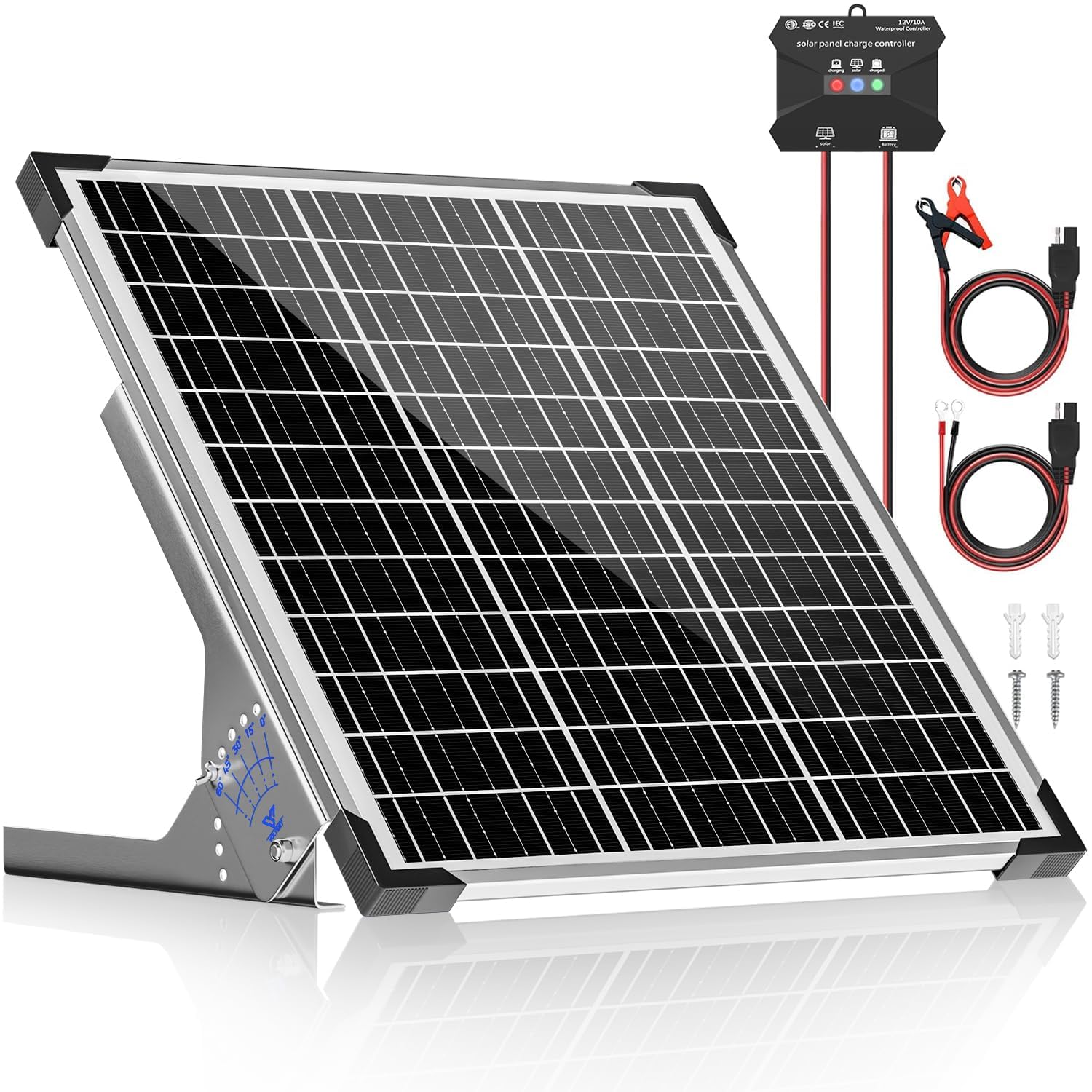
The boat-battery babysitter with an adjustable 60-degree bracket
Fishing boats sit for weeks, and that is exactly the job this 50-watt kit handles. Its bracket adjusts 0°, 15°, 30°, 45°, or 60°, so you can point the panel at your real sun angle instead of whatever angle the deck happens to give you. Owners running a 35-foot boat with two battery banks in southeast Alaska report the panel holding a full charge through cloudy and rainy days and climbing past 13 volts in sun. The same kit gets used on gates, tractors, and pontoons, where the goal is never a dead battery on launch day.
The charge controller carries an IP65 waterproof rating — that rating means it resists dust and water jets rather than surviving full submersion. It manages overcharge protection and shows charging status through three lights, which is enough to tell at a glance whether the panel is working. The panel itself uses monocrystalline cells with a conversion rate between 21% and 30%, sealed behind low-iron tempered glass on a corrosion-resistant aluminum frame rated to 2400Pa wind and 5400Pa snow. The manufacturer rates the panel’s lifespan up to 25 years, but owners mention the controller failing first.
The panel output holds up well, but the controller is the weak link — the review pages sum it up best with one owner reporting the controller failing at about three months before adding “Would purchase again for sure.” That is the pattern worth knowing: budget for a replacement controller down the road, and treat this as a panel you will keep. It charges LiFePO4, lithium ion, AGM, SLA, GEL, and gel-type start batteries, ships with alligator clips and a 10-foot SAE cable, and comes with the mounting screws you need.
The panel is the keeper: 50 watts on a rustproof frame with a 21%-30% conversion rate handles a stored battery in genuine weather.
Keep a spare controller in mind: the included unit is the part most likely to need swapping, so factor that into your expectations.
Suits: boat, tractor, and gate owners who want a stored battery held at full charge with a bracket they can aim.
Look elsewhere if: you need to run an appliance continuously — 50 watts maintains a battery, it does not power your day.
3. Voltset 50W Solar Panel Kit 12V Solar Battery Trickle Charger Maintainer
An MPPT controller on a trickle charger is a rare pairing
Most 50-watt trickle kits cut costs on the controller. This one does not. Its cells reach an effective conversion rate of up to 30%, and that figure is the highest efficiency in this whole roundup — higher than the Renogy 200W kit’s 22%. Trailer owners who want the battery tended for an electric jack and interior lights report never needing supplemental charging at all.
The 10A MPPT controller — MPPT meaning it tracks the panel’s peak output to squeeze more into the battery — is rated 100% waterproof and can be completely submerged, which is far beyond what the IP65 SOLPERK controller claims. It protects against overcharge, over-discharge, over-voltage, over-current, over-load, short circuit, reversed polarity, and over-temperature. The mounting bracket is engineered with an alloy ball to adjust across 60 degrees for chasing better sunlight, and four corner guards protect the glass during installation and moving. The panel carries an IP67 rating and the same 2400Pa wind and 5400Pa snow load figures as the rest of the trickle-charger class.
What owners praise most about this kit is simply that it does its job away from a plug: one buyer counts roughly 1.2KV from a full day of sun, and the panel is regularly reported putting a 100% charge back even when parked in partial shade. The recurring honest gripe is the indicator lights — on at least one unit the charge light stayed lit even when disconnected from the battery, which makes it hard to confirm the connection is live. Check the wiring yourself before you trust the lights. It charges LiFePO4, lithium ion, AGM, SLA, GEL, EFB, and MF batteries and comes with a 12-month warranty.
What makes it stand out
- Up to 30% conversion rate — the top efficiency figure in this lineup
- 10A MPPT controller that is fully submersible
- Four corner guards protect the glass while you mount it
- Roughly 1.2KV output from a full day of sun reported in use
Small print worth reading
- Indicator lights can misreport charge state, so verify the connection yourself
- 50 watts still caps out on what it can maintain through a long cloudy stretch
Reach for this if: you want the smartest controller on a small maintenance panel and efficiency is your deciding metric.
Otherwise look to: the SOLPERK if you would rather trade a little panel efficiency for a simpler, cheaper setup.
4. Topsolar 100W 12V Solar Panel Kit Battery Charger 100 Watt 12 Volt Off Grid System

The 100-watt workhorse that quietly runs a shed, cabin, or gate
This is the kit you buy when a trickle charger is not enough but a full lithium package is more than you need. At 100 watts it sits right in the middle of the range, and the review volume backs up just how many people arrive at that same conclusion. What owners praise most is raw functionality — this is the most-discussed aspect by a wide margin — with the running theme being that it simply does the job, whether that is a fridge, a set of yard lights, or a battery bank on a tractor.
The 30A intelligent charge controller handles 12V and 24V systems and builds in full protection against overcharge, over-discharge, over-voltage, and short circuits. The panel is monocrystalline behind tempered glass on a corrosion-proof anodized aluminum frame, weighing 7.2 kg, with a V-shape tilt rack bracket that adjusts the mounting angle and mounts to ground, wood, or wall. The kit includes two 16-foot MC4 cables and two 5-foot O-ring battery cables, so you are not hunting for extra wiring on install day.
The 30A controller reportedly struggles to switch a system from 24V down to 12V once configured, and some kits arrived with mounting brackets that did not line up with the instructions or panels. The fix for the bracket issue is simpler than it sounds — one RV owner drilled straight through the panel’s aluminum, called it “no big deal,” and said they would buy again. If you want dead-simple instructions and factory-aligned hardware, expect to spend a few extra minutes improvising.
Why it sells: 100 watts, a 30A controller, and a complete cable set cover off-grid sheds, camps, and gates without pushing into premium territory.
One thing to know going in: the 24V-to-12V switching can be fussy, so decide your configuration before you wire it up.
Pick it when: you want midday running power for a shed or cabin on a mid-range budget.
skip it if: you need precise factory hardware alignment and step-by-step printed instructions — this kit asks for some patience.
5. ECI Power 100W 12V Solar Power Kit with 12V 20Ah LiFePO4 Battery

The kit that hands you a working battery, not a shopping list
Most 100-watt panels leave you to source a battery separately. This one boxes the whole chain: a 100-watt monocrystalline panel, a 12V 20Ah LiFePO4 battery, a 10A PWM controller, plus 10-foot 12AWG MC4 solar cables, 6-foot battery cables, and mounting brackets. It is the closest thing in this lineup to walk-up-and-go. Owners use it for garden-shed lighting, a backyard fountain that runs around the clock, and irrigation pumps with no trouble reported.
LiFePO4, or lithium iron phosphate, is a chemistry the manufacturer guarantees to deliver a minimum of 2000 cycles at 80% depth of discharge and up to 5000 cycles at 50% depth — cycles meaning full charge-and-drain rounds, so the higher figure reflects shallower discharge. That is a very different lifespan picture from a lead-acid battery. The 10A PWM controller detects 12V and 24V systems automatically and uses a CC-CV charging algorithm tuned to keep that lithium battery healthy, with a digital display showing state of charge and battery health right on the screen.
The one honest caveat is winter. One truck-camper owner found the battery voltage swung more in the cold than expected, which is worth knowing if your install lives in an unheated space. The other thing to be clear-eyed about is scale: this is a small starter system, not a whole-house solution, and a fan or a light is the honest ceiling for what 100 watts and a 20Ah battery will happily carry. Over-build your expectations and you will be disappointed; match it to a shed or a starter setup and it does everything asked.
Made for: first-time builders who want a complete, pre-matched 100W system including the battery.
Know before buying: 100 watts plus a 20Ah battery is sized for lights, pumps, and small loads, not heavy continuous draw.
6. Topsolar Solar Panel Kit 200W (2 x 100W) 12 Volt Monocrystalline Off Grid System

Two panels that turn any roof into a small power plant
Two 100-watt panels give you options a single panel cannot. You can run them in series for a 24V configuration or in parallel for 12V, depending on where your system is headed — a flexibility the single-panel kits above cannot offer. The manufacturer rates the pair at 800Wh per day across four hours of full sunshine, and the cells carry up to 22% efficiency on monocrystalline silicon, with pre-drilled holes and plug-and-play cables to speed the mount. The panels are built to withstand 2400Pa of wind and 5400Pa of snow load on tempered glass and aluminum frames.
What owners consistently praise is build quality — it is the most-mentioned aspect of this kit — and it holds up: one panel survived a fall from a roof with a bent frame and kept working. The 30A controller, though, draws the mixed feedback. Some kits shipped with controllers that failed in under a year or a screen that went blank after a day, and in one case batteries hit 16 volts in full sun, high enough to damage them. The saving grace is service: the seller replaced failed controllers free within days and answered quickly, which several owners credit for keeping them on board.
If you want an efficient panel being the deciding factor rather than a whole pre-built system, the Topsolar panels are the part worth your money. The controller is the part worth a backup plan. Buying a spare controller ahead of time is the move owners who did it recommend, and it turns a possible headache into a non-event.
The parts that earn praise
- 200 watts of panels configurable as series 24V or parallel 12V
- Panels rated for 2400Pa wind and 5400Pa snow on tempered glass
- One panel survived a roof fall with a bent frame still working
- Fast seller response with free replacement parts when issues arise
The parts to size up
- Included controller reliability is the recurring complaint across reviews
- No extended warranty beyond the basic coverage
Go for it when: you want two efficient 100W panels you can wire to suit a growing system.
Have a fallback if: you want to rely on stock components long-term — budget for a spare controller.
7. ExpertPower 200W 12V Solar Power Kit with 12V 20Ah LiFePO4 Battery

A battery with built-in smarts paired to a pair of 100-watt panels
The lithium battery here is the headline, and its built-in Battery Management System is why. That BMS is a small onboard computer that guards the cells against overcharge, deep discharge, overloading, overheating, and short circuits. It also cuts off charging below 23°F to protect the battery in cold weather, and the manufacturer rates the battery at 2500 to 7000 cycles with up to a year of maintenance-free storage. The panels add up to 200 watts on two monocrystalline units, and the 20A PWM controller detects 12V or 24V automatically while regulating charge based on ambient temperature.
Installation is the strong suit. The kit includes a 20Ah LiFePO4 battery, two panels, a 20A PWM controller, MC4 solar cables, battery cables, mounting brackets, and a Y branch adapter cable, and owners put it to work on barns and wildlife pond motors with minimal fuss. The pre-programmed controller stands out as a genuine convenience for anyone who has wrestled with setting charge profiles by hand. One barn owner described the whole thing as easy to install without assistance and working great, which is the experience this kit is built around.
The honest friction point is documentation. The manual is thin on printed guidance, and reaching a human for support has proven difficult for some. The controller also drew a blunt one-word verdict from at least one owner who preferred the battery and panels. Read that as a kit you can install confidently but one where you should expect to self-guide on setup, and where the lithium battery is the part holding the most long-term value.
What sells it: a BMS-protected LiFePO4 battery rated for thousands of cycles, paired to 200 watts of panels and a pre-programmed controller.
The honest catch: written instructions are thin, so plan to research your specific wiring setup yourself.
Ideal for: remote loads like ponds, barns, and outbuildings that want lithium reliability and auto-detected charging.
Not for you if: you want detailed instructions in the box and easy phone support throughout the install.
8. ECI Power 200W 12V Solar Power Kit with 2 x 12V 20Ah LiFePO4 Batteries

Two batteries and an MPPT controller for storage-hungry off-grid builds
Storage is the reason to look here. Two 12V 20Ah LiFePO4 batteries double the reserve of the single-battery ECI kit, and each is guaranteed for a minimum of 2000 cycles at 80% depth of discharge and up to 5000 cycles at 50% depth. The controller upgrades too — it is a 20A MPPT unit with a Bluetooth adapter. MPPT, meaning it tracks the solar array’s peak power point, is what the manufacturer says boost power generation by over 20% compared with PWM. For a kit where you are paying for battery capacity, that controller choice matters.
The digital display shows state of charge and battery health, the controller auto-detects 12V or 24V systems, and the kit ships with two sets of mounting brackets, MC4 solar cables, battery cables, and a Y branch adapter cable. Where owners put it to work is exactly where storage helps: a pond aerator that keeps a battery sitting at 100% charge. The panels are two 100-watt monocrystalline units, and the frames carry the standard weather ratings.
Two real wrinkles. First, connectors — the kit sells you two batteries but the box does not include quite enough to wire both, and one owner who bought it said exactly that. Second, if you are dragging it into a rainy climate, the panels drop to almost no charge under thick cloud, and the recurring advice is to roughly double the rated solar power for your actual needs. This kit shines when its extra batteries are doing the work; it is not a substitute for more panels on gray days.
Why the extra battery pays off
- Two 12V 20Ah LiFePO4 batteries double your reserve capacity
- 20A MPPT controller with Bluetooth adapter squeezes more from the panels
- Battery rated up to 5000 cycles at 50% depth of discharge
Worth budgeting for
- Short on connectors to wire both batteries as shipped
- Cloudy-day output is thin, so plan extra panel capacity if you live under gray skies
Right choice when: battery reserve is the bottleneck in your off-grid plan and you want every amp counted.
Reconsider if: you are solar-power-limited rather than storage-limited — extra panels may serve you better than extra batteries.
9. ECO-WORTHY 200 Watt 12V Complete Solar Panel Starter Kit for RV Off Grid

The kit that hands a beginner a whole off-grid house in a box
Most kits here stop at powering 12-volt gear. This one adds a 600W pure sine wave inverter — an inverter being the device that converts battery power into household AC current so you can run standard appliances. That, plus a 12V 50Ah LiFePO4 battery, two 200W solar panels, and a 30A charger, is what makes it the most complete kit here. Owners use it for lights, phones, vent fans, and a mini fridge on DC, and one described setting the whole thing up on a shed in about three hours.
The panel technology is the interesting part. It uses N-Type monocrystalline cells rated at 25% efficiency, with a dual-sided design the manufacturer says captures reflected light for up to 15% extra output. N-Type cells also perform well in low light, so dawn, dusk, and cloudy stretches are less of a dead zone. The 12V 50Ah LiFePO4 battery is rated for 4000 to 15000 recharge cycles and includes an XT60 port with an adapter for cigarette-lighter or car devices. The 600W inverter includes a smart LiFePO4 charger and a 20ms UPS auto-switch, so it flips to battery power when the grid drops — fast enough that a computer or router can ride through most power cuts.
The honest trade-off is that this is a beginner kit with beginner watts. It runs lighting and charging, but it is not powerful enough for most power tools, so heavy tasks are off the table. Reliability is the other thing to weigh — while plenty of units work fine, some customers note controllers that malfunctioned during programming, and one had a stock inverter burn out within an hour of use. The kit rewards a careful setup and the willingness to source a better inverter if you plan to lean on the AC side hard. The good news is that it modularizes, so you can add panels and batteries as you go.
Perfect for: someone starting from zero who wants panels, storage, and household AC output arriving in one purchase.
Best paired with: realistic expectations about beginner watts and a plan to upgrade the stock inverter if you lean on AC.
10. Renogy 400Watt Premium Solar Kit with 40A MPPT Charge Controller

Four hundred watts that will run a chainsaw off a shed roof
If you want to genuinely run power tools from a garden shed with no outlet, this is the kit built for it. Four 100-watt monocrystalline panels combine for 400 watts feeding a 40A MPPT Rover controller. MPPT here is the controller type that tracks the array’s peak output and delivers notably more usable power than a basic PWM unit on the same panels. Owned and run in real conditions, this kit has charged batteries from near-dead to full in hours and kept them full during tool use, and it handles a corded drill and a chainsaw without complaint.
The completeness is why it earns such steady word-of-mouth. The box includes the four panels, the 40A MPPT controller, Z-brackets, an adaptor kit, a tray cable, and a Bluetooth module that pairs with the manufacturer’s app for real-time system metrics. Value for money and ease of install are the two aspects owners appreciate most, and the controller handles temperature-compensated charging. The panels carry a 5-year material and workmanship warranty. It is a genuine entry-to-mid kit that people keep running for years, and at least one owner upgraded their whole build from this starting point.
Two things to plan around. The included panel-to-controller wiring runs short enough that it can complicate a long Class A motorhome install, and the Bluetooth module has drawn mixed reports — it is handier as a quick check than as a precise battery monitor, and a hardwired shunt is the route serious users take for accurate readings. Also expect to research your own wiring setup, because the bag contains controller and Bluetooth manuals rather than one grand master guide. Neither is a flaw so much as a heads-up that this kit assumes you are curious about how the pieces connect.
The draw: 400 watts, a 40A MPPT controller, and enough content in the box to wire a shed-based power system from the start.
Set expectations on: the short panel wiring and the Bluetooth module, which is convenient but not a precision monitor.
Best matched to: shed and cabin owners who want to run tools and appliances on stored and harvested solar power.
Not the shortest path if: you want a fully guided, hand-held setup — this kit expects you to do the research.
11. ExpertPower 2.5KWH 12V Solar Power Kit with 12V 100Ah LiFePO4 and 3KW Inverter

The top of the range — big battery, big inverter, big ambition
This is the kit you graduate to when your off-grid ambitions outgrow trickle chargers and single-battery setups. It pairs four 100-watt monocrystalline panels with two 12V 100Ah LiFePO4 batteries and a 3000W pure sine wave inverter charger. That inverter turns stored 12-volt power into household AC current, so you can run real appliances, and it carries built-in UPS functionality that switches between shore power and battery in 5ms — fast enough for sensitive electronics to stay up through a changeover. The 30A MPPT controller uses the tracking technology that the manufacturer says boost generation by over 20% versus PWM.
The battery side is where the value concentrates. Each 100Ah LiFePO4 battery is rated for 2500 to 7000 cycles and has a built-in Battery Management System that guards against overcharge, deep discharge, overloading, overheating, and short circuits, plus a low-temp cutoff that stops charging below 23°F. Bluetooth is built in on both batteries, so you can watch state of charge, temperature, and protection warnings from your phone, and the system expands up to ten batteries in series at 48V 100Ah or parallel at 12V 1000Ah. The inverter charger offers 8 battery profiles covering AGM, wet, gel, and LiFePO4.
Where owners run into friction is the paperwork. Multiple accounts describe contradictory manuals, missing cabling, and no guidance on fuses or breakers, so the kit is not quite self-contained for someone who has never wired a system. In one case a 20A controller shipped instead of the specified 30A unit before being replaced within days. Install itself is generally described as not difficult but technical enough that a first-timer without electrical knowledge may want help.
The good news is the support behind it. Owners consistently credit the brand’s responsive service and patient technical help for resolving issues, and the build quality repeatedly comes up as precise. This is a premium kit for someone building a serious off-grid setup who wants the storage and inverter already matched to the panels — and who is willing to add their own fuses, breakers, and heavier cables for any expansion.
What the money buys
- 400 watts of panels with two 12V 100Ah LiFePO4 batteries for real storage
- 3000W pure sine wave inverter charger with 5ms UPS auto-switch
- Bluetooth battery monitoring and expansion to ten batteries
What to have ready
- Documentation is inconsistent and cabling incomplete, so expect to source extras
- Some electrical knowledge or a helper makes installation far smoother
Built for: off-grid builders who want a large matched system with lithium storage and an inverter already in the box.
Plan for: gathering your own fuses, breakers, and cables and reading up on the wiring before you start.
Understanding the Specs
Panel watts and daily output
Panel wattage is the raw power rating under full sun, and it sets a ceiling on how much energy you can pack back into a battery each day. A 50-watt kit is built to hold a battery at full charge; a 100-watt kit runs light loads while charging; a 200-watt or larger array can carry a fridge, fan, or pump through a day. Look for a daily output figure in watt-hours to see how the manufacturer translates panel watts into real energy across a normal sun window. Remember that clouds cut output sharply, so matching wattage to your loads keeps you from running short when the sky turns.
MPPT vs PWM controllers
The charge controller sits between panels and battery and decides how much of the harvested energy actually reaches the battery. PWM is the simpler, more budget-friendly type and works well on small kits. MPPT tracks the array’s peak power point and can extract noticeably more usable power from the same panels, which pays off most when sunlight is weak or the array is undersized. You will often see a 10A, 20A, 30A, or 40A rating on the controller, describing its maximum current handling. If you plan to add panels later, MPPT usually makes those extra watts go further.
FAQ
What size 12V solar kit do I need to run a fridge?
Is an MPPT controller better than PWM for a 12V system?
Can I charge a lithium LiFePO4 battery with these kits?
How much power does a 50W solar panel make on a cloudy day?
Does a 12V solar kit need a battery to work?
Can I run a 12V solar panel system in winter?
What wire gauge do these kits use for the battery cables?
How long will a LiFePO4 battery last in a solar kit?
Can a 12V solar kit power a 120V household appliance?
Do these kits work on a boat?
Final Thoughts: The Verdict
For most people, the 12 volt solar power system winner is the Renogy 200W 12V N-Type RV Solar Panel Kit — 200 watts, an 800Wh daily output rating, and a Bluetooth-equipped Adventurer 30A PWM controller that keeps real appliances running, all backed by a 5-year warranty. If your priority is squeezing the most charging power from the smallest panel, pick the Voltset 50W Solar Panel Kit with its MPPT controller and up to 30% conversion rate. And if you want two efficient panels or a large matched system with lithium storage, the Renogy 400Watt Premium Kit and ExpertPower 2.5KWH Kit cover the ambitious end. Support shown throughout this roundup is a decision factor too — Renogy, SOLPERK, and both Topsolar kits all drew fast, replacement-first service from buyers who had parts fail, and that kind of backup does not show up on a spec sheet.
How We Picked
We do not accept paid placement. Every pick is matched to a real buyer and a real use-case; we do not hands-on test units.
Sources & Methodology
Specifications: manufacturer listings and product documentation. Review insights: verified customer reviews, as of September 2026. Pricing: not shown on this page (it changes often); check the current price via the retailer link.
As an Amazon Associate, Non Toxic Blog earns from qualifying purchases. This does not affect which products we feature.