Specs are compiled from manufacturer listings and verified buyer reviews and can change over time — please confirm the key details on the product page before buying.
If you are buying a 120-quart cooler, the one thing you actually care about is how long the ice survives. That is what separates a good party chest from a disappointing one. This list mixes rolling patio carts with rotomolded expedition boxes, so you can pick the right one for your actual weekend rather than the fanciest spec sheet.
I’m Mo Min — the founder and writer behind Non Toxic Blog. This guide is built by comparing the manufacturers’ published specifications and the patterns across verified customer reviews, so you get each pick’s real strengths and trade-offs instead of marketing spin.
Here is how to think about it. A cooler that rolls is for the driveway and the tailgate; a cooler you carry is for the boat ramp and the campsite. This is a quick compare of the best 120 Qt Cooler options so you can settle on a finalist fast.
Our Picks at a Glance

How To Choose The Best 120 Qt Cooler
Most buyers of this size get confused by the number on the box, and that is fair. There is no single industry standard for how a cooler maker arrives at a quart figure, so a cart labeled 120 quarts and a box labeled 110 quarts can hold surprisingly similar loads once ice goes in. What actually decides whether you enjoy the cooler is where you use it and how heavy it gets when you fill it.
Quart capacity vs can count
Quarts tell you how much liquid volume the tub holds before ice. Can counts are the more useful spec when you are stocking a party, because they assume you are packing drinks instead of loose ice. A cooler advertised for up to 188 cans is built for a large gathering, while a chest rated for 150 to 185 cans depending on how you pack your ice suits a family cookout. Ignore the label mismatch and check the can number if you are buying for a crowd.
Insulation thickness and the gasket
Thicker walls hold cold longer because there is more foam between the outside air and your ice. Freezer-style gaskets matter just as much, since they are the rubber seal that stops cold air leaking out of the lid gap. Look for a stated foam thickness in inches and a real gasket when ice retention over multiple days is your goal.
Roto-molded vs standard plastic shells
Roto-molded construction (a one-piece shell formed without seams) makes the cooler stiffer and harder to crack, so it survives rough handling. That is the build behind the toughest camping coolers. Standard plastic shells are lighter and roll better on patios, so pick based on whether you load a truck bed or your own driveway.
Weight and wheels
An empty weight in the 46 to 51 pound range is normal for this size, and once you add ice and drinks you will not want to lift it. Wheels change everything here. A cart with swivel casters can be pushed across a patio fully loaded, while a solid box needs two people or a permanent spot.
Quick Comparison
| Model | Best For | Capacity | Empty Weight | Construction | Amazon |
|---|---|---|---|---|---|
| Igloo Hard Cooler Polar & Party Bar Series★ Best Overall | Big gatherings on a budget | 113 liters | 8.26 kg | Polyethylene insulation | Amazon |
| Permasteel Rolling Patio CoolerBest For Hosting | Backyard hosting and pool decks | 120 quarts | 50.7 pounds | Polyurethane foam | Amazon |
| RTIC 110 QT Ultra-Tough Hard Cooler | Rugged campsites and truck beds | 110 quarts | 51.1 pounds | Rotomolded | Amazon |
| Blue Coolers Ark Series with Wheels | Long trips that stay put on site | 110 quarts | 46 pounds | Roto-molded HDPE | Amazon |
| YETI Tundra 110 Hard Cooler | Raft frames and serious expeditions | 108.9 liters | 20 pounds | Rotomolded, PermaFrost | Amazon |
In‑Depth Reviews
1. Igloo Hard Cooler | Polar & Party Bar Series | Insulated Ice Chests
Our pick — over 4.5★ from 11,500+ verified ratings; the strongest balance of quality and price.
The chest that holds 188 cans and a whole hunting trip without asking for a cart.
Start with what you can fit. This Igloo is built to hold 188 cans, and its 113-liter tub swallows a large family’s worth of drinks with room left over for a bag of ice. The interior runs smooth, which means no awkward ledges trapping melted water or crumbs, and the stain- and odor-resistant liner wipes clean after a weekend of greasy food. UV inhibitors in the lid guard it against sun damage, so parking it outside all season will not chalk the plastic.
What wins people over here is the value. At its sale price, the 113-liter tub and 188-can capacity make it the default grab for camping, fishing, and beach days. The drains, the dual snap-fit latches, and the reinforced swing-up handles with tie-down loops all work the way you would expect on a chest this size.
The honest catch is the hinges and the lid. Most owners get years of service, but a smaller group reports hinge failure after a handful of uses, and the lid draws more complaints than any other part. Order it with the expectation that the liner and the tub are the strong points, and treat the lid gently rather than slamming it shut.
Where it wins
- Holds 188 cans, so a full party fits in one chest
- 113 liters of smooth, easy-to-wipe interior space
- UV inhibitors in the lid fight sun damage
- Threaded drain plug hooks straight up to a garden hose
Where it asks for care
- Hinge and lid complaints pop up more than on premium boxes
- An 8.26 kg empty weight means two hands when it is loaded
- Nobody is calling this a multi-day expedition cooler
Buy it if: you are feeding a crowd and want the most capacity for the least fuss.
Think twice if: you need a lid you can drop-kick.
2. Permasteel Rolling Patio Cooler – Large Outdoor Ice Chest with Wheels
The farmhouse cart that puts 120 quarts of cold drinks at arm’s height.
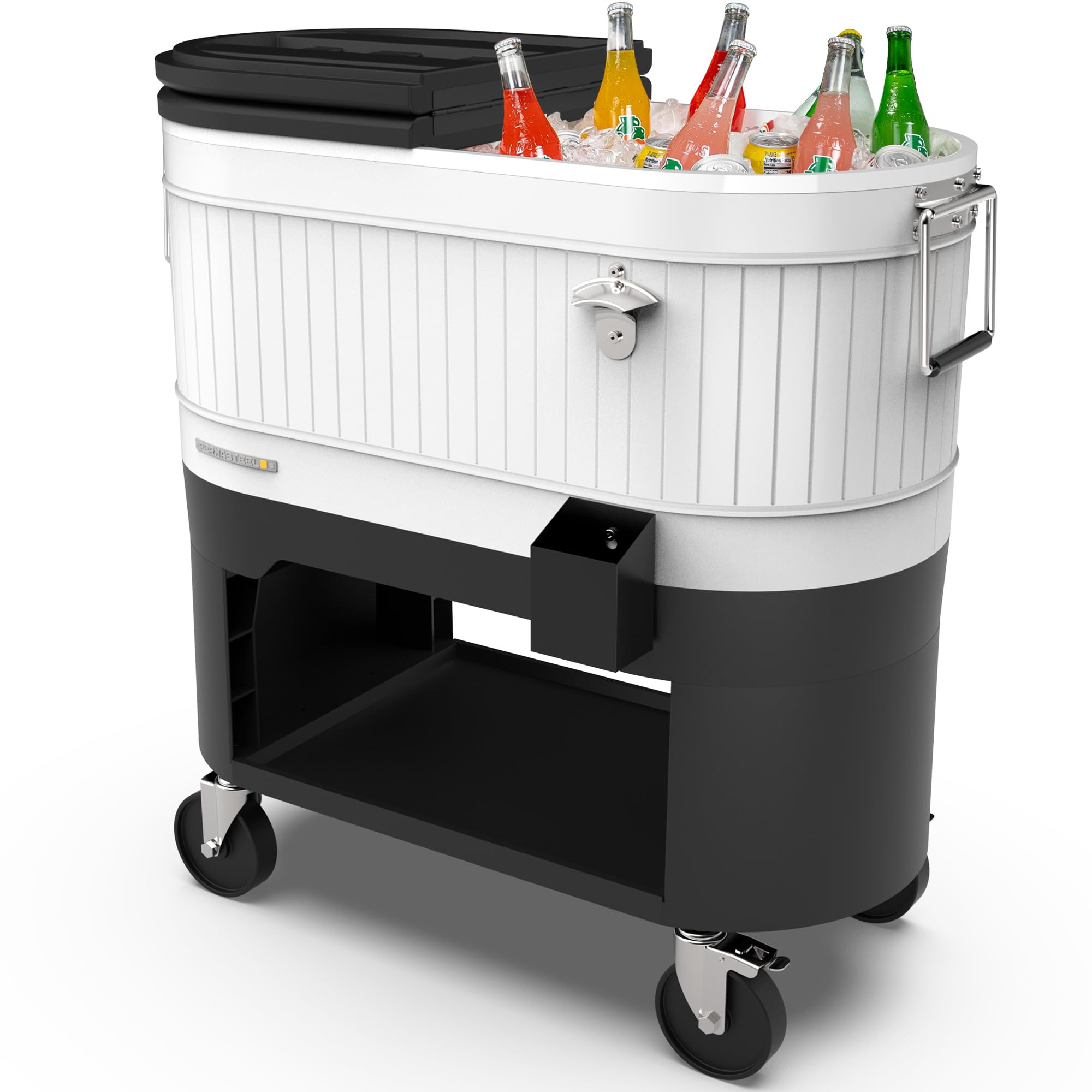
This is the only cooler on the list that names its capacity at a full 120 quarts, and it is the one that actually gets rolled into position rather than dragged. Four swivel caster wheels plus side handles let you push it around a patio fully loaded, and two of those wheels lock so it stays put while guests help themselves. The farmhouse white-and-black look means it earns a spot next to your outdoor furniture instead of hiding behind it.
Two dividers turn the tub into three compartments, which is the quiet genius of this design — soda on one side, beer in the middle, ice in the third. Flip a divider flat and it becomes a counter for setting down plates. A built-in cup holder and a bottle opener with cap catcher round out the bar-cart idea, and the removable flip-top lid lifts off completely for loading.
Ask the obvious question and the spec answers it: drinks stay chilled for up to 36 hours. Pre-chill what you put in and skip a mountain of ice, and the coverage holds through a long afternoon and into the next morning. The metal exterior does heat up in direct sun, so a shaded spot or a towel over the top keeps the shell from working against the insulation.
The hosting math: at 120 quarts it holds more than the RTIC 110 QT and the YETI Tundra 110, which matters if you are stocking for a party rather than a packing list.
The trade-off: the lid is thin and sets loosely, so it does not seal with the authority of a roto-molded gasket. Fine for a covered patio, less ideal for a jostling truck bed.
Reach for this if: your entertainment happens on a deck and you want furniture-grade looks.
Look elsewhere if: your weekend involves a bumpy dirt road.
3. RTIC 110 QT Ultra-Tough Hard Cooler
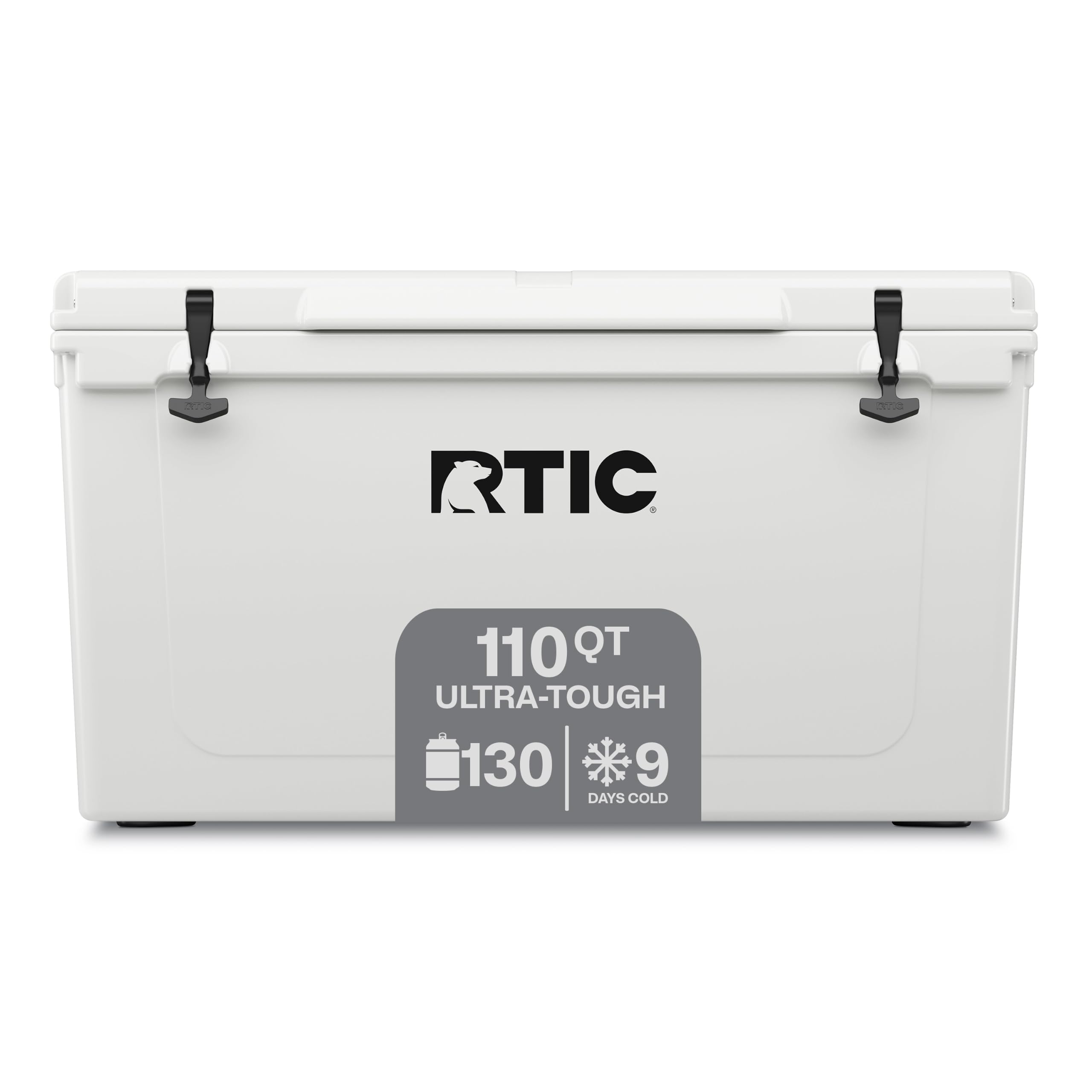
Up to 2.6 inches of foam and a freezer gasket — the camping workhorse.
Here is the number that decides everything in this category: up to 2.6 inches of closed-cell foam insulation, paired with a freezer-style gasket that seals the lid like a refrigerator door. RTIC states ice retention of up to 7 days when you follow its cooling tips, and that is the construction doing the work. Rotomolded one-piece shell, no seams, no panels.
Compared to the Igloo above, this is a heavier, stiffer, more serious box — and at 51.1 pounds empty it is 0.4 pounds heavier than the Permasteel cart, which tells you how much material is packed into these walls. The same 195-can marketing language shows up on other RTIC sizes, so check the spec sheet rather than the family photo when you order.
Owners run this as a multi-day cooler, and the 2.6-inch foam walls hold ice through a long weekend. Buyers report ice surviving five-day trips even with the lid opened constantly in a truck bed. The recurring gripe is weight — fully loaded, this becomes a two-person lift, and it is not the cooler you casually relocate once it is full.
What earns its place
- Up to 2.6 inches of foam with a freezer-style gasket
- Stated ice retention of up to 7 days with RTIC’s cooling tips
- Rotomolded shell built for truck beds and rough ground
- Doubles as a bench, step stool, or tabletop in camp
What to plan around
- 51.1 pounds empty, so loaded it wants two people
- No wheels — every relocation is a carry
- Ice retention is genuinely mixed depending on how you pack it
The camp answer: for a five-day trip where the cooler sits in one spot, this is the one to load.
The caveat: you are buying a cooler that stays where you put it.
4. Blue Coolers Ark Series with Wheels 110 Quart, Roto-Molded Ice Cooler
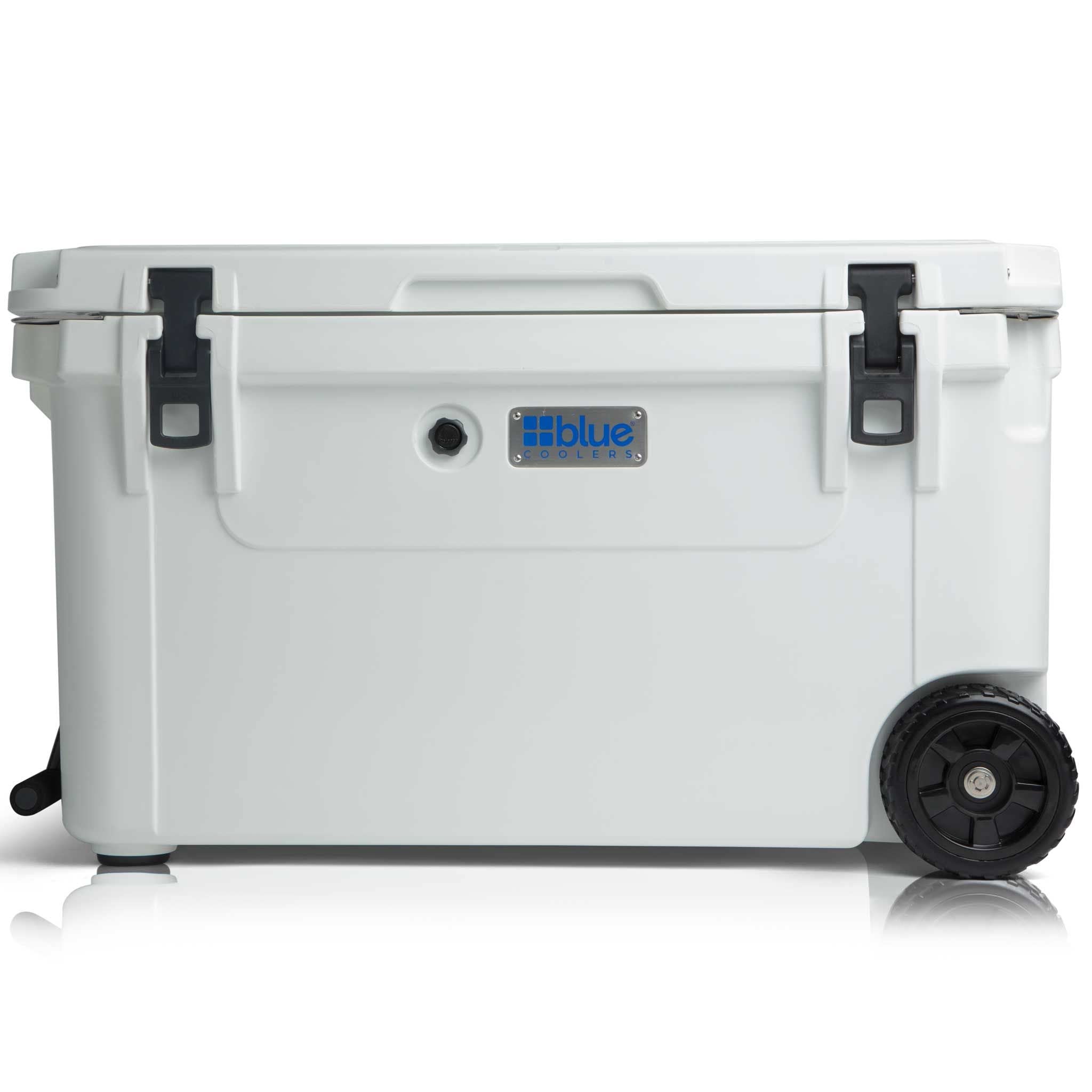
Ten days of ice in a shell built to sit still and take a beating.
Blue Coolers builds this one around a single promise: the Ice Vault keeps ice up to 10 days, backed by 2 inches of insulation. The shell is high-density polyethylene formed with roto-molded construction, which the maker says produces a consistent wall thickness and is virtually indestructible. Non-skid feet, a lockable lid, a freezer-style gasket, sure-grip handles, and a rapid drain system come included — plus the wheels.
At 110 quarts it takes second place to the Permasteel’s 120 quarts, and this is exactly the note serious buyers need. The brand’s own literature says to wheel it into place empty and then fill it, because once loaded you are not moving it around casually. This is a cooler with a permanent spot on the campsite, not a portable bar you push around a lawn.
The honest read on the headline claim: those ten days assume proper packing and limited opening. Pre-chilled and packed tight with block ice, owners get multiple days; opened all afternoon in the sun, they get fewer. In a black truck bed under direct Texas sun the interior can hit punishing temperatures, and the lid has been known to warp after a few days of that kind of abuse. Treat the lid as the weak point in an otherwise brutal shell.
Weight you will notice: at 46 pounds empty, this is lighter than the RTIC’s 51.1 pounds, and the wheels plus steel handle mean one person can move it while the RTIC needs a partner.
Who this is not for: buyers who want a cooler they can shift around the party by themselves.
The fit: long trips, campsites, and any setup where the cooler gets parked and left.
The mismatch: a cooler this size that lives on casters still wants a permanent home.
5. YETI Tundra 110 Hard Cooler

Built to fit a raft frame, drop in a truck bed, and outlast the trip.
The Tundra 110 gets its “110” from liters, not quarts — 108.9 liters, to be exact, which lands right in the same neighborhood as the other big boxes here. Up to 3 inches of PermaFrost insulation and a FatWall design carry the cold, and that thick wall is also what earns the cooler its bear-resistant certification. T-Rex Lid Latches are rubber, heavy-duty, and built with patented keeper technology so you are not chasing a latch on the ground.
Dimensions tell the real story for boaters: 37 inches long, 18 inches wide, 20 inches high, sized to fit all major raft frames snugly. The empty weight of 37 pounds is the number that surprises people next to the 51.1-pound RTIC and the 46-pound Blue Coolers. YETI calls it 37 pounds; the listing’s shipping weight line says 20 pounds, so trust the manufacturer’s stated 37 and plan your lift accordingly.
This is the premium pick because of what it does after the party ends, not at the party. YETI claims seven-day ice retention at 7,000 feet in mid-80s weather, but that assumes pre-cooling, block ice, shade, and a towel over the lid. Rafters and truck-bed haulers report the shell and latches holding up over years of use. The recurring gripe is honest: it is the most expensive cooling box in this guide, and there is no second opinion on that.
The durability view: the component that usually fails first on any cooler — the latch — is the thing YETI over-engineered, and the rubber T-Rex latches are the reason.
The budget view: you are paying for a shell meant to outlive the frame it sits on. Not the pick for drink duty at a single barbecue.
Buy it if: your cooler lives on a boat, in a raft, or on multi-day trips where cold has to hold.
skip it if: your use case tops out at driveway cookouts.
Understanding the Specs
Quart Capacity
Quarts describe volume, but brands measure them differently, so a chest labeled 120 quarts, a chest labeled 110 quarts, and a box labeled in liters can all hold a similar load once ice goes in. Ignore the label for a moment and look at the can count instead. A cooler advertised for up to 188 cans or up to 195 cans is built for a full crowd, while one rated for 150 to 185 cans depending on how you pack your ice expects real drinks and real ice in the same tub.
Insulation Thickness And Gasket
Insulation is measured in inches, and in this category you will see numbers like 2 inches up to 2.6 inches of closed-cell foam. More foam means a longer buffer between the outside air and your ice, which translates into multi-day retention instead of a single afternoon. The freezer-style gasket matters just as much, because it seals the gap where cold air escapes. Thick insulation with a weak lid seal is wasted effort, which is why the best boxes here pair both.
Rotomolded Construction
Rotomolded construction means the shell is formed as a single piece by rotating molten material in a mold until it coats the walls evenly. The result is no seams, no weak joints, and a shell that resists cracking under weight. Polyethylene and high-density polyethylene are the plastics used, and either is fine for rough handling. This is the construction behind coolers designed for truck beds, boat decks, and wilderness trips rather than patio duty.
Weight And Mobility
An empty weight of 46 to 51 pounds is standard for a roto-molded box in this size, and a rolled cooler with a wheeled base carries the same tonnage but moves it differently. A cooler with caster wheels and side handles can be pushed across a patio fully loaded, while a solid cube needs two people to lift, or a permanent spot. A drain plug matters here too, because draining meltwater is how you avoid carrying water weight you no longer need.
FAQ
Is a 120-quart cooler big enough for a whole party?
How long will a 120-quart cooler actually hold ice?
Do I need wheels on a cooler this size?
What does rotomolded mean and does it matter?
Can a 120-quart cooler fit in a car or truck bed?
Will one person be able to move a loaded cooler this size?
Does the lid gasket really change ice retention?
Do I need to pre-chill a 120-quart cooler?
Is a drain plug important on a cooler this size?
Which is better, a wheeled cooler or a solid hard cooler?
Final Thoughts: The Verdict
The strongest 120 Qt Cooler for most people is the Igloo Polar & Party Bar Series, because it holds 188 cans and 113 liters of interior space at a value tier that few boxes this large can touch. Its 4.6-star average across thousands of Amazon ratings backs that up.
If you want a cooler that earns its spot on a patio, grab the Permasteel Rolling Patio Cooler — the only pick here that names a true 120 quarts and rolls on four locking casters. If the goal is cold that lasts through a five-day campsite, the RTIC 110 QT with its 2.6 inches of foam and freezer gasket is the one to load. And for raft frames and hard-use trips, the YETI Tundra 110 is the premium pick that justifies itself over years, not weekends.
How We Picked
We do not accept paid placement. Every pick is matched to a real buyer and a real use-case; we do not hands-on test units.
Sources & Methodology
Specifications: manufacturer listings and product documentation. Review insights: verified customer reviews, as of September 2026. Pricing: not shown on this page (it changes often); check the current price via the retailer link.
As an Amazon Associate, Non Toxic Blog earns from qualifying purchases. This does not affect which products we feature.