Specs are compiled from manufacturer listings and verified buyer reviews and can change over time — please confirm the key details on the product page before buying.
If your kitchen has no 240-volt range outlet, you are not locked out of real cooking. The best 120 Volt Electric Stove plugs straight into an ordinary household socket, the same one your toaster uses, and gives you two working burners without an electrician, a permit, or a rewire. That single fact is what separates this whole category from a full-size range, and it is why these units end up in basement apartments, dorms, RVs, boats, guest suites, and kitchens where the old range finally gave out. The trade-off is real too: a 120-volt circuit only carries so much power, so you are not getting the blistering heat of a 240-volt coil. What you are getting is a compact glass-top cooktop, usually 12 to 24 inches wide, with knobs or touch controls, overheat protection, and a plug already attached.
I’m Mo Min — the founder and writer behind Non Toxic Blog. This guide is built by comparing the manufacturers’ published specifications and the patterns across verified customer reviews, so you get each pick’s real strengths and trade-offs instead of marketing spin.
What follows is a plain-English walk through the specs that actually matter and the models that hold up in daily use, so you can pick the right 120 volt electric stove for your counter on the first try.
Our Picks at a Glance

How To Choose The Best 120 Volt Electric Stove
Before you spend a cent, answer three questions. First, what does your outlet deliver? A 120-volt circuit is the ceiling here, and every burner pulls from it. Second, how do you want to control heat? A knob and a touch panel feel completely different in a hot kitchen. Third, where will it live—on the counter or sunk into a cut-out? That choice changes the model you buy, not just the installation.
Check the circuit before anything else
This is the step most people skip, and it is the one that causes the most returns. A 120-volt cooktop with two burners can pull serious amperage, and if your kitchen outlet sits on a 15-amp breaker shared with other appliances, you will trip it the moment both burners run hot. Buyers have flagged this directly: as owners put it, “Both burners draw >15A at 120V—do not use on 15A breakers.” A dedicated 20-amp circuit is the safe setup for a two-burner unit. On a single-burner model the draw is smaller, but the same logic applies. If you can only confirm a 15-amp shared line, plan to run one burner at a time, or pick a lower-wattage model and cook in stages.
Ceramic radiant or induction
A ceramic radiant cooktop heats a glowing element underneath the glass and passes that heat up into whatever pan sits on it. That means any flat-bottomed pot works — iron, stainless, glass, ceramic, copper, even aluminum. An induction cooktop instead creates the heat inside the pan itself using a magnetic field, so the glass stays comparatively cool and the cooking surface is quicker to respond. The catch is the pan: induction needs cookware with enough iron content to attract a magnet, which typically means cast iron, steel, or enameled iron. If your cupboard is full of non-magnetic pots, ceramic is the simpler path.
Knobs or touch controls
Knob-controlled units are the ones people buy for a parent or grandparent, and the listings say so out loud. There is no menu, no hold-to-scroll timer, no multi-tap sequence — you turn the dial and the burner heats. Touch-control models offer more: presets, timers, child locks, and precise temperature readouts, and they are easier to wipe clean because the surface is one smooth sheet of glass. The honest trade-off is that some older users find layered digital controls confusing, and a capacitive touch panel can be fussy with wet or floury fingers.
Countertop or built-in
Nearly every cooktop in this category installs two ways, which is genuinely useful. For countertop use, clip on the included bottom brackets and set it down; you can move it off the counter when done. For built-in use, cut a hole to the listed cut-out size and drop the unit in—this saves counter space and looks far more finished. One warning: countertop use on a radiant model exposes the underside, and on some designs that base gets hot enough to matter. Give it clearance and never set it on a surface you care about while it runs.
Quick Comparison
| Model | Best For | Burner Type | Control | Rated Power | Amazon |
|---|---|---|---|---|---|
| Karinear 110v Electric Cooktop 2 Burners, 12”★ Best Overall | Small kitchens and backup cooking | Radiant ceramic | Knob | — | Amazon |
| VBGK Electric Cooktop 110V 2400W 9 Power LevelsBest Value | A second cooking zone at a value | Radiant ceramic | Knob | 2100W (1200W + 900W) | Amazon |
| GTKZW Double Induction Cooktop 2 Burner 110v-120vCompact Pick | Induction cooking in a tight footprint | Induction | Touch | 2300W (1200W + 1100W) | Amazon |
| 2 Burner Electric Cooktop 110V 2000W (Jessier) | Simple knob control for older cooks | Radiant ceramic | Knob | 2000W (1400W + 600W) | Amazon |
| VBGK 24 inch 2 Burner Electric Cooktop 3000W | Two wide burners side by side | Radiant ceramic | Touch | 3000W (1500W + 1500W) | Amazon |
| GTKZW Electric Cooktop 2 Burner 2400W Hot Plate | Boats and off-grid kitchens | Radiant ceramic | Knob | 2400W (1200W + 1200W) | Amazon |
| GTKZW 110v Electric Cooktop 2 Burners 12” | Everyday cooking on a small surface | Radiant ceramic | Knob | 2100W (1200W + 900W) | Amazon |
| Empava IDC12B2 12 Inch Induction Cooktop | RV and yacht galley upgrades | Induction | Touch | 3100W (1800W + 1300W) | Amazon |
| Empava Flex Induction Cooktop 2 Burner | Frequent cooks who want precision | Induction | Touch | 1800W | Amazon |
In‑Depth Reviews
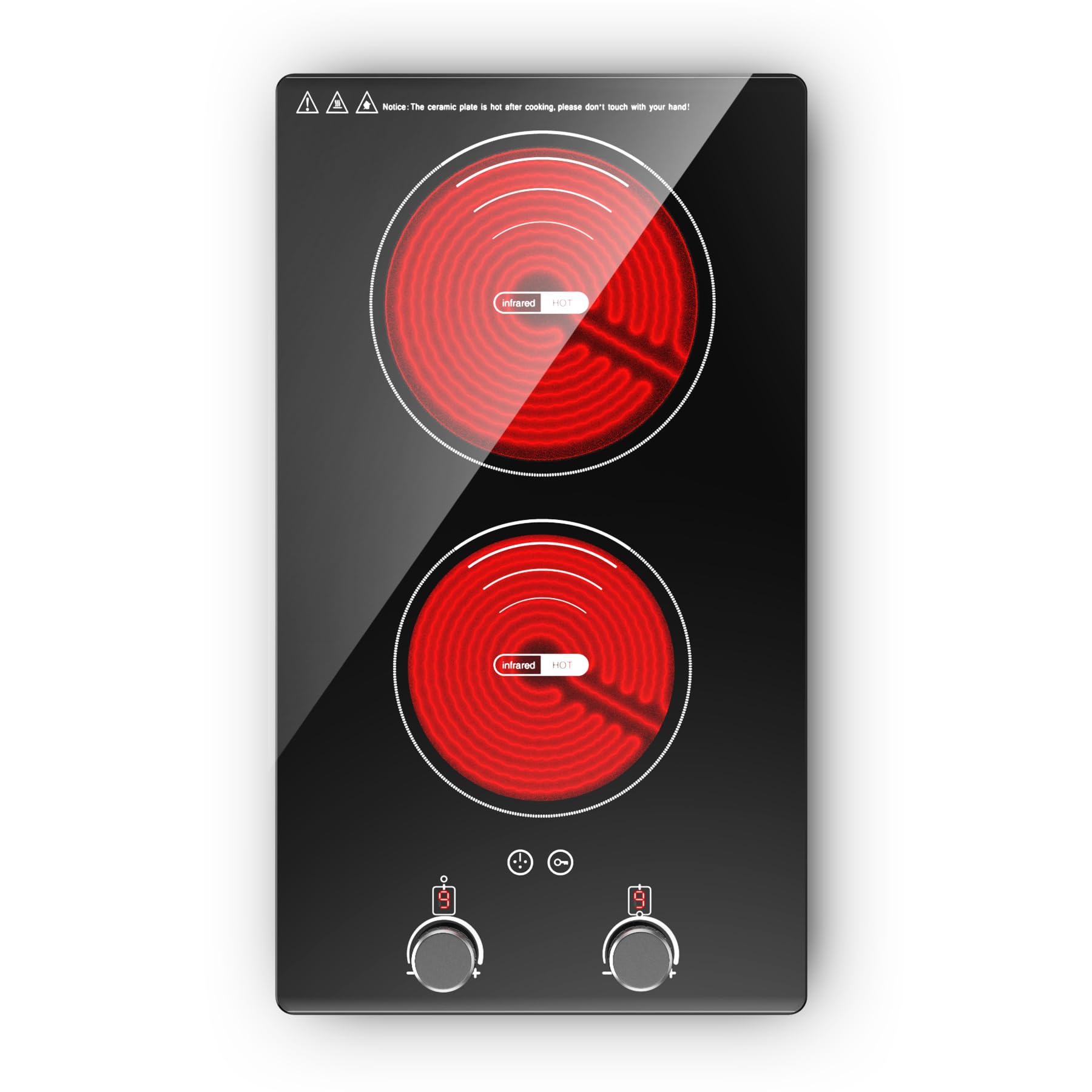
1. Karinear 110v Electric Cooktop 2 Burners, 12” Electric Stove Top Plug in
Our pick — over 4.5★ from 250+ verified ratings; the strongest balance of quality and price.
A 12-inch plug-in that turns a dead outlet into a working two-burner kitchen.
This is a 12-inch radiant ceramic cooktop with two burners and a nine-level knob, and it is the pick that most closely matches what a first-time buyer of a plug-in stove actually needs. It arrives with a plug already on the cord, so the installation is literally set it down and twist a dial — no electrician, no rewiring, no waiting. The 19.3 by 10.6 inch footprint is small enough for a basement counter or a galley, and the unit weighs 9.5 pounds, so one person can lift it in and out of a cabinet without help.
The secondary burner is deliberately gentler than the main one, which is exactly what you want for a simmer, a sauce, or a small pot. Owners describe one panel doing the heavy lifting for big pots while the other handles slow, low work, and that split is the reason people keep buying this shape. It also takes any flat-bottomed pan you own — iron, stainless, glass, or ceramic — which widens your options versus an induction unit. What wins people over most is simply how well the size suits a cramped space, and it stands out as a backup, a rental-kitchen solution, or a replacement for a range that finally quit.
Two honest notes. First, the glass surface scratches and stains fairly easily, and a scraper comes in the box for exactly that reason, so treat the top with care from day one. Second — and this matters before you order — owners have flagged that both burners combined pull more than 15 amps at 120 volts, so a 15-amp breaker is the wrong home for this unit. Plan on a dedicated 20-amp circuit. The cord is short enough in feel that you should confirm your outlet sits close, and consider a short heavy-duty extension only if it is rated for the load.
Who it fits best: anyone replacing a failed range in a small kitchen, a cottage, or a basement suite, and anyone who wants to fix dinner without calling an electrician.
What earns its place here
- Plugs into a standard 120-volt outlet with a cord that already has the plug attached
- Nine-level knob keeps operation dead simple — twist and cook, nothing to program
- Accepts any flat-bottomed pan, unlike induction models that lock you into magnetic cookware
- 12-inch body and 9.5-pound weight make it genuinely portable and easy to store
What to plan around
- Both burners together exceed 15 amps at 120 volts — a dedicated 20-amp circuit is the right setup
- The black glass top scratches and holds stains, so use the included scraper and wipe while warm
- Countertop use exposes the underside, so give it clearance on any surface that heat would mar
The verdict in one line: this is the safest first purchase in the category — simple, portable, and forgiving of whatever pots you already own.
Look elsewhere if: your kitchen only offers a shared 15-amp line, in which case step down to a single-burner model or budget for one burner at a time.
2. VBGK Electric Cooktop, 110V 2400W Electric Stove Top with Knob Control
Two independent burners and a knob you can work by feel — no menus to learn.
This is a 12-inch two-burner radiant cooktop rated at a combined 2100 watts, split into a 1200-watt zone and a 900-watt zone. That means one burner for a real sear or a rolling boil and one for gentle work like simmering a sauce or warming a plate. The nine power levels give you a wide range in between, and the ceramic glass surface wipes clean with a damp cloth once it has cooled.
The knob is the headline. There are no complicated buttons here, and the design is aimed squarely at people who prefer a dial they can turn without looking — which is why it keeps showing up in the kitchens of older cooks. It also accepts any flat-bottomed pot: aluminum, copper, cast iron, or non-magnetic stainless. Compared to the induction pick further down this list, the VBGK is the more forgiving purchase, because it will heat whatever you set on it rather than refusing a non-magnetic pan.
Here is the honest catch. Reliability on this one splits down the middle — some units are still cooking after years, and a few report the unit stopping after about a year, so buying with a warranty-conscious mindset is smart. The auto-off feature also divides opinion, because it can cut a burner before you expect it to. And the layer of digital controls can confuse a user who was hoping for zero technology, even though the main knob is simple. Treat the electronic panel as a bonus, not the point of the purchase.
Buy it if: you want two burners, a real knob, and enough power to boil and simmer at once without fuss.
Straight take: a fair-priced, plain-spoken cooktop that earns its keep in small apartments and second kitchens, provided you accept that the electronics carry some risk.
Made for: value hunters who want a dial, two burners, and a plug-in setup without paying premium money.
Think twice if: your priority is a decade of trouble-free electronics — the mixed long-term reports are the thing to weigh.
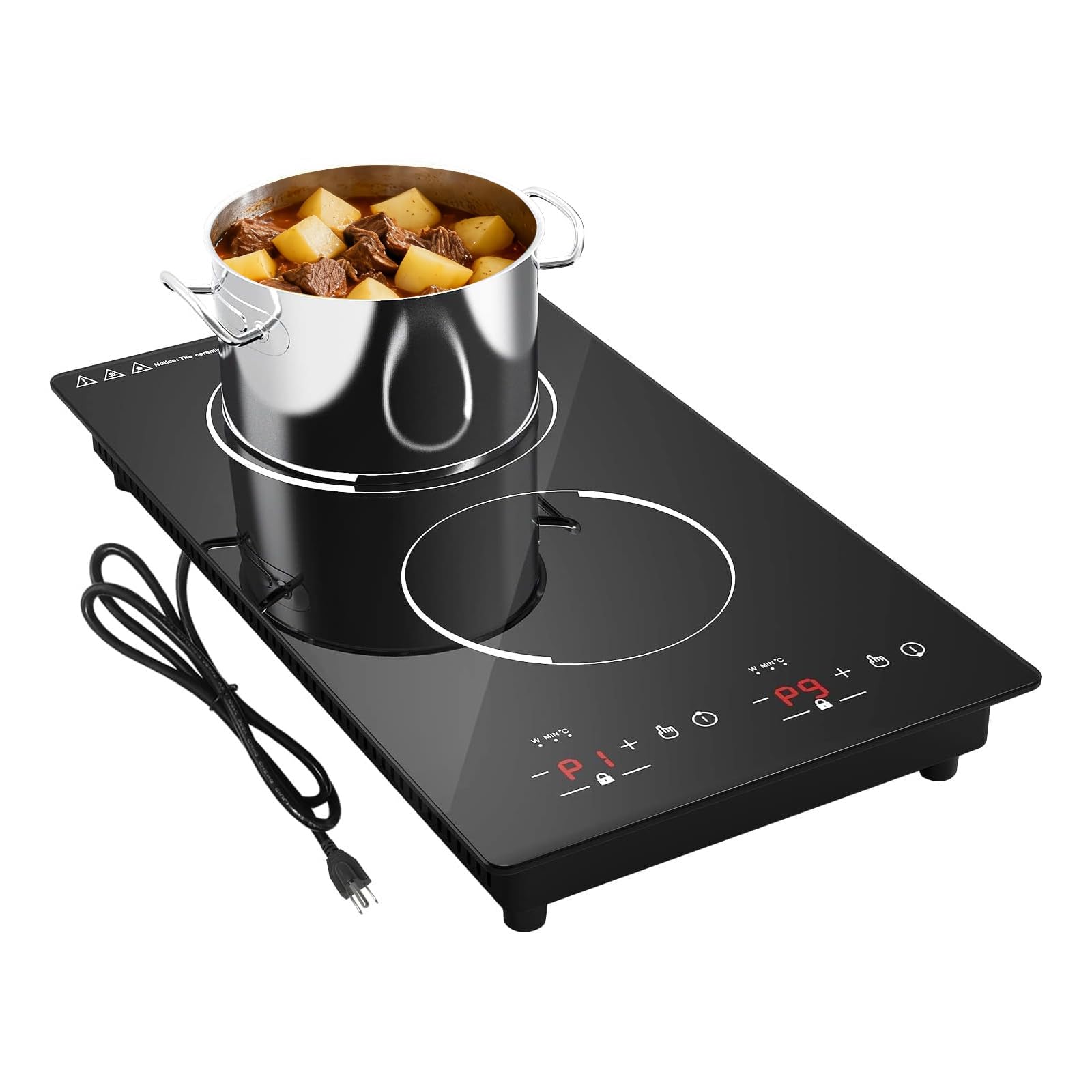
3. Induction Cooktop 12″, GTKZW Double Induction Cooktop 2 Burner 110v-120v
Induction heat in forty seconds, in a 12-inch body barely wider than a cutting board.
This one cooks with magnetism rather than a glowing element, which is why the glass top stays comparatively cool while the pan itself gets hot. Owner accounts put a cold pan to a frying egg at roughly 40 seconds, with the two induction zones running 1200 watts and 1100 watts across nine power levels and 176°F to 464°F. That range covers a low simmer through to a hard fry.
The safety package is where this earns points with families. If the burner detects no suitable cookware within 30 seconds it shuts itself off, which is a genuine answer for anyone who worries about a pan left unattended. There is a child lock, a timer you can set from 1 minute up to 120 minutes, overheat protection, and rounded corners with no sharp edges. The black crystal glass surface resists scratches and wipes clean easily.
Now the limitation, because it is the one that catches people out. Induction only works with magnetic cookware — cast iron, steel, or enameled iron with a high enough iron content — and the pan needs to sit within 6 to 11 inches. If your pots are aluminum or copper, or non-magnetic stainless, this cooktop will simply refuse to heat them. Some users also note it does not get hot enough to put a proper sear or char on a steak; it shines for sides, simmering, and everyday meals instead. Compared with the Karinear above, this GTKZW gives you faster reaction but a much narrower set of approved pans, so check your cupboard with a fridge magnet before you commit. Its 20 by 11.33 by 3.14 inch body is close in footprint to the Karinear’s 19.3 by 10.6 inch shell, so the two are near twins on the counter.
Best for: a household already cooking on cast iron or steel, or anyone who wants a cooler surface around curious kids.
Choose this if: your cookware is magnetic and you want quick, precise heat with a 30-second auto-off safety net.
skip it if: you rely on glass, ceramic, or aluminum pots — this burner will not heat them.
4. 2 Burner Electric Cooktop 110V 2000W Countertop or Built-in (Jessier)

Two dials, two burners, and a 600-watt warming zone for first-time cooks.
What you get here is a stark split between the burners: a 1400-watt large zone for real cooking and a 600-watt small zone meant mainly for keeping food warm or melting. Two separate knobs control them, one each, with nine power levels on the larger burner and a high-temperature warning that flashes “H” on the glass when the surface is still dangerously hot to touch. There is overheat protection too, which cuts the unit off if internal temperatures climb abnormally.
This model gets recommended for older family members because of its knobs. There is no touch grid to misread and no hold-to-scroll timer—you spin a dial and the burner responds. The listing notes it suits people whose grip strength is not what it used to be. Because it is a ceramic radiant cooktop, not induction, it accepts iron, stainless, glass, and ceramic pots alike, and there is no electromagnetic field involved.
The one thing to get right is the installation. Built into a counter with the included cut-out of 19.3 by 10.6 inches, this cooktop behaves beautifully and looks finished. Set on a bare counter, though, the exposed underside gets very hot, and that is a burn risk owners have raised. If you plan to use it on the countertop, treat it as a temporary setup and keep it clear of anything that heat would damage. Its 20.5 by 11.4 inch body is a touch broader than the Karinear above, so measure your counter before you commit.
The practical read: the best pick in this list for someone who wants built-in looks and dial-simple operation, provided the counter is cut to the specified opening.
Reach for this if: you are installing a cooktop into a fitted counter and prefer knobs over a screen.
Look elsewhere if: you need to leave it sitting on the countertop full time, because that base runs hot.
5. VBGK Electric Cooktop, 110V 24 inch 2 Burner Electric Cooktop 3000W

Two full-size burners rated at 1500 watts each on a 24-inch deck.
Where most picks in this list squeeze two burners onto a 12-inch frame, this VBGK spreads them across 24 inches, with each zone rated at 1500 watts for a combined 3000 watts. That means a big pot on one side and a skillet on the other without crowding, and the separate LED displays let you track both at once. It runs on the standard 110 to 120 volts found in North American homes and arrives with the plug attached.
The feature list reads more like a premium unit. Nine power levels span 176°F to 518°F, so you can go from a slow simmer to a hard sear. You also get a child safety lock, a timer, overheat protection, and a residual heat indicator that warns you while the glass cools. The black ceramic glass top resists scratches and heat and cleans up with a wipe. The rounded corners are a small but welcome detail on a surface this wide.
The honest questions here are about size and consistency. Some owners love the extra room; others find 24 inches simply too large for the counter they had in mind, so measure carefully before ordering. Reliability and temperature control also draw mixed notes, with the majority of buyers cooking happily and a minority reporting the unit stopping. It is also the heaviest countertop pick here at 5.8 kg, so it is not the one you toss in a cabinet between uses. Compared with the 12-inch VBGK above, this is a substantial step up in cooking room and in weight.
Made for: cooks who regularly run two big pans and have the counter width to give this unit a proper home.
Pick this one if: you want two genuinely equal burners and a wide, easy-to-wipe surface.
Consider the smaller option if: your counter is tight or you need something you can lift out easily.
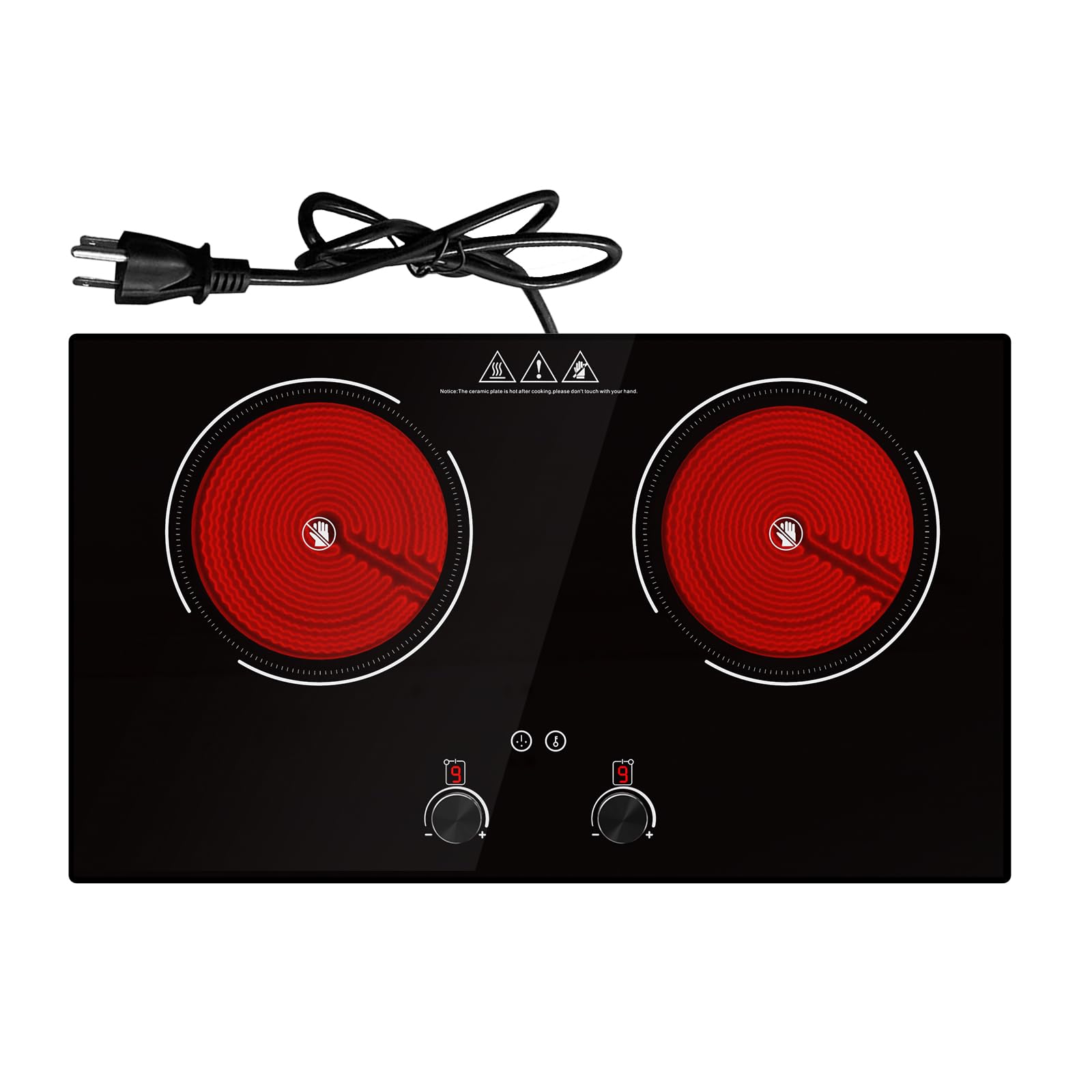
6. GTKZW Electric Cooktop 2 Burner 2400W Hot Plate Double Burner
Built for the galley and the cabin, where a 120-volt socket is all you have.
Two burners, 1200 watts apiece, rated between 212°F and 1112°F across ten power levels, controlled by two rotary knobs. The temperature ceiling here is unusually high for a 120-volt unit, and the two upgraded low-noise cooling fans underneath keep the electronics from cooking themselves during long sessions. A scrub scraper is not needed; the tempered glass top wipes clean.
On a boat or in a cabin, this is exactly the shape of appliance you want. It runs from a standard 110 to 120-volt outlet with a plug already fitted. It sits on the counter via four included brackets, or drops into a cut-out to save space. Boat buyers report replacing an old cookstove with this unit and being very satisfied. The honest note: heating is slower than a 240-volt household range—that is simply the physics of a 120-volt supply, not a defect.
Plan around the control panel’s lighting. The power buttons keep a red LED lit even when the cooktop is off, and there is no separate hot-surface warning light. One owner found it genuinely hard to tell at a glance whether the burner was live. Keep the manual nearby and check the dial positions out of habit.
Where it shines: dependable, quiet, high-ceiling heat for a fixed installation in a boat, RV, or off-grid kitchen.
Suits you if: your kitchen is a boat, an RV, or a cabin and you want a permanent, well-cooled two-burner unit.
Pass if: a permanently lit button light would genuinely confuse you at a glance.
7. GTKZW 110v Electric Cooktop 2 Burners 12” Electric Stove Top Knob Control

The 12-inch burner people keep coming back to year after year.
Two burners in a 12-inch glass body, split 1200 watts and 900 watts, with ten power levels and a temperature range of 212°F to 1112°F. That high ceiling is the interesting part—it means this small cooktop can take on more than you would expect, from a hard fry to a fast boil, while the lower settings handle soups and curries without scorching. The two knobs are the only controls you touch.
What makes this model stand out is durability. Owners mention running this 12-inch cooktop twice a day for three years or more, wiping it with disinfectant wipes, and finding it still working like new. There are safety features too: a timer, automatic shutdown, a child safety lock, residual heat indication, and overheat protection. It accepts any flat-bottomed pot — iron, stainless, glass, or ceramic — and the black glass surface keeps a clean, simple look on the counter.
None of that means it is perfect. The temperature behavior draws mixed notes—some find medium settings heat beautifully, while a minority report the unit shutting off after a few minutes. There is also the occasional unit that fails early or trips a breaker on plug-in, the rare bad apple any appliance line produces. Given how many are out there and how long most last, the odds are in your favor. Buy from a seller with a clear return window and test it in the first week.
Whose counter it belongs on: anyone who cooks at least once a day on a small surface and wants a 12-inch unit that has the track record to back it up.
Go with this if: you want a small, honest cooktop with a proven record of daily use and a plug-in setup.
Be cautious if: you cannot return it quickly — test it thoroughly within the first days.
8. Empava IDC12B2 Horizontal Electric Stove Induction Cooktop, 120V, 12 Inch

An induction cooktop built for tight quarters where open flame is not welcome.
This is a 12-inch induction unit rated at 1800 watts on the left burner and 1300 watts on the right, with nine temperature settings from 120°F to 460°F and eleven power levels in total. It is ETL certified for the USA and Canada, carries a 2-year US-based manufacturer warranty, and ships with a 120-volt plug pre-installed. It runs from a 20-amp breaker, which is the key line to check before you order.
The list of small but meaningful features is long: a hot-surface “H” indicator, a pan size sensor that sizes the element to your cookware, automatic shutoff when no pan is present, and a child control lock to prevent accidental activation. The tempered glass surface is designed to withstand intense heat without cracking and cleans up in a swipe. The timer runs from 1 to 179 minutes, so you can set a long braise and walk away.
Where this earns its place is boats and RVs, and the reason is safety rather than show. Removing a gas cooktop and dropping induction into a yacht or RV galley eliminates the open flame, and the surface stays cooler to the touch because the heat is generated inside the pan. Two quick cautions: induction needs magnetic cookware — most stainless and cast iron qualify — and smaller pans under 12 inches fit best unless you have a particularly heavy-bottomed pan. Also let the unit cool and wipe it rather than running it under water.
Ideal for: galley and RV upgrades, and anyone prioritizing a flat, flameless, cooler cooking surface.
Best fit: boat and RV owners replacing a gas cooktop, plus anyone who wants induction precision in 12 inches.
Not the one if: your kitchen only offers a 15-amp circuit, because this unit needs a 20-amp breaker.
9. Empava Flex Induction Cooktop 2 Burner, Countertop or Drop-in, Plug in

Eighteen heat levels for the cook who wants the pan to do exactly what they said.
This is the most granular control on the list: eighteen temperature levels, a range from 120°F to 460°F, an 1800-watt power ceiling, and a timer you can set from 1 minute all the way to 599 minutes. Three preset modes cover melt, keep warm, and simmer, and a pause function lets you stop everything without losing your settings. Touch-sensitive controls sit flush on the glass, easy to wipe down after a spill.
The safety package is thorough: an integrated child lock to stop accidental activation, an auto-shutoff feature, and a pan sensor. It is cTUVus certified, with a ceramic glass top over an 1800-watt induction element. Installation is a choice — bolt on the included kit and use it as a portable countertop unit, or drop it into a cut-out as a built-in. The 20.5 by 14.1 inch body is a touch wider than the 12-inch units above, which gives you more room per burner.
Owners notice speed and consistency. It brings water up fast by induction standards, cooks a full breakfast without wasting time, and works beautifully with cast iron. The honest limits are the usual ones for induction: if your pan is off-center or a poor magnetic match, the small coil heats only the middle and you get a hot spot rather than an even spread; power levels around the lower settings can cycle on and off; and the fan runs audibly during a hot session. Some cooks find the fan noise distracting the first few times, then stop noticing. This is a unit for someone who cooks three meals a day and wants to dial in the heat precisely.
Bottom line: the elite pick for frequent cooks who value fine-grained control and are willing to match their cookware to the technology.
Choose this if: you cook daily and want eighteen levels of control with a timer measured in hours, not minutes.
Step down if: you prefer a simple dial, or your cookware is not magnetic.
Understanding the Specs
Voltage and Amperage
A 120-volt cooktop runs on an ordinary household socket, the same circuit your microwave or small toaster oven uses. That convenience comes with a limit: the circuit will carry only so much current — measured in amps — before the breaker trips. Two-burner units in this category commonly pull more than 15 amps at full heat, which is why a dedicated 20-amp circuit is the safer setup. If you have only a shared 15-amp line, choose a single-burner model or run one burner at a time, and never stack a cooktop onto a circuit already loaded with a heater or a refrigerator.
Radiant vs Induction
A radiant ceramic cooktop passes heat up through the glass from a glowing element underneath. It works with any flat-bottomed pan — iron, stainless, glass, ceramic, copper, aluminum — and it is the forgiving choice if you do not want to replace your cookware. An induction cooktop instead generates heat directly in the pan using a magnetic field, so the glass stays cooler and the heat responds faster. The trade-off is that induction only works with cookware that a magnet will stick to, typically cast iron, steel, or enameled iron. Test your favorite pan with a fridge magnet before you decide which one to buy.
Power Levels and Temperature Range
Most two-burner cooktops here offer nine or ten power levels, with some reaching eighteen on the higher-end induction models. Watts determine how forcefully a burner heats — 1200 to 1500 watts per burner is common — and the temperature range tells you whether you can only melt and simmer or also sear and boil. Look at the top-end temperature if you want a hard sear, and the low-end if you want to melt chocolate without scorching. A wider range gives you more control across everything you cook.
Countertop vs Built-In Installation
Nearly every model in this category installs two ways. Countertop use means attaching the included brackets and setting the unit down, so you can move it or store it. Built-in use means cutting an opening to the listed cut-out dimensions — often around 19.3 by 10.6 inches on 12-inch models — and dropping the unit in for a fitted look that saves counter space. Check the cut-out figure against your counter before you order, and check that the unit clears any under-counter appliance below it.
Safety Features That Actually Matter
A residual heat indicator is the one to look for first. It lights an “H” on the glass when the surface is still too hot to touch, long after the burner is off. Child locks prevent accidental activation, and overheat protection cuts the unit off if internal temperatures climb abnormally. On induction models, a pan sensor will shut the burner down when no cookware is detected, which is a real safeguard against an empty, dangerous hot zone. None of these replace good habits, but they make a plug-in cooktop safer than a bare hot plate.
Timer and Auto Shutoff
A timer lets you set a burner to cook for a fixed window—often 1 to 120 minutes on many models, and up to 599 minutes on the most advanced one here—and then shut itself off. That is a big help for soups, braises, and anything you might otherwise forget on the stove. Auto shutoff is a related safety net that cuts power when the cooktop senses a problem or a set time has passed. Keep in mind the auto-off feature can trigger sooner than you expect on some units, which some cooks find surprising mid-simmer.
FAQ
Will a 120 Volt Electric Stove work in a normal home outlet?
Do I need an electrician to install one of these cooktops?
Can I use my existing pots and pans on a 120 volt cooktop?
Why does my cooktop keep tripping the breaker?
Can I install a 120 volt cooktop in a boat or RV?
Is a 12 inch cooktop big enough to cook two dishes at once?
How long does the glass surface last on these stoves?
What is the difference between a knob control and a touch control cooktop?
Does a 120 volt cooktop heat as well as a full size range?
Can I leave a portable 120 volt cooktop on the countertop permanently?
Is induction or radiant ceramic better for a small kitchen?
Final Thoughts: The Verdict
The 120 volt electric stove that fits most kitchens is the Karinear 110v Electric Cooktop 2 Burners, 12” because it turns any standard outlet into a working two-burner stove with nothing more than a plug and a twist of the dial—and it accepts whatever pans you already own. If your cookware is magnetic and you want faster, cooler, more precise heat, the Empava Flex Induction Cooktop gives you eighteen temperature levels and a timer measured in hours instead of minutes. And for the galley of a boat or the counter of an RV, the Empava IDC12B2 replaces a gas flame with a flameless, ETL-certified surface that stays cooler to the touch.
Whatever you choose, run one final check before you order: confirm the amperage on the circuit you plan to use, and confirm that your pan bottoms are flat and sit within the size range the manufacturer lists. Do those two things and a plug-in cooktop will quietly carry a whole kitchen’s worth of meals.
How We Picked
We do not accept paid placement. Every pick is matched to a real buyer and a real use-case; we do not hands-on test units.
Sources & Methodology
Specifications: manufacturer listings and product documentation. Review insights: verified customer reviews, as of September 2026. Pricing: not shown on this page (it changes often); check the current price via the retailer link.
As an Amazon Associate, Non Toxic Blog earns from qualifying purchases. This does not affect which products we feature.