Specs are compiled from manufacturer listings and verified buyer reviews and can change over time — please confirm the key details on the product page before buying.
If you want a warm garage without hiring an electrician, the answer is simple: buy a 120V heater that runs off the ordinary wall outlet you already have. That single requirement — a standard 120-volt household plug, not a 240V hardwired line — is what separates the heaters worth buying from the ones that force a panel upgrade. Every pick below was checked for that one thing first, then ranked on how well it actually throws heat at a person standing in a cold bay.
I’m Mo Min — the founder and writer behind Non Toxic Blog. This guide is built by comparing the manufacturers’ published specifications and the patterns across verified customer reviews, so you get each pick’s real strengths and trade-offs instead of marketing spin.
Radiant heaters warm bodies and tools directly, while fan heaters push warm air around a room, and knowing which one suits your space decides whether you end up comfortable or disappointed. Below you will find the honest pros, the real complaints, and a 120v garage heater that plugs into the outlet you already own.
Our Picks at a Glance

How To Choose The Best 120V Garage Heater
Before you shop for a heater, check the circuit. A 120V garage heater pulls a lot of current (the flow of electricity), and if you plug it into a line that already feeds a freezer or a table saw, you will trip a breaker the moment both run at once. Match the heater’s amperage (the current it draws) to the breaker behind that outlet. Then decide: do you want radiant warmth on your body, or warmed air for the whole room?
Volts, amps, and the circuit you already have
The whole appeal of a 120V garage heater is that it runs on a standard household outlet — the same kind of plug your vacuum cleaner uses. The trade-off is current draw: pulling full power from one of these is a big load on a single circuit. Check the amperage printed on the heater against the breaker feeding that outlet, and give it a circuit of its own if you can. A 3-prong grounded plug matters too, because these units are metal and heat is involved.
Radiant heat versus forced-air heat
Radiant heaters warm people and objects directly, so you feel warmth the moment you step in front of one even if the room air is still cold. Forced-air heaters move hot air with a fan, which takes longer to heat the space but spreads warmth more evenly across a larger area. In a garage or shop where you are usually standing in one spot, radiant often wins; in a greenhouse or a room you want evenly warmed, a fan unit can make more sense.
Mounting position and the angle that matters
A ceiling-mounted unit keeps your floor clear and puts the heat above the work area, but the adjustable tilt is what decides whether it actually reaches you. Look for how far the head rotates so you can aim it down at a workbench instead of a wall. Forced-air units sit on the floor and need open space in front of the vent, so a crowded garage favors a ceiling mount.
Quick Comparison
| Model | Best For | Heat Output | Mount Type | Coverage | Amazon |
|---|---|---|---|---|---|
| Shinic Ceiling Mounted Radiant Quartz Heater★ Best Overall | Best overall ceiling-mounted spot heat | 1500W / 750W | Ceiling Mount | 200-300 sq. ft. | Amazon |
| BEYOND HEAT Electric Garage Heater 120VSlim Ceiling Pick | Slim ceiling radiator with work light | 1500W | Ceiling Mount | — | Amazon |
| iPower Electric Heater Fan | Portable floor heat for greenhouses and sheds | 1500W | Floor-standing | Air output 4500 Cubic Foot/Hour | Amazon |
| Shinic 2-Pack 120V Electric Garage Heater | Covering two bays or a large shop | 1500W / 750W | Ceiling Mount | 400-600 sq. ft. | Amazon |
| sundate Hanging Heater 1500W | Covered patios and outdoor living spaces | 1500W | Ceiling Mount | — | Amazon |
In‑Depth Reviews
1. Shinic 120V Electric Garage Heater, Ceiling Mounted Radiant Quartz Heater
Dual quartz tubes that warm you directly the second the pull string clicks.
This heater does the most with a single 120V outlet. Its dual quartz heating elements (two tubes that glow and throw radiant warmth) send heat straight at whoever stands in front of it. You feel warmth on your face and hands before the room air catches up — exactly what you want in a cold garage. It draws 12.5 amps (the current flow it pulls from the circuit), so give it an outlet with its own breaker and you are set. Heat coverage is listed at 200-300 sq. ft. (square feet).
Five settings are the real reason it earns the top slot. You get low heat at 750 watts with one element, high heat at 1500 watts with both elements, and versions of each that switch on the halogen work light at the same time — a bright lamp built into the housing that lights up your bench for late-night jobs. The head rotates 90° (a quarter turn) so you aim the heat where you actually stand. Mounting it to the ceiling frees up every square foot of floor in a crowded bay.
Owners praise how fast it heats a cold bay, and the pull string cycles through all five settings without fuss. The honest catch is long-term durability: a heater that runs hard in a damp garage can eventually quit, and how long it lasts depends on how often you lean on the high setting. Plan on mounting it in one spot, because it is built to stay put.
Where it earns its place
- 1500W and 750W settings let you dial the draw down when the garage is only mildly chilly.
- Built-in halogen work light means one ceiling fixture covers both heat and visibility.
- 90° tilt aims radiant heat at your workbench instead of the wall.
- Ceiling mount keeps your floor clear for cars, tools, and storage.
The honest trade-offs
- Radiant heat warms the person in front of it, not the whole room evenly.
- The halogen lamp runs dim — better for ambient glow than fine detail work.
- Give it its own 120V circuit to avoid tripping a shared breaker.
Made for the spot-heater: if you work in one area of a garage, shop, or patio and want heat on your body fast, this is the one to reach for.
Think twice if: you expect to warm an entire large garage evenly from cold — radiant units like this target you, not the whole space.
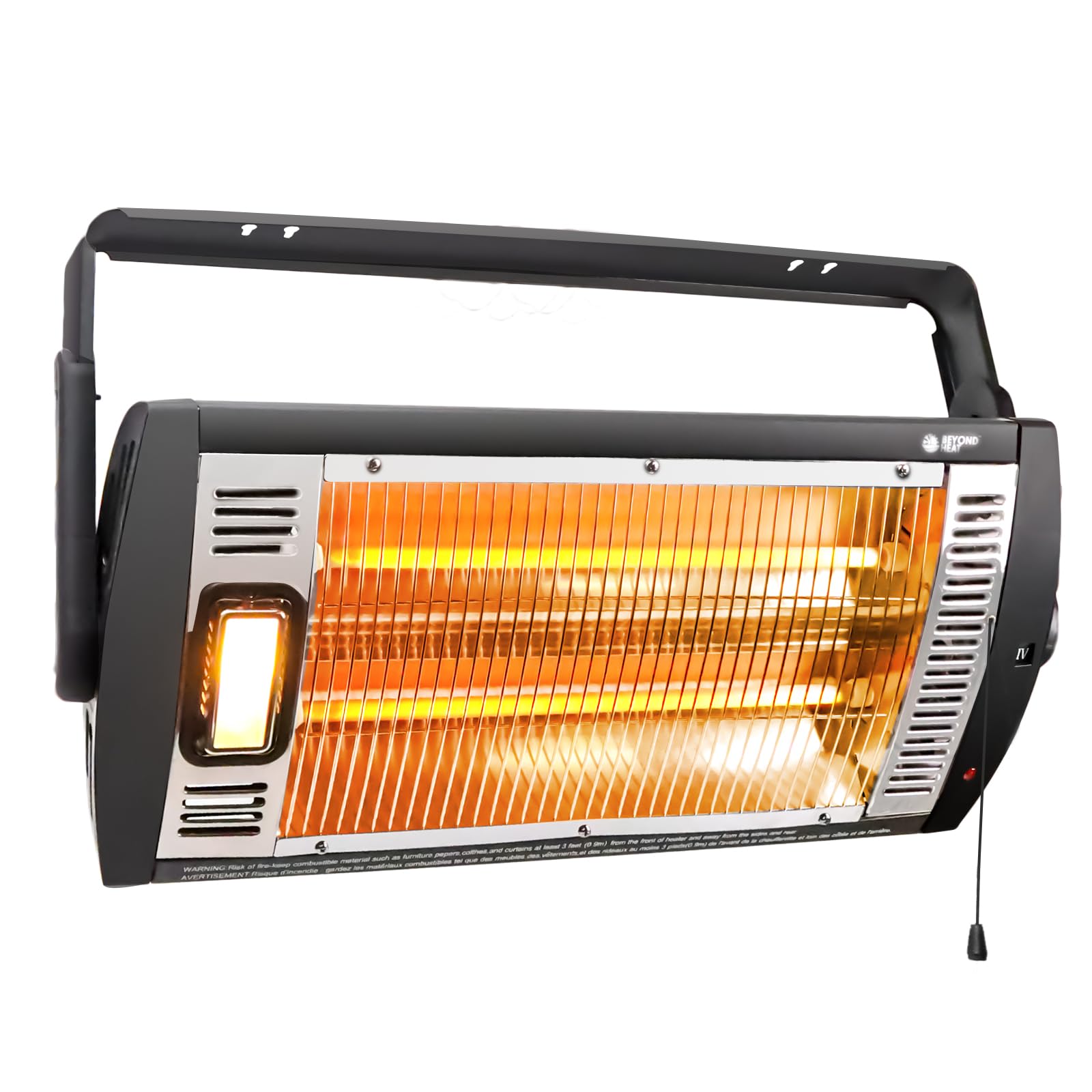
2. BEYOND HEAT Electric Garage Heater 120V, 1500W Radiant Space Heater
A profile so low it tucks against the ceiling and stays out of your way.
Here is where the shape does the work. This heater measures 24″D x 3.3″W x 12.2″H, and against the Shinic Ceiling Mounted Radiant Quartz Heater’s 11″D x 24″W x 15″H, that is a 2.2x gap in footprint — a much narrower, flatter body that hugs the ceiling in a tight bay where headroom is short. Mount it on a 2×4 along a corner and it nearly disappears.
It runs on the same 120V household power at 12.5 amps, with two radiant heat settings controlled by a pull string: full heat, or a single setting with the built-in halogen light for visibility. The tilt head swings 90° so you can angle the heat at a woodturning lathe or a table where you are standing still. The pull string is built to resist fraying, and the metal safety grille keeps objects off the hot elements.
What owners rave about is how well it mounts and how steady the heat stays in an insulated, sheet-rocked garage — the kind of setup where two of these hold a comfortable working temperature around the clock. The genuine caveat is reach: radiant heat here lands where you point it, so do not expect it to thaw a frozen floor-to-ceiling space quickly. Aimed at your back while you work, it does exactly its job.
Standout spec: at 3.3 inches wide, it is the slimmest body in this lineup, which matters most in low-ceiling garages and sheds.
Keep in mind: it ships as a single-pack here, so covering a large two-bay space means buying more than one unit.
Reach for it when: your ceiling is low and you need a low-profile radiant unit that stays flush and out of sight.
Look elsewhere if: you want to warm a big open room from one fixture — this targets the area you aim it at.
3. iPower Electric Heater Fan, Portable with Overheat Protection
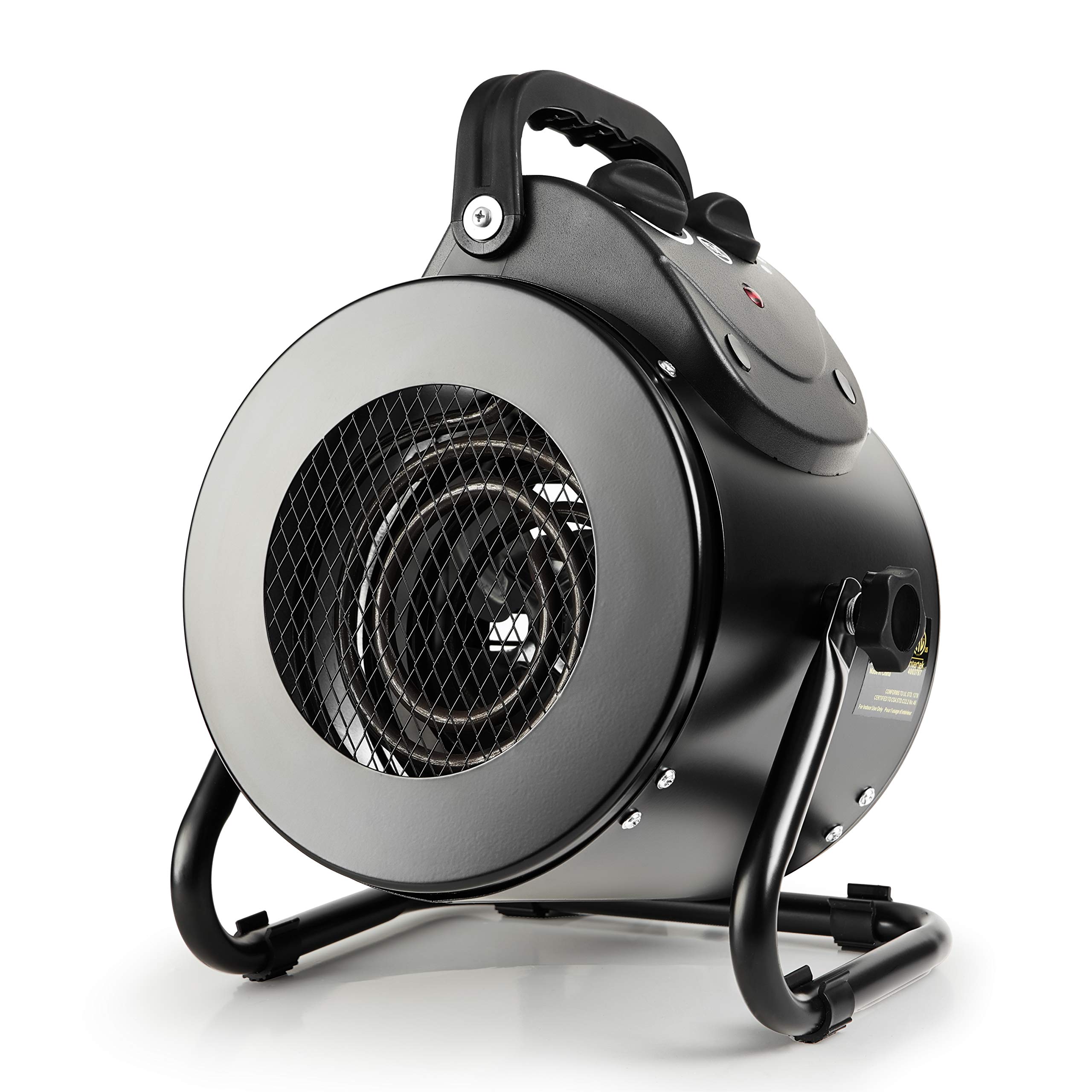
A carry-handle fan heater built for greenhouses, tents, and damp little rooms.
This one takes a different route entirely. Instead of aiming radiant warmth at a person, it uses a fan to push heated air — moving 4500 cubic feet per hour via forced air (a fan blows the warmth around), so it warms the space around it rather than just the body in front of it. That makes it the natural fit for a greenhouse, grow tent, or shed where plants or stored items need the air warmed, not a single person. It draws 12.5 amps on 120V and runs 25W to 1500W with an adjustable heat range from -58°F to 210.2°F, plus an internal overheat circuit that shuts it off once the target temperature is reached.
At 8.6 pounds with a built-in carrying handle and a floor-standing form, it is the portable option in this group — carry it from the garage to the basement to the tent as seasons shift. Setting it on the floor means the heat, plus the built-in circulation, reaches low across the space rather than pooling at the ceiling. For a greenhouse in a cold climate, that circulation also keeps air moving against mold on plants.
The honest note is that this is a mixed bag on function and durability. It works well in grow rooms and keeps a greenhouse noticeably warmer, and a lot of owners get multiple seasons out of one. But a few report the heating element giving out after a while, so think of it as a value-tier greenhouse workhorse rather than a forever appliance. If you want air warmed across a small space and portability matters, it earns its spot.
Why it fits grow spaces
- Forced air reaches low across the floor instead of pooling overhead.
- Built-in carrying handle and 8.6-lb weight make it genuinely portable.
- Overheat circuit shuts it off automatically once it hits the set temperature.
- Adjustable range spans -58°F to 210.2°F.
Where it gives ground
- It warms the air, so the room takes a while to feel it — direct heat on a person is slow.
- A handful report the heating element failing over multiple seasons.
- Not a substitute for a radiant unit when you want warmth on your body fast.
It suits the grower: a greenhouse, grow tent, or small basement where circulating warmed air across the space is the goal.
skip it if: you want to feel heat on your hands within seconds of walking into a cold garage.
4. Shinic 2-Pack 120V Electric Garage Heater, 1500W/750W Ceiling Mounted Heater

Two radiant heads for a garage big enough to need warmth in more than one spot.
When one heater is not enough, this pair changes the math. You get two ceiling-mounted 1500W/750W radiant quartz units rated for 400-600 square feet of coverage total — which roughly doubles where the first Shinic lands, and puts heat over two work zones instead of one. Each unit has the same 5-setting pull string (low heat at 750W with one bulb, high heat at 1500W with both, both wattages with the work light on, and off), a 90° adjustable tilt, and a halogen work light for late jobs.
The pull of buying two is getting warmth where you actually work. Owners who hang a pair from the ceiling in a cold garage find they stay warm enough sitting right under them, and the units are happy running through the night on the low setting without complaint. Speed is a genuine strength — one owner describes temperatures climbing fast enough to make a chill room feel usable within a short session.
Here is the reality check on a two-pack: these are spot heaters, so the warmth is strongest directly beneath each head rather than everywhere in the garage. A few owners mounted theirs high and found the heat thin at that height, then moved them lower. The recurring gripes are electrical cost, since running two units pulls a heavy load, and the pull cord, which wants a firm hand. Mounted where you stand, though, the pair does exactly what you bought it for.
Coverage you can feel: 400-600 sq. ft. across two heads means two separate warm zones instead of one hot corner.
Worth knowing: two units at full power draw a lot of current — they want dedicated circuits, and running them 24/7 will show on your bill.
Best matched to: a workshop or two-bay garage where you want radiant heat in more than one place at once.
Not the pick if: your space is a single small nook — one heater covers that just as well.
5. sundate Hanging Heater, 1500W Outdoor Electric Patio Ceiling Heater with Remote
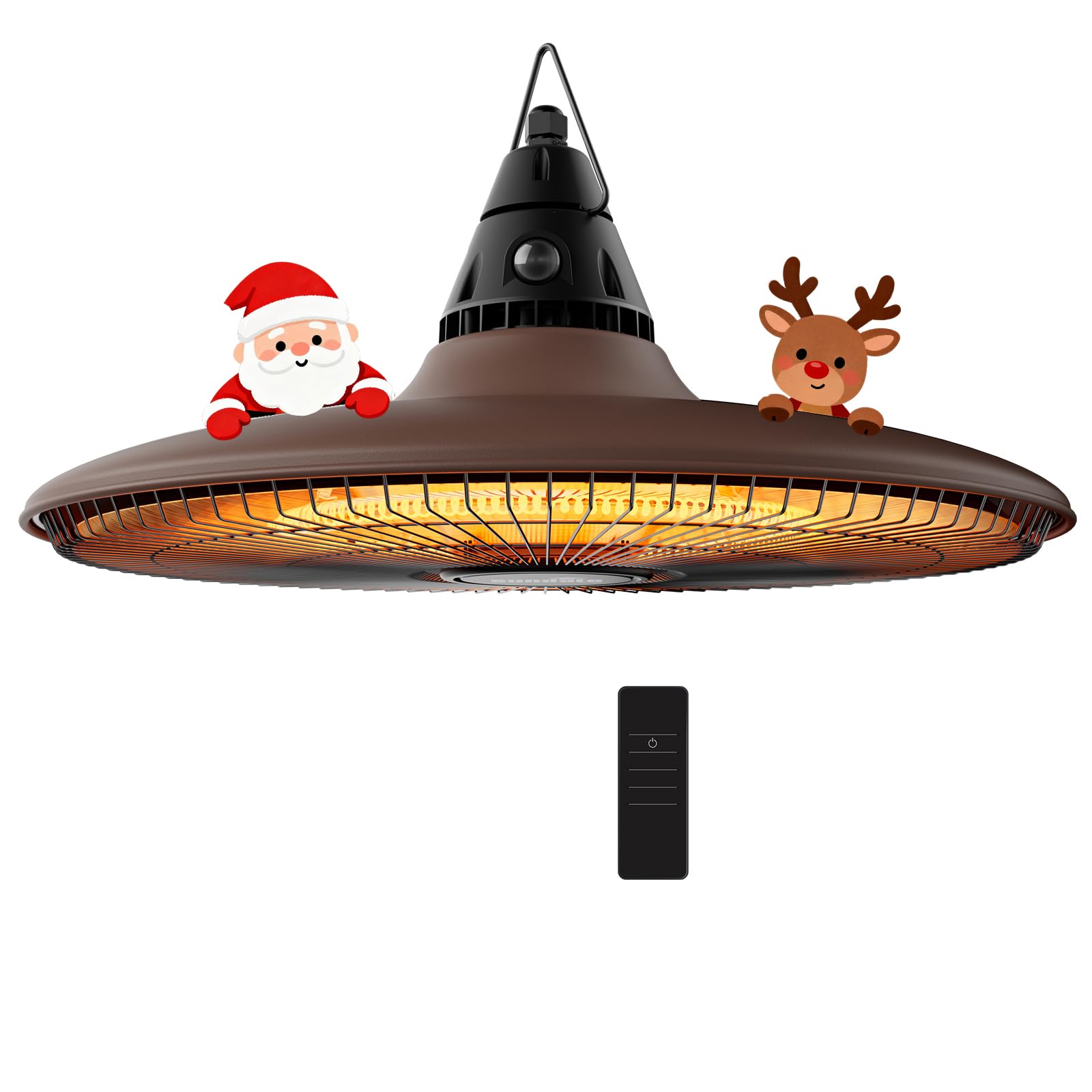
A silent carbon-fiber hanger for covered patios, gazebos, and open-air garages.
If your heater needs to hang outdoors over a porch or gazebo, this is the pick with the right build. It runs a carbon fiber heating tube (a sealed element that glows instead of blowing) that delivers infrared heat in as little as one second, warming people and objects directly rather than the surrounding air. There is no fan, so it operates silently with no blowing air or circulating dust — a real advantage when you are relaxing or entertaining under a covered deck.
At roughly 5 pounds it hangs light, and the included 22-inch adjustable chain lets you set the height for your space. It runs on a standard 120V household outlet, and the weather-resistant housing plus a protective dust cover help it survive the seasons. For safe installation, keep it at least 1 foot below the ceiling and more than 5.9 feet above the floor — guidance that also keeps it clear of tall guests. Its carbon fiber tube glows softly instead of the harsh white of quartz, and the included remote lets you switch it on from across the patio.
The honest edge here is reliability, which lands as a mixed picture: some owners get a strong-working unit that handles genuine cold snaps, while a few report quality-control misses on arrival, like a missing or dead remote. Expect to test the remote early and use the mounting height so you can reach the unit directly if you ever need to. For a covered outdoor space where silence and looks matter, it does the job well.
Built for the outdoors
- Carbon fiber tube delivers infrared heat in as little as one second.
- Fanless and silent — no blowing air or dust on a covered patio.
- Roughly 5 lbs with a 22-inch adjustable chain for flexible hanging height.
- Weather-resistant housing and a dust cover for seasonal use.
The fine print
- A few units arrive with remote issues or quality-control misses — test early.
- Because it hangs high, a failed remote can mean reaching for a ladder.
- It is an outdoor-rated supplemental heater, not a whole-garage air warmer.
Perfect for the porch: covered patios, gazebos, balconies, and open-air spaces where you want silent, good-looking overhead warmth.
Choose another if: your priority is warming an enclosed garage bay with a hard-mounted radiant unit.
Understanding the Specs
Voltage and amperage on a 120V circuit
Every heater here runs on standard household 120V power, which is why they plug into an ordinary outlet instead of needing a 240V hardwired line. The number that decides whether your circuit can take it is the amperage — the current the unit pulls while running. These units draw 12.5 amps, so a dedicated 120V outlet keeps them from competing with a fridge or freezer on the same breaker. If you share a circuit, expect the breaker to pop when everything runs at once.
Wattage settings and radiant versus forced air
The wattage rating tells you how much heat you can expect and how much power you are burning. A 1500W setting is the full-power blast for warming up a cold space; dropping to 750W roughly halves the draw for when things are only mildly chilly. Separately, how that heat travels matters: radiant heaters warm people and objects directly in front of them, while forced-air heaters use a fan to push warm air across a room. Pick radiant for warmth on your body in one spot, forced air for warming the air across a greenhouse or small room.
FAQ
Will a 120V garage heater trip my breaker?
Can I plug a 120V garage heater into a regular wall outlet?
How long does a radiant garage heater take to heat up a garage?
What is the difference between a radiant heater and a fan heater?
Should I mount a garage heater on the ceiling or use a floor unit?
Do I need a dedicated circuit for a 1500W garage heater?
Is radiant heat good for a large two-car garage?
Can I use an outdoor-rated hanging heater in my garage?
What wattage setting should I use for a garage in winter?
Final Thoughts: The Verdict
For most buyers, the 120v garage heater winner is the Shinic Ceiling Mounted Radiant Quartz Heater, because it pairs the spot-warming power of dual quartz tubes with a built-in halogen work light and a 90° tilt, all on a standard 120V outlet. If low headroom is your problem, the slim BEYOND HEAT 120V Heater hugs the ceiling in a tighter footprint. And for a two-bay workshop that needs warmth in more than one place, the Shinic 2-Pack covers 400-600 square feet across two heads.
How We Picked
We do not accept paid placement. Every pick is matched to a real buyer and a real use-case; we do not hands-on test units.
Sources & Methodology
Specifications: manufacturer listings and product documentation. Review insights: verified customer reviews, as of September 2026. Pricing: not shown on this page (it changes often); check the current price via the retailer link.
As an Amazon Associate, Non Toxic Blog earns from qualifying purchases. This does not affect which products we feature.