Specs are compiled from manufacturer listings and verified buyer reviews and can change over time — please confirm the key details on the product page before buying.
If you only need hot water at one sink, a 120V tankless water heater is the simplest fix you can buy — but only if you pick the one that can actually raise your water temperature enough. A 120V unit runs on standard household current instead of the 240V line a whole-house heater needs, so you skip the electrician, the panel work, and the steep bill. The trade-off: these heaters warm water for a single tap, not a shower, and their temperature rise is capped by 120V current. This guide breaks down how much heat each pick delivers, how much space it eats under your cabinet, and how hard it is to wire in.
I’m Mo Min — the founder and writer behind Non Toxic Blog. This guide is built by comparing the manufacturers’ published specifications and the patterns across verified customer reviews, so you get each pick’s real strengths and trade-offs instead of marketing spin.
Every unit here is a point-of-use model that mounts right at the tap, and the differences come down to flow rate, wattage, and genuine heating performance. Below is a straight comparison of the best 120V tankless water heater options for a single sink.
Our Picks at a Glance
How To Choose The Best 120V Tankless Water Heater
The deciding spec is how many degrees the unit can add to your incoming water. A 120V heater is limited by the current available in a standard household circuit, so the wattage cap (3 kW to 3.5 kW, which is 3,000 to 3,500 watts of heating power) controls how far the water temperature can climb. Pick a unit with too little wattage for your flow and the tap runs lukewarm.
Match wattage and flow rate to your ground water
A heater’s real-world output depends on two factors: the wattage of the heating element and the flow rate of water passing through it. Slow the water down and the heater has more time to warm each gallon; open the tap wide and the water rushes through before it can heat up. Many installers solve this with a flow limiter — a small restrictor that holds the flow at a set rate so the heater can keep up. The practical rule: if your ground water comes in cold, you need either lower flow or higher wattage, and a 120V unit can only go so far.
Quick Comparison
| Model | Best For | Power | Flow Rate | Weight | Amazon |
|---|---|---|---|---|---|
| CAMPLUX TE04N3★ Best Overall | Single sink, easy DIY install | 3.5 kW at 120V | 2.5 L/min (0.66 GPM) | 3 pounds | Amazon |
| Stiebel Eltron Mini 3 | Compact under-sink spaces | 3000 watts | 0.08 L/sec | 3.4 pounds | Amazon |
| LECLOC C3000 | Low-flow single taps, apartments | 3kW (3000 watts) | — | — | Amazon |
| GE GE04SNLPDG | Kitchen sink with remote control | 3.5 kW (3500 watts) | 0.7 GPM | 4.7 pounds | Amazon |
In‑Depth Reviews
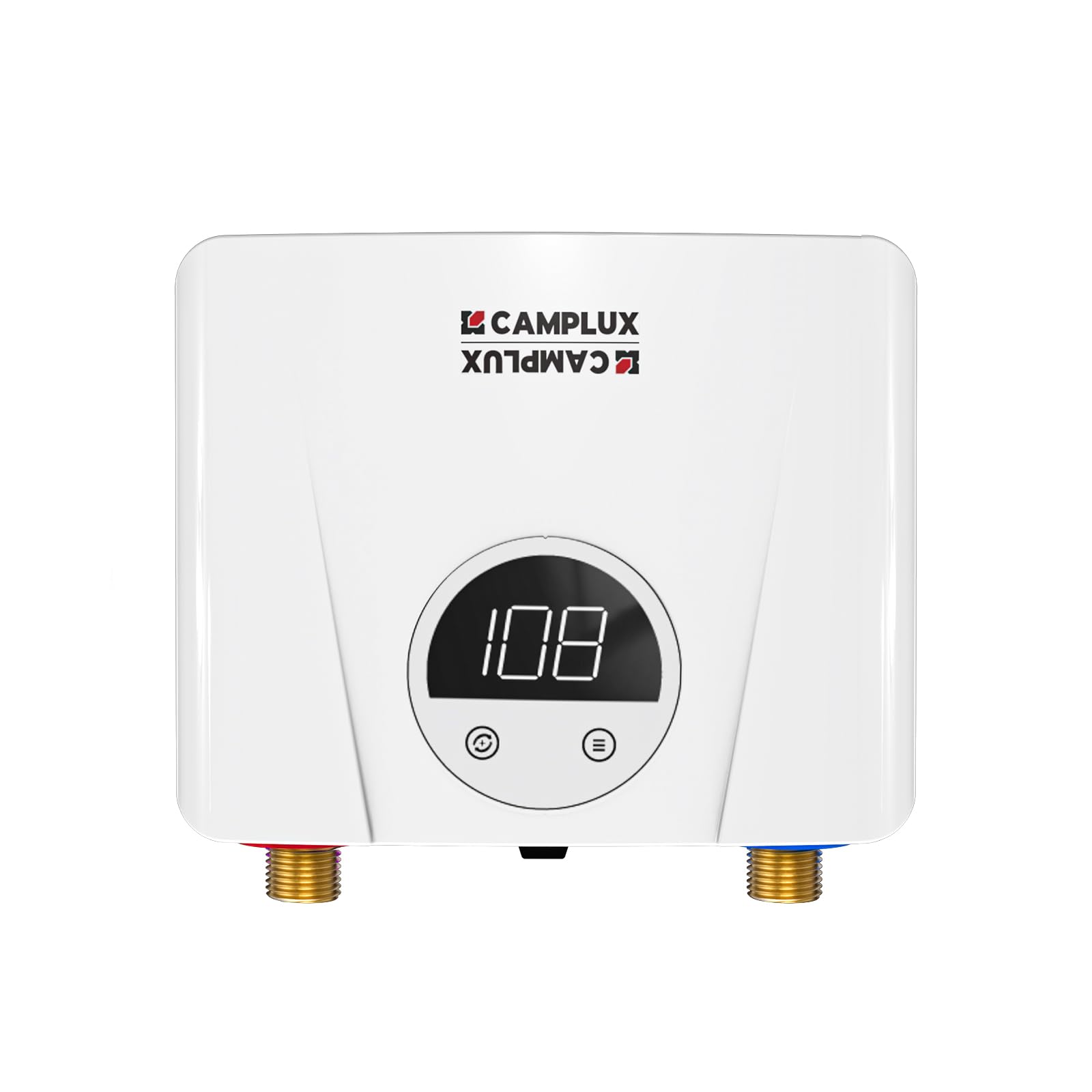
1. CAMPLUX Electric Tankless Water Heater, 3.5kW at 120 Volts
Our pick — over 4★ from 100+ verified ratings; the strongest balance of quality and price.
The 3.5kW workhorse that squeezes the most heat out of a standard circuit.
If your goal is to get the warmest water a 120V line can produce, this is the one to beat. At 3.5kW (3,500 watts of heating power), the CAMPLUX delivers the highest wattage in this lineup, and it pairs that with a self-modulating design that adjusts power input based on flow rate and your temperature setting in real time — so it is not burning full power when the tap is barely open. CAMPLUX claims up to 98% energy savings versus a tank heater, since it heats water only while the tap is running.
What wins people over is the steady performance. This is a 3.5kW@120V unit that calls for a 32A circuit breaker, a 10AWG wire size, and a 1/2″ NPT water connection, so the install is a real hardwired job — there is no plug. Once in, it activates on just 0.4 to 0.66 GPM of flow, which is exactly what you want at a single faucet. It measures a compact 7″W x 6″H, so it tucks under a cabinet without swallowing the whole space. The housing is aluminum and stainless steel, it handles up to 150 psi of pressure, and it is capped at a 131 °F maximum temperature.
The honest catch is heating performance. This heater’s whole job is to raise your water temperature at a set flow rate, and the amount of rise depends entirely on how cold your incoming water is. CAMPLUX rates it at a 22°F rise at 1.0 GPM, so a true 73°F output is realistic only when the heater serves one sink. That is not a flaw — it is the physical limit of running on 120V household current — but it means you should size your expectations to your climate, not to the marketing copy.
What You Get For The Wattage
- Highest wattage in the lineup at 3.5kW, paired with self-modulating power control that responds to flow and temperature in real time
- Low 0.4–0.66 GPM activation threshold — ideal for a single faucet that never draws heavy flow
- Full ETL certification with leakage and overheat protection, plus water and electrical lines routed separately
- Slim 3-pound body at 7″W x 6″H handles up to 150 psi and fits tight cabinet runs
- Two-year limited warranty with 24/7 customer support
Where It Asks For Patience
- Demands a hardwired setup: 32A breaker, 10AWG wire, and 1/2″ NPT connection — no plug-and-play
- The 22°F temperature rise at 1.0 GPM is modest, and cold-climate ground water keeps output lukewarm by design
- Maximum output of 131 °F means it is not a shower solution
Best when: you have one sink that needs reliable, consistent warm water and you want the most heating power a 120V line allows.
Think twice if: your heart is set on piping hot shower water — this unit’s temperature ceiling keeps it strictly a point-of-use heater.
2. Stiebel Eltron 220816 Mini 3 Tankless Water Heater

The pocket-sized pick that disappears into the tightest under-sink space.
Stiebel Eltron’s Mini 3 is the heater you choose when cabinet room is the thing that actually matters. It runs 3000 watts of heat output, and the whole body weighs 3.4 pounds. Its 1″W x 1″H footprint is by far the smallest in this comparison — against the CAMPLUX’s 7″W x 6″H, that is a 7.0x gap in the space it eats.
What makes the Mini 3 a smart buy is its straightforward, serviceable design. Mounting, wiring, and disconnecting all happen without drama, and it can sit in plain sight thanks to its polished white housing and slim profile. The build quality backs that confidence: a 7-year leakage warranty paired with a 3-year parts warranty, though the parts coverage requires a licensed installer to perform the work.
The recurring gripes are worth knowing. This is a small point-of-use heater with modest heat lift, and hot water is quick and dependable when the unit is properly wired, but the flow is low enough that some users find it only marginally warm after the initial burst. A unit like this is also prone to freeze damage if water is left inside over a bitter winter with no power. Neither issue is a defect — both are the reality of a 120V point-of-use heater.
Warranty play: the 7-year leakage / 3-year parts coverage is the standout here — just remember the parts warranty expects a licensed installer behind the work.
Install reality: the 3000-watt heating element and the small footprint make it a natural fit for a kitchen or hall bath sink, and owners find the mounting plate and flexible connection plan straightforward once the dedicated circuit is live.
Reach for this if: your under-sink space is brutally tight and you value a long warranty over raw heating power.
Look elsewhere if: you need maximum temperature rise — its modest output keeps it a warm-water, not hot-water, solution.
3. Mini Tankless Under Sink Instant Water Heater 120V 3kW Plug-in, Grey
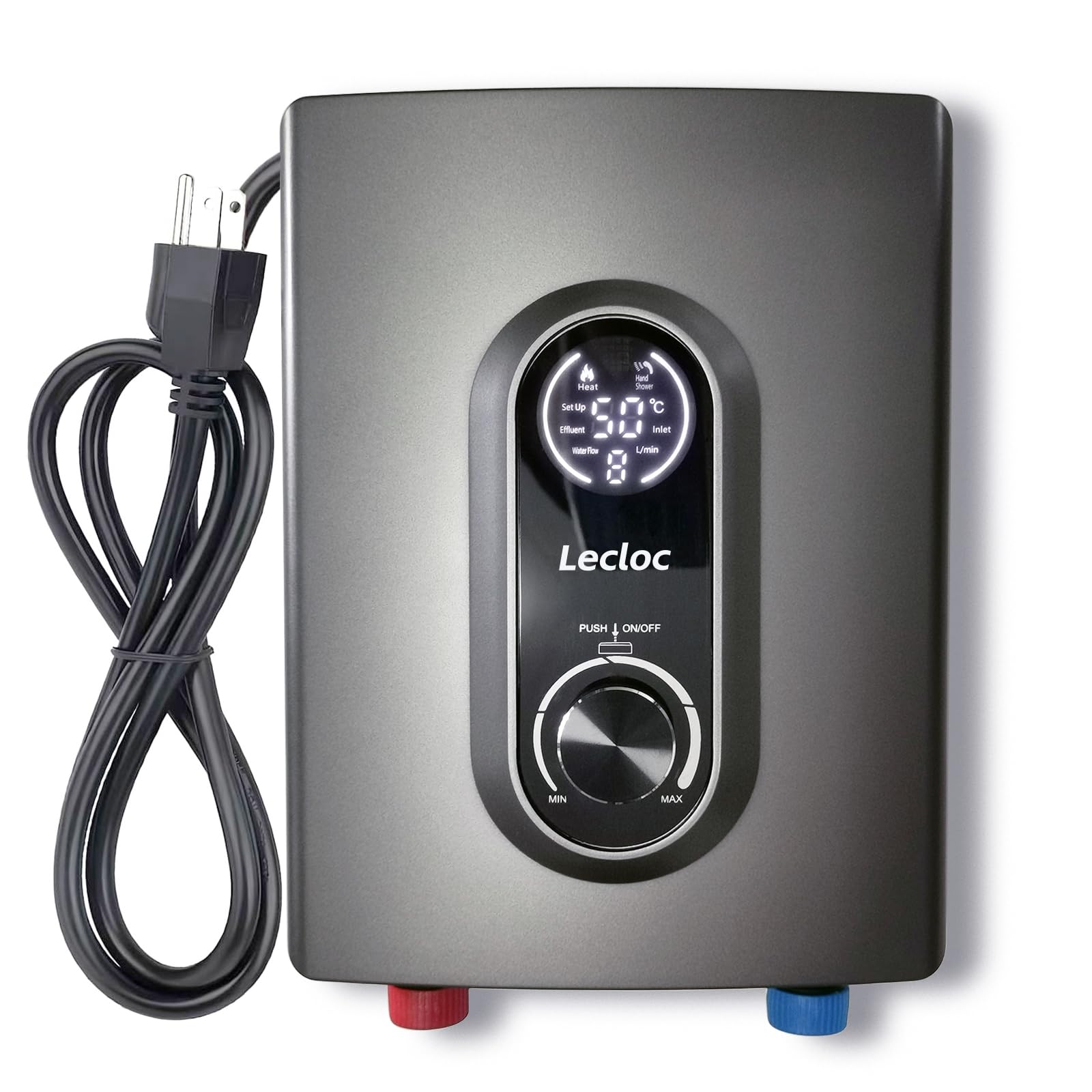
One dial, a bright display, and a heater built for one slow-flowing tap.
The LECLOC C3000 leads with its control panel. Instead of a row of tiny touchscreen buttons, it gives you one large LED digital display and a single control knob that handles both power and temperature adjustment — you can dial it anywhere between 30°C and 55°C. That single-knob layout is genuinely easier to operate with wet hands than fiddly button clusters.
On safety, this unit is loaded. It carries leakage protection, overheat protection, dry combustion protection, and high water pressure protection, wrapped in an IPX4 waterproof rating (resistant to splashes from any direction) and drop-test passed. It also logs automatic fault diagnosis and remembers your last temperature setting — a small convenience that saves re-dialing every time. The compact body measures 7.1″ x 9.8″ x 2.8″ (W x H x D) and mounts to the wall.
The main thing to understand before you buy: LECLOC is explicit that this 3kW 120V model is designed for low-flow use only and is not suitable for showers or multiple taps at once.
Smart control: a single knob for on/off and temperature is a real upgrade over multi-button panels, and the constant-temperature memory keeps your setting locked in.
Built for one sink: the 3kW element delivers 24-hour endless warm water without preheating, which suits kitchens, laundry rooms, garages, and bars — anywhere one dedicated tap lives.
Pick this one if: you want the easiest controls to use and the deepest safety feature set for a single low-flow point of use.
Choose differently if: you need to feed more than one tap — the manufacturer specifically limits this model to one point of use, not showers or multi-tap runs.
4. GE APPLIANCES 3.5 kW 120v Tankless Water Heater (GE04SNLPDG)

The only one here you can run from across the room.
GE’s take on the point-of-use heater stands out for one feature no other unit in this lineup has: a remote control. You can adjust temperature and settings on the touch screen, or change them from up to 30′ away — handy when the heater is buried behind cabinet doors. It runs 3.5 kW (3,500 watts) at 0.7 GPM, which GE specs for one faucet across climates at a 72°F inlet and 105°F outlet.
On paper the numbers are competitive. It moves 0.7 GPM, just above the CAMPLUX’s 0.66-gallon capacity, and it holds up to 150 psi of pressure. The included components are the remote control and the heater itself, and it is backed by a 5-year replacement warranty. It is also the heaviest unit here at 4.7 pounds.
Where this one asks you to temper expectations is heat output. Real-world buyers report the water warms but does not get truly hot, and that it takes the chill off a shower stream rather than delivering a steamy one. As with every 120V point-of-use heater, the ceiling on temperature rise is real, and GE’s own spec sheet pegs performance at one faucet — not a shower. The remote control is a genuine convenience; the warmth is where you should set your expectations honestly.
Standout Extras
- Remote control adjusts temperature from up to 30′ away — unique in this lineup
- Easy-use touch screen on the unit itself for on-the-spot changes
- 0.7 GPM flow rate and 150 psi pressure rating match the top performers here
- 5-year replacement warranty
Honest Limits
- Warms water rather than getting it truly hot — owners describe tepid results
- Rated for one faucet, not a shower
- At 4.7 pounds it is the heaviest pick in this comparison
Worth it when: you want remote temperature control and a long replacement warranty for a single kitchen sink.
skip it if: genuinely hot water is your priority — this unit’s job is taking the chill off, not delivering scalding output.
Understanding the Specs
Wattage and Temperature Rise
A heater’s wattage (in kW) is the amount of electrical power it turns into heat. On a 120V household circuit, that ceiling sits around 3 to 3.5kW. The practical result is the temperature rise figure — how many degrees the unit lifts the incoming water. A higher rise means warmer output, but only if the flow through the tap stays low enough for the element to keep pace.
Flow Rate and Activation
Flow rate (measured in GPM, or gallons per minute) is how much water passes through the heater. Push flow too high and the water rushes past before it heats. Devices like flow limiters restrict that rate so the heater can maintain temperature. An activation threshold — the minimum flow needed to switch the element on — matters too, since low-flow faucets can fail to trigger some units.
FAQ
Can a 120V tankless water heater run a shower?
Do I need a special circuit for a 120V tankless water heater?
Why is the water only lukewarm from my under-sink heater?
How many sinks can one 120V tankless heater handle?
What does a flow limiter do on a tankless water heater?
Is a 3kW or 3.5kW heater better for a cold-climate sink?
What safety features should I look for in a 120V water heater?
How long does a 120V tankless water heater last?
Will a 120V tankless heater lower my energy bill?
Can these heaters be plugged into a standard wall outlet?
Final Thoughts: The Verdict
For most single-sink setups, the 120v tankless water heater that balances power and affordability best is the CAMPLUX TE04N3, because its 3.5kW output and self-modulating control give you the most heating power a standard circuit allows. If you are short on cabinet room, the Stiebel Eltron Mini 3 shrinks the footprint and backs it with a 7-year leakage warranty. Want the easiest controls? The LECLOC C3000 gives you a single dial and a deep safety set. And if remote temperature control is what you are after, the GE GE04SNLPDG gives you that from up to 30′ away — just set your warmth expectations to point-of-use, not shower-level.
How We Picked
We do not accept paid placement. Every pick is matched to a real buyer and a real use-case; we do not hands-on test units.
Sources & Methodology
Specifications: manufacturer listings and product documentation. Review insights: verified customer reviews, as of September 2026. Pricing: not shown on this page (it changes often); check the current price via the retailer link.
As an Amazon Associate, Non Toxic Blog earns from qualifying purchases. This does not affect which products we feature.