Specs are compiled from manufacturer listings and verified buyer reviews and can change over time — please confirm the key details on the product page before buying.
If you are building a solar setup for a camper, cabin, or off-grid shed, the single biggest decision is the battery chemistry. Lead-acid is cheaper upfront but heavy and slow to charge, while lithium iron phosphate (LiFePO4) is light, fast, and lasts for thousands of cycles. The real question is which one fits your power needs and your budget.
I’m Mo Min — the founder and writer behind Non Toxic Blog. This guide is built by comparing the manufacturers’ published specifications and the patterns across verified customer reviews, so you get each pick’s real strengths and trade-offs instead of marketing spin.
We’ve pored over the data on capacity, weight, and protection features to bring you the most reliable 12V solar battery options for RVs, boats, and home backup the market has to offer.
Our Picks at a Glance

How To Choose The Best 12V Solar Battery
Choosing a solar battery means matching its chemistry and capacity to your real power draw. A 100Ah battery stores 1.28kWh of energy — enough to run a small fridge and lights for a day, but not a microwave or air conditioner. Start by listing what you actually need to power.
Chemistry: lead-acid vs. LiFePO4
Lead-acid batteries are the budget-friendly entry point, but they are heavy and only allow a 50% discharge. LiFePO4 (lithium iron phosphate) batteries cost more but are two-thirds lighter, can be drained to 80-100%, and handle thousands of cycles. For solar use, the weight and cycle-life advantages of lithium usually win.
Capacity: Ah and Wh
Amp-hours (Ah) tell you the battery’s charge capacity, while watt-hours (Wh) tell you the total energy. For example, a 12V 100Ah battery holds about 1,280Wh. To estimate runtime, divide that wattage by the watts your devices draw. A 100W fridge would run for roughly 12 hours on a full charge.
Protection: the BMS matters
The Battery Management System (BMS) is the safety brain that prevents overcharging, over-discharging, and short circuits. Look for a BMS with low-temperature cut-off if you live somewhere cold — it stops charging below freezing to protect the cells, which can be permanently damaged otherwise.
Quick Comparison
| Model | Best For | Chemistry | Weight | Capacity | Amazon |
|---|---|---|---|---|---|
| WEIZE 100Ah Group 31★ Best Overall | Budget lead-acid replacement | Lead Acid (AGM) | 63 lb | 100 Ah | Amazon |
| DUNFUME 100Ah Group 31Best Value | Value lithium upgrade | LiFePO4 | 21.6 lb | 100 Ah | Amazon |
| HQST 100Ah Group 22NFLongest Warranty | 10-year longevity | LiFePO4 | 22 lb | 100 Ah | Amazon |
| yeagulch 150Ah | Extended runtime | LiFePO4 | 41.03 lb | 150 Ah | Amazon |
| Mighty Max ML100-12 | Simple SLA setup | Lead Acid (SLA) | 28 lb | 100 Ah | Amazon |
| Dyness AR1.2-BT | Bluetooth monitoring | LiFePO4 | 25.3 lb | 100 Ah | Amazon |
| ECO-WORTHY 100Ah | Smart app + display | LiFePO4 | 25.1 lb | 100 Ah | Amazon |
| yeagulch 100Ah 2-Pack | Dual-battery installs | LiFePO4 | 21.6 lb ea. | 100 Ah | Amazon |
| Dyness AR1.2 2-Pack | Premium dual-bank | LiFePO4 | 25.3 lb ea. | 100 Ah | Amazon |
In-Depth Reviews
1. WEIZE 12V 100Ah Deep Cycle Battery
Our pick — 4.5★ from 450+ verified ratings; the strongest balance of quality and price.
The dependable lead-acid workhorse that keeps your RV essentials running all night.
This WEIZE is a sealed lead acid (AGM — absorbed glass mat) battery built for deep-cycle jobs like RVs, trolling motors, and off-grid systems. It delivers a 1150A max discharge current, so it can handle a big surge when you need it. The spill-proof, maintenance-free design means you never have to check water levels — install it and forget it.
You can trust this battery to run your rig for days — it earned 4.5 stars across 490+ owners. One motorhome owner said: “Used it as a replacement house battery for my motor home its been that factory install one.” Others report it powered 18 interior LED lights and 3 vent fans for over 20 hours without recharging. The trade-off is the 63-pound weight — you will feel it when carrying it into place.
At 63 pounds, it is nearly three times heavier than a typical 22-pound LiFePO4 battery like the HQST below. That weight is the price of the budget-friendly lead-acid chemistry. For a stationary setup in a cabin or shed, it’s a non-issue. For a camper where every pound counts, you may want to look at lithium instead.
What owners love
- Built quality is the most-praised feature, with 63 buyers highlighting it
- Holds a charge well — 51 owners call out the battery life
- Good value for money, noted by 40 owners
The trade-offs
- Heavy at 63 pounds — a few owners find it difficult to move
- Lead-acid limits you to about 50% usable capacity
Who it suits: Budget-minded buyers with a stationary solar setup who want a proven, no-maintenance lead-acid battery.
Reality check: It’s heavy — plan where it sits before you buy, because you won’t want to move it often.
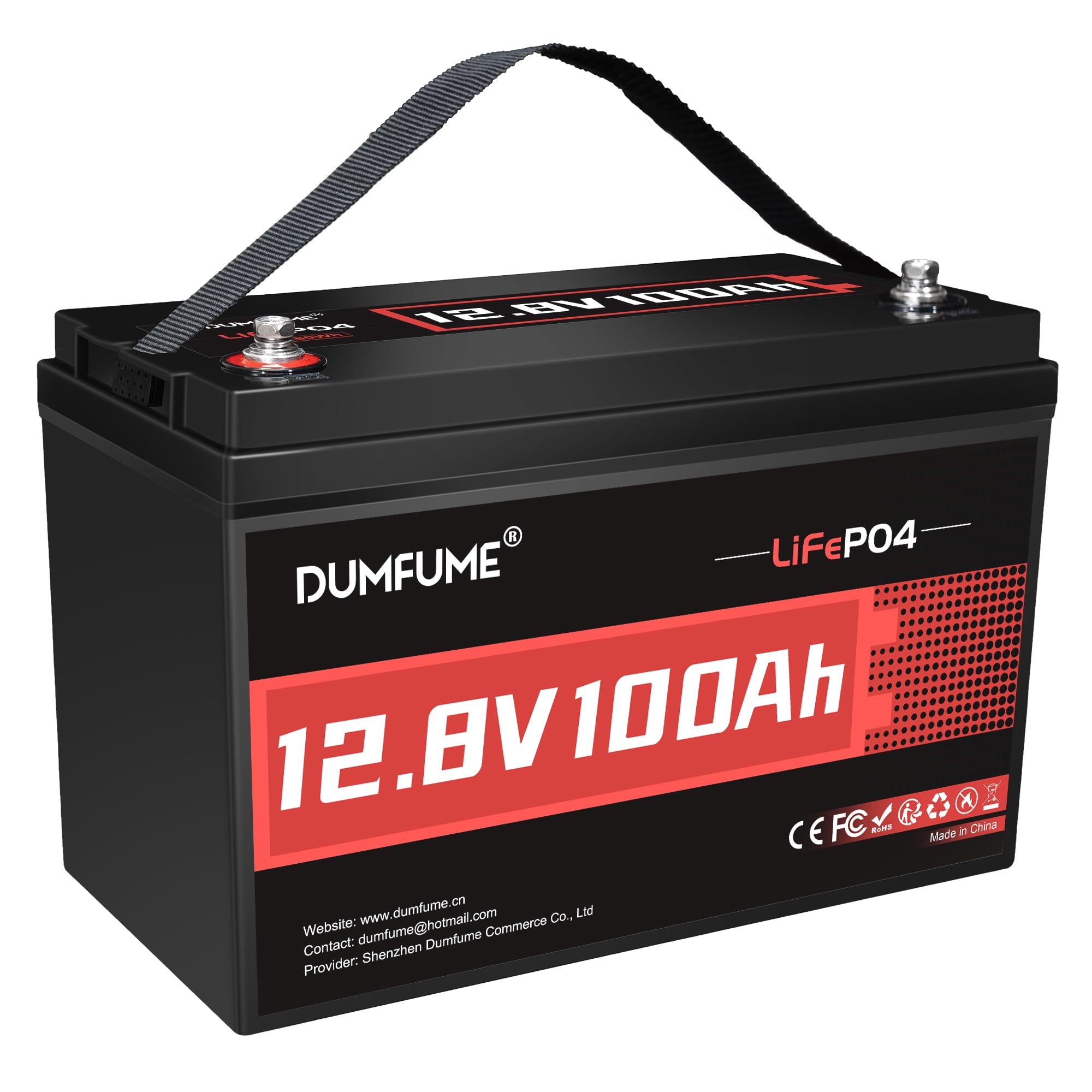
2. DUNFUME 12V 100Ah LiFePO4 Battery
A featherweight lithium upgrade that slashes 42 pounds off your existing lead-acid bank.
This DUNFUME is a 100Ah lithium iron phosphate (LiFePO4) battery that weighs just 21.6 pounds — fully two-thirds lighter than the 63.9-pound lead-acid equivalent. It packs 1.28kWh of energy with a 40% increase in energy density over standard cells, so you get more usable power in a smaller footprint. The built-in 100A BMS protects against overcharging, over-discharging, and short circuits.
The performance story is strong: it works well even on just 100 watts of solar, as a Scamp camper owner reported: “So far so good. Working good on my Scamp Camper whit 100 watts solar on the roof.” The 1280Wh capacity and 7.5X higher energy density than a 70Ah AGM means it delivers more usable energy at a fraction of the weight. The 763 reviews back up its popularity, though a few buyers report charging quirks.
The honest caveat is that “won’t fully charge” appears in the review mix — some units need a jump from a charged LiFePO4 to wake up. It’s a known lithium quirk, not a widespread failure. For the price, you get a genuine lithium upgrade that’s 42.3 pounds lighter than the WEIZE while holding the same 100Ah capacity.
Editor’s read: This is the value pick — you get lithium performance at a near lead-acid price. The 100A BMS (a battery management system that protects against overcharge and over-discharge) and A-grade cells give you confidence without the premium markup.
Reach for this if: You want lithium’s weight savings and cycle life without paying flagship prices.
Look elsewhere if: You need guaranteed first-charge reliability — a minority of units arrive needing a wake-up jump.
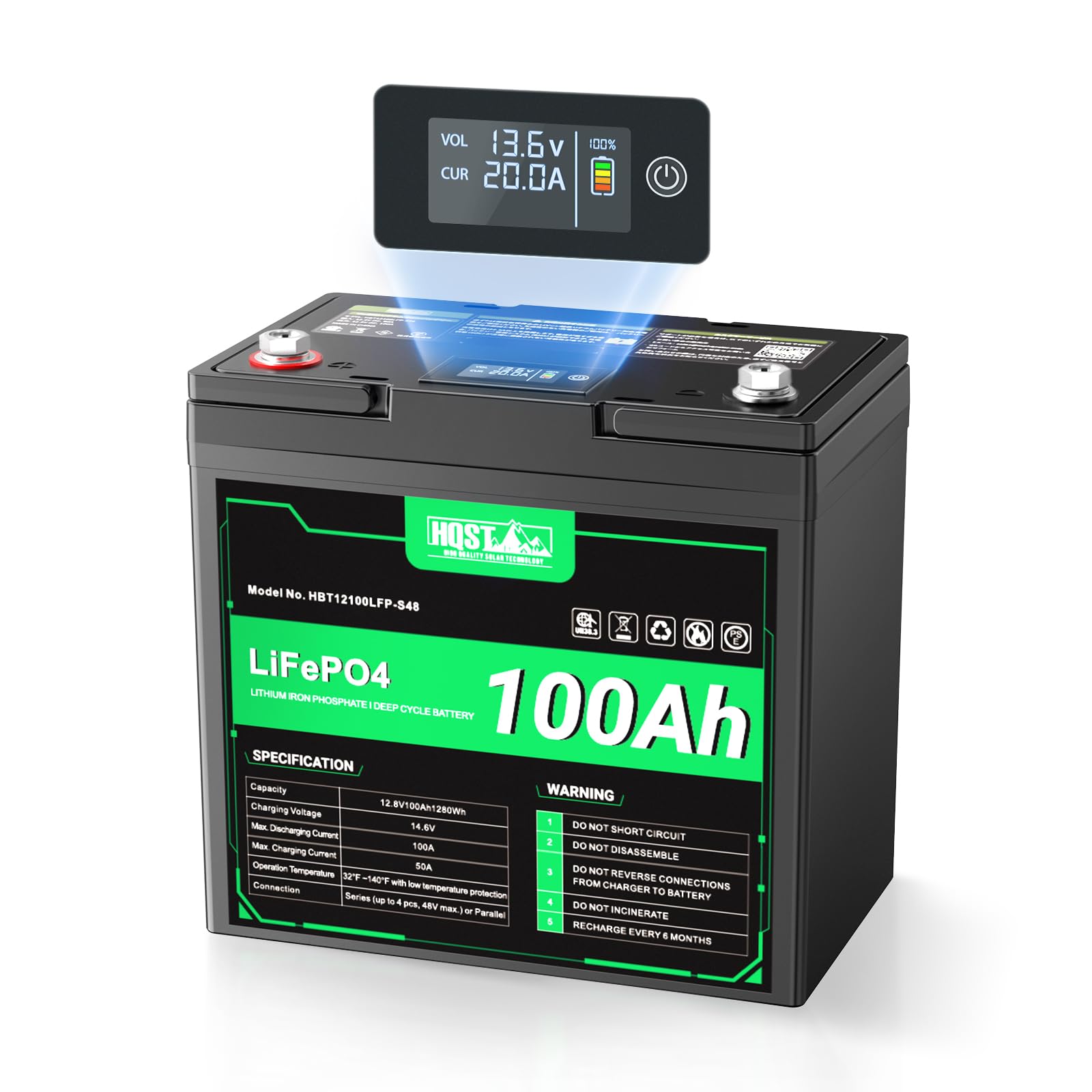
3. HQST 12V 100Ah LiFePO4 Battery
The 22-pound lithium pick that backs its 4000+ cycles with a decade-long warranty.
The HQST stands out for its 10-year warranty — a rare commitment that signals confidence in its A-grade LiFePO4 cells. It delivers 1,280 Wh (watt-hours — the total energy it can store) with up to 100A continuous discharge, making it strong enough for trolling motors and off-grid systems. Its dimensions of 13.07 x 6.77 x 8.66 inches are nearly identical to the WEIZE’s footprint, but at 22 pounds it’s a dramatic 41 pounds lighter.
What wins people over is the battery life — the most-cited positive across its reviews. Owners mention running a 1500W stovetop, coffee maker, and diesel heater through a 2000W inverter, then seeing the charge hold at 82-90% before a 40-minute drive tops it back up. The low-temp protection stops charging below 23℉ and above 140℉, so the cells stay safe in both RV winters and hot cabins.
The 10-year warranty is the headline, but the support story is just as good — a boat owner with a charging issue had the battery exchanged after sending videos to customer service. That combination of longevity and responsive support makes this the pick for buyers who plan to keep their system for a decade.
Why it wins: The 4000+ deep cycles and 10-year warranty mean this could be the last battery you buy for your setup — it lasts 6x longer than lead-acid, per the manufacturer.
Best for: Long-term owners who want warranty-backed confidence and plan to leave the battery untouched for a decade.
Think twice if: You need a golf cart battery — this one is explicitly not suitable for that use.
4. yeagulch Upgrade 12V 150Ah LiFePO4 Battery
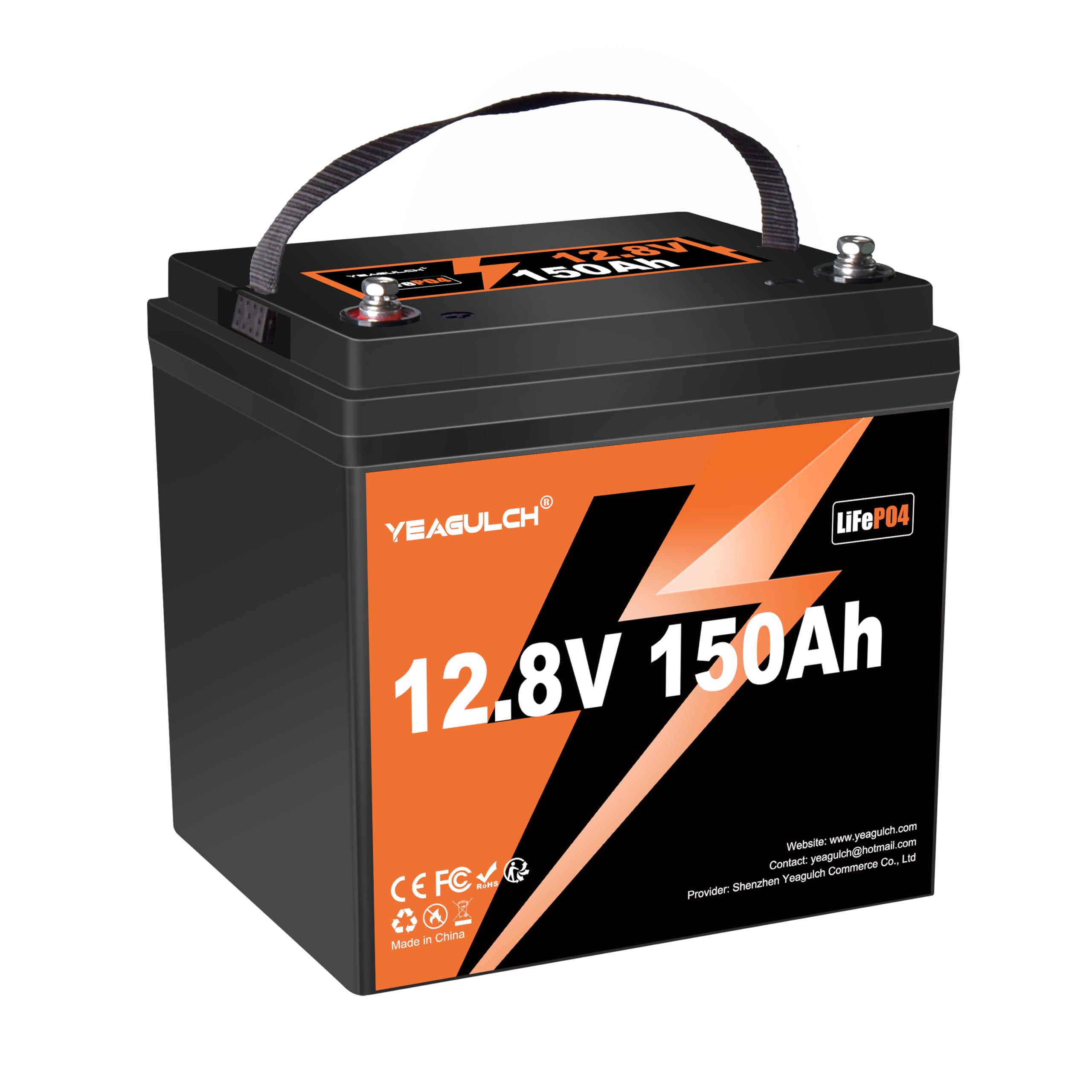
The high-capacity lithium battery that keeps a trolling motor running all week.
This yeagulch packs 150Ah of capacity into a compact 10.01 x 7.68 x 9.84-inch case weighing 41.03 pounds. That’s more stored energy than any 100Ah pick here, with a rated 1290Wh capacity. The 100A BMS includes low-temperature cut-off that stops charging at 32°F and high-temperature cut-off at 149°F, protecting the cells in extreme conditions.
The reliability reputation is the standout — the most-praised aspect with 45 owners highlighting it. One pontoon owner reported pulling the boat around the lake all week and still having half a charge left. Another ran it for six months at full power charging from solar in about half a day. It’s built to take a beating and keep delivering.
Unlike the 100Ah options, this one is sized for bigger draws — like a trolling motor that drains a battery in a few hours. The 1290Wh capacity gives you 50% more runtime than a standard 100Ah unit. The trade-off is the 41-pound weight, which is heavier than other lithium picks but still far lighter than a lead-acid equivalent.
Built for endurance
- Reliability is the top praise — 45 owners highlight it
- Holds charge for long periods, per the battery life reviews
- Compact size fits tight RV and boat compartments
Noted limitations
- Some customers note inconsistent charge-holding
- No Bluetooth monitoring — check voltage via a shunt or solar controller
Who it beats: Standard 100Ah batteries for anyone who wants extended runtime between charges.
Not for: Starting engines — the manufacturer explicitly says not to use it for starting devices or golf carts.
5. Mighty Max Battery 12V 100AH

A UL-certified, 28-pound sealed battery that powers a shed’s LEDs and a van’s house loads alike.
The Mighty Max ML100-12 is a sealed lead acid (SLA) battery that’s 28 pounds — far lighter than the 63-pound WEIZE, despite the same 100Ah capacity. It’s UL certified, which means it’s passed independent safety testing. The AGM construction is spill-proof and can be mounted in any position, resisting shocks and vibration.
For solar duty, it performs well — one owner ran a 32″ TV and Roku on a 500W inverter for 4 hours and drained only 1%. Another reported it powers all LED lighting in their shed and runs a fridge, fan, and lights without issues. The battery also survived 3 years in a 400W solar system with 200Ah of storage, still running fine.
The catch is the return policy — if you get a defective unit, shipping a 60-pound battery back via UPS hazardous materials costs money. The manufacturer does offer a one-year warranty, but you may cover return shipping. For the price, though, it’s a solid, proven SLA with a lighter footprint than most lead-acid rivals.
Editor’s take: A dependable, lighter lead-acid option that solar owners have trusted for years. The UL certification (a safety standard from Underwriters Laboratories) adds confidence that budget SLA (sealed lead-acid) units lack.
Reach for this if: You want a proven, lighter SLA battery without paying for lithium.
Reality check: Returns are costly due to hazardous shipping — inspect it carefully on arrival.
6. Dyness 12V 100Ah Bluetooth LiFePO4 Battery
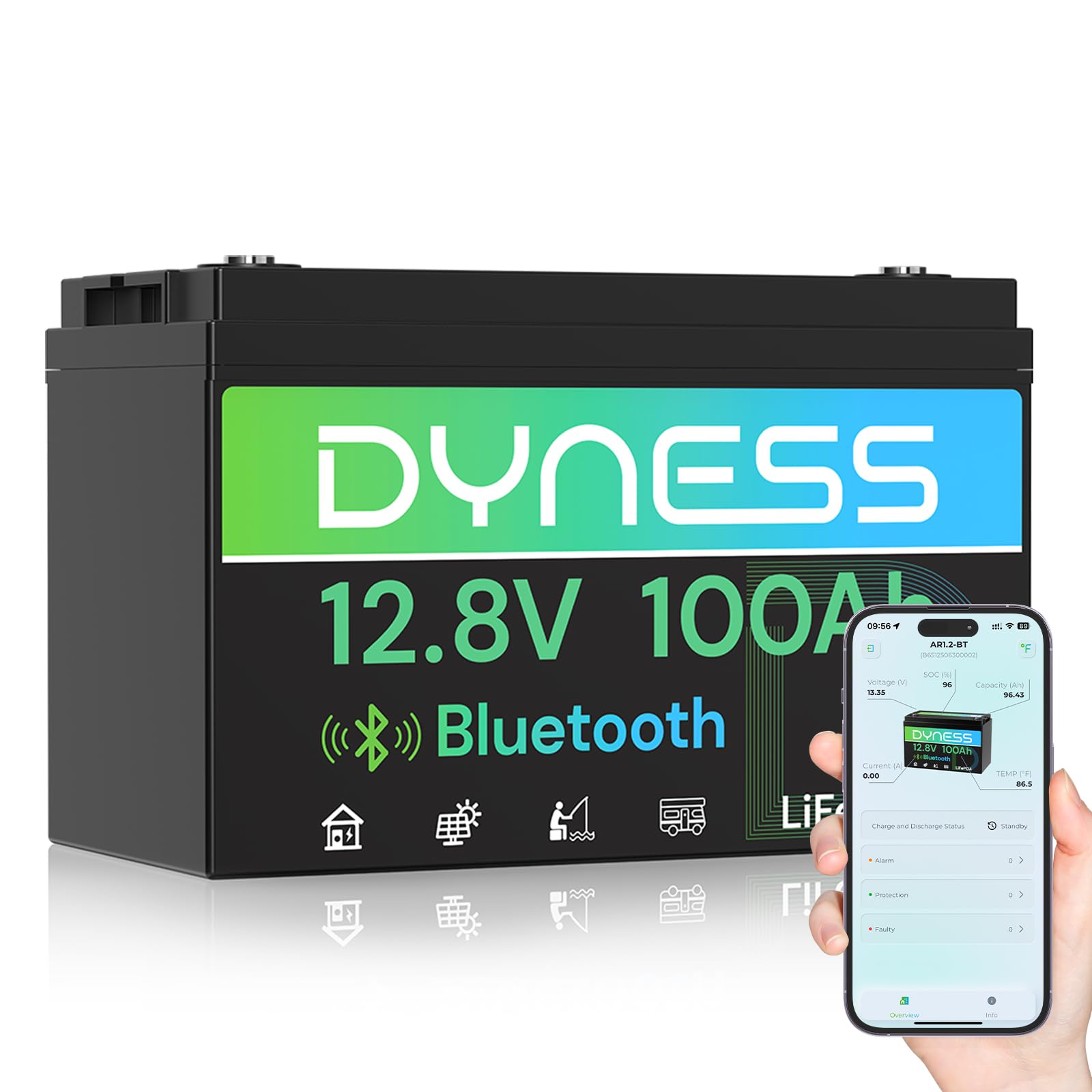
The Bluetooth-equipped battery that shows you every volt from your phone — no guesswork.
The Dyness is a 100Ah LiFePO4 battery with Bluetooth 5.0, letting you monitor voltage, current, and capacity in real time through the “Dyness” app. At 25.3 pounds, it’s a manageable lift and significantly lighter than any lead-acid. It delivers 1280Wh of energy with a 4000+ deep-cycle rating from A+ grade cells.
You can check each battery’s status from your phone — the Bluetooth monitoring is the defining feature. Owners love seeing what each battery is doing in a multi-battery bank. One owner with a bank of 4 reported that Dyness tech support patiently helped balance them, calling the support “so patient and helpful.” The app shows state of charge, charge/discharge current, and temperature, so you always know what’s happening.
Winter protection is built in: charging automatically disconnects below 32°F (0°C) and resumes at 41°F (5°C), and power cuts off entirely at -4°F (-20°C). That makes it a strong choice for cabins and off-grid setups in cold climates. The 10-year lifespan and 4000+ cycles mean it should outlast your solar panels.
Why it stands out: The Bluetooth app turns battery monitoring from a mystery into a live dashboard — the most-cited reason owners pick it over dumb batteries.
Best for: RV and cabin owners who want live status on their phone and worry about winter charging.
Note: Stay within 10 meters of the battery for the Bluetooth connection to work.
7. ECO-WORTHY 12V 100AH LiFePO4 Battery
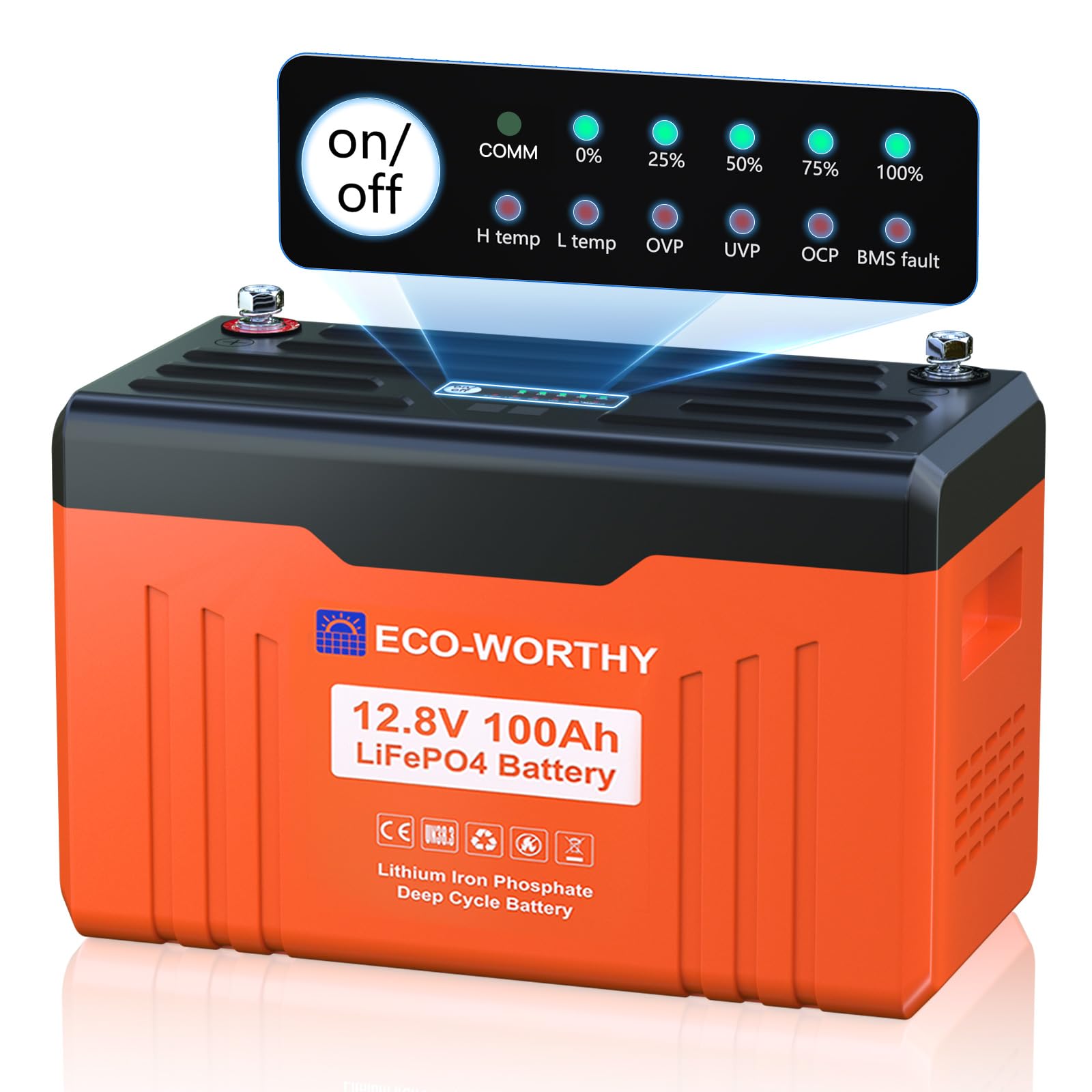
A battery that talks back — LED display on the unit and a full app on your phone.
The ECO-WORTHY is a 100Ah lithium battery with a built-in LED panel that shows state of charge (SOC) at a glance — no app needed for basic checks. It also has Bluetooth for deeper monitoring through the ECO-WORTHY app within 98 feet. At 25.1 pounds with dimensions of 11.8 x 6.9 x 8.7 inches (Group 27), it’s compact and portable.
Safety is a theme here: it’s passed over 15 strict tests and has a built-in buzzer that alerts you instantly to BMS faults. A metal fixture secures the cells to prevent expansion and short circuits. The 100A BMS includes low-temperature protection, making it winter-ready for trolling motors, RVs, and solar systems.
The smart features earn strong praise — one owner using it for HAM radios and clearance lights found the “Bluetooth status monitor is very handy.” A pontoon boat owner ran four of these for a year including winter with zero issues. The one honest caveat: the app’s state-of-charge reading can be inaccurate at very low loads under 1A (one amp), so keep an external voltmeter handy for precise checks.
Smart safety net
- Quality construction is the top praise — 24 owners highlight it
- Buzzer alerts you to BMS faults instantly
- LED display needs no phone for basic SOC checks
Watch out for
- Bluetooth app can misread SOC at loads under 1A
- May arrive with a low charge — normal per shipping rules
Who it suits: Tech-minded owners who want both an on-unit display and phone monitoring.
Keep in mind: Use the display for quick checks, but trust a voltmeter for precise state-of-charge readings.
8. yeagulch 2 Pack 12V 100Ah LiFePO4 Battery
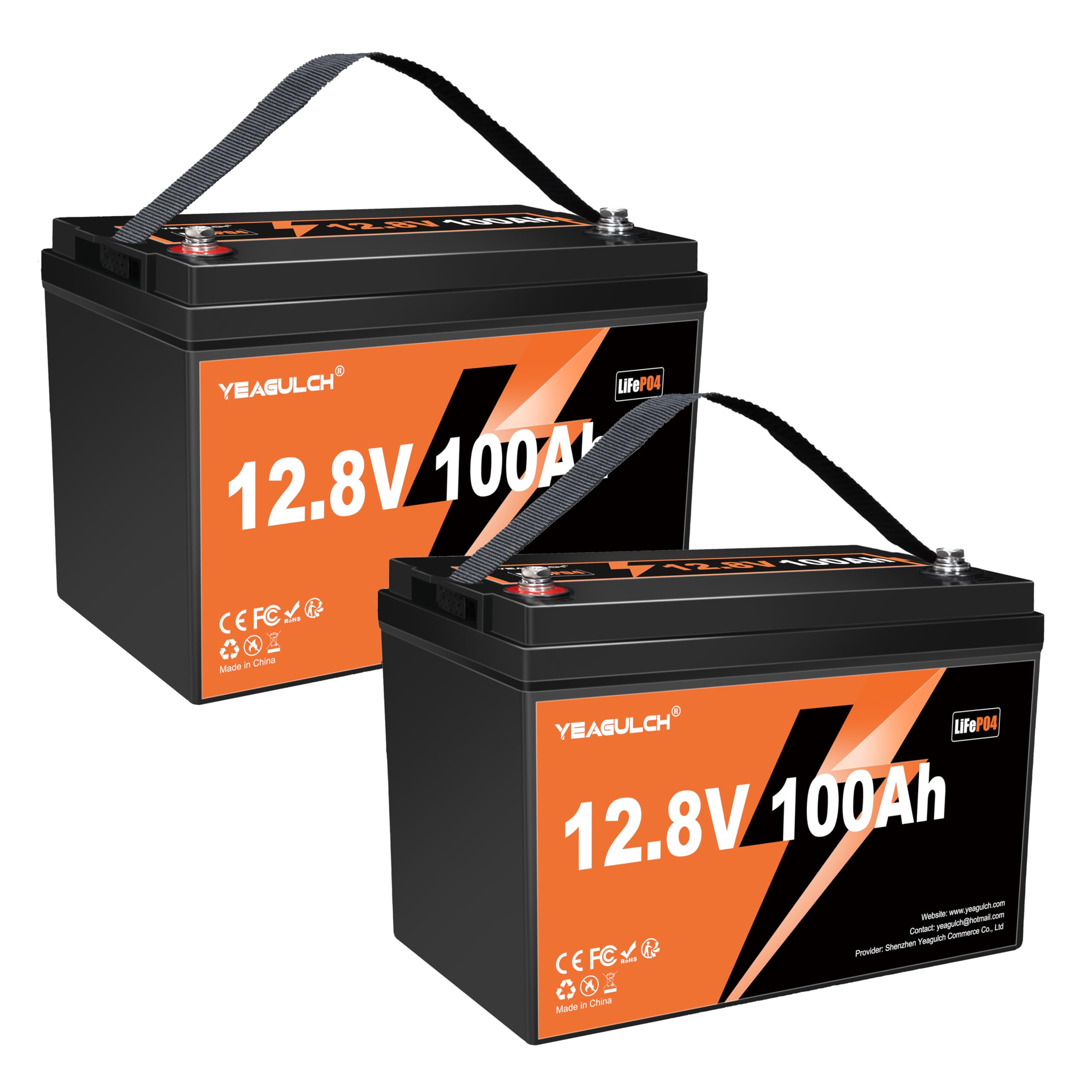
Two identical 21.6-pound lithium batteries that give you a full 200Ah bank right from the start.
This is a 2-pack of 100Ah LiFePO4 batteries — a 200Ah bank in one box. Each weighs just 21.6 pounds, which is two-thirds lighter than comparable lead-acid. The headline spec is 95% usable capacity, meaning you can drain it to nearly empty without damage, compared to just 50% for lead-acid. That flat discharge curve delivers longer runtime per charge.
Owners are impressed with the power difference — one called the upgrade over lead-acid “night and day.” An 80-pound trolling motor ran through 4+ outings on a 10-foot pontoon with a 10% speed boost thanks to the lighter weight. The charging speed gets mixed reviews — some report fast charges with a 40A (40-amp) charger, while others note a full first charge can take up to 10 hours.
Each battery supports 4000+ cycles at 100% depth of discharge, with a lifespan up to 10 years. The 95%* efficiency at 12.8V 100A means you get nearly every watt-hour you paid for. The 2-pack format is ideal for parallel setups — wire both together for 200Ah of capacity in a space that would barely fit one lead-acid battery.
Why the 2-pack wins: You save on per-battery cost and get matched cells for a balanced parallel bank — the battery life is the top praised aspect.
Reach for this if: You need a 200Ah bank for an RV or off-grid cabin and want matched batteries.
Note: Don’t use these in high-power trolling motors above 700W — the manufacturer advises against it.
9. Dyness 12V 100Ah LiFePO4 Battery (2 Pack)
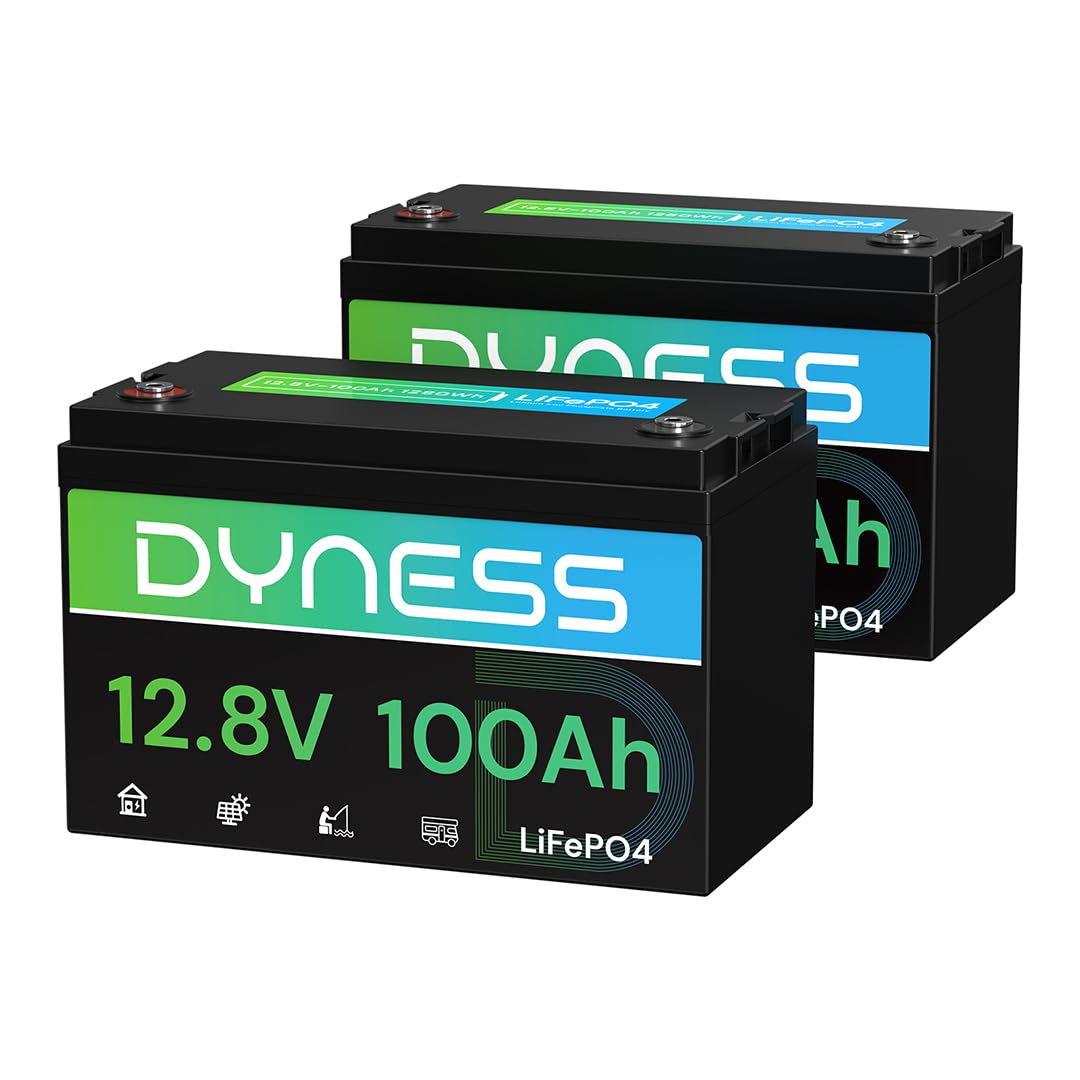
A certified, IP65-rated lithium pair that shrugs off salt spray and freezing winters.
This Dyness 2-pack brings premium certifications to the table — FCC, CE, RoHS, and UN38.3 — along with IP65 waterproofing that resists dust and salt spray. Each 100Ah battery weighs 25.3 pounds and holds 1.28kWh of energy. The 100A BMS delivers full protection against overcharging, over-discharging, overcurrent, and overheating.
The build quality is the top praised aspect, and the certifications back it up. Owners call them “light weight and work as should” with one noting they’re “a great replacement for older deep cycle battery.” Another reported they run all normal camper equipment and last two to four times longer than lead-acid. The low-temp charging protection — disconnecting below 32°F and resuming at 41°F — makes them winter-proof.
It’s the most premium-feeling option here, with a nearly 50% smaller footprint and over 65% lighter weight than equivalent lead-acid. The A+ grade cells are individually tested, with production parameters you can trace. For a permanent off-grid install where reliability is everything, this is the pair to buy once and trust for a decade.
Premium build
- Build quality is the most-praised aspect — 17 owners highlight it
- IP65 waterproofing resists salt spray for marine use
- Certified to FCC, CE, RoHS, and UN38.3 standards
Consider first
- Larger footprint may not fit every battery tray — one owner had to relocate
- No Bluetooth on this model, unlike the single Dyness
Who it’s for: Serious off-grid owners who want certified, weatherproof batteries that outlast their lead-acid days.
One thing to know: Check your battery tray dimensions first — this pair is slightly larger than a standard Group 24 spot.
Understanding the Specs
Amp-Hours (Ah) and Watt-Hours (Wh)
Amp-hours tell you the battery’s capacity — how much charge it holds. Multiplied by the 12V voltage, you get watt-hours, the total energy. A 100Ah battery holds about 1,280Wh. To estimate runtime, divide that by your device’s wattage: a 100W fridge runs about 12 hours on a full 100Ah charge.
Depth of Discharge (DOD)
DOD is how much of the battery’s capacity you can safely use before recharging. Lead-acid batteries allow about 50% DOD — drain them deeper and you shorten their life. LiFePO4 batteries allow 80-100% DOD, which means you get nearly double the usable energy from the same rated capacity.
FAQ
How long will a 12V 100Ah battery run a fridge?
Can I use a 12V solar battery to start my engine?
What is the difference between LiFePO4 and lead-acid for solar?
Why does a LiFePO4 battery need low-temperature protection?
How many cycles will a 12V solar battery last?
Can I connect multiple 12V batteries together?
What size solar panel do I need to charge a 100Ah battery?
Will a 12V solar battery fit in my RV’s battery compartment?
Final Thoughts: The Verdict
Across the board, the 12v solar battery winner is the WEIZE 100Ah because it delivers proven, reliable deep-cycle performance at a budget-friendly price, backed by the strongest owner reputation in the lineup. If you want a lighter lithium upgrade that slashes weight by over 40 pounds, grab the DUNFUME 100Ah. And for a decade-long warranty with premium build quality, the HQST 100Ah is the one to reach for.
How We Picked
We do not accept paid placement. Every pick is matched to a real buyer and a real use-case; we do not hands-on test units.
Sources & Methodology
Specifications: manufacturer listings and product documentation. Review insights: verified customer reviews, as of September 2026. Pricing: not shown on this page (it changes often); check the current price via the retailer link.
As an Amazon Associate, Non Toxic Blog earns from qualifying purchases. This does not affect which products we feature.