Specs are compiled from manufacturer listings and verified buyer reviews and can change over time — please confirm the key details on the product page before buying.
Short answer first: for most people the EPEVER 30A MPPT is the one to buy, because it handles both 12V and 24V banks automatically and its tracking squeezes usable current out of weak morning sun. A charge controller sits between your solar panel and your battery, and its whole job is to stop the panel from overfilling the battery while pushing in as much usable current as it can. Get that wrong and you either boil a battery dry or leave half your panel’s output on the table.
I’m Mo Min — the founder and writer behind Non Toxic Blog. This guide is built by comparing the manufacturers’ published specifications and the patterns across verified customer reviews, so you get each pick’s real strengths and trade-offs instead of marketing spin.
The two technologies you will see named on every box are PWM (pulse width modulation, which simply switches the panel straight onto the battery) and MPPT (maximum power point tracking, which actively hunts for the panel’s best operating voltage). If you are wiring a camper, a boat, or a shed panel, this is the shortlist of 12v solar charge controller options worth your money.
Our Picks at a Glance

How To Choose The Best 12V Solar Charge Controller
Most first-time buyers get burned by the same three things: buying PWM when their panel voltage is far above their battery’s, sizing the amperage by panel watts alone, and trusting a display that reads a few tenths of a volt off. Get those right and everything else is preference.
MPPT or PWM — the one decision that matters most
An MPPT controller converts the panel’s higher voltage down to what the battery wants, which is why it can deliver noticeably more current from the same panel, especially in thin light. A PWM controller simply gates the panel to the battery. PWM is cheaper and perfectly fine for a small panel running close to battery voltage, but it wastes the headroom on a 30V or 36V panel.
Sizing amperage to your panel and bank
A controller’s amperage rating caps the charging current it can push to the battery. Pair a 30A controller with a 12V bank and it comfortably feeds a modest roof panel, and the same unit on a 24V bank handles roughly double the panel wattage at the same amperage. Undersize the controller and it just clips the current you paid for.
Battery chemistry, presets, and user modes
Charge profile is where the real damage happens. Lithium chemistries want their low-temperature cutoff respected and their absorption voltage set deliberately, while lead-acid banks are far more forgiving. Controllers that lock a LiFePO4 profile behind a fixed number give you fewer ways to get it wrong — and fewer ways to get it right.
Quick Comparison
| Model | Best For | Max PV Input | System Voltage | Type | Amazon |
|---|---|---|---|---|---|
| EPEVER MPPT 30A Tracer★ Best Overall | Camper and RV banks | 390W at 12V | 12V / 24V auto | MPPT | Amazon |
| Bateria Power SunRock 10Best Value | Motorcycles and boats | 150W, 30Voc max | 12V only | MPPT | Amazon |
| Victron BlueSolar PWM 10ASimplest Setup | Set-and-forget simplicity | — | 12V / 24V | PWM | Amazon |
| Renogy Voyager 20A | Wet, exposed installs | 55V PV input | 12V / 24V auto | PWM | Amazon |
| Renogy Adventurer 30A | Flush wall mounting | — | 12V / 24V auto | PWM | Amazon |
| Bateria Power Sunrock 20Pro | Phone-app monitoring | 60V max | 12V / 24V | MPPT | Amazon |
| PowMr 60A MPPT | Big multi-panel arrays | 720W at 12V | 12V / 24V / 36V / 48V | MPPT | Amazon |
| BougeRV Sunflow 30A MPPT | Cold-climate LiFePO4 | 450W at 12V | 12V / 24V | MPPT | Amazon |
| LiTime 30A MPPT | Hands-off off-grid systems | 450W at 12V | 12V / 24V | MPPT | Amazon |
In‑Depth Reviews
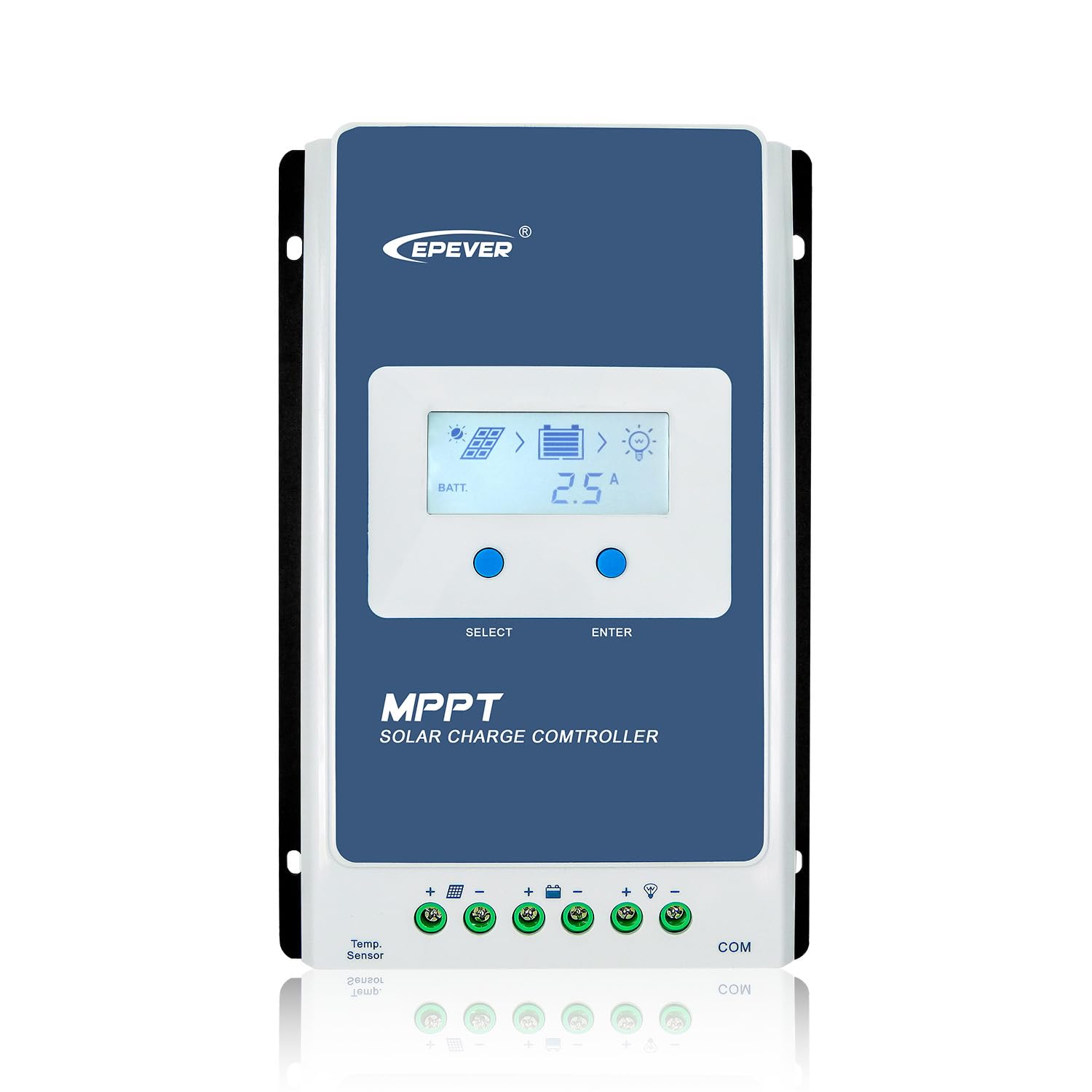
1. EPEVER MPPT Solar Charge Controller 30A 12V 24V Auto Max PV 100V
Our pick — 4.5★ from 200+ verified ratings; the strongest balance of quality and price.
The camper-grade workhorse that starts pulling current the moment the sun cracks the horizon.
If you are running a roof panel over a deep-cycle bank and want one box that just does the job, this is the pick. It handles a 390W panel array on a 12V battery, and because it also auto-recognizes 24V systems, you can double your panel wattage to 780W later without buying a second controller. The maximum power point tracking here is rated higher than 99.5% efficient, which in plain terms means it loses almost nothing while converting your panel’s voltage down to what the battery actually wants.
What wins people over is simply that it functions — the camper crowd is the loudest group here, and the recurring theme is a unit that starts charging early and keeps two deep-cycle batteries topped up. One verified owner put it this way: “I have 100 watts of sola on my roof and this unit starts putting out power with the crack of the morning sun.” A separate build running a 450Ah lead-acid bank off a 320W panel reports it charging up to 21A in full sun when the bank is depleted, which is exactly the headroom you want on a hard-drawn system.
Two things to plan for. First, this is a physically substantial unit — it measures 8.98″ long by 6.46″ wide by 2.17″ tall, and at roughly a 2.4x larger footprint than the little Bateria Power SunRock 10 below, it needs real wall or bulkhead space rather than a cramped corner. Second, the setup depth is the trade-off: the manual assumes some familiarity with LiFePO4 parameters, and the menu carries more options than a beginner will know what to do with. The practical fix is to enable the temperature compensation, pick your preset, and leave the rest alone.
What earns its place on the shortlist
- Auto-detects 12V or 24V banks, so it grows with your system
- Rated tracking efficiency above 99.5% and up to 98% DC/DC conversion
- Handles Gel, AGM, Flooded, Sealed, LiFePO4 (4s/12V; 8s/24V) and Li(NiCoMn)O2 packs
- RS485 port opens the door to MT50, WiFi, BLE or USB monitoring later
- Overheating power reduction and charging current limitation built in
Where it asks more of you
- The manual leaves beginners guessing on LiFePO4 setup and screen options
- Large footprint for a 30A unit — measure your mounting space first
- Built-in Bluetooth is not standard; monitoring accessories are separate
Buy it if: you run a camper, RV, or home bank and want a 30A MPPT that scales from 12V to 24V on the same hardware.
Think twice if: you want a phone app in the box or a two-button setup you can master in five minutes.
2. 10Amp 12 Volt MPPT Solar Charge Controller, Bateria Power Intelligent Portable Solar Panel Controller (SunRock 10)
Palm-sized MPPT charging that stays bolted to a motorcycle or boat battery all season.
At 145 g and roughly 3.7″ by 2.42″ by 1.06″, this is the controller you buy when the battery lives somewhere awkward — under a seat, in a lazarette, on a trickle-tender shelf. That compactness is a real advantage, not a nicety: the EPEVER above occupies a 2.4x larger footprint, and this one slips into spaces the bigger unit simply cannot go. It caps out at a 150W panel with a maximum 30Voc (open-circuit voltage, meaning the panel’s unloaded voltage reading), so it is built for a single modest panel, not a roof array.
Where it earns its keep is charging behaviour. Buyers report 30-40% more charge than a comparable PWM unit, and one 1,700cc high-compression engine started after six months on nothing but a 35W panel. The plug-and-play SAE connector plus two included 130mm SAE extension cables means you can disconnect the panel and walk away without unscrewing terminals. It is also built to handle rain and spray, though the maker’s own note advises against soaking it in standing water.
Set expectations on two fronts. The meter is not lab-grade — it can read 100-400mV off true, and it stops charging at 14.4V rather than 14.6V for LiFePO4, which matters if you like squeezing the last few percent into a lithium pack. There are also no adjustable charge settings at all. Then there is the connection rule nobody should skip: battery first, panel second, and never hook this to a battery above 12V.
The honest read: a genuinely compact MPPT that keeps stored batteries healthy, with the trade being a fixed charge profile and a meter you should treat as a guide rather than a reference.
One more thing worth knowing: it runs a three-stage charge sequence (Equalize, Float, Boost) and covers the usual protection set — over charge, over temperature, over voltage, over current, short circuit, discharge and reverse polarity.
Reach for this if: you are maintaining motorcycle, boat, or seasonal batteries and want MPPT efficiency in a pocket-sized housing.
Look elsewhere if: you need user-tunable charge voltages or want to run a panel array beyond a single 150W unit.
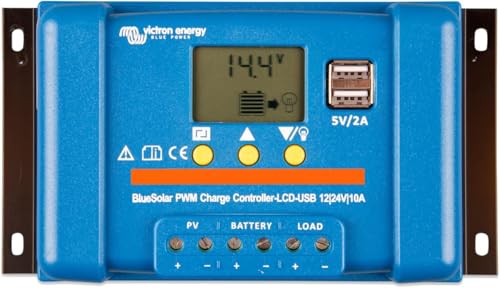
3. Victron Energy BlueSolar PWM-LCD&USB 12/24-Volt 10 amp Charge Controller
A 150 g PWM box with two USB ports that you wire in once and then forget about.
Not every system needs maximum power point tracking, and this is the pick for the ones that do not. It is a PWM controller, meaning it passes the panel’s current straight to the battery rather than converting voltage down, which is exactly right when your panel already sits close to battery voltage. It works on both 12V and 24V banks, carries three-stage charging (bulk, absorption, float), and adds a pair of 5V USB outputs so you can charge a phone off the same box that maintains your battery.
The programmable load output is the underrated part. You can set a low voltage disconnect so the controller cuts the load before the battery is drained too far, and there is a fully programmable lighting control function for anyone running shed or yard lights off the bank. Everything about this unit is protected — reverse polarity on either the array or the battery, overload, and short circuit on the load side.
The caveat is honest and worth stating plainly: because it is PWM, it will not stretch extra current out of a high-voltage panel the way the MPPT picks in this list will. If your panel reads well above battery voltage, you are leaving output on the table. For a straightforward setup where the panel and battery are already close in voltage, that trade costs you nothing and buys you a controller you never think about again.
Why it stays on the list: LCD readout, dual USB ports, programmable lighting and low-voltage disconnect in a housing small enough to tuck into a battery box.
skip it if: your panel runs 30V or higher — you want an MPPT unit instead.
The verdict: the right controller for a small, simple 12V or 24V system where reliability and a built-in USB tap beat chasing extra amps.
4. Renogy Voyager 20A PWM Solar Charge Controller IP67 12/24V for Marine

An 8.8-ounce controller rated to shrug off rain, spray, and condensation where it sits.
An IP67 rating is the number to care about here: it means the housing is dust-tight and survives being hit by water spray, rain, and condensation without quitting. That is why this one belongs on boats, camping trailers, and fence-line installs where the controller is mounted somewhere the weather can reach it. It weighs 8.8 ounces and runs four charging stages (Bulk, Absorption, Float and Equalization), with overcharge, short-circuit, reverse polarity, reverse current, overload and over-discharge protection built in.
It auto-senses whether you are on a 12V or 24V bank and works with Gel, AGM and Flooded batteries, with a Lithium activation feature for waking a flat lithium pack. The backlit LCD shows charging current, generated energy, temperature, battery voltage and error codes. A sailboat running a 24V system with two 12V batteries and two 12V panels auto-detected the voltage and started charging immediately, and one owner running a 12V fence charger off a 20W panel went a full month without a shop recharge, floating at 13.8V.
Two real gripes show up. Voltage accuracy is the recurring one — readings can drift by.2 to.4V, and that error gets worse with the temperature sensor attached. And the control scheme is not friendly: changing battery chemistry means two buttons pressed in exactly the right sequence, which is unforgiving if you fumble it. A fair number of buyers never touch it again once it is set, which is a reasonable strategy here. One unit reportedly lasted three years fully exposed to the elements.
Why owners keep buying it
- Built quality carries the most weight in owner feedback, with easy installation close behind
- IP67 waterproofing lets you mount it where it gets wet
- Handles a 55V PV input and auto-senses 12V or 24V
- Backlit LCD surfaces error codes instead of leaving you guessing
- Removable mount makes portable trailer setups simpler
What to plan around
- Voltage readings can run.2-.4V off, and worse with the temp sensor on
- Two-button chemistry changes are easy to get wrong
- Reporting that a battery drained overnight does exist, so verify your load wiring
- Flush mounting leaves little room for wire behind the unit
Matches best with: marine, trailer and outdoor installs where weather exposure is the deciding factor.
Pass on it if: you plan to change charge profiles often and want forgiving, obvious controls.
5. Renogy 30A 12V/24V PWM Solar Charge Controller with LCD Display Flush Mount (Adventurer 30A)

The one that disappears into your wall instead of hanging off it on a bracket.
This is a 30A PWM controller built around a flush-mount housing, and it is the pick for anyone wiring a van or cabin where a surface-mounted box would look like an afterthought. The panel-cutting kit is included, so it sits nearly flush with a wall once installed, and the backlit LCD gives you charge status plus self-diagnostics on the spot. It auto-detects 12V or 24V banks and handles lithium, AGM, gel and flooded batteries through a four-stage sequence — Bulk, Boost, Float and Equalization — with a 30A rating that also revives over-discharged lithium packs.
The wiring story is the standout. This one is designed for standard negative-ground systems, which removes the reverse-polarity risk that trips up DIY installs, so you can ground your panel, batteries and loads together without worrying about it. Renogy also rates the unit for operation between -4°F and 140°F with automatic temperature compensation. Renogy backs it with a two-year warranty and reports use across 500,000+ systems.
The thing owners flag most is the documentation. The positive and negative wiring instructions in the manual have sent more than one DIYer into an error state before reversing the polarity fixed it — though to the brand’s credit the same manual lists the error messages and their fixes. A separate recurring complaint is that no paper template is included for cutting the flush-mount hole, so measure twice. If you would rather skip the cutout entirely, the BougeRV Sunflow 30A below offers app control without any wall surgery.
Ease of use is what owners praise most here, with the clean integrated look close behind — both traits that make a permanent van install feel finished rather than improvised.
Good to know: the unit runs on a three-stage digital display showing percentage charged for both battery and panel input, and app monitoring requires Renogy’s BT-1 module, which is not included.
Worth it for: RV, van and marine builds where a flush panel with real temperature-compensation range is the goal.
Not the one for: buyers who want out-of-the-box app connectivity or a template to guide the cutout.
6. 20A 12V/24V MPPT Wireless Solar Charge Controller, Bateria Power Sunrock 20Pro

A 20A MPPT you can check from indoors without walking out to the battery shed.
Remote visibility is the whole reason to pick this one. It carries a built-in phone app that lets you watch charger and panel productivity without standing next to the unit, and it includes a “USE Mode” that lets you build your own custom charge parameters for battery types that do not match the standard presets. It handles both 12V and 24V banks and covers AGM, Gel, Deep Cycle, Sealed, Lead Acid, Flooded and LiFePO4 packs. MPPT tracking is rated up to 100%, and the maker claims 20-30% faster charging than lesser controllers.
Plug-and-play is genuinely the theme. The SAE connector clicks on and off like a trailer plug, and the box includes two 130mm SAE extension cables for extending or customizing your run. A fountain-pump owner running two very large batteries bought a second unit for another pump hookup. It also runs the full protection set — over charge, over temperature, over voltage, over current, short circuit, discharge and reverse polarity — plus a three-stage Equalize/Float/Boost charge sequence.
The two things you should know going in. First, the panel input cannot exceed 60V, so stick to the matching panel scale rather than a big series array. Second, the app logs data only while it is open and within range — there is no all-day background recording, so if you want a full daily graph you will be disappointed. The unit also runs hot to the touch in operation, which is normal for the form factor but worth knowing if it will sit somewhere enclosed.
The honest trade: you are buying convenience and a small footprint here, not the deepest feature set — the app is a monitoring window rather than a full control room.
Pick this one when: you want MPPT charging with app visibility and SAE plug-and-play in a compact housing.
Look past it if: you need continuous data logging or plan to run a panel array above 60V.
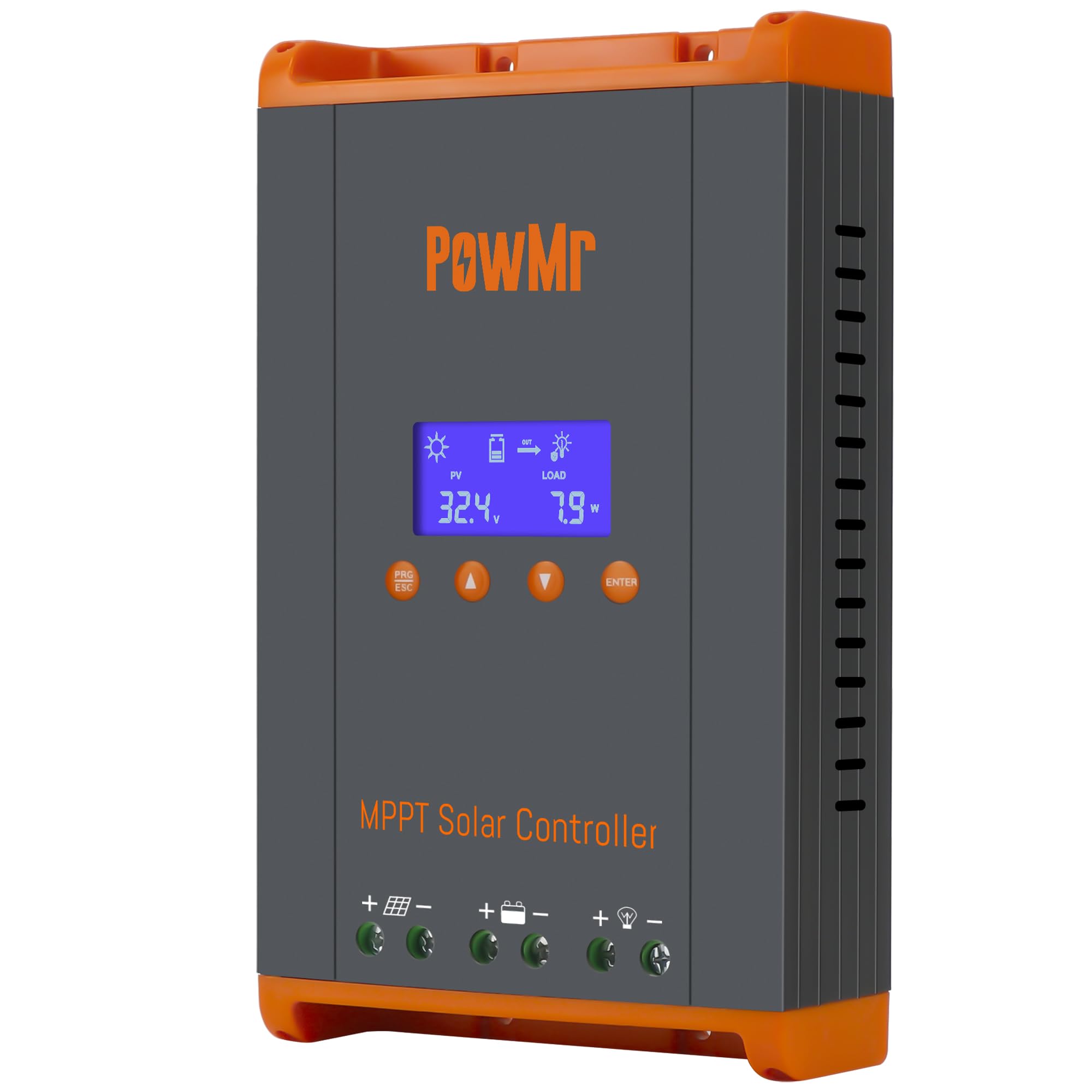
7. PowMr 60A MPPT Solar Charge Controller 12V/24V/48V with LCD Display
A 60A box you can stack twelve deep once your array outgrows a single controller.
Scaling is the story with this one. Up to twelve of these 60A controllers can be wired in parallel to grow a system’s total capacity, which makes it the pick for someone building toward a genuinely large array rather than maintaining a single camper bank. On a 12V battery it is rated to take 720W of solar within a DC20V-80V window; the same controller handles 1440W on a 24V bank, 2100W on 36V, and 2800W on 48V. Tracking efficiency is rated at not less than 98.1%, with peak conversion efficiency up to 97%.
Cooling is handled by a die-cast aluminum body plus a silent bladeless fan that kicks in above 45°C and shuts off below 40°C — a quieter arrangement than a conventional bladed fan spinning constantly. The negative-grounding design automatically handles sealed, gel and flooded lead-acid banks without any parameter changes, and there are preset charging profiles for LI (LFP) packs plus user-programmable absorption voltage, float voltage, low voltage cutoff and load timer. Recommended wire size is 9AWG, so plan for chunky cable runs.
Two notes to file. Lithium users must adjust parameters to their actual battery voltage, because a “12V” lithium pack can sit anywhere from about 11.1V to 14.8V, and the brand explicitly warns that the PV input must be disconnected before you change settings. The fan is described as moderately noisy though effective. And if the controller ever displays night mode while only the battery is connected, holding the last button for more than five seconds restores factory settings.
The value conversation: owners are split on whether it is a bargain for the capacity it delivers — the fair read is that you get serious scaling for the tier, and the middle ground on value reflects the setup attention a big array demands.
Choose it if: you want one controller platform that spans 12V to 48V and can be paralleled as your array grows.
pass on it if: you want zero-configuration lithium charging or a completely silent enclosure.
8. BougeRV Sunflow 30A MPPT Solar Charge Controller with Low-Temp Cut-Off

Built so a freezing night does not turn your lithium pack into a paperweight.
If your batteries see below-freezing temperatures, this is the reason to pick it: a low-temp cut-off stops charging below 32°F, which protects a LiFePO4 battery from the chemistry damage that cold charging causes. It can also restart or activate dormant 12V or 24V LiFePO4 packs that shut down from short circuits or over-discharge. Charge current is adjustable from 0A to 30A, tracking efficiency is rated up to 99.5%, and peak conversion efficiency up to 99%. Max panel input is 450W on a 12V bank or 900W on 24V, with a 95V ceiling on PV input voltage.
Control comes two ways. The BougeRV app offers remote monitoring up to 32 feet and shows your panel, battery and load status, while the on-unit LCD has three display modes — full-featured, no-load, and viewing. If you would rather not download anything, the full-featured mode lets you modify every adjustable parameter using the screen buttons. An aluminum heat sink handles dissipation, and a dual MOS circuit blocks reverse current while cutting operating heat. It carries CE and RoHS certification and six protections, with an 18-month tech support window.
Bluetooth reliability is the caveat. Connection issues show up more than any other complaint, with a connection reportedly taking several attempts and the app described as not especially helpful compared to the frustration of the on-device configuration. If you plan to run this without the app at all, the on-screen controls handle everything. Wire range is 15-8AWG and the units have been observed reading battery voltage 0.2-0.4V off, so confirm with a separate meter.
What actually works here
- Low-temp cut-off below 32°F protects LiFePO4 charging in cold weather
- Wake-up function revives over-discharged or shorted lithium packs
- Adjustable 0A-30A charge current with 99.5% tracking efficiency
- Three display modes let you configure everything without the app
- 18-month tech support and dual MOS reverse-current protection
Before you commit
- Bluetooth is the most-complained-about part — pairing can take several tries
- On-device buttons are frustrating for anything but the basics
- Battery voltage can read 0.2-0.4V off true
- Rated load current is 20A, so plan your load runs accordingly
Built for: cold-climate off-grid and RV setups running LiFePO4 where winter charging protection is the deciding feature.
Less suited to: anyone who wants the app to be the primary control surface rather than a backup.
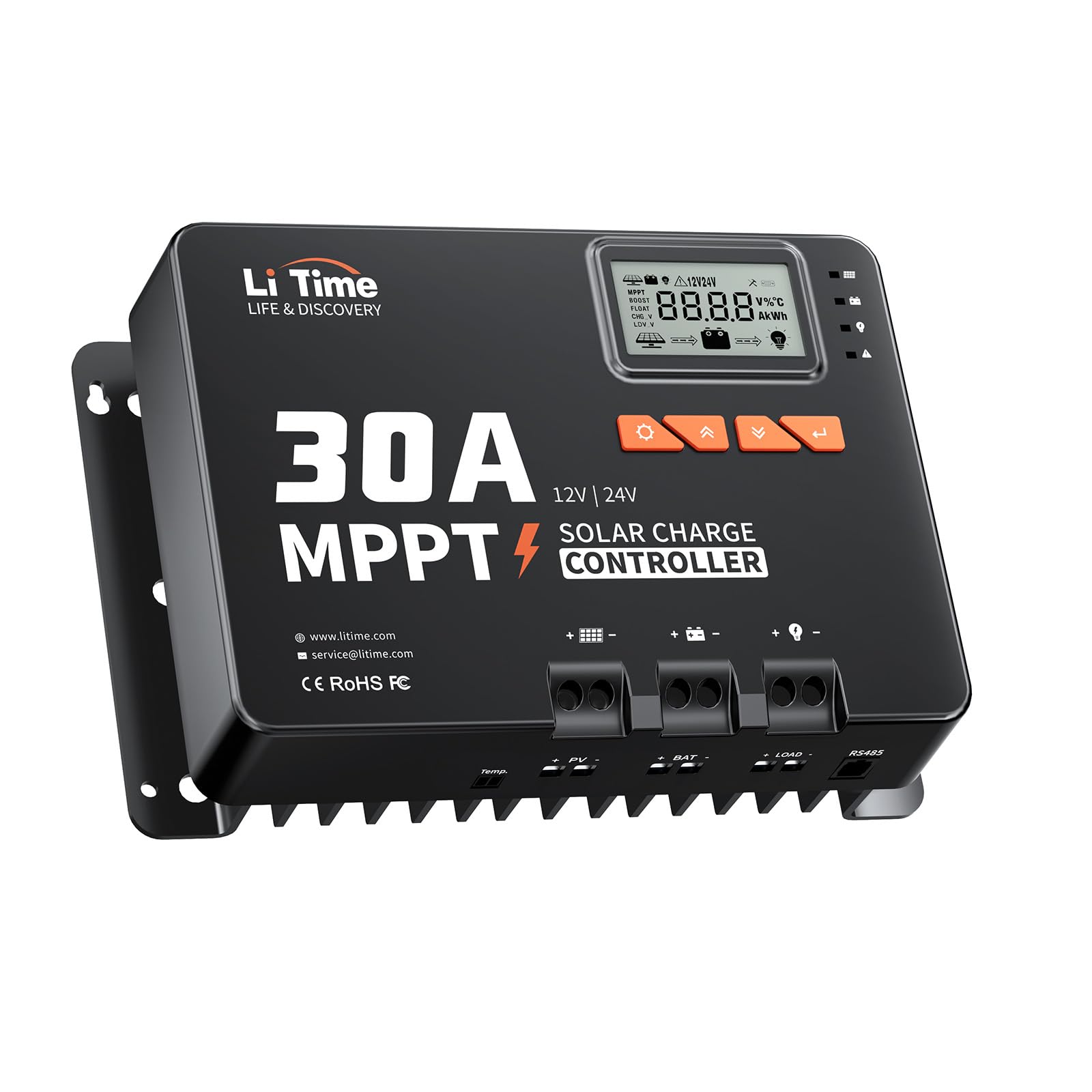
9. LiTime 12V/24V 30A MPPT Solar Charge Controller Bluetooth, LCD Display
The die-cast aluminum tank for off-gridders who want to stop babysitting a battery bank.
If your previous system was lead-acid and you spent every week watching a hydrometer, this is the upgrade that ends that routine. It is a 30A MPPT controller that handles 450W of panel input on a 12V bank and 900W on 24V, with tracking efficiency not less than 99% and peak conversion efficiency up to 98%. The housing is die-cast aluminum, which pulls heat off the electronics far better than a plastic shell, and the accessory pack includes copper wire connectors that widen the contact area between your cable and the terminal to move current more efficiently.
Bluetooth is built in rather than sold as an add-on, so remote control and status reads come standard, and the unit pairs that with an LCD screen and four menu buttons plus LED indicators for the panel array, battery, loads and controller state. Multiple protections cover reverse connection, overpower, overvoltage, short-circuit and over-temperature. It carries LiFePO4 charging mode from the start and will also run Sealed and Gel lead-acid banks once you adjust the parameters. The product is covered by AIG Product Liability Insurance.
There is a genuinely good story here about what this kind of controller changes: a system running 40 years on lead-acid moved to LiFePO4 with this unit and went from constant monitoring to hands-off operation. One owner also confirmed it does not generate RF interference on ham radio gear, which matters if you run a radio shack off the same bank. The catch worth knowing: the paper and online manuals conflict on whether a remote temperature sensor is needed for LiFePO4, and the brand confirmed the sensor is not required because the battery’s BMS handles low-temperature protection. Pair that with one real limitation — discharge Ah readings are inaccurate if loads bypass the controller.
Best fit: long-term off-grid installations upgrading from lead-acid to lithium, where build quality and a hands-off routine matter more than the lowest possible outlay.
The one to weigh: Bluetooth app support has been inconsistent for some Android users, and the on-unit controls remain fully functional if you prefer them.
Made for: off-gridders running LiFePO4 over a 12V or 24V bank who want to set it and stop tracking it daily.
Think twice if: you need the phone app to work flawlessly on every Android release or you route loads around the controller.
Understanding the Specs
MPPT vs PWM — what the letters actually mean
PWM stands for pulse width modulation and simply gates your panel’s current straight onto the battery. MPPT stands for maximum power point tracking, and it actively hunts for the voltage at which your panel produces the most watts, then converts that down to battery voltage. MPPT earns its premium when your panel voltage runs well above your battery’s. The EPEVER and the BougeRV picks both quote tracking efficiency above 99%, which is the number that tells you how little is lost in that conversion.
Amperage rating and why it caps your array
The amp rating caps the charging current the controller can push to the battery. A 10A unit like the Bateria Power SunRock 10 caps out around a 150W panel on a 12V bank, while a 30A unit like the EPEVER handles 390W at 12V and double that on 24V. Buying more amperage than you need is wasted headroom; buying less means you leave panel output uncollected. Match the rating to your panel wattage and the voltage of the bank it feeds.
Battery chemistry, presets and low-temperature cutoff
AGM, Gel, Flooded and Sealed lead-acid banks are forgiving and will run on a preset without much fuss. Lithium chemistries are not, which is why a controller like the BougeRV with a low-temp cut-off below 32°F matters — cold charging can damage a lithium pack. Presets are convenient but they fix your absorption and float voltages, so a unit with user-programmable parameters, like the PowMr, gives you more room to dial them in correctly.
Waterproofing, mounting and display reality
An IP67 rating means the housing is dust-tight and survives water spray, rain and condensation, which is exactly what the Renogy Voyager carries and why it belongs on boats. A flush-mount design like the Renogy Adventurer suits a wall inside a van or cabin. And treat displays as a useful guide, not gospel — voltage readings on these units can sit a few tenths of a volt off true, so verify with a separate meter before you trust a critical number.
FAQ
Do I need MPPT or PWM for a 12V solar setup?
What size charge controller do I need for a 100W panel?
Will a 12V charge controller work with a LiFePO4 battery?
What is the correct wiring order when connecting a solar charge controller?
Can I connect a 24V solar panel to a 12V charge controller?
How long does a solar charge controller last?
Does a charge controller drain my battery when the sun goes down?
What does the IP rating on a solar charge controller mean?
Can I run more than one charge controller on the same battery bank?
Why does my charge controller read a different voltage than my multimeter?
Final Thoughts: The Verdict
For most people the winner among these 12v solar charge controller options is the EPEVER MPPT 30A Tracer — it auto-senses 12V and 24V, tracks above 99.5% efficiency, and starts pulling current early in weak morning light, which is exactly what a camper or home bank needs. If you are maintaining motorcycle, boat or seasonal batteries in a tight space, the Bateria Power SunRock 10 does that job at 145 g and plugs in with SAE connectors. For a large scalable array that spans 12V to 48V and can be paralleled twelve deep, the PowMr 60A MPPT is the one to reach for.
If you are building around a LiFePO4 pack that sees freezing nights, the low-temp cut-off on the BougeRV Sunflow 30A is the feature that protects your investment, and if you want to stop babysitting a bank entirely, the die-cast LiTime 30A MPPT handles the job with Bluetooth built in. Whichever you pick, buy the right technology for your panel voltage and the right amperage for your array — those two decisions matter more than any brand badge.
How We Picked
We do not accept paid placement. Every pick is matched to a real buyer and a real use-case; we do not hands-on test units.
Sources & Methodology
Specifications: manufacturer listings and product documentation. Review insights: verified customer reviews, as of September 2026. Pricing: not shown on this page (it changes often); check the current price via the retailer link.
As an Amazon Associate, Non Toxic Blog earns from qualifying purchases. This does not affect which products we feature.