Specs are compiled from manufacturer listings and verified buyer reviews and can change over time — please confirm the key details on the product page before buying.
If your truck, boat, RV, or gate battery keeps going flat while it sits, the fix is a 12V solar panel with a built-in charge controller that tops the battery up every day without you touching it. That is the whole job of the nine kits here: catch daylight, feed the battery, and stop before it overcharges. The Renogy 200W kit takes the top spot for raw daily output, but a tiny 20-watt trickle panel can be all a parked car ever needs. Below, every pick is matched to a real job, from a motorcycle battery to a full off-grid camper build.
I’m Mo Min — the founder and writer behind Non Toxic Blog. This guide is built by comparing the manufacturers’ published specifications and the patterns across verified customer reviews, so you get each pick’s real strengths and trade-offs instead of marketing spin.
Bigger wattage means more daily charge, but the controller and the cable ends decide whether a kit is genuinely plug-and-play for your battery. Read on for the breakdown of each panel, what it really delivers, and which one fits your setup.
Our Picks at a Glance


How To Choose The Best 12V Solar Panel with Charge Controller
Start with the battery you are trying to protect, not the panel. A car that sits for a week needs far less daily charge than a camper running a fridge, and buying too much panel just means more money and more roof space than the job calls for.
Match the wattage to what you are maintaining, not charging
A trickle panel keeps a healthy battery topped up so it does not slowly drain while parked. Bigger arrays do real work. The difference is enormous — the Renogy 200-watt kit puts out ten times the power of the 20-watt FlexSolar, so one flips a big bank of batteries back to full while the other simply holds a resting car battery steady. Decide which one of those jobs is yours before you buy.
Read the controller type — PWM versus MPPT
A PWM controller is the simple, budget-friendly option: it is included on most small kits and handles everyday topping-up fine. An MPPT controller actively tracks the panel’s best operating point, and the SUNER POWER and ExpertPower units here use it to wring more usable output from the same panel. If you run lithium batteries or want the most charge per watt, the MPPT kits are the ones to shortlist.
Check the cable ends and mounting against your setup
This is where most returns happen. A kit with alligator clips is ready for a bare battery post. A tired car may need an OBDII plug or a cigarette-lighter socket so you never lift the hood. Pole and wall mounts want the opposite — a fixed bracket that holds the panel at an angle all year. Count the connectors you will actually use before you commit, and check whether the included hardware matches where the panel will live.
Quick Comparison
| Model | Best For | Max Power | Controller Type | Weight | Amazon |
|---|---|---|---|---|---|
| Renogy 200W Kit★ Best Overall | Full RV and camper power | 200 watts | 30A PWM | 16.5 pounds | Amazon |
| FlexSolar 20W KitBest Value | Parked cars and trucks | 20 watts | Built-in smart | 1.7 pounds | Amazon |
| ECO-WORTHY 25W KitBest for Gates and Trailers | Tractor and gate batteries | 25 watts | Waterproof PWM | 2.34 kg | Amazon |
| SUNER POWER 30W PRO | Boats and dump trailers | 30 watts | MPPT | 1.81 kg | Amazon |
| DOKIO 100W Suitcase | Portable camping power | 100 watts | PWM | 18.5 pounds | Amazon |
| SUNER POWER 30W Pole | Gate and dock pole mounts | 30 watts | MPPT | — | Amazon |
| Topsolar 100W Kit | Off-grid cabin and shed | 100 watts | 12V/24V smart | 7.2 kg | Amazon |
| JJN 300W Kit | Large off-grid systems | 300 watts | 40A PWM | 45 pounds | Amazon |
| ExpertPower 200W Kit | Serious roof-mounted builds | 200 watts | 20A MPPT | — | Amazon |
In‑Depth Reviews
1. Renogy 200W 12V N-Type RV Solar Panel Kit with Adventurer 30A Controller
Our pick — over 4.5★ from 500+ verified ratings; the strongest balance of quality and price.
A 200W two-panel kit that runs a 12V fridge through the night on two deep-cycle batteries.
Buy this if you want a whole RV or camper running off stored daylight, not just a battery kept topped up. The two 100-watt panels combine for 200 watts of maximum power — roughly ten times the output of the 20-watt FlexSolar below, which means this one can carry real loads instead of only holding a battery steady. Once installed on the call, owners describe it keeping a 12-volt refrigerator running through the night on two deep-cycle batteries: “The setup works as it should. It has enough energy to keep my 12 volt refrigerator running with two deep cycle batteries.” Cloudy stretches slow it, as they do every panel, but the same owner reports getting close to 48 hours of run time even then.
The 22% cell efficiency and a corrosion-resistant aluminum frame that the maker says withstands high winds and snow loads make this a panel you mount and forget. Every connection is plug-and-play with MC4 connectors and pre-drilled holes, and it supports lithium, lead-acid, and gel batteries. The Adventurer-Li 30A PWM controller guards against overcharging, overload, short circuits, and reverse polarity, and the panel ships as a full kit with a 30ft adaptor cable, a 16ft tray cable, branch connectors, a BT-1 Bluetooth module, and a cable entry housing. Four-season owners have leaned on it hard: it reliably charged camera batteries, phones, and laptops across a 10-day Glacier National Park trip with no grid hookup at all.
The catch is weight and space. At 16.5 pounds and 41.8 inches long, this is a fixed-mount system that wants a roof or a rack, not a trunk you fold away — it is close to ten times the weight of the FlexSolar trickle panel. Think about roof real estate before you commit, and plan on mounting hardware if your vehicle is not already solar-ready. For buyers building a genuine off-grid setup, that trade is the price of serious daily output.
What earns it the top slot
- 200 watts of maximum power across two 100W panels — enough for a 12V fridge, not just top-ups
- 22% cell efficiency in a corrosion-resistant aluminum frame rated IP67 when mated
- Complete kit: 30A PWM controller, 30ft adaptor kit, branch connectors, and a BT-1 Bluetooth module
- Supports lithium, lead-acid, and gel batteries with protection against overcharge and reverse polarity
The trade-offs worth knowing
- At 16.5 pounds and 41.8 inches long, it is a permanent roof-mount install
- Cloudy weather cuts output — real-world users report partial charge on grey days
Reach for it if: you are kitting out an RV, camper, boat, or greenhouse and want a complete 200-watt system in one box.
Look elsewhere if: you only need to stop a parked car battery draining — this is far more panel than that job needs.
2. FlexSolar 20W 12V Solar Panel Battery Trickle Charger Maintainer Kit
A 0.11-inch trickle panel that keeps a stored car battery from draining.
The job here is simple: stop a stored battery dying. This panel pushes 20 watts at 12 volts — lean next to the 200W Renogy, but that is the point, since a resting car battery only needs a maintenance trickle, not a recharge. The headline number is thickness. At 0.11 inches it is about as thick as a coin, so it conforms to a curved windshield or boat deck and sits flat against glass with the included suction cups and carabiners. No drilling, no brackets, no permanent install.
What wins people over is the connection flexibility. Four plug-and-play options come in the box — a cigarette-lighter plug, alligator clips, an OBDII adapter, and ring terminals — so there is a way to hook it up no matter what your vehicle offers. The integration of a smart controller that halts charging at full and restarts when voltage drops means you can leave it plugged in for weeks. A 2015 Leaf owner reported exactly that payoff: “Plugged into OBDII, parked in sun; after 2 days battery at 12.75V, lights cleared.” At 1.7 pounds, it tucks into a glovebox and is genuinely pocket-sized for a solar panel.
The unavoidable limitation is weather. Owners who park facing away from the sun, or under fog and cloud, still see their battery drain — one Silverado owner found it only kept pace with direct sunlight from sunrise to sunset. The supplied cables also feel flimsy to some, and a few swap in better third-party ones. If you cannot park in the open, this panel will disappoint; if you can, it does its job without fuss.
Why owners keep buying it: a thin, light, four-connector trickle panel that just works on cars, boats, and RV batteries left for weeks — the connective flexibility is what makes it so easy to live with.
Great match for: seasonal cars, motorcycles, and boats parked outdoors that you want ready to start on the first cold morning.
Think twice if: your vehicle sits in deep shade or a garage — without direct sun this panel cannot keep up.
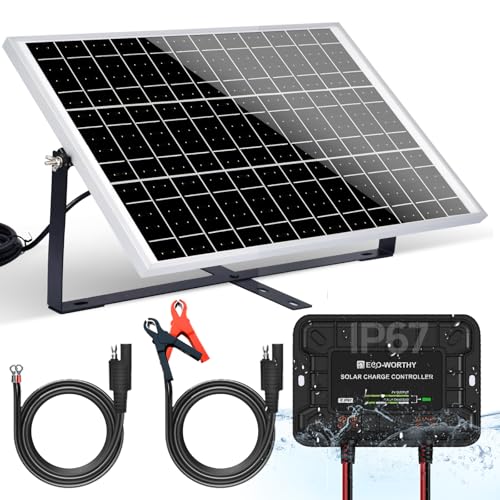
3. ECO-WORTHY 25W 12V Solar Panel Battery Charger Trickle Maintainer Kit
A 25W trickle kit with a sealed waterproof controller for gate, winch, and fence-line batteries.
This is the kit for a battery bolted to a winch, a gate opener, or a fence line — somewhere the weather gets a vote. The 25-watt panel uses premium monocrystalline cells rated at up to 23% efficiency, which is a hair above the 22% figure on the Renogy, and the maker says it produces 100Wh of daily power. It arrives with a fully sealed waterproof controller that consumes nothing at night and carries battery temperature compensation plus overvoltage, over-discharge, overload, and short-circuit protection. The panel itself wears low-iron tempered glass and a corrosion-resistant aluminum frame.
The real proof comes from owners with stubborn jobs. Once installed to a trailer winch battery, it has quietly kept the charge steady for years — the kind of set-and-forget most people want from a trickle kit. Performance is what buyers praise most, and it holds up outdoors too: someone on a van build used one to top up a battery while camping with Starlink, and it worked straight from the start on the very first try. A van owner was blunt about it: “Worked straight from the start, quality product at a good price.”
Here is the honest wrinkle: the kit’s controller is the weaker half of the package. Some owners skip it entirely because it has no screen to show you power flowing, and swap in their own unit. Build quality draws mixed reactions as well — one buyer found it flimsy next to the otherwise solid construction. That does not sink the panel, which is the part carrying its weight here, but the display limitation is worth knowing if you like seeing numbers.
Best fit: remote or outdoor batteries — gate motors, electric fences, tractor and boat batteries that sit unused for long stretches.
Consider the alternative if: you want a kit whose controller gives you a visible readout, since this one keeps a low profile.
4. SUNER POWER Waterproof 30W 12V Solar Battery Charger & Maintainer PRO

A 30W panel with an MPPT controller that squeezes 20% to 30% more charge than PWM.
What sets this one apart is the controller, not just the panel. The 30-watt output is modest, but the UltraSmart MPPT (a controller that continuously hunts for the panel’s best operating point) is claimed to hit tracking efficiency up to 99% and peak conversion efficiency of 98%, which the maker says improves consumption by roughly 20% to 30% against rival designs. Paired with a three-stage charging cycle (bulk, absorption, float), it squeezes more usable charge from the daylight than a plain PWM unit on the same wattage.
Three selectable modes — 12V, 12V AGM, and 12V Lithium — let it work over flooded, gel, AGM, SLA, VRLA, maintenance-free, and LiFePO4 batteries, backed by eight safety protections including reverse polarity and over-temperature. Owners trust it around boats, especially. A bilge pump that ran hard through three straight days of rain still had its battery waiting to be topped up on Monday, and that reviewer was blunt: “I’ve been very pleased with its performance.” The charge-level indicators walk you up through 25% to 100% so you always know where things stand.
Know what you are buying, though. Like most panels in this tier, it trickle-charges and maintains — it will not revive a completely dead battery, and it is not meant to. A few owners also wish the included wiring were longer for out-of-the-way mounting spots. If you want to bring a deeply discharged battery back, you need a proper charger; this one keeps a healthy battery right where it should be.
The controller advantage: the MPPT brain and its 20% to 30% claimed utilization edge over plain PWM is the whole reason to pick this over a cheaper 30-watt kit — you pay for efficiency, and you get selectable modes for lithium or AGM.
Set it and leave it: it stops when full and restarts on discharge, so the only thing you do is mount it and forget it.
Ideal buyer: boat, trailer, and truck owners who want their battery held at 100% with zero weekly fuss.
Not built to: rescue a battery that is already flat — this maintains a healthy one, so pair it with a real charger for revivals.
5. DOKIO Foldable Solar Panel 100 Watt Monocrystalline Solar Suitcase
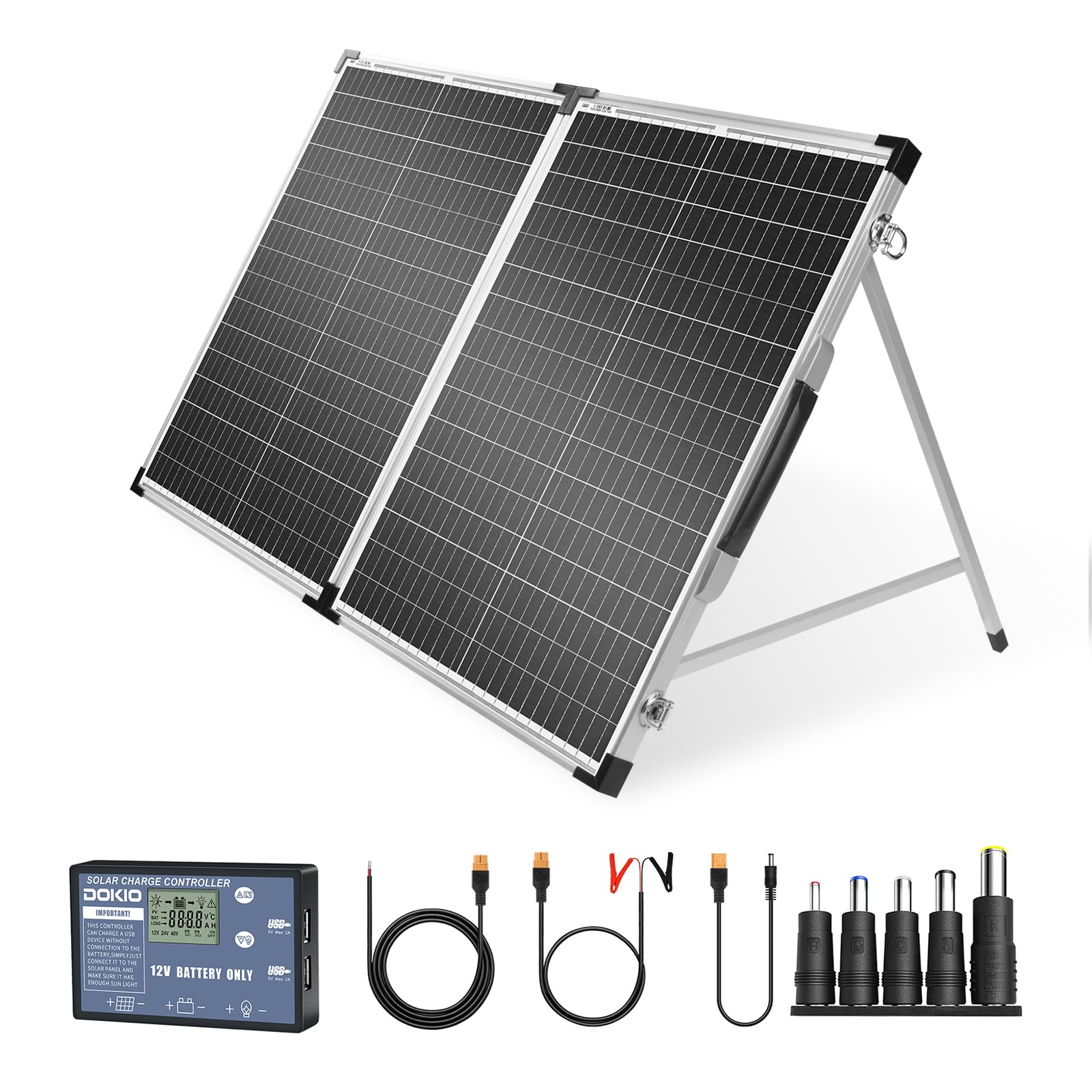
A 100W folding suitcase with alligator clips that charges any battery you point it at.
This is the pick for a camper who moves every day rather than parking the panel on a roof. It folds into its own carry case with a rubber handle, opens to set on the ground, and the alligator clips hook straight to any battery you point it at. Clip the leads correctly and it charges immediately — no installer, no roof drilling. As one buyer described its use case, it “performed reliably during week-long beach camping,” powering smartphones, a portable fan, and a mini fridge while charging batteries even through cloudy stints.
The output backs that up. On a 12-volt system it is rated up to 5.56 amps, and one owner ran a compressor cooler while charging a battery at the same time and measured a steady 5 to 5.5 amps — right on spec. The adjustable bracket lets you angle the panel toward the sun for more output, and the built-in dual 5V 2A USB ports let you top off phones directly off the panel. The 100-watt array puts it in the same class as the Topsolar below, though this one folds down for travel while that one is built for a fixed mount.
The honest catch is build finishing. The storage bag has no padding and its handle has snapped for some buyers, and the legs can arrive sharp at the edges. One owner even had a panel arrive shattered in transit before a replacement came through fast. Treat it with care and pack it snug; the glass cells themselves are sturdy and held up across a full week of daily use.
Pick this if: you camp, hike, or caravan and want 100 watts that folds into a bag and clips to any battery.
Handle with care if: you plan to treat it roughly — pack padding around it and expect the included bag to be basic.
6. SUNER POWER 30W 12V Solar Battery Trickle Charger with Adjustable Pole Mount Brackets

A 30W panel with a bracket that clamps 1.5 to 3.0-inch poles and tilts through five angles.
Here the hardware is the selling point. The adjustable bracket clamps onto a pole measuring 1.5 to 3.0 inches in diameter and tilts the panel through 0, 15, 30, 45, and 60 degrees, so you can chase the best angle and leave it locked there. The panel itself is built like the other SUNER POWER unit above — the same UltraSmart MPPT controller claiming tracking efficiency up to 99% and peak conversion up to 98%, the same three-stage charging, and the same 12V, 12V AGM, and 12V Lithium selectable modes.
Owners fit these to the batteries nobody wants to climb a fence to check. Gates are the standout use, and it clearly satisfies them: one buyer wrote, “It works perfectly with my mighty mule gate.” Docks are another — the pole bracket bolts straight to a standard post, so a boat battery stays topped up even when the boat only splashes on weekends. The functionality and overall quality are what draw the praise, with the sturdy construction and hardware repeatedly noted as feeling solid. Premium Grade A+ cells behind tempered glass and a corrosion-resistant frame shrug off UV, hail, and salt air.
Two things to keep realistic. The kit uses the same smart charging logic as the rest of the range, so it maintains rather than resurrects a dead battery. And while the hardware is praised, support can be uneven — a buyer here had a cable issue go unanswered, and there is a rare report of a unit failing early. For a fixed outdoor post, though, the bracket-and-panel combo does exactly the job it promises.
Built for the post: the 1.5 to 3.0-inch pole bracket and the five tilt positions are why this beats the flat 30W unit if your panel has to bolt onto a fixed mast.
Where it stumbles: customer support has left at least one buyer hanging over a missing cable, so verify your parts on arrival.
The move for: anyone powering a gate opener, dock, or remote post battery that needs a permanent, angle-set mount.
Skip the mount if: your panel is going on a windshield or loose surface — the pole bracket is the reason to choose it, and it is wasted elsewhere.
7. Topsolar 100W 12V Solar Panel Kit with 30A Charge Controller

A 100W kit with a V-shape tilt bracket and an auto-start 12V/24V controller.
For a cabin, shed, or boat that lives off-grid, this is the turnkey option — a 100-watt monocrystalline panel with a V-shape tilt bracket, a 12V/24V intelligent charge controller, two 16ft MC4 cables, and two 5ft O-ring battery cables all in one box. The controller auto-starts once it senses a battery, meaning no programming. Buyers report it charged a Class A engine battery from low to full in about four hours, and a buyer running two panels in parallel to feed a fleet of tractors and buggies had no complaints at all.
Functionality is the feature that wins people over — this system simply does what it says, keeping batteries charged and running loads like an RV fridge. It weighs 15.84 pounds with a heavy-duty anodized aluminum frame and tempered glass, so it stands up to weather. Note the controller quirk: one long-term owner set theirs to 24V and could not switch it back to 12V, so leave it locked on 12V unless you genuinely run a 24-volt bank.
The weak spot is the mounting hardware. The brackets draw mixed reviews — some kits arrive missing them, and the pre-drilled holes did not line up for one RV-roof owner who simply drilled through the aluminum instead. Instructions are the least-praised part of the package. If you are handy, this is an easy fix; if you want everything to bolt together exactly as pictured, budget a little patience.
Turnkey and forgiving: the auto-start controller and the four-hour class A engine battery charge make this the friendliest fixed-mount kit for a first off-grid setup.
Right for: cabins, sheds, and RVs where you want a complete 100-watt roof or ground kit with cables and brackets already included.
Plan around: fussy mounting hardware and a controller that will not switch back from 24V to 12V once set.
8. JJN Solar Panel Kit 300 Watt 12 Volt Monocrystalline with 40A PWM Charge Controller

A 300W three-panel array with a 40A PWM controller for large off-grid banks.
Three hundred watts is the biggest output on this list, and it shows in every number. The kit uses 10BB (ten-busbar) cell design rated at up to 22% conversion, and the maker says each panel can deliver about 500Wh of electricity a day depending on sun. The half-cut cell construction is claimed to cut power loss, run cooler, and soften the impact of shading. A 40A PWM controller handles the charging and supports Wet, Gel, MF, EFB, and AGM batteries, and the box ships with two pairs of cables, three sets of Z brackets, and a four-way connector.
Real-world output holds up. In Texas at 4pm a single panel hit 92 watts, and the owner expected it to reach its full 100-watt rating in stronger midday sun. Buyers also wired extra panels in without a fuss — one added a further 100-watt unit and reported the whole lot working like a charm. The included bracket system and cables mean you do not have to shop for extras, and coverage runs to RV, camper, boat, and home green-energy storage.
Two caveats for the honest shopper. The included controller is basic — its small unlit display and confusing instructions have owners swapping in their own Bluetooth controller — so treat it as a backup rather than the star. And the aluminum frame is thin: one unit arrived with a bent corner, and this kit is not the one to bolt loosely to a highway-speed vehicle. Mount it where it can stay still and it delivers its rated power.
Power per panel: with up to 22% efficiency and about 500Wh daily claimed per panel, this is the kit to choose when 100 watts will not cut it — the biggest array here by a wide margin.
The thin-frame truth: corners can bend in transit, so inspect on arrival and keep it off jostling highway mounts.
Choose this when: you are expanding a serious off-grid bank and want maximum wattage with wiring and brackets included.
Look past it if: you want a top-tier controller from the start — plan on replacing the included PWM unit.
9. ExpertPower 200W 12V Solar Power Kit with 20A MPPT Charge Controller
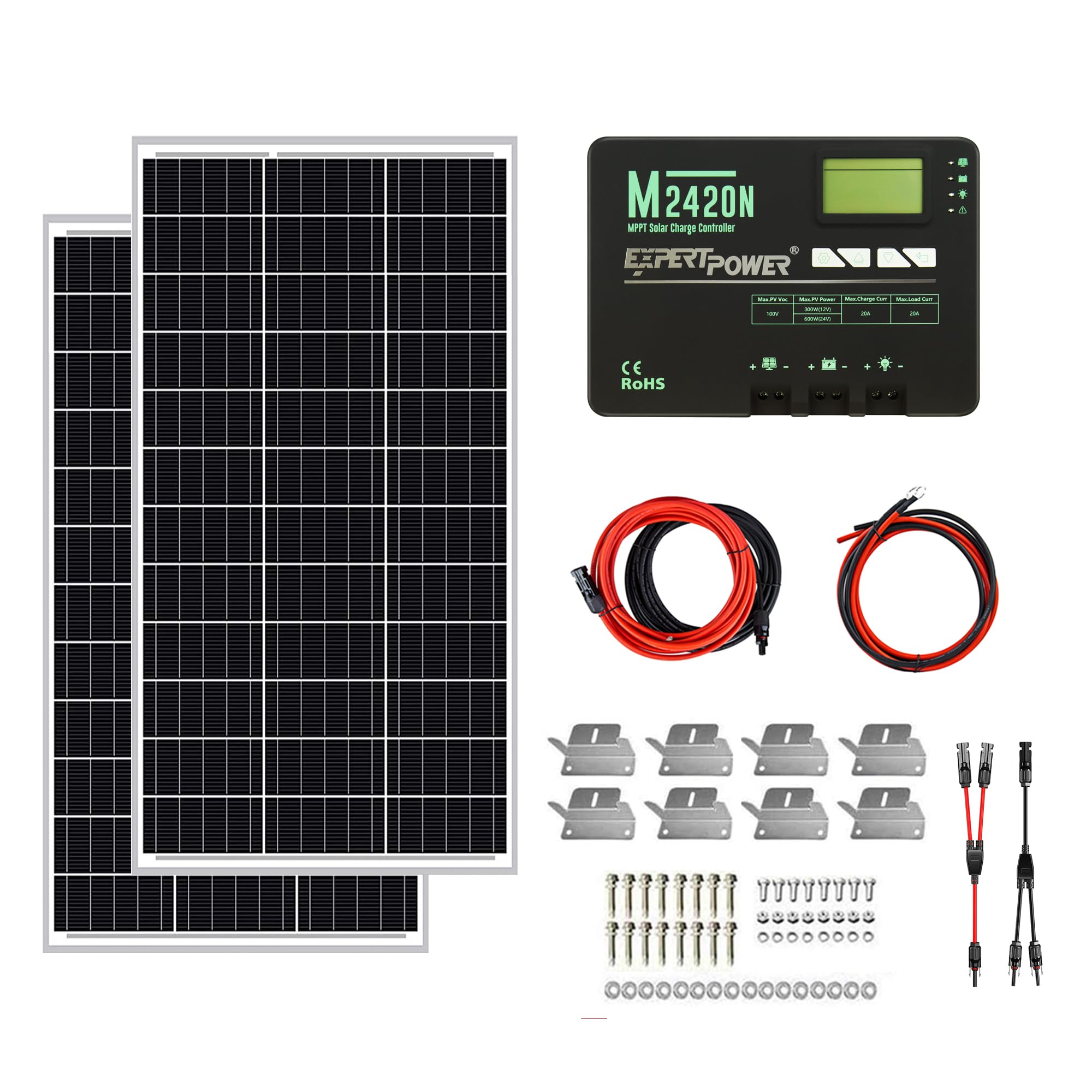
Two panels and a Bluetooth MPPT brain for a proper roof build.
This is the kit for someone assembling a real off-grid system, not topping up a parked truck. It bundles two 100-watt monocrystalline panels with a 20A MPPT charge controller that carries Bluetooth, plus a pair of 10ft MC4 solar cables, a pair of 6ft battery cables, and two sets of mounting brackets. The controller auto-detects 12V and 24V systems and, the maker says, uses its tracking tech to lift array generation by over 20% compared with a plain PWM controller while regulating charge based on ambient temperature.
Owners push these hard. One runs it with two 100Ah batteries and a 5000W inverter and reports running a 12-inch chop saw and an air compressor at the same time on an off-grid build. Another mounted it on a 1999 Roadtrek camper across five phases and found it performed great. A Jayco owner called the parts “excellent quality” and installed the whole system in about three hours, though that buyer noted the wires were not marked as advertised.
It is worth flagging that this kit carries fewer total owner ratings than several others here, so you are leaning on the 200-watt spec and the MPPT controller rather than a deep pile of feedback. The Bluetooth app is also older — it pairs with a legacy Renogy-style app and does not allow parameter changes. If you want smartphone control, factor that in; if you want a solid 20-watt-plus-per-panel MPPT starter, this is a strong, upgradable base.
A smart foundation for: RVs, trailers, and off-grid builds you plan to expand with more panels and batteries over time.
Weigh the app if: you want deep Bluetooth control — the module leans on older software and limits parameter tweaks.
Understanding the Specs
Wattage and daily output
Wattage is the panel’s peak rating in full sun, but what actually reaches your battery depends on how many hours of real daylight you get. A 20-watt trickle panel holds a resting car battery steady; a 200- or 300-watt array can run a fridge or charge a bank of batteries. Match the number to the load, not the other way around. The maker-to-maker daily figures like 100Wh or 500Wh per panel are guides for strong sun, not guarantees, so size up a little if you camp in cloudy regions.
PWM versus MPPT controllers
The charge controller is the safety brain that stops a panel overcharging your battery and restarts charging when voltage drops. A PWM (pulse-width modulation) controller is the simple budget choice and handles everyday topping-up fine. An MPPT (maximum power point tracking) controller actively searches for the panel’s best operating point, and the makers of the SUNER POWER and ExpertPower kits claim gains of 20% or more over PWM at the same wattage. If you run lithium batteries or want maximum charge per watt, MPPT is worth the extra.
FAQ
Will a 12V solar panel with charge controller overcharge my car battery if I leave it connected?
Can I use one of these kits to jump-start a completely dead battery?
Do I need an MPPT controller or is PWM good enough?
What is the difference between an MPPT and a PWM charge controller?
Will these kits work with lithium LiFePO4 batteries?
How much do I need to angle a solar panel to get good output?
Can I mount these panels on an RV roof or do they have to be portable?
Do these kits include the cables and connectors I need?
Can a solar kit damage my battery if the controller is set wrong?
Will these panels keep charging on a cloudy day?
Final Thoughts: The Verdict
For most people, the 12v solar panel with charge controller winner is the Renogy 200W N-Type RV Solar Panel Kit because it packs 200 watts, a 30A PWM controller, and every cable and bracket you need into one complete package that genuinely runs real loads. If you just want to stop a parked car or boat battery draining, grab the FlexSolar 20W Trickle Charger — it is thin, light, and fits four connection types. And for a fixed gate, dock, or post battery that needs an angle-set mount, the SUNER POWER 30W Pole Mount is the one to reach for. Whatever your setup, choose by the battery you are protecting first, then decide how much wattage and which controller type the job really calls for.
How We Picked
We do not accept paid placement. Every pick is matched to a real buyer and a real use-case; we do not hands-on test units.
Sources & Methodology
Specifications: manufacturer listings and product documentation. Review insights: verified customer reviews, as of September 2026. Pricing: not shown on this page (it changes often); check the current price via the retailer link.
As an Amazon Associate, Non Toxic Blog earns from qualifying purchases. This does not affect which products we feature.