Specs are compiled from manufacturer listings and verified buyer reviews and can change over time — please confirm the key details on the product page before buying.
If you are shopping for a 14 inch window fan to pull heat, fumes, or musty air out of a garage, shed, attic, or coop, the honest answer is this: the HG Power Upgraded 14 Inch Shutter Exhaust Fan is the one most buyers should start with, because it pairs the highest airflow in this lineup with a build that holds up over years of daily running. Everything below is chosen to help you match a fan to your space, not to sell you the biggest number on the box.
I’m Mo Min — the founder and writer behind Non Toxic Blog. This guide is built by comparing the manufacturers’ published specifications and the patterns across verified customer reviews, so you get each pick’s real strengths and trade-offs instead of marketing spin.
Airflow is only half the story here, because a fan that moves a lot of air but rattles or fails in damp weather leaves you right back where you started. What follows walks you through the specs that actually change how a 14 inch window fan performs in a real shed or attic, so you can pick the right one on the first try.
Our Picks at a Glance
How To Choose The Best 14 Inch Window Fan
A 14 inch window fan is not a plug-in box fan you set on a sill and forget — it is a wall or window-mounted exhaust unit that pulls hot, humid, or smelly air out and forces fresh air in behind it. The size number refers to the fan opening the housing is built around, and the decision that matters most is how much air it moves and how loudly it does that job.
Match airflow to the space you are venting
Airflow is measured in CFM, or cubic feet per minute — the volume of air the fan pushes out every minute. A small coop or single-bay garage clears fine with a lower-CFM unit, while a large attic or a workshop that fills with welding fumes needs the higher end of the range. The fans here span from 882 CFM up to 2100 CFM, and picking too little airflow is the most common mistake: the fan runs constantly and never quite wins the fight against the heat.
Check the motor and its power draw
The motor is the heart of the fan, and the two types you will see here behave differently. An AC motor (standard alternating-current, the same current that runs your lights) is simpler and often louder at high speed, while an EC motor (electronically commutated — a newer design that varies its own speed efficiently) tends to draw less power and run more quietly for the same airflow. Wattage tells you how hard the motor works; lower wattage for the same CFM generally means a more efficient unit that is easier on your wiring.
Look at shutters, mounting depth, and cord reach
Automatic shutters (louvers that swing open when the fan runs and drop closed when it stops) are the feature that keeps rain, insects, and winter drafts out of your space once the fan powers down. Beyond that, measure your mounting depth and cord length before you buy — a fan that needs a deep wall cavity or a cord run to a far outlet can turn a simple install into a weekend project.
Quick Comparison
| Model | Best For | Airflow (CFM) | Motor / Speed | Mounting Depth | Amazon |
|---|---|---|---|---|---|
| HG Power Upgraded 14 Inch Shutter Exhaust Fan★ Best Overall | Overall shed, garage, and barn venting | 882 cfm | AC motor, 1400 RPM | 8.9″D | Amazon |
| VEVOR 14 in Shutter Exhaust Fan (Variable Speed)Best Value | Dial-in airflow for sheds and workshops | 1802 cfm | AC motor, 1600 RPM, 47.8W | 17.13″D | Amazon |
| VEVOR 14 inch Exhaust Fan (Temp & Humidity Controller)Best Climate Control | Hands-off climate control in attics | 2000 cfm | EC motor, 1500 RPM, 80W | 16.54″D | Amazon |
| VENTISOL 14 Inch Shutter Exhaust Fan | Corrosion-prone and humid spaces | 1950 cfm | 1590 RPM | 14.96″D | Amazon |
| addlon 14″ Shutter Exhaust Fan | Quiet, remote-controlled everyday venting | 1400 cfm | EC motor, 1750 RPM, 35W | 13.98″D | Amazon |
| KEN BROWN 14 Inch Shutter Exhaust Fan | High-ceiling garages and large bays | 1520 cfm | 1590 RPM | 7.49″D | Amazon |
| iPower 14 Inch Wall Mounted Shutter Exhaust Fan | Greenhouses with thermostat needs | 1000 cfm | 1600 RPM, 70W | — | Amazon |
| iLIVING 14″ Wall Mounted Shutter Exhaust Fan | Large spaces up to 1800 sq ft | 1200 cfm | DC motor, 1600 RPM | 6.9″D | Amazon |
| InoKraft 14 in Shutter Exhaust Fan | Maximum airflow for big attics | 2100 cfm | EC motor, 120V/60Hz | 8.07″D | Amazon |
In‑Depth Reviews
1. HG Power Upgraded 14 Inch Shutter Exhaust Fan
Our pick — 4.5★ from 600+ verified ratings; the strongest balance of quality and price.
The metal-bodied 14-inch fan built to clear barn air through season after season.
For a shed, garage, or barn that needs steady air exchange day after day, this HG Power model is the one to reach for first. It moves 882 CFM of air, and the fan body is built from thicker material than the older version — a change meant to stop the frame from warping in transit or bending over time. The blade itself measures 13.5 inches and is made of metal rather than plastic, so it holds its shape when it spins up to its 1400 RPM running speed.
You can mount the unit in a far corner of a barn or up high in a garage gable and still reach an outlet without dragging out an extension cord. Tying it into a simple timer plug is the setup most owners land on, and that pairing is what makes it feel automatic — the fan kicks on when the afternoon heat builds and shuts off before you notice the smell creeping back.
What wins people over here is the overall build and the raw performance of the pull: the metal body and upgraded motor are the two things owners talk about most, and those are exactly the parts that decide whether a fan survives a hot, dusty season. It keeps coops cooler on still days and clears musty barn air well enough that owners running theirs on a timer describe it as perfect for the job. The honest trade-off is durability in one specific spot — the louver assembly is the part that has drawn the most mixed feedback, so treat the shutter mechanism gently and mount it where it is not getting knocked around. Airflow buffs should note the real-world pull runs a touch under the headline figure in practice, which is normal for any exhaust fan fighting back pressure.
What earns the top spot
- 882 CFM of pull clears a garage, shed, or coop without straining
- Metal blade and thicker fan body resist warping and deformation
- 8-foot cord reaches an outlet from a high or far mount
- Simple on/off switch pairs cleanly with a timer plug
Where it asks for care
- The louver assembly is the part most likely to need a gentle hand
- No remote or speed dial — it is a set-it-and-run fan, not an adjustable one
Grab this if: you want one metal-bodied fan that clears barn, coop, or garage air on a simple timer and can take a beating.
Steer toward a dial model if: you need to fine-tune speed by the hour rather than run flat-out.
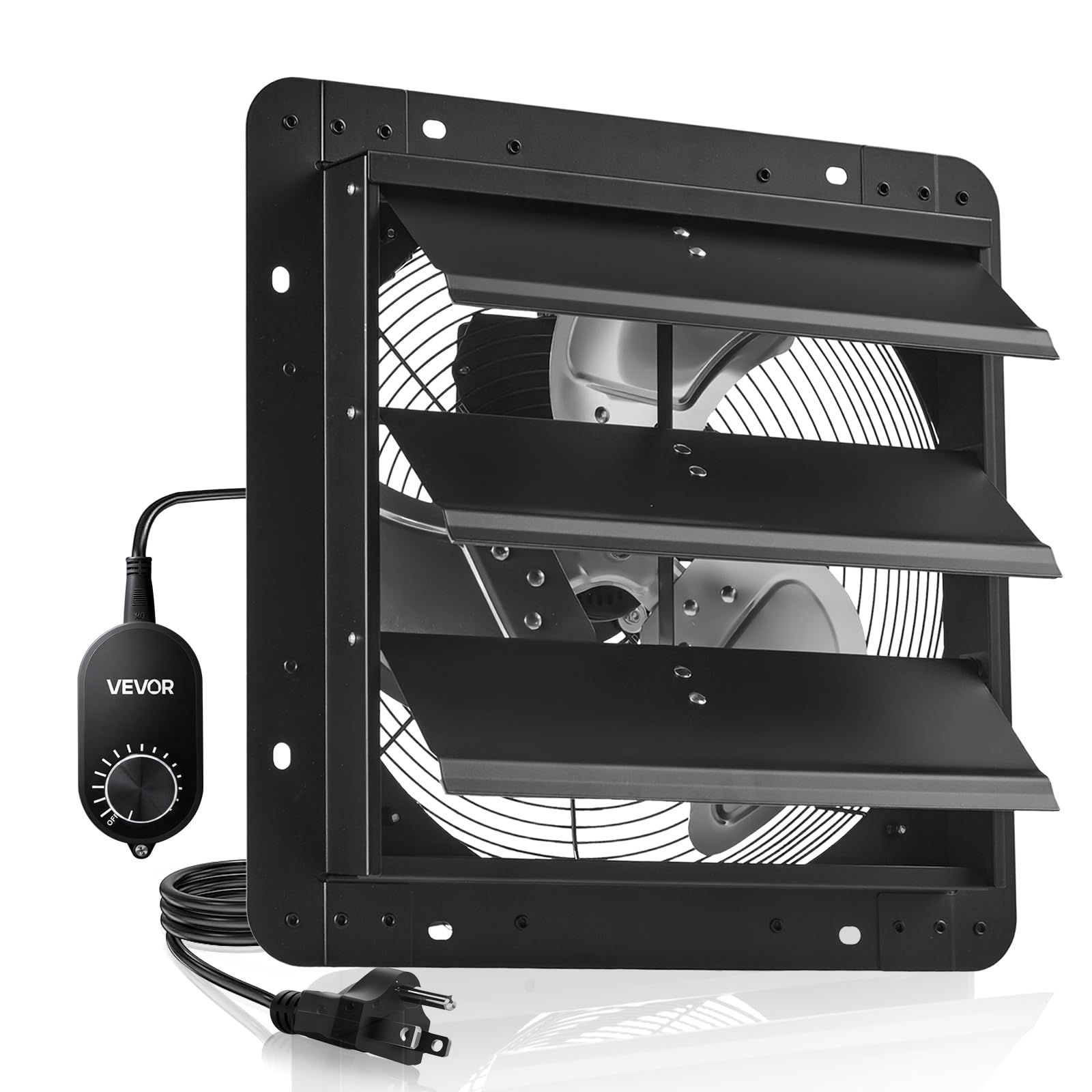
2. VEVOR 14 in Shutter Exhaust Fan Wall-Mount Automatic Louvers Variable Speed
1802 CFM — double the top pick — with a stepless dial that drops it to a gentle pull.
If raw air movement is your deciding factor, this VEVOR is the value play. It pushes 1802 CFM against the HG Power’s 882 CFM — more than double the airflow, and at a lower sticker for what you get. The stepless speed controller is the part that makes it livable: turn it down for a gentle pull during mild weather, then open it up when the shed turns into an oven. The 1600 RPM AC motor draws 47.8W and is rated for up to 7.5 m/s airflow while running smoothly.
The housing is powder-coated steel, which is the right call for a damp shed or garage corner where a plastic shell would eventually crack. Like the HG Power, it uses gravity shutters that swing open on power and drop closed when you flip it off, helping keep rain and debris out. Installation is straightforward — owners routinely describe getting the whole thing mounted and running in 45 minutes to an hour, and the parts you need come in the box.
What everyone raves about is the build and how well it just works in a shed or coop for moving air. The catch is sound: some owners find it noticeably noisy at higher speeds, and the speed controller has a habit of defaulting to high when you first power it up, so you will want to dial it down each time. It is also a physically large unit, and more than one owner has wished they had sized up rather than down once they saw the airflow in a bigger space. Treat the dial as a daily touch, not a set-and-forget setting.
The dial is the draw: adjust from a light breeze to a hard pull in seconds, something the flat on/off models cannot do.
Mount it with room around it: the powder-coated steel housing needs clearance, and the included masonry bolts mean wood mounting takes a trip to the hardware store.
Suits you if: you want the most airflow for a mid-range spend and you value being able to dial the speed down.
Skip if you need dead silence at full power — this one lets you know it is running.
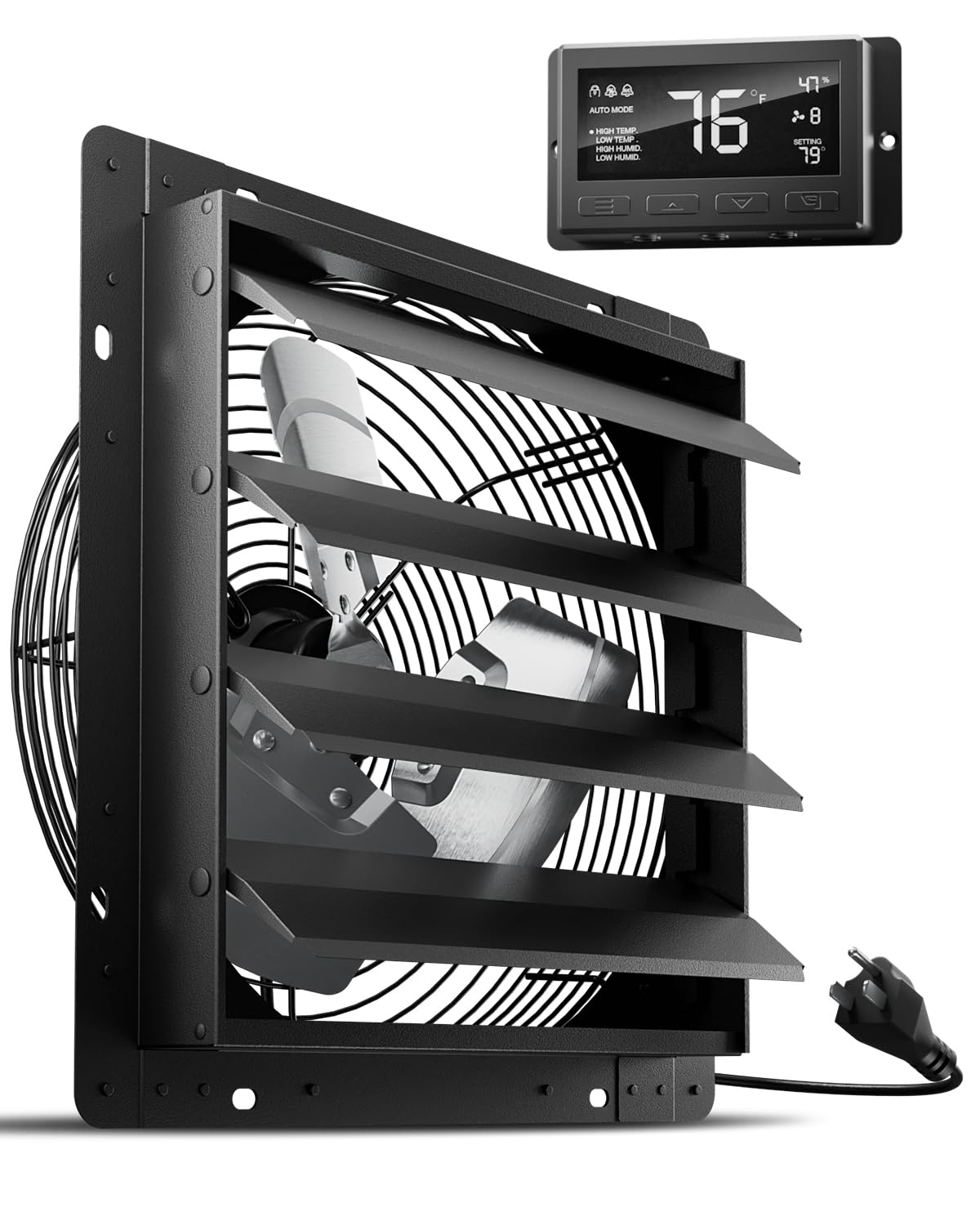
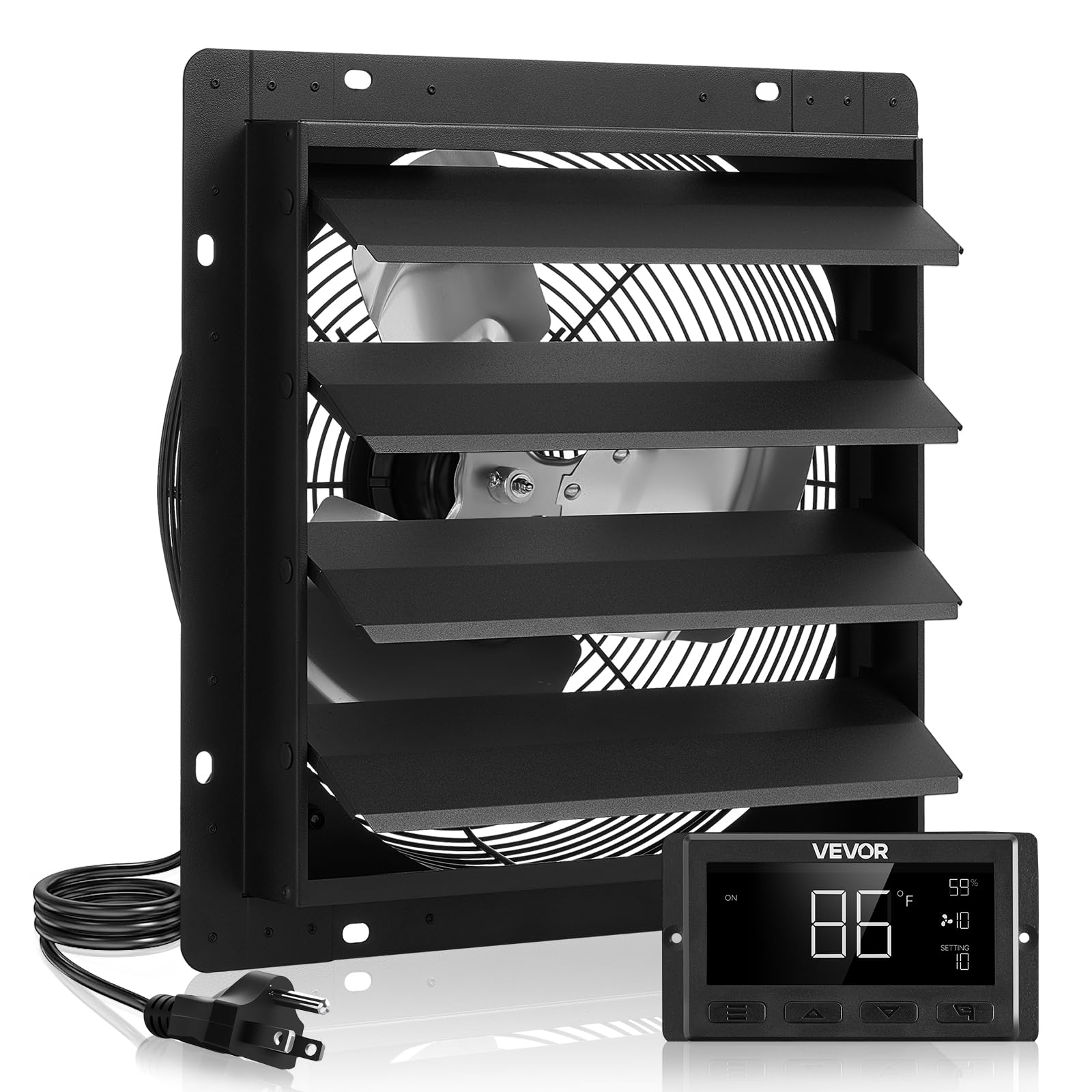
3. VEVOR 14 inch Exhaust Fan with Temperature & Humidity Controller
The 2000 CFM attic fan that triggers itself on temperature and humidity.
The headline here is 2000 CFM of airflow, the second-highest pull in this group, paired with an intelligent controller that watches temperature and humidity and adjusts the fan for you. It offers up to 10 speed settings that shift automatically as conditions change, plus multiple modes, a timer, and an alarm. The EC motor runs at 1500 RPM and 80W, delivering up to 7.2 m/s of airflow while keeping noise low — a real step up in efficiency over a basic AC unit.
The build is all-metal steel, finished with a coating meant to resist deformation and handle damp and rainy installs, and the shutters close when the fan is off to block rain and small debris. The kit includes a temperature and humidity sensor cable plus the controller, so you can place the sensor where the air actually is rather than guessing. In a screened porch gable or a tool room, owners describe it holding the space noticeably cooler on hot afternoons and adjusting its own speed as the day heats up.
Where this one demands a little patience is the interface — the settings menu is not immediately obvious and takes a few tries to learn. The thermostat also tends to cycle on and off quickly when the temperature flickers around the set point, so picking a slightly wider trigger band smooths that out. The bigger wildcard is hardware: a few buyers have opened the box to find mounting bolts or gaskets missing, and the replacement process with support can drag. If you get a complete kit, it is a genuinely capable automated fan — it just pays to check the contents before you start cutting a hole.
Automation done right: the temp and humidity triggers mean you mount it and largely forget it, which is the whole point of an attic fan.
Mind the learning curve: budget fifteen minutes with the manual and set a forgiving temperature band to avoid rapid cycling.
Pick this if you want the fan to think for you — temp and humidity triggers plus up to 10 automatic speeds handle a porch or attic without daily fuss.
Not the one for a no-fiddling buyer: the menu takes learning, and occasional boxes arrive short on mounting hardware.
4. VENTISOL 14 Inch Shutter Exhaust Fan

Aluminum blades and steel guards built to resist rust in damp garages and greenhouses.
Greenhouses and welding rooms are brutal on hardware, and this VENTISOL is aimed squarely at those spaces. It runs 1590 RPM with 1950 CFM of airflow on high, which is right up near the top of this lineup and plenty for a two-car garage or a working shop. The blades are aluminum, and both the shutters and the steel wire guards are chosen to resist corrosion and stop rust from eating the fan from the inside out.
The shutters are automatic and gravity-driven, opening and closing with the fan’s power so rain stays out when it is idle. It ships with a 6-foot power cord kit to simplify wiring, and the whole assembly is a rugged all-metal structure rather than a mix of plastic and steel. The performance and the quiet running are the two things owners bring up most — a garage owner in Arizona running one overnight behind a slightly open door reports meaningfully bringing down the morning temperature versus outside.
Two things are worth knowing before you commit. First, on humid days the airflow does not feel as strong as it does in dry heat, so if you live somewhere muggy, this is a fan that works but wants help — a bigger or stronger unit will serve you better in a wet climate. Second, the shutters themselves have drawn the most mixed-to-negative feedback of any feature, with a handful of owners seeing them stick or fail to open fully, which quietly cuts airflow. Keep the tracks clear and it behaves; neglect them and you lose some of that 1950 CFM.
Why the build sells it
- 1950 CFM on high handles a two-car garage or active workshop
- Aluminum blades and wire guards fight corrosion in damp rooms
- Automatic shutters and a 6-foot cord kit ease installation
What to keep in mind
- Humid air dulls the felt airflow, so wet climates want a higher-CFM pick
- The shutters are the part that occasionally sticks — keep them clean
Made for you if: damp garages and greenhouses are the job and you want rust-resistant metal parts doing the work.
Think twice in a wet climate: muggy air thins out the performance, and stuck shutters cut airflow further.
5. addlon 14″ Shutter Exhaust Fan
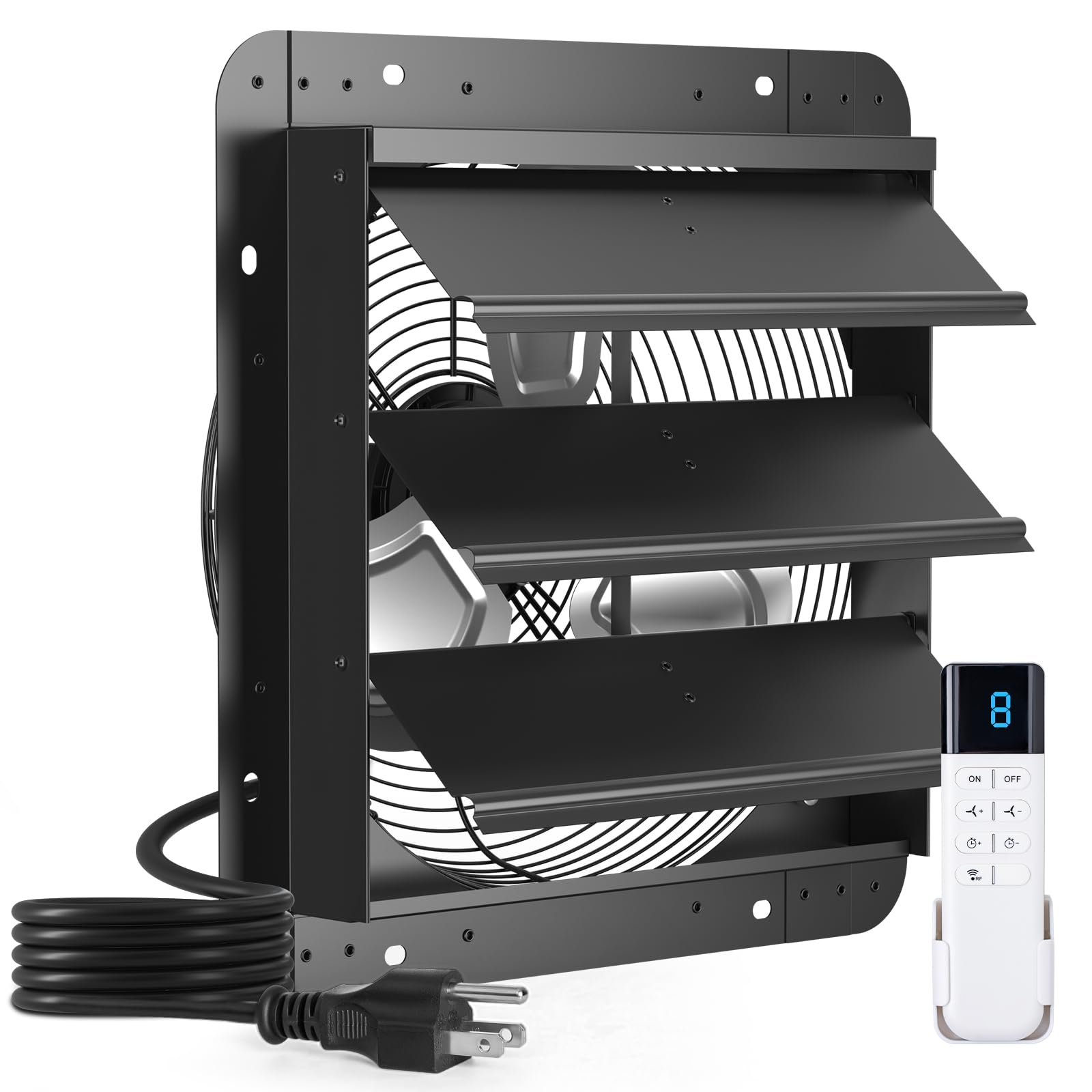
A 55 dB remote-controlled fan quiet enough to run in a basement without hearing it upstairs.
This addlon is the pick if you care about noise as much as airflow. At 55 dB it is rated as one of the quieter units here, and the 35W EC motor is the reason — that efficiency delivers 1400 CFM at 1750 RPM while drawing less power and staying smoother than a comparable AC motor. The aluminum blades are shaped to cut vibration, so you get a low hum instead of the mechanical drone that old high-speed fans are known for.
Control is entirely remote, with eight variable wind speeds and a 1-8 hour timer that shuts the fan off on its own. That matters for basements and kitchens where you want a fan to run for a set stretch and then stop without you climbing up to flip a switch. Owners use these to pull cool air up from a basement, to clear fumes and odors, and to handle humid garage days with a speed to match — the multi-speed range and the reliability of the remote get called out again and again.
The one thing to plan around is installation. The unit is pre-assembled, which helps, but the hole size wants care — the instructions are thin, and getting the opening slightly smaller than the full 14 inches keeps the fit tighter. The shutters also leave a few millimeters of gap when closed, so a determined small bug can still find a way in. Budget a bit of time with a template and the job goes smoothly; rush the cut and you will fight the frame.
Silence is the selling point: rated low at 55 dB with a vibration-tamed blade, it runs in living-adjacent spaces without being a nuisance.
Measure twice before cutting: a snug opening and thin instructions mean the install rewards patience over speed.
Best for basement and kitchen venting where the quiet 35W EC motor and the 8-speed remote let you run it without the noise.
Look elsewhere if you want maximum pull: the lower airflow suits average-sized spaces, not a big open shop.
6. KEN BROWN 14 Inch Shutter Exhaust Fan
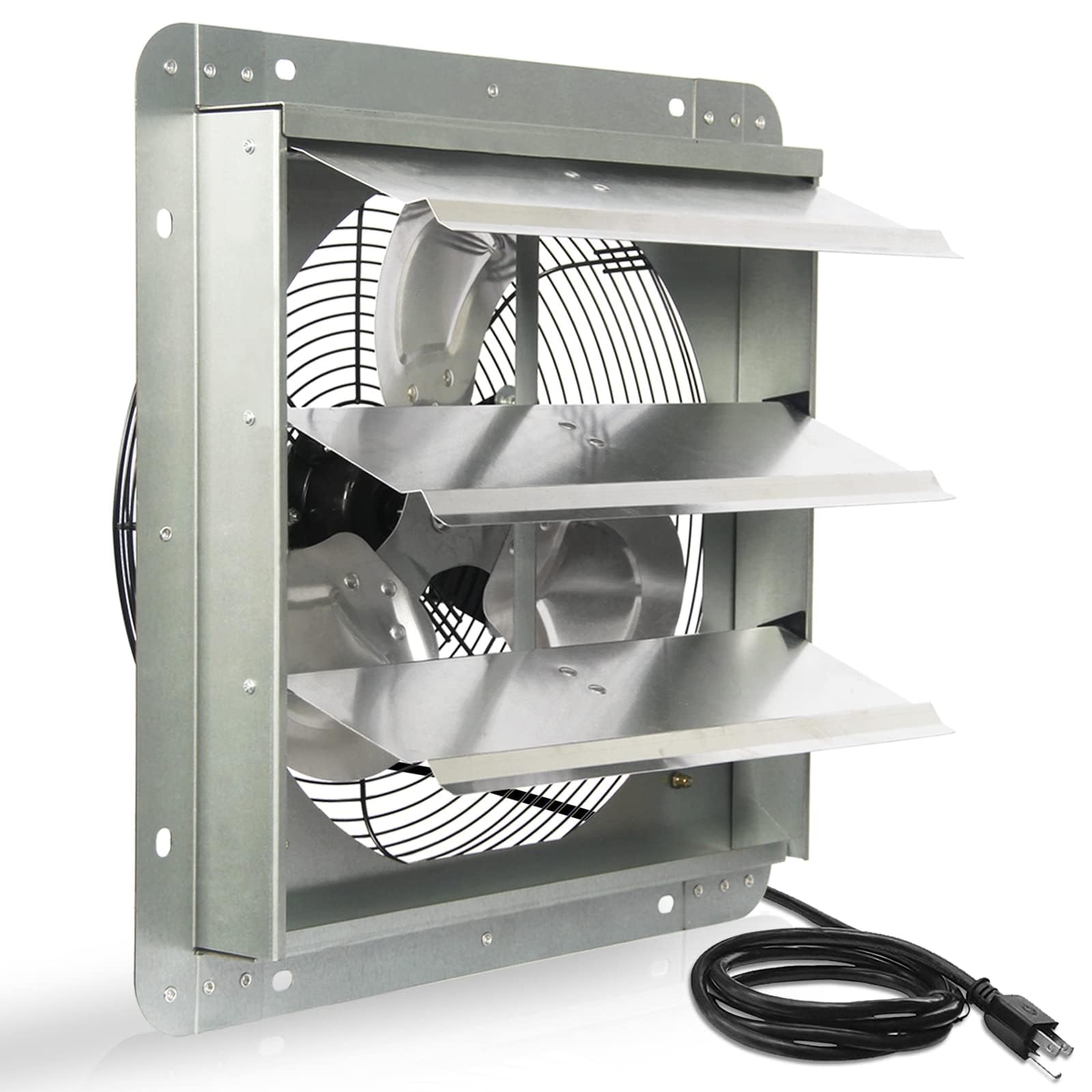
An 8.8-pound all-metal fan with an aggressive blade pitch for high-ceiling garages.
An 8.8-pound all-metal fan with an aggressive blade pitch is what you get here, and the weight is a feature — it feels solid in the hand and resists the rattle that lighter units develop. It delivers 1520 CFM at 1590 RPM on a standard 120V, 60Hz current, which is strong enough for a large bay or a mezzanine where heat likes to sit. Silver aluminum blades and shutters keep it weather-tolerant, and the housing holds up in a hot metal building where lesser fans cook.
The practical install detail worth planning for is the power setup. It comes with a 3-foot cord kit and a strain-relief clamp, but it does not have a built-in on/off switch — you supply either a controller or a plug to manage it. That is fine if you were planning to add a thermostat anyway, and plenty of owners do exactly that, mounting a cheap thermostat at fan height so the unit handles its own switching. Used as a window box fan, buyers report it fits a three-sided bay window well and pushes an immediate, strong airflow.
What people praise is how well it functions — installation is quick, and the pull is forceful enough to cool a high-ceiling workspace or clear the air over a canning stove. The trade-off is honest and specific: it is a flat-out fan, not a finessed one, so if you want variable speeds or a factory switch, you are adding them yourself. In a space that just needs strong, steady exhaust, that simplicity is a strength rather than a fault.
The case for the heavy build
- 1520 CFM and aggressive blade pitch push a lot of air fast
- 8.8-pound all-metal body resists the rattle cheaper fans develop
- Aluminum shutters and blades handle hot, humid conditions
Plan for before you buy
- No built-in on/off switch — you supply a controller or plug
- The 3-foot cord kit is short, so a nearby outlet or an added length is likely
Reach for this if: you are comfortable wiring in your own thermostat and want a heavy-duty pull in a large, hot workspace.
It is not for the plug-and-play crowd: no switch in the box means you are adding the controls yourself.
7. iPower 14 Inch Wall Mounted Shutter Exhaust Fan

A 1000 CFM greenhouse fan with a 50°F–120°F thermostat that holds temperatures steady.
This iPower is built for greenhouse and attic duty, and the included temperature controller is the centerpiece. The fan runs 1600 RPM for 1000 CFM at 120V, 60Hz, and 70W, with aluminum louvers and blades on a steel frame. The controller is its own capable device: it handles 115V-120V at 13A and 1200W, offers 8 levels, and can be adjusted anywhere from 50°F to 120°F. Set the dial and the fan handles the switching for you.
For a greenhouse, that turns into stable temperatures without you babysitting the door. Owners running a 20-inch version in a 10x20x7.5-foot poly greenhouse report holding temps at or below 92°F with a 10 to 12 degree differential against outside — the kind of swing control that keeps plants from cooking at midday. The automatic shutters open when running and drop closed by gravity when the fan stops, keeping mosquitoes and dust out, and the unit arrives mostly assembled so mounting is the main task.
The honest caveats are small but real. Some owners find the power cord too short for their layout and end up adding an extension, and a strain-relief fitting that only comes in a single count can leave you wanting a second. A few note that the louvers do not always close completely, and a couple of buyers added their own speed control, which can make the fan buzz below full speed. For straightforward thermostat-driven exhaust in a modest space, it does the job well, as long as you plan the wiring reach.
The thermostat is the value: a 50°F to 120°F range with 8 levels means the fan switches itself, which is exactly what a greenhouse needs.
Check your cord run: a short lead plus a single strain relief means you may need an extension and an extra fitting.
Ideal for greenhouse growers who want a real thermostat keeping temperature steady without daily trips to open a vent.
Less ideal for very large spaces: at 1000 CFM it suits modest greenhouses and attics, not sprawling barns.
8. iLIVING 14″ Wall Mounted Shutter Exhaust Fan

A 1200 CFM fan with a 12-speed digital controller rated for spaces up to 1800 square feet.
The spec that sets this iLIVING apart is reach. It delivers 1200 CFM and is rated to exchange air in spaces up to 1800 square feet, using deep-pitch aluminum blades on an ETL-certified EC motor that runs at 1600 RPM. The digital controller is the part that makes it easy to live with: it regulates temperature anywhere from 50 to 99°F with up to 12 adjustable speeds and a 24-hour timer, and it responds to humidity as well as heat. The controller can even be extended into the house with a Type A USB cable, so you manage the fan from indoors while it works the garage.
Owners put this to real use — one running it almost continuously in a garage reports the air keeps moving and that even full volume stays quiet, while a barndo owner credits it with holding the interior near thermostat temperature through the hot part of the day despite thin insulation. The galvanized steel frame, aluminum shutters, and OSHA-compliant wire guards speak to a unit meant for serious spaces, and the 5.6-foot cord makes for a straightforward plug-and-play setup. The 14-inch blades are the widest in this group, pairing with that deep pitch for strong air movement.
Two quirks are worth knowing. This fan is sensitive to power interruptions — if the supply blips, it drops out, and owners who want uninterrupted running plug it into a backup system. Reliability is also the most mixed area of feedback, with a handful of units reported to stop working over time, so buying where the warranty is honored matters. Get past those, and the combination of wide coverage and a genuinely smart controller makes it among the most flexible units here.
Where it stands out
- Rated to exchange air in spaces up to 1800 square feet
- Digital controller handles 50-99°F with up to 12 speeds and a 24-hour timer
- Controller can be run into the house for indoor adjustments
The fine print
- Drops out on a power blip — a backup supply helps
- A handful report durability issues over the long haul
Choose this for large, hard-to-cool spaces: the 1800 sq ft rating and 12-speed digital controller earn their keep in big garages and barndos.
Skip if you want zero maintenance worries: a power blip knocks it offline, and long-term reliability is the weaker spot.
9. InoKraft 14 in Shutter Exhaust Fan
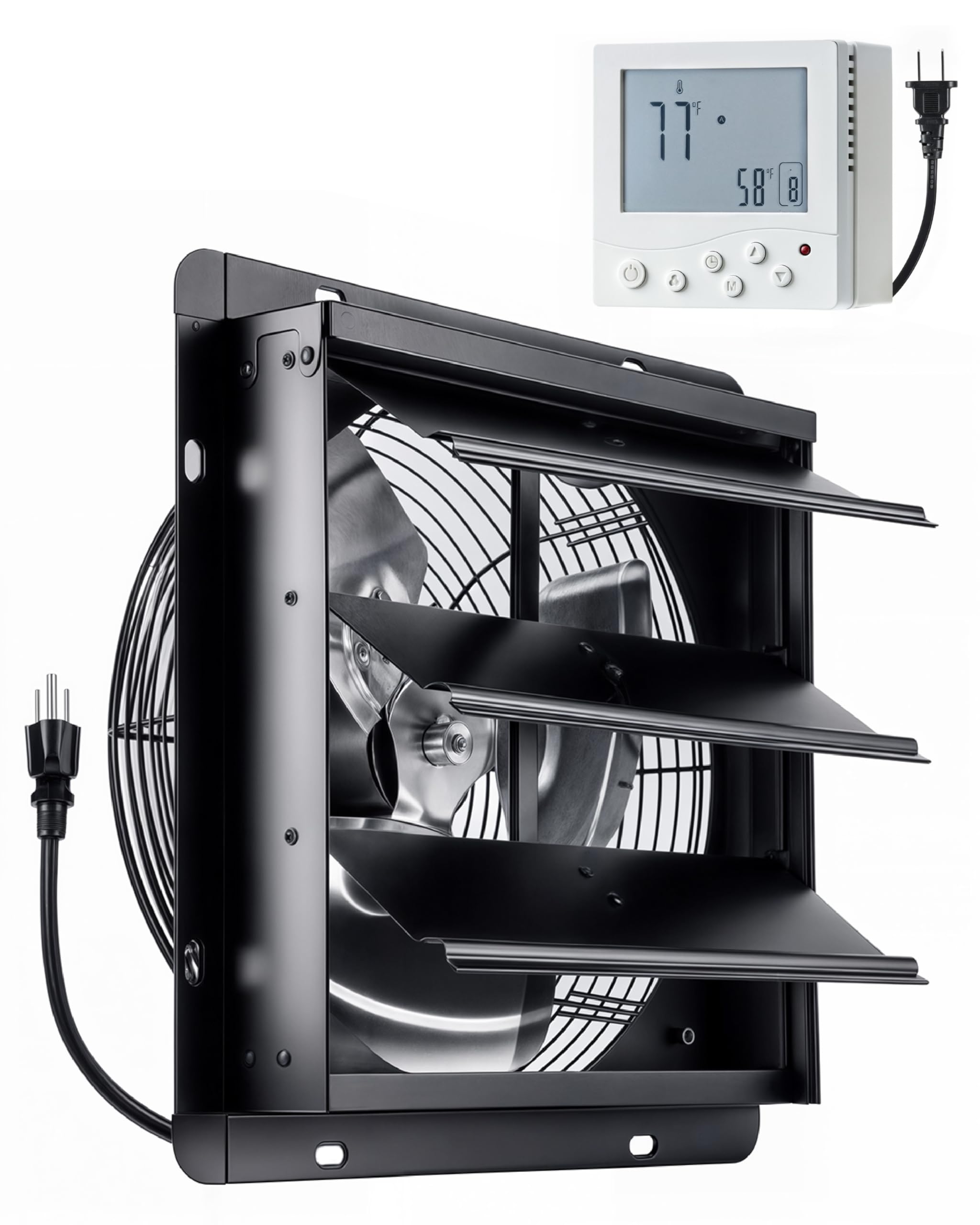
The biggest pull in the group, at 2100 CFM, with a remote you can mount anywhere.
If none of the other fans move enough air for you, this InoKraft is the ceiling. At 2100 CFM it is the highest airflow in this entire lineup — well beyond the iPower’s 1000 CFM or the addlon’s 1400 CFM — and it is rated for enclosed spaces up to 1260 square feet, so it suits a large attic or a full workshop. The ETL-certified EC motor runs on 120V/60Hz and stays at just 65 dB even at maximum speed, which is remarkable given the volume of air it is moving.
Control is where it earns its keep. The wireless remote panel reaches up to 33 feet and can be mounted on a bench, wall, or hallway for instant speed and temperature changes — though the signal will not pass through solid walls and obstructions cut the range. It has a memory for your set temperature and ramps its own speed up as the space heats toward your target, and there is a dedicated auto mode. The build leans into weather resistance with coated aluminum shutters on a heavy-duty steel frame and sealed strips to block insects and rain.
The detail to understand before you buy is how it handles the controller’s own limits. The temperature sensor lives inside the controller, so if you mount the panel out in the house, it reads the house temperature, not the attic — plan the placement with that in mind. There is also a power-recovery behavior to know: after an interruption, the fan restarts at high speed and needs a manual reset to return to your custom setting. Set the controller sensibly, and the fan runs beautifully, sealing tight when off and ramping up on its own as the day warms.
The airflow king: 2100 CFM for spaces up to 1260 square feet, and still only 65 dB at full tilt.
Place the controller with care: because the sensor sits in the panel, its location decides what temperature the fan is actually reacting to.
The pick for maximum airflow: big attics and workshops up to 1260 square feet get the strongest pull here, with a remote that runs 33 feet.
Know its quirk going in: after a power interruption it restarts at high speed and waits for a manual reset.
Understanding the Specs
CFM (Cubic Feet Per Minute)
This is the single number that tells you how much air a fan moves each minute, and it is the best guide to whether a unit is right for your space. A small coop or single-bay garage clears comfortably with a lower figure, while a large attic or a fume-heavy workshop needs the higher end of the range. Picking too little airflow means the fan runs nonstop and never quite wins — so size up when you are between two options.
Motor Type (AC vs EC)
The motor decides how much power the fan draws and how smoothly it runs. An AC motor is the simpler, traditional design, while an EC motor varies its own speed more efficiently and tends to run quieter and cooler for the same airflow. When you see a fan rated at a low wattage for a high CFM figure, that is usually an EC motor doing the work — a hint that it will be gentler on your wiring and your ears.
Automatic Shutters and Mounting Depth
The shutters are the louvers that swing open when the fan runs and drop closed when it stops, keeping rain, insects, and winter drafts out. Mounting depth is the space the housing needs behind the wall, and it varies widely across these units — some sit close to the wall while others need a deep cavity. Measure both before you buy, because a shallow space rules out the deeper units and a shallow fan may not fit the opening you already have.
Noise Level and Controls
Noise is rated in dB (decibels — how loud the fan sounds while running), and a fan that pushes a lot of air can still stay quiet if its blades are shaped to reduce vibration. Controls run from a simple on/off switch to remotes, dials, and digital panels that read temperature and humidity. Decide how hands-off you want the fan to be: a thermostat or auto controller saves daily trips, while a basic switch is cheaper and less to go wrong.
FAQ
Will a 14 inch exhaust fan fit my existing wall or window opening?
How do I know what CFM I actually need for my shed or garage?
Is an EC motor worth it over a standard AC motor?
Do the automatic shutters really keep rain and insects out?
Can I run a 14 inch exhaust fan on a timer or thermostat plug?
How loud is a 14 inch exhaust fan when it is running?
What is the difference between a shutter exhaust fan and a box fan?
Do these fans work for a chicken coop or greenhouse?
What happens to these fans during a power outage?
How long should a 14 inch exhaust fan last?
Final Thoughts: The Verdict
For most people shopping a 14 inch window fan to clear a shed, garage, or barn, the HG Power Upgraded 14 Inch Shutter Exhaust Fan is the right first look — its metal build, 882 CFM pull, and thickened body are the details that decide whether a fan lasts through season after season, and it holds the highest airflow among the simple on/off models here. If you want the most air for your spend and the freedom to dial it down, grab theVEVOR 14 in Shutter Exhaust Fan with Variable Speed at 1802 CFM. And for a big attic or workshop where you want the strongest pull with a remote you can mount anywhere, the InoKraft 14 in Shutter Exhaust Fan at 2100 CFM is the one to reach for — it leads the entire group on raw airflow, and for large, hard-to-cool spaces that number is the one that keeps the air moving.
How We Picked
We do not accept paid placement. Every pick is matched to a real buyer and a real use-case; we do not hands-on test units.
Sources & Methodology
Specifications: manufacturer listings and product documentation. Review insights: verified customer reviews, as of September 2026. Pricing: not shown on this page (it changes often); check the current price via the retailer link.
As an Amazon Associate, Non Toxic Blog earns from qualifying purchases. This does not affect which products we feature.