Specs are compiled from manufacturer listings and verified buyer reviews and can change over time — please confirm the key details on the product page before buying.
If you want one answer fast: the The North Face Dolomite One 15F is the bag worth buying here. It is a three-in-one modular system that lets you build a 15-degree bag for cold nights or strip a layer for mild ones, which is why it holds the top spot. The other six picks each solve a specific problem — being big and tall, packing down small, surviving damp weather, or fitting a woman’s frame — and this guide tells you plainly which one fits your trip. One note before you read: this list uses flexible matching for 15 degree Fahrenheit temperature ratings, roughly the 10F to 20F class, so not every pick is stamped with the exact same number. The nearest same-type rating does the same job, and we tell you the real rating on every bag below so you are never guessing.
I’m Mo Min — the founder and writer behind Non Toxic Blog. This guide is built by comparing the manufacturers’ published specifications and the patterns across verified customer reviews, so you get each pick’s real strengths and trade-offs instead of marketing spin.
The cold that wakes you at 3 a.m. is rarely the cold your bag was rated for — it is the cold sneaking through a draft collar, a compressed footbox, or a damp shell. So here is what actually separates a warm night from a long one in any 15 degree sleeping bag.
Our Picks at a Glance
How To Choose The Best 15 Degree Sleeping Bag
Buying a 15-degree bag is really a question of one thing: what your body feels like at 4 a.m. The rating on the tag is not the temperature you will sleep comfortably at. It is closer to the temperature you can survive in. So the first job is learning to read the number honestly, then matching the bag’s shape and fill to how and where you actually sleep.
Read the rating as a limit, not a promise
A 15-degree bag means the manufacturer tested it to keep a sleeper alive, not cozy, at roughly 15°F. Your real comfort zone usually sits higher. If you sleep cold, or you camp on a thin foam pad, plan for the bag to feel right about ten degrees above its label. Pairing a 15-degree bag with a decent insulated mat matters just as much as the bag itself — the ground pulls heat out of you all night.
Down versus synthetic fill
Down (the fluffy underfeathers of ducks and geese) gives you the most warmth for the least weight and crushes down into a tiny sack. Its weakness is moisture: get it wet and it stops insulating. Synthetic fill (man-made polyester fibers) is heavier and bulkier for the same warmth, but it keeps working when damp — the smarter pick for wet, humid trips.
Shape, size, and the footbox
A mummy bag (narrow, tapered, hooded) traps heat most efficiently because there is less dead air to warm. A rectangular bag gives your legs room to move but is heavier and less warm for the same fill. Whichever you pick, check the length against your height and the shoulder width against your sleeping style. Side sleepers and broad-shouldered campers feel every inch of tightness, while the footbox — the closed end at your feet — should be roomy enough that your toes are not jammed flat.
Quick Comparison
Every column below uses the same dimension across all seven picks, so you can scan warmth, fill type, and packed weight side by side.
| Model | Best For | Temperature Rating | Fill Type | Weight | Amazon |
|---|---|---|---|---|---|
| The North Face Dolomite One 15F★ Best Overall | Versatile car camping | 15°F to 50°F (3-in-1) | Polyester synthetic | 4 pounds | Amazon |
| Retrospec Dream Mummy 15°FBest Value | Budget backpacking | 15°F / -9°C | Hypoallergenic synthetic | 3 lbs 7 oz (Regular) | Amazon |
| Coleman Big Basin 15°F | Big and tall campers | 15°F | Coletherm polyester | 8.2 pounds | Amazon |
| QEZER Down Mummy 600 Fill | Ultralight backcountry | Comfort 18°F–32°F / Limit 10°F | 600 fill power duck down | 2.2 pounds | Amazon |
| Marmot Trestles 15 | Wet-weather treks | 15°F | SpiraFil synthetic | 1535 g | Amazon |
| Marmot Men’s Trestles 15° (Long) | Tall male sleepers | 15°F | SpiraFil synthetic | 3.74 pounds | Amazon |
In‑Depth Reviews
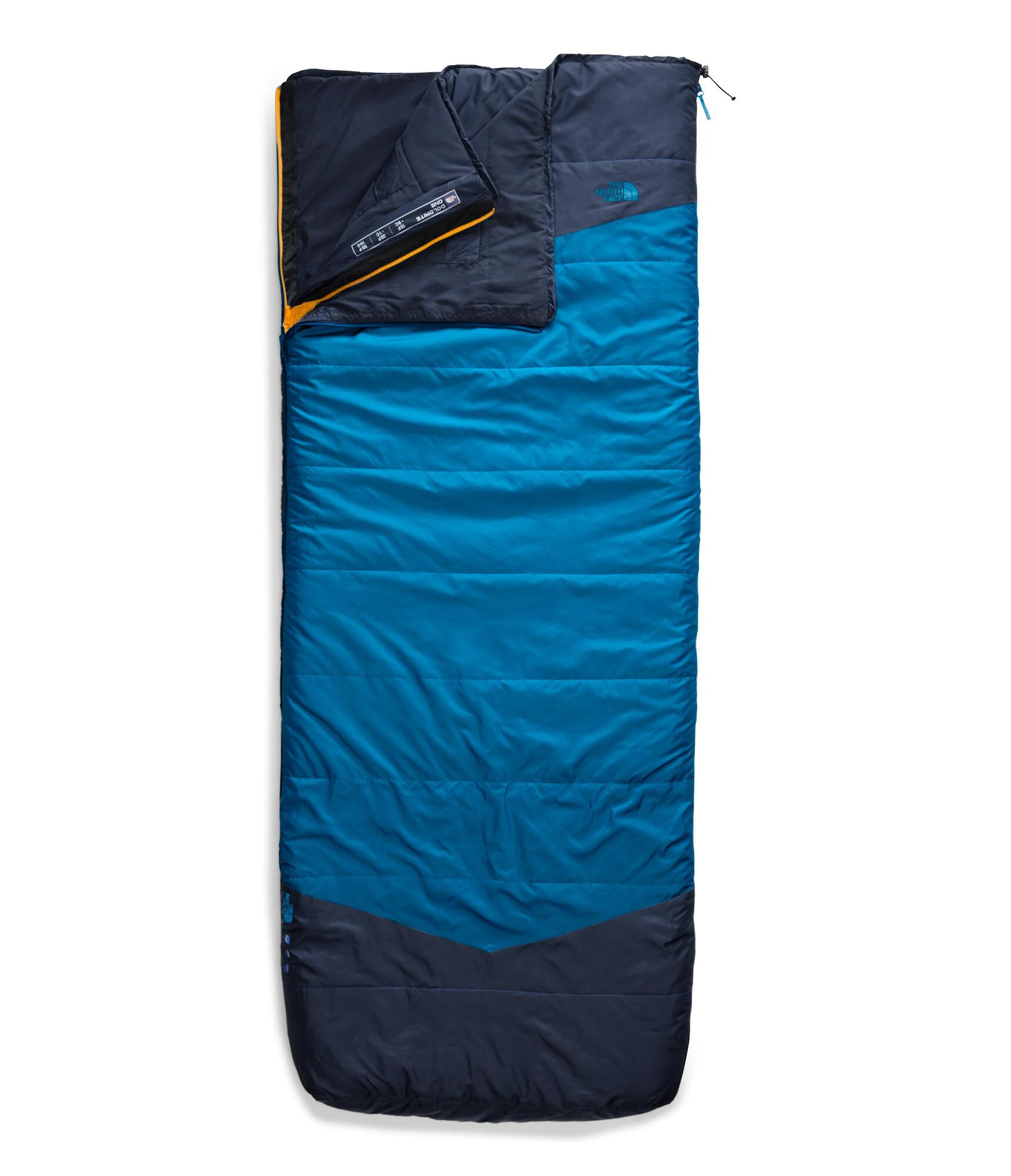
1. The North Face Dolomite One 15F / -9C, 3-in-1 Insulated Sleeping Bag
Our pick — over 4.5★ from 100+ verified ratings; the strongest balance of quality and price.
One bag, three temperature settings: the modular system that follows the weather
This is the bag for the camper who cannot predict the forecast — the one who leaves for a weekend and gets 28°F on Friday and 50°F by Sunday. Instead of owning three bags, you own one that changes. A top layer carries 50-degree-rated synthetic insulation, a mid-layer carries 30-degree-rated synthetic insulation, and zipped together they form a 15-degree bag. That range is the entire point: 15F up to 50F from a single purchase.
The shape helps too. It is rectangular rather than a tapered mummy, so you get real room to roll over, and the mid-layer is lined with fleece you can feel against your skin the moment you slide in. Sleep hot? The zippers open from the bottom so you can dump heat without climbing out. Owners consistently say the size is the thing they love most — it is genuinely spacious by comparison, and the second most-discussed win is warmth. One owner’s review of their September trip, when nights dropped below 30F, is blunt about it: “I was never cold and I slept fantastic.” A 4.6 rating across more than 10,000 owner reviews backs that up.
The honest catch is the zipper system. Amazon’s own review summary flags the zipper quality as mixed, with several owners finding the multi-layer setup confusing at first. It is a learning curve, not a fault — most people have it sorted inside a couple of minutes, and the panels even double as throw blankets once separated. The other trade-off is bulk. At 4 pounds and rectangular, this is a car-camping bag, not a pack-it-in-and-hike-ten-miles bag, and owners say exactly that. If your trip involves a trailhead and a long walk, look at the QEZER below instead.
What Makes It The Pick
- Three layers combine for a real 15F bag or split for 30F and 50F nights — one purchase covers a whole season
- Rectangular shape with 77″L x 33″W gives side sleepers and restless bodies genuine roll-over room
- Fleece-lined mid layer is the layer you notice, and the foot-end Velcro flap seals in heat
- Zippers open from the bottom for ventilation without leaving the bag
Where It Asks Something Of You
- The multi-layer zipper takes a couple of minutes to learn before it feels obvious
- At 4 pounds and rectangular, it is a car-camping shape, not a light backpacking one
Settle on this if: you camp from a vehicle, want one bag that works from 15F to 50F, and value room to move over shaving ounces.
Keep looking if: you are counting grams for a long-distance hike — the 4-pound rectangular build is the price of that comfort.
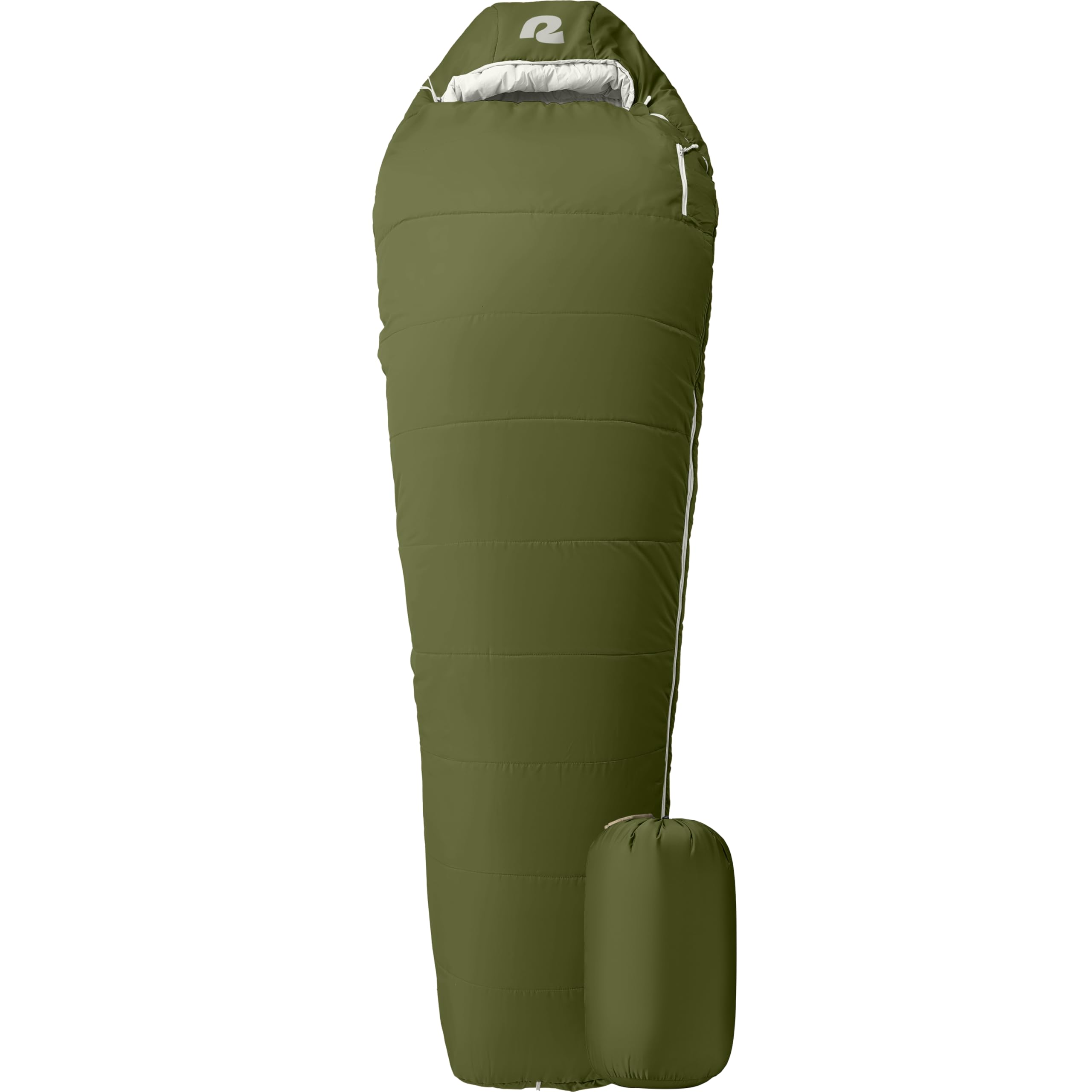
2. Retrospec Dream Mummy Sleeping Bag 15°F
A true mummy cut at the entry price — and it packs to 3 lbs 7 oz
Most cheap bags are rectangles that feel like sleeping in a grocery sack. This one is not. It is a proper mummy (narrow, tapered, hooded) built to trap the heat your body makes, and it does it for the Regular size at just 3 lbs 7 oz — with the Long size at 3 lbs 11 oz. It compresses into the included stuff sack, and the whole thing is rated to 15°F / -9°C with a water-resistant inner and outer shell, a draft collar, and a draft tube that blocks cold air from sneaking through the zipper.
One detail earns its place here: the draw cords are differentiated, meaning you can tell them apart by feel in the dark — the hood zipper is knotted, while the side and pocket zippers lie flat. There is a side stash pocket for a phone or headlamp, and the hood cinches around your head. A 5’4″ camper chose the Long size for extra room and found the hood cozy and the full-length double zipper handy. Another owner sleeping at low 30s°F summed it up as “cozy, comfortable, and content.”
The real-world honesty you want here: seven months of all-season use confirms the 15°F rating holds up and the synthetic insulation keeps lofting — but on a thin R-2 foam mat at 19°F, that owner’s feet went cold and numb, and the advice was that a better mat would have fixed it. The ground steals your heat; the bag cannot fight that alone. There is also no compression sack included, and since the fill is synthetic, it is bulky — this is a backpacking bag by weight, not by volume. Quality control can wobble too; an occasional unit arrives with a faulty zipper.
At 78″L x 62″W it is a real mummy with room to wiggle, not a coffin you crawl into.
The packing math: for a bag in the entry tier, 3 lbs 7 oz in the Regular plus an included stuff sack makes it one of the more packable picks here — it leans toward the trail, while the Coleman below is built for the tent.
Set it up right: pair this with a thicker sleeping mat than R-2 and the 15°F rating is genuinely usable. Skip the thin pad and you will feel the floor through it.
Buy this one if: you are watching the budget, want a genuine mummy shape, and prioritize low pack weight.
Look elsewhere if: you want a small packed volume — the synthetic fill is bulky without a compression sack, so car camping or short hikes suit it better than a multi-day walk.
3. Coleman Big Basin 15°F Big & Tall Sleeping Bag

Built for the camper who has never fit a sleeping bag in their life
If you are six-foot-two and 225 pounds, most sleeping bags fit you like a straitjacket. This one is cut for people up to 6 ft. 6 in. tall, and the first thing owners say is exactly that: how much room there is. A parent bought it for a 6’2″ 225 lb. son who slept in it the night before their trip and loved it on the spot. If wide shoulders, big feet, or a side-sleeping habit has ever made a bag feel like a punishment, this is the fix.
Warmth comes from Coletherm hollow polyester insulation, which the maker describes as providing better heat retention with less weight than a standard fill. The construction details matter here too — a double-batt, offset quilt layout that removes potential cold spots, a fleece-lined footbox for your feet, and an adjustable hood you can open for ventilation or cinch down for warmth. A 2-way zipper opens the bottom, and a tough ripstop-reinforced polyester cover resists tears. It is also machine washable, which most cold-weather bags are not.
The trade-off is weight and packed size, and it is real. This bag is bulky even when packed, which the company’s own buyers confirm — one reviewer’s warning that it is “HUGE” and heavy is fair, and another simply says to keep in mind that it is bulky even rolled up. Layered under a 40°F bag for extra warmth, it stays roomy for side sleepers with a smooth zipper and extra foot padding. It is a car-camping bag in every sense: a tent, truck, or cabin bag, not one you carry far.
That roominess is the whole personality of this bag, and it earns its keep the second you stop fighting the fabric.
The size no one else matches: 20.5″L x 12.6″W packed and built for 6 ft. 6 in. — compare that to the Retrospec’s 78″L x 62″W footprint and you can see how differently these two live in a car.
Worth knowing: at 8.2 pounds it is the heaviest bag on this list, and unlike the 4-pound North Face above, you will feel it every time you move it. Zipper durability has been the rare weak point on individual units.
Reach for it if: you are tall, broad, or simply refuse to sleep curled into a ball, and you camp near your vehicle.
Pass on it if: you are hiking to your campsite — the 8.2-pound packed weight is a serious carry, and a mummy like the Retrospec suits a trail far better.
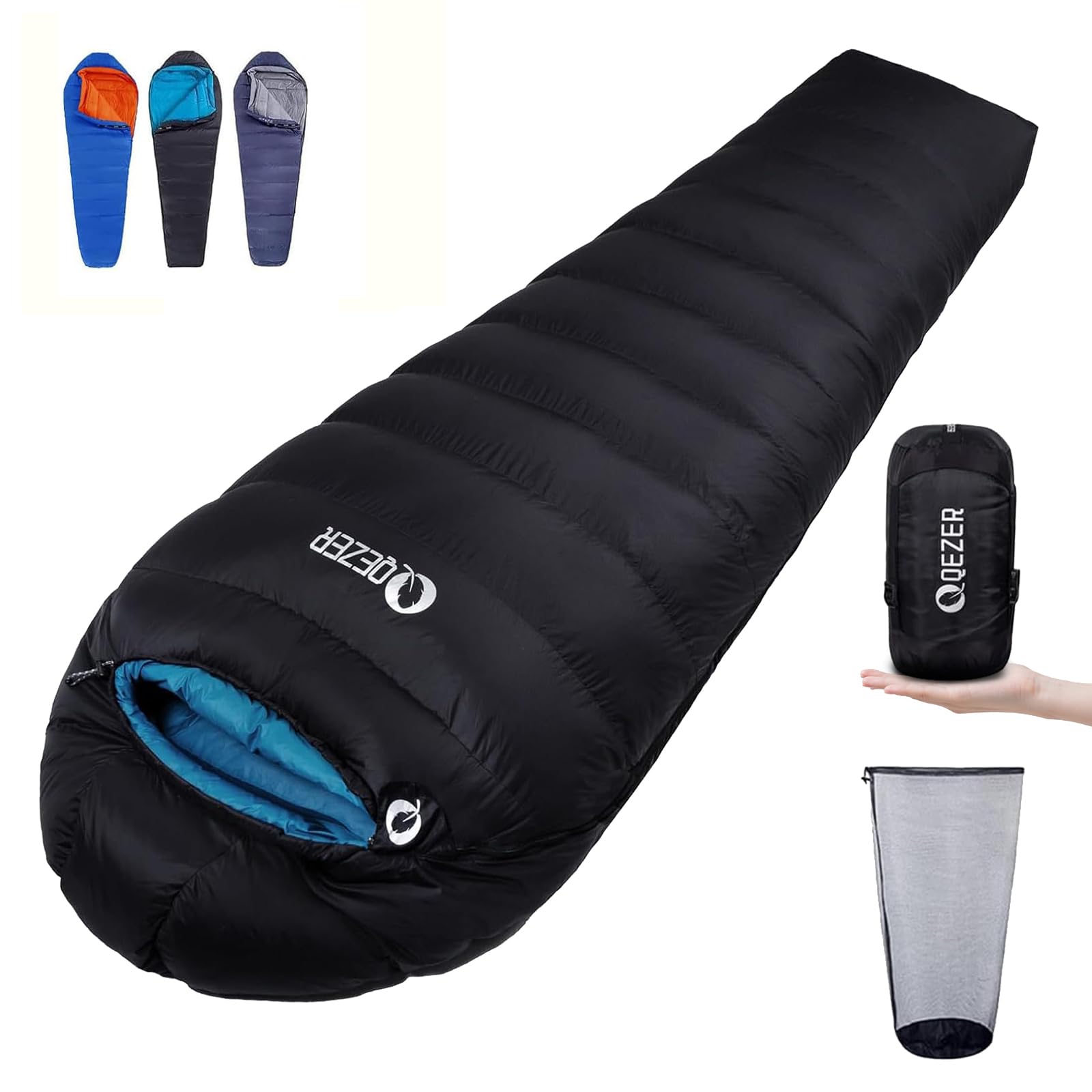
4. QEZER Down Mummy Sleeping Bag, 600 Fill Power
Down does what synthetic cannot: warmth in a bag you barely notice carrying
Here is where down earns its reputation. This bag is filled with 2.2 lb of natural duck down at 600 fill power (a measure of how much loft, and therefore warmth, each ounce of down gives you), and it weighs 2.2 pounds total — roughly half the weight and volume of a polyester-cotton bag, according to the maker. Its comfort range is listed as 18°F-32°F with a limit of 10°F. It squashes into a 14.96″ x 7.48″ storage size, which is why backpackers reach for it over every synthetic pick here.
The build details show real thought. The shell is 400T tear-resistant nylon — a high-density weave that also stops down from poking through. The bottom widens into a trapezoidal footbox so your toes are not squashed flat. Left and right zippers mean two bags can zip together as a double for family trips. Owners confirm it compresses tighter than a Mountain Hardware Pinhole and repacks to its original size, unlike synthetic bags that never quite stuff back down. A tall owner called it “more than adequate” for his height and “extremely comfortable and warm.”
Two things you should know before buying. First, down and damp weather are enemies — the QEZER is a dry-cold bag, so if you camp in humid, rainy conditions the Marmot SpiraFil bags below are the safer call. Second, warmth here is temperature-sensitive and the labeling has caused honest confusion: one owner slept in a real 17°F night outside a tent and found it insufficient, and flagged that the bag’s own label numbers did not match the listing’s. Treat the comfort figure as your realistic target and add a good mat. Zippers also draw some criticism — they need a specific pull motion, and a few owners found them stiff.
That 2.2-pound weight and a packable 14.96″ x 7.48″ make it the bag that disappears into a backpack, and that is the whole reason it exists.
Choose it if: you carry your bag any distance, want the smallest packed size here, and will keep it dry.
Think twice if: your trips run wet and humid — synthetic fill like the Marmot’s survives moisture that would flatten down.
5. Marmot Trestles 15 Sleeping Bag

Keeps working when it is wet — the synthetic bag built for damp mountains
Where down fails, SpiraFil works. This bag uses Marmot’s SpiraFil high-loft synthetic insulation, which is designed to keep you warm even when things get wet — exactly the scenario down cannot handle. If you backpack in the Pacific Northwest, Scotland, or anywhere the air is heavy with moisture, that single property outweighs every weight saving on the list. The construction layers a wave-construction top over a blanket-construction bottom and an anatomical 3D footbox (a shaped, roomy end that lets your feet rest naturally), plus a locking YKK two-way zipper and an included compression stuff sack.
Owners describe the material quality as the standout — the second thing they mention is warmth — and the practical verdicts back it up. One camper slept in it down to 38 degrees and stayed warm. Another used it through a 7-day motorcycle trip across the Andes in 0-10°C conditions and calls it an excellent insulator, noting it packed well in a backpack with the compression sack. A third found it comfortable to around 30°. It carries an EN-tested 15°F rating, and the SpiraFil warmth-to-price math reads strong.
Bulk is the honest cost of synthetic fill, and this bag is no exception. Owners call it a little bulky — one notes it is bulkier than ideal for lightweight hiking, which is precisely the trade-off you accept in exchange for moisture-proof warmth. At 1535 g (about 3.4 pounds) it sits at a reasonable weight for what it does, and it fits well enough in a backpack for a serious trek. This is the bag for the camper who would rather carry a little more than gamble on a wet night.
Buy it for the wet conditions, not the lightest possible pack — that is the deal, and it is a good one for three-season backpacking.
Why it holds up in the rain: SpiraFil synthetic insulation is the direct answer to down’s one weakness, and an EN-tested 15°F rating with a locking YKK zipper is real cold-weather gear, not a warm-weather bag dressed up.
It is the right bag if: you backpack through wet, cool conditions and want a warmth rating you can trust when the weather turns.
Not your match if: you are chasing the absolute lightest carry — the synthetic fill is bulkier than the QEZER down bag above, and that is the deliberate trade.
6. Marmot Men’s Trestles 15° Sleeping Bag, Long
The long-cut Trestles for tall men who are tired of cramping their knees
Same proven SpiraFil warmth as the bag above, cut longer and sized for men — worth knowing because if you are past six feet, the standard length simply will not do. One owner’s 6’1″ husband fits this “perfectly” after years of sleeping in bags that were too tight, with just enough wiggle room at the feet and no cold gap. If your feet have ever jammed the end of a bag, this is the version to buy.
The construction matches the Trestles formula: SpiraFil high-loft insulation that keeps insulating when wet, a full-length two-way zipper, a roomy 3D footbox, and wave-construction top over blanket-construction bottom. There is a stash pocket for small items and a fold-down secondary zipper for dumping heat when the interior gets too warm. An Airborne soldier took one to Alaska and it worked well; the same owner’s small but useful tip was to leave the bag unpacked between trips so the insulation does not stay compressed. It carries an EN-tested 15°F rating and delivers strong cold-weather value at 3.74 pounds.
Two honest notes. The fill is polyfill, not down, so it does not compact as tightly as a down bag for extended cold-weather backpacking — one owner’s exact point. And at 19 x 9.5 x 19 inches packed, it takes up real space in a pack. Scout troops have slept in these bags across seasons of cold and warm weather without failures, a reassuring track record for a synthetic bag.
Built to last: the SpiraFil insulation and durable shell have held up to heavy troop use across seasons, which speaks to the build quality — though the bag lifespan depends on storing it uncompressed, as the Alaska tip suggests.
This is your bag if: you are a taller man who wants the proven Trestles performance in a longer, roomier cut.
Skip the long cut if: you are under six feet — the shorter standard Trestles above will pack smaller and leave you less empty air to warm.
Understanding the Specs
Temperature Rating: Comfort vs. Limit
A sleeping bag usually carries two numbers: a comfort rating, the temperature a cold sleeper stays warm at, and a limit rating, the temperature a warm sleeper can survive. The lower the number, the more insulation you are carrying. When you see a 15-degree bag, treat the comfort rating as your real target — a 600-fill down bag listed with a comfort range of 18°F-32°F and a limit of 10°F is designed to be genuinely cozy across that band. Cold sleepers should plan for the limit number, not the comfort number.
Fill Power And Fill Type
Fill power measures how much loft, and therefore warmth, an ounce of down provides. A 600 fill power duck down bag will be light and packable, which matters when you carry it. Synthetic fill — polyester or SpiraFil — is heavier and bulkier for the same warmth, but it keeps insulating when it gets damp, and it is usually the friendlier choice for a tight budget. Down needs to be kept dry; synthetic shrugs off moisture. The right call depends on where and how you camp, not on which is objectively better.
Bag Shape And Footbox
Mummy bags taper toward the feet and use a hood to trap heat efficiently, so they run warm and light but tight. Rectangular bags give your legs room but weigh more and trap less heat for the same fill. At the foot end, a shaped 3D footbox or a wide trapezoidal footbox lets your toes rest naturally instead of being pressed flat — a small detail you feel every single night.
Staying Warm Beyond The Rating
No bag works alone. A sleeping pad with a real R-value (a measure of how well it blocks the cold from the ground) insulates you from below, and a good mat can make a borderline bag feel warm. A draft collar and a draft tube behind the zipper stop cold air seeping in at the neck and the zip line, and an adjustable hood seals the last big heat leak around your head. Match the bag’s fill, shape, and pad to the trip, and the rating on the tag will finally mean what it promises.
FAQ
What does a 15 degree sleeping bag actually mean?
Is down or synthetic fill better for a 15 degree bag?
Will a 15 degree sleeping bag keep me warm at 15 degrees?
How should I store my 15 degree sleeping bag?
What size 15 degree sleeping bag do I need for my height?
Can two 15 degree sleeping bags zip together?
Is a mummy bag warmer than a rectangular 15 degree bag?
Do I need a sleeping pad with a 15 degree sleeping bag?
How long does a 15 degree sleeping bag last?
Can I machine wash a 15 degree sleeping bag?
Final Thoughts: The Verdict
The pick that earns its place at the top is the The North Face Dolomite One 15F, because its three-layer system hands you a genuine 15-degree bag, a 30-degree bag, and a 50-degree bag in one purchase — the flexibility simply is not matched here. If you want a lightweight backpacking bag that stays cozy at a real 15°F, the Retrospec Dream Mummy 15°F is the value call at 3 lbs 7 oz. And if your problem has always been fitting, the Coleman Big Basin 15°F Big & Tall is the one to grab, built for sleepers up to 6 ft. 6 in. tall. Match the bag to the trip — car camping, backpacking, or wet weather — and 15 degrees stops meaning a long night.
How We Picked
We do not accept paid placement. Every pick is matched to a real buyer and a real use-case; we do not hands-on test units.
Sources & Methodology
Specifications: manufacturer listings and product documentation. Review insights: verified customer reviews, as of September 2026. Pricing: not shown on this page (it changes often); check the current price via the retailer link.
As an Amazon Associate, Non Toxic Blog earns from qualifying purchases. This does not affect which products we feature.